2009 DODGE CARAVAN lock
[x] Cancel search: lockPage 78 of 534

located on the inside of the fuse block cover for the
proper airbag fuses. See your authorized dealer if the
fuse is good.
Event Data Recorder (EDR)
In the event of an accident, your vehicle is designed to
record up to approximately five seconds of specific
vehicle data parameters (see the following list) in an
event data recorder prior to the moment of airbag de-
ployment, or near deployment, and up to a quarter-
second of high-speed deceleration data during and/or
after airbag deployment. EDR data are ONLY recorded if
an airbag deploys, or nearly deploys, and are otherwise
unavailable.
NOTE:
•A near-deployment event occurs when the airbag
sensor detects severe vehicle deceleration usually in-
dicative of a crash, but not severe enough to warrant
airbag deployment.
•Under certain circumstances, EDR data may not be
recorded (e.g., loss of battery power).
In conjunction with other data gathered during a com-
plete accident investigation, the electronic data may be
used by the manufacturer and others to learn more about
the possible causes of crashes and associated injuries in
order to assess and improve vehicle performance. In
addition to crash investigations initiated by the manufac-
turer, such investigations may be requested by custom-
ers, insurance carriers, government officials, and profes-
sional crash researchers, such as those associated with
universities, and with hospital and insurance organiza-
tions.
In the event that an investigation is undertaken by the
manufacturer (regardless of initiative), the company or
its designated representative will first obtain permission
of the appropriate custodial entity for the vehicle (usually
76 THINGS TO KNOW BEFORE STARTING YOUR VEHICLE
ProCarManuals.com
Page 80 of 534
•Engine control status (including engine speed)
•Transmission gear selection
•Cruise control status
•Traction/stability control status
•Tire Pressure Monitoring System status (if equipped)
Integrated Child Booster Seat — If Equipped
The Integrated Child Booster Seat (if equipped) is located
in each second-row passenger seat. The booster seat is
designed for children weighing between 48 and 85 lbs (22
and 39 kg) and between 47 in (119 cm) and 57 in (145 cm)
tall.
The booster seat is designed to raise the child high
enough to use the vehicle lap and shoulder belt. The
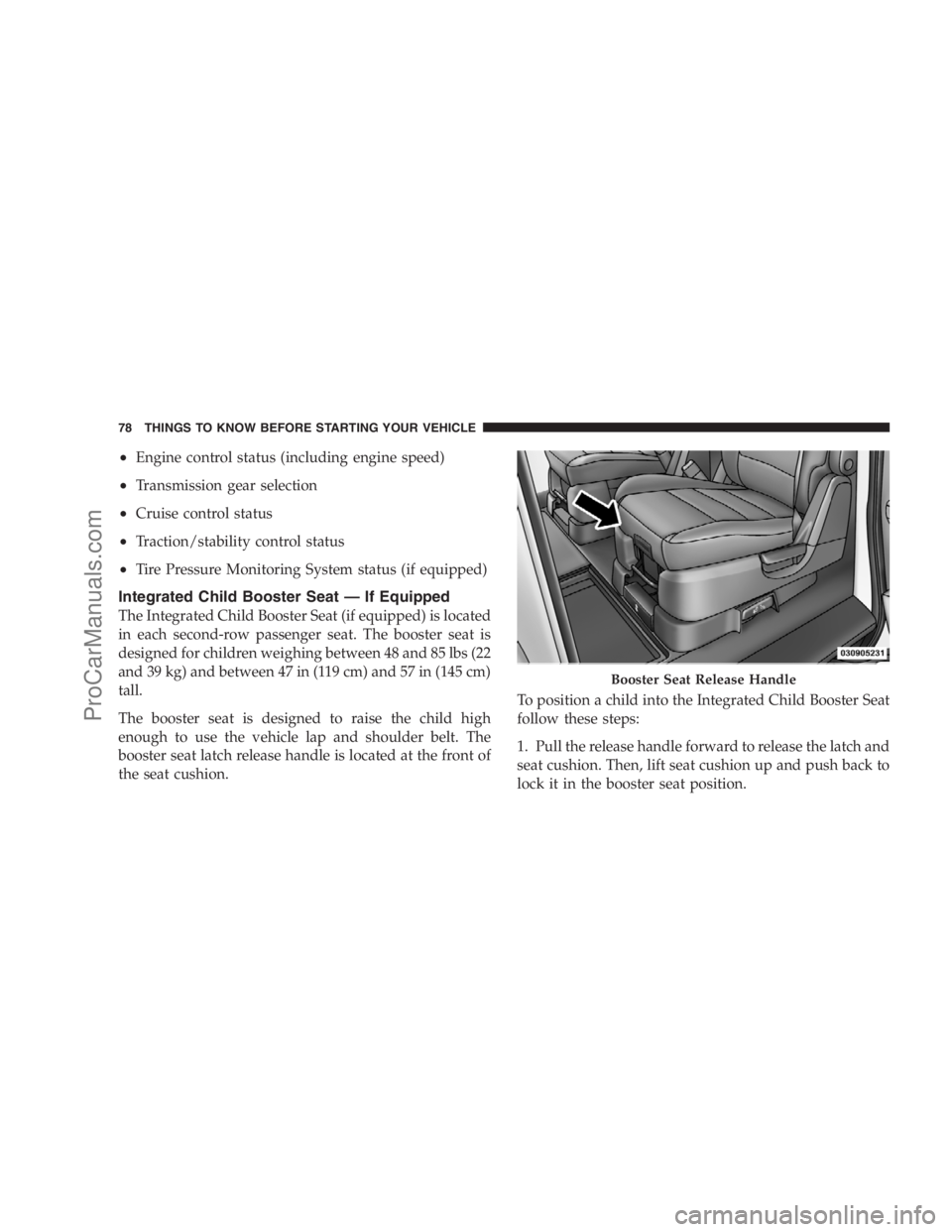
booster seat latch release handle is located at the front of
the seat cushion.To position a child into the Integrated Child Booster Seat
follow these steps:
1. Pull the release handle forward to release the latch and
seat cushion. Then, lift seat cushion up and push back to
lock it in the booster seat position.
Booster Seat Release Handle
78 THINGS TO KNOW BEFORE STARTING YOUR VEHICLE
ProCarManuals.com
Page 84 of 534
•Safety experts recommend that children ride
rearward-facing in the vehicle until they are at least
one year old and weigh at least 20 lbs (9 kg). Two types
of child restraints can be used rearward-facing: infant
carriers and convertible child seats. Both types of child
restraints are held in the vehicle by the lap/shoulder
belt or the LATCH child restraint anchorage system.
Refer to “Lower Anchors and Tether for CHildren
(LATCH)” later in this section.
•The infant carrier is only used rearward-facing in the
vehicle. It is recommended for children who weigh up
to about 20 lbs (9 kg). Convertible child seats can be
used either rearward-facing or forward-facing in the
vehicle. Convertible child seats often have a higher
weight limit in the rearward-facing direction than
infant carriers do, so they can be used rearward-facing
by children who weigh more than 20 lbs (9 kg) but are
less than one year old.
WARNING!
Rearward-facing child seats must NEVER be used in
the front seat of a vehicle with a front passenger
airbag. An airbag deployment could cause severe
injury or death to infants in this position.
•Rearward-facing child seats and infant carriers must
NEVERbe used while the second row Swivel ’n Go
seats are in the rearward-facing position.
WARNING!
Never place any child seat or infant carrier in the
Swivel ’n Go seat while it is in the rearward-facing
position. The swivel seat should be locked in the
forward position when using any child seat or infant
carriers, with the vehicle in motion. Failure to do so
could result in serious injury or even death.
82 THINGS TO KNOW BEFORE STARTING YOUR VEHICLE
ProCarManuals.com
Page 86 of 534
and use the lap belt. Never allow a child to put the
shoulder belt under an arm or behind their back.
NOTE:For additional information, refer to
www.seatcheck.org or call 1-866-SEATCHECK.
WARNING!
•Improper installation can lead to failure of an
infant or child restraint. It could come loose in a
collision. The child could be badly injured or
killed. Follow the manufacturer’s directions ex-
actly when installing an infant or child restraint.
•A rearward-facing child restraint should only be
used in a rear seat. A rearward-facing child re-
straint in the front seat may be struck by a deploy-
ing passenger airbag which may cause severe or
fatal injury to the infant.
(Continued)
WARNING! (Continued)
•Occupants riding in Swivel ’n Go seating must be
wearing their seat belt and the seat must be locked
in either the forward or rearward position. Failure
to do so could result in serious injury or even
death.
Here are some tips on getting the most out of your child
restraint:
•Before buying any restraint system, make sure that it
has a label certifying that it meets all applicable Safety
Standards. We also recommend that you make sure
that you can install the child restraint in the vehicle
where you will use it, before you buy it.
•The restraint must be appropriate for your child’s
weight and height. Check the label on the restraint for
weight and height limits.
84 THINGS TO KNOW BEFORE STARTING YOUR VEHICLE
ProCarManuals.com
Page 87 of 534

•Carefully follow the instructions that come with the
restraint. If you install the restraint improperly, it may
not work when you need it.
•The passenger seat belts are equipped with cinching
latch plates, which are designed to keep the lap
portion tight around the child restraint so that it is not
necessary to use a locking clip. Pulling up on the
shoulder portion of the lap/shoulder belt will tighten
the belt. The cinching latch plate will keep the belt
tight, however, any seat belt system will loosen with
time, so check the belt occasionally and pull it tight if
necessary.
•In the rear seat, you may have trouble tightening the
lap/shoulder belt on the child restraint because the
buckle or latch plate is too close to the belt path
opening on the restraint. Disconnect the latch plate
from the buckle and twist the short buckle end of thebelt several times to shorten it. Insert the latch plate
into the buckle with the release button facing out.
•If the belt still can’t be tightened, or if pulling and
pushing on the restraint loosens the belt, disconnect
the latch plate from the buckle, turn the buckle
around, and insert the latch plate into the buckle
again. If you still can’t make the child restraint secure,
try a different seating position.
•Buckle the child into the seat according to the child
restraint manufacturer’s directions.
•When your child restraint is not in use, secure it in the
vehicle with the seat belt or remove it from the vehicle.
Don’t leave it loose in the vehicle. In a sudden stop or
collision, it could strike the occupants or seatbacks and
cause serious personal injury.
THINGS TO KNOW BEFORE STARTING YOUR VEHICLE 85
2
ProCarManuals.com
Page 90 of 534
NOTE:
•When using the LATCH attaching system to install a
child restraint, please ensure that all seat belts not
being used for occupant restraints are stowed and out
of reach of children. It is recommended that before
installing the child restraint, buckle the seat belt so the
seat belt is tucked behind the child restraint and out of
reach. If the buckled seat belt interferes with the child
restraint installation, instead of tucking the seat belt
behind the child restraint, route the seat belt through
the child restraint belt path and then buckle it. This
should stow the seat belt out of the reach of an
inquisitive child. Remind all children in the vehicle
that the seat belts are not toys and should not be
played with, and never leave your child unattended in
the vehicle.
•If your child restraint seat is not LATCH compatible,
install the restraint using the vehicle seat belts.
Installing the Child Restraint Using the Vehicle
Seat Belts
Because the lower anchorages are to be introduced to
passenger carrying vehicles over a period of years, child
restraint systems having attachments for those anchor-
ages will continue to have features for installation in
vehicles using the lap or lap/shoulder belt. They will also
have tether straps, and you are urged to take advantage
of all of the available attachments provided with your
child restraint in any vehicle.Seat belts, except for the
driver’s seat belt, are equipped with an Automatic Lock-
ing Retractor (ALR) and/or a cinching latch plate. Both
types of seat belts are designed to keep the lap portion
tight around the child restraint so that it is not necessary
to use a locking clip. In seating positions that are
equipped with an ALR retractor, it will make a ratcheting
noise after all the webbing is extracted and allowed to
return back. For additional information, refer to “Auto-
matic Locking Mode” earlier in the section.
88 THINGS TO KNOW BEFORE STARTING YOUR VEHICLE
ProCarManuals.com
Page 110 of 534

The area on the rear fascia where the radar sensors are
located must remain free of snow, ice, and dirt/road
contamination so that the BSM system can function
properly. Do not block the area of the rear fascia where
the radar sensors are located with foreign objects
(bumper stickers, bicycle racks, etc.).The BSM system notifies the driver of objects in the
detection zones by illuminating the BSM warning light
located in the outside mirrors.
Sensor Locations
BSM Warning Light
108 UNDERSTANDING THE FEATURES OF YOUR VEHICLE
ProCarManuals.com
Page 114 of 534
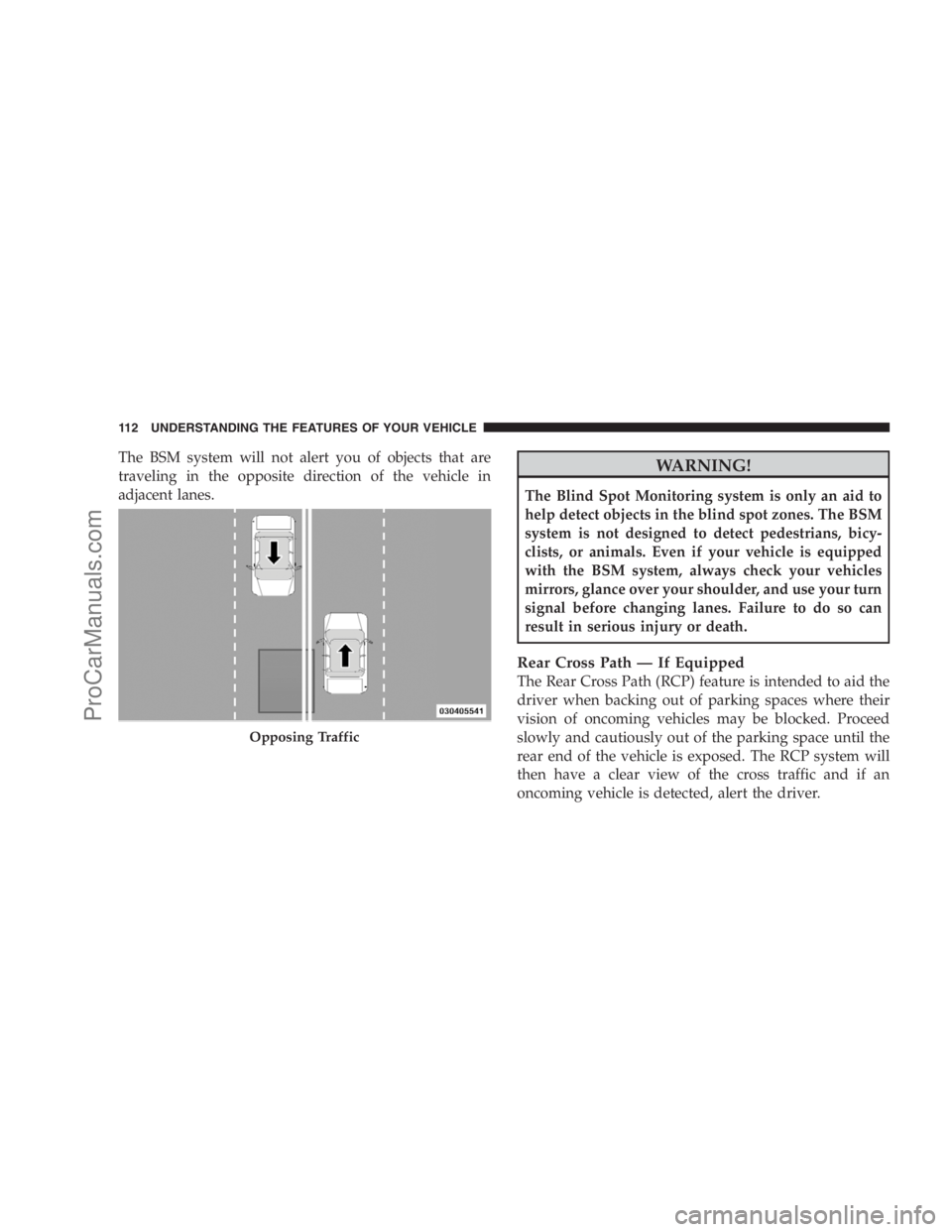
The BSM system will not alert you of objects that are
traveling in the opposite direction of the vehicle in
adjacent lanes.WARNING!
The Blind Spot Monitoring system is only an aid to
help detect objects in the blind spot zones. The BSM
system is not designed to detect pedestrians, bicy-
clists, or animals. Even if your vehicle is equipped
with the BSM system, always check your vehicles
mirrors, glance over your shoulder, and use your turn
signal before changing lanes. Failure to do so can
result in serious injury or death.
Rear Cross Path — If Equipped
The Rear Cross Path (RCP) feature is intended to aid the
driver when backing out of parking spaces where their
vision of oncoming vehicles may be blocked. Proceed
slowly and cautiously out of the parking space until the
rear end of the vehicle is exposed. The RCP system will
then have a clear view of the cross traffic and if an
oncoming vehicle is detected, alert the driver.
Opposing Traffic
112 UNDERSTANDING THE FEATURES OF YOUR VEHICLE
ProCarManuals.com