Page 206 of 534
POWER SUNROOF — IF EQUIPPED
The power sunroof control switch is located in the front
overhead console.The sunroof panel tilts upward at the
rear for ventilation or slides rearward under the roof.
Power Sunroof Operation
Opening the Sunroof Manually
Press the switch rearward and hold, and the sunroof will
open automatically from any position. The sunroof will
open fully, then stop automatically. During this opera-
tion, any release of the sunroof switch will stop the
sunroof.
WARNING!
In an accident, there is greater risk of being thrown
from a vehicle with an open sunroof. You could also
be seriously injured or killed. Always fasten your
seat belt properly and make sure all passengers are
properly secured.
Closing the Sunroof Manually
To close the sunroof from an open or vent position, press
and hold the switch forward. The sunroof will close fully
and stop automatically. Release the switch to stop sun-
roof travel at any point.
Sunroof Sunshade Operation
The sunroof sunshade can be opened manually. How-
ever, the sunshade will open automatically as the sunroof
opens.
204 UNDERSTANDING THE FEATURES OF YOUR VEHICLE
ProCarManuals.com
Page 246 of 534

18. Oil Pressure Warning Light
This light indicates low engine oil pressure. The
light should turn on momentarily when the engine
is started. If the light turns on while driving, stop the
vehicle and shut off the engine as soon as possible. A
chime will sound for four minutes when this light turns
on.
Do not operate the vehicle until the cause is corrected.
This light does not show how much oil is in the engine.
The engine oil level must be checked under the hood.
19. Front Fog Light Indicator — If Equipped
This light shows when the front fog lights are ON.
20. Seat Belt Reminder Light
When the ignition switch is first turned ON, this
light will turn on for five to eight seconds as a bulb
check. During the bulb check, if the driver’s seat
belt is unbuckled, a chime will sound. After the bulbcheck or when driving, if the driver’s seat belt remains
unbuckled, the Seat Belt Reminder Light will illuminate
and the chime will sound. Refer to the Occupant Re-
straints section for more information.
21. Vehicle Security Light — If Equipped
This light will flash at a fast rate for approxi-
mately 15 seconds when the vehicle security
alarm is arming and then will flash slowly until
vehicle is disarmed.
22. Airbag Warning Light
This light turns on and remains on for four
seconds as a bulb check when the ignition
switch is first turned ON. If the light is not on
during starting, stays on, or turns on while
driving, have the system inspected by an authorized
dealer as soon as possible.
244 UNDERSTANDING YOUR INSTRUMENT PANEL
ProCarManuals.com
Page 326 of 534
STARTING PROCEDURES
Before starting your vehicle, adjust your seat, adjust the
inside and outside mirrors, fasten your seat belt, and if
present, instruct all other occupants to buckle their seat
belts.
WARNING!
•Never leave unattended children alone in a ve-
hicle. Leaving children in a vehicle is dangerous
for a number of reasons. A child or others could be
seriously or fatally injured. Do not leave the key in
the ignition. A child could operate power win-
dows, other controls, or move the vehicle.
•Do not leave animals or children inside parked
vehicles in hot weather. Interior heat build-up may
cause serious injury or death.
(Continued)
WARNING! (Continued)
•Be sure to turn off the engine and remove the key
from the ignition switch if you want to rest or
sleep in your car. Accidents can be caused by
inadvertently moving the shift lever. Accidents
can also be caused by pressing the accelerator
pedal. This may cause excessive heat in the ex-
haust system, resulting in overheating and vehicle
fire, which may cause serious or fatal injuries.
Automatic Transaxle
The shift lever must be in the NEUTRAL or PARK
position before you can start the engine. Depress the
brake pedal before shifting into any driving gear.
Normal Starting (Above 32°F/0°C)
1. Do not depress the accelerator.
324 STARTING AND OPERATING
ProCarManuals.com
Page 428 of 534
5. Connect the other cable, first to the negative terminal
of the booster battery, and then to the engine of the
vehicle with the discharged battery. Make sure there is a
good contact on the engine.
WARNING!
Do not connect the cable to the negative post of the
discharge battery. The resulting electrical spark could
cause the battery to explode.
6. Start the engine in the vehicle that has the booster
battery. Let the engine idle a few minutes, then start the
engine in the vehicle with the discharged battery.7. When removing the jumper cables, reverse the above
sequence exactly. Be careful of the moving belts and fan.
WARNING!
Any procedure other than the jump-starting process
listed could result in:
•Personal injury caused by electrolyte squirting out
the battery vent;
•Personal injury or property damage due to battery
explosion;
•Damage to charging system of booster vehicle or
of immobilized vehicle.
426 WHAT TO DO IN EMERGENCIES
ProCarManuals.com
Page 448 of 534

Air Conditioner Maintenance
For best possible performance, your air conditioner
should be checked and serviced by an authorized dealer
at the start of each warm season. This service should
include cleaning of the condenser fins and a system
performance check. Drive belt tension should also be
checked at this time.
WARNING!
•Use only refrigerants and compressor lubricants
approved by the manufacturer for your air condi-
tioning system. Some unapproved refrigerants are
flammable and can explode, injuring you. Other
unapproved refrigerants or lubricants can cause
the system to fail, requiring costly repairs. Refer to
Section 3 of the Warranty Information book for
further warranty information.
(Continued)
WARNING! (Continued)
•The air conditioning system contains refrigerant
under high pressure. To avoid risk of personal
injury or damage to the system, adding refrigerant
or any repair requiring lines to be disconnected
should be done by an experienced repairman.
Refrigerant Recovery and Recycling
R-134a air conditioning refrigerant is a hydrofluoro-
carbon (HFC) that is endorsed by the Environmental
Protection Agency and is an ozone-saving product. How-
ever, the manufacturer recommends that air conditioning
service be performed by an authorized dealer, or other
authorized service facility, using recovery and recycling
equipment.
NOTE:Use only manufacturer-approved A/C System
Sealers, Stop Leak Products, Seal Conditioners, Compres-
sor Oil, or Refrigerants.
446 MAINTAINING YOUR VEHICLE
ProCarManuals.com
Page 468 of 534
1. Clean with a wet soft rag. A mild soap solution may be
used, but do not use high alcohol content or abrasive
cleaners. If soap is used, wipe clean with a clean damp
rag.
2. Dry with a soft tissue.
Seat Belt Maintenance
Do not bleach, dye or clean the seat belts with chemical
solvents or abrasive cleaners. This will weaken the fabric.
Sun damage can also weaken the fabric.
If the seat belts need cleaning, use a mild soap solution or
lukewarm water. Do not remove the belts from the car to
wash them.
Replace the seat belts if they appear frayed or worn, or if
the buckles do not work properly.
Cleaning the Instrument Panel Cupholders
Removal
Pull the flexible liner from the cupholder drawer starting
at one edge to ease removal.
Cleaning
The liner is top shelf dishwasher safe, or you may follow
the cleaning procedure below.
Soak the liner in a mixture of medium hot tap water and
one teaspoon of mild liquid dish soap. Let soak for
approximately 30 minutes. After 30 minutes, pull the
liner from the water and dip it back into the water about
six times. This will loosen any remaining debris. Rinse
the liner thoroughly under warm running water. Shake
the excess water from the liner and dry the outer surfaces
with a clean soft cloth.
466 MAINTAINING YOUR VEHICLE
ProCarManuals.com
Page 496 of 534

96,000 Miles (160,000 km) or 96 Months Maintenance Service
Schedule
❏Change the engine oil and engine oil filter.
❏Rotate tires.
❏If using your vehicle for any of the following: Dusty or off-road conditions. Inspect the
engine air cleaner filter, replace if necessary.
❏Replace the air conditioning filter.
❏Inspect the brake linings, replace if necessary.
❏Inspect the CV Joints.
❏Inspect the exhaust system.
❏Inspect the front suspension, tie rod ends and boot seals, replace if necessary.
Odometer Reading Date
Repair Order # Dealer Code
Signature Authorized Chrysler Dealer
102,000 Miles (170,000 km) or
102 Months Maintenance
Service Schedule
❏Change the engine oil and engine oil
filter.
❏Rotate tires.
❏Flush and replace the engine coolant.
❏Replace the ignition cables (3.3L and
3.8L engines).
❏Replace the spark plugs (3.3L, 3.8L,
and 4.0L engines).
❏Replace the timing belt (4.0L engine).
Odometer Reading Date
Repair Order # Dealer Code
Signature Authorized Chrysler Dealer
494 MAINTENANCE SCHEDULES
8
M
A
I
N
T
E
N
A
N
C
E
S
C
H
E
D
U
L
E
S
ProCarManuals.com
Page 498 of 534
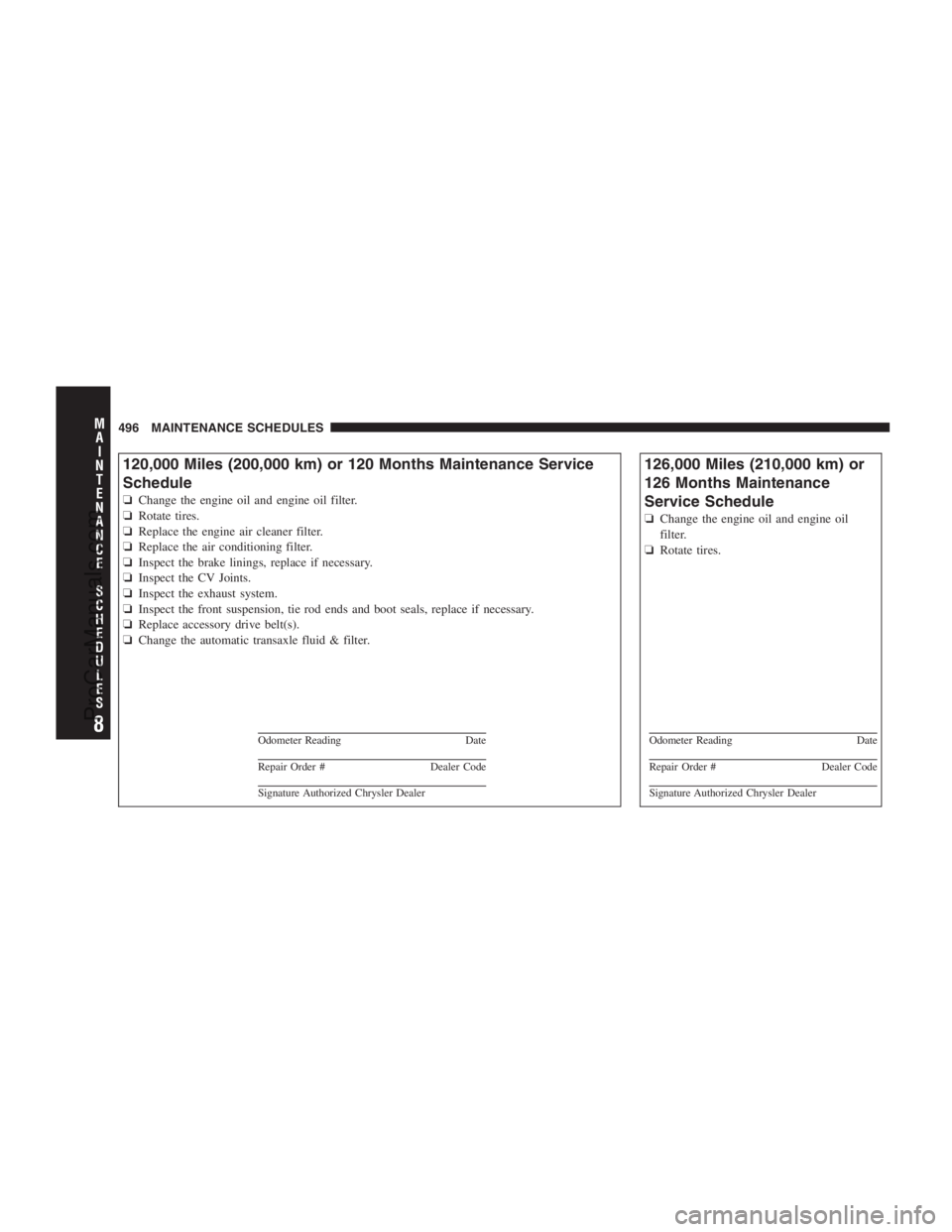
120,000 Miles (200,000 km) or 120 Months Maintenance Service
Schedule
❏Change the engine oil and engine oil filter.
❏Rotate tires.
❏Replace the engine air cleaner filter.
❏Replace the air conditioning filter.
❏Inspect the brake linings, replace if necessary.
❏Inspect the CV Joints.
❏Inspect the exhaust system.
❏Inspect the front suspension, tie rod ends and boot seals, replace if necessary.
❏Replace accessory drive belt(s).
❏Change the automatic transaxle fluid & filter.
Odometer Reading Date
Repair Order # Dealer Code
Signature Authorized Chrysler Dealer
126,000 Miles (210,000 km) or
126 Months Maintenance
Service Schedule
❏Change the engine oil and engine oil
filter.
❏Rotate tires.
Odometer Reading Date
Repair Order # Dealer Code
Signature Authorized Chrysler Dealer
496 MAINTENANCE SCHEDULES
8
M
A
I
N
T
E
N
A
N
C
E
S
C
H
E
D
U
L
E
S
ProCarManuals.com