Page 71 of 534
collisions, both the front and side airbags may be trig-
gered. However, even in collisions where the airbags
work, you need the seat belts to keep you in the right
position for the airbags to protect you properly.
Here are some simple steps you can take to minimize the
risk of harm from a deploying airbag.
Children 12 years old and younger should always ride
buckled up in a rear seat. Infants in rear-facing child
restraints shouldNEVERride in the front seat of a
vehicle with a passenger front airbag. An airbag deploy-
ment can cause severe injury or death to infants in that
position.
Children that are not big enough to wear the vehicle seat
belt properly (see Section on Child Restraints should be
secured in the rear seat in child restraints or belt-
positioning booster seats. Older children who do not use
child restraints or belt-positioning booster seats shouldride properly buckled up in the rear seat. Never allow
children to slide the shoulder belt behind them or under
their arm.
If a child from 1 to 12 years old must ride in the front
passenger seat because the vehicle is crowded, move the
seat as far back as possible, and use the proper child
restraint. Refer to the section on Child Restraints.
You should read the instructions provided with your
child restraint to make sure that you are using it properly.
All occupants should wear their lap and shoulder belts
properly.
The driver and front passenger seats should be moved
back as far as practical to allow the front airbags room to
inflate.
If your vehicle has side airbags, do not lean against the
door, airbags will inflate forcefully into the space be-
tween you and the door.
THINGS TO KNOW BEFORE STARTING YOUR VEHICLE 69
2
ProCarManuals.com
Page 72 of 534

If the airbag system in this vehicle needs to be modified
to accommodate a disabled person, contact the Customer
Center. Phone numbers are provided under�If You Need
Assistance�in Section 9 of this manual.
WARNING!
•Relying on the airbags alone could lead to more
severe injuries in a collision. The airbags work
with your seat belt to restrain you properly. In
some collisions, the airbags won’t deploy at all.
Always wear your seat belts even though you have
airbags.
•Being too close to the steering wheel or instrument
panel during front airbag deployment could cause
serious injury. Airbags need room to inflate. Sit
back, comfortably extending your arms to reach
the steering wheel or instrument panel.
(Continued)
WARNING! (Continued)
•Side airbags also need room to inflate. Do not lean
against the door. Sit upright in the center of the
seat.
Airbag Deployment Sensors and Controls
Occupant Restraint Controller (ORC)
TheORCis part of a Federally regulated safety system
required for this vehicle.
The ORC determines if a frontal or side collision is severe
enough to require the airbags to inflate. Based on the
impact sensors signals, a central electronic ORC deploys
the front airbags, side inflatable airbag curtains, side seat
thorax airbags, and front seat belt pretensioners as re-
quired for each type of impact.
The ORC monitors the readiness of the electronic parts of
the system whenever the ignition switch is in the START
70 THINGS TO KNOW BEFORE STARTING YOUR VEHICLE
ProCarManuals.com
Page 73 of 534

or ON position. These include all of the components
listed above except the steering wheel and column,
instrument panel, and seat belt reminder light. If the key
is in the OFF position, in the ACC position, or not in the
ignition, the airbags are not on and will not inflate.
The ORC contains a backup power supply system that
will deploy the airbags even if the battery loses power or
it becomes disconnected prior to deployment.
Also, the ORC turns on the Airbag Warning
Light in the instrument panel for approxi-
mately four to six seconds for a self-check
when the ignition is first turned on. After the
self-check, the Airbag Warning Light will turn off. If the
ORC detects a malfunction in any part of the system, it
turns on the Airbag Warning Light, either momentarily
or continuously. A single chime will sound if the light
comes on again after initial start up.It also includes diagnostics that will illuminate the instru-
ment cluster Airbag Warning Light if a malfunction is
noted. The diagnostics also record the nature of the
malfunction.
WARNING!
Ignoring the Airbag Warning Light in your instru-
ment panel could mean you won’t have the airbags to
protect you in a collision. If the light does not come
on, stays on after you start the vehicle, or if it comes
on as you drive, have the airbag system checked right
away.
Front and Side Impact Sensors
Impact Sensors trigger airbag deployment in front and
side impacts, and aid the ORC in determining appropri-
ate response to impact events. Additional sensors in the
ORC determine the level of airbag deployment and
provide verification.
THINGS TO KNOW BEFORE STARTING YOUR VEHICLE 71
2
ProCarManuals.com
Page 76 of 534
WARNING!
Deployed airbags and seat belt pretensioners cannot
protect you in another collision. Have the airbags,
seat belt pretensioners, and the front passenger seat
belt retractor assembly replaced by an authorized
dealer as soon as possible. Also, have the Occupant
Restraint Controller (ORC) system serviced as well.
Maintaining Your Airbag System
WARNING!
•Modifications to any part of the airbag system
could cause it to fail when you need it. You could
be injured if the airbag system is not there to
protect you. Do not modify the components or
wiring, including adding any kind of badges or
stickers to the steering wheel hub trim cover or the
upper right side of the instrument panel. Do not
modify the front bumper, vehicle body structure,
or add aftermarket side steps or running boards.
•It is dangerous to try to repair any part of the
airbag system yourself. Be sure to tell anyone who
works on your vehicle that it has an airbag system.
(Continued)
74 THINGS TO KNOW BEFORE STARTING YOUR VEHICLE
ProCarManuals.com
Page 79 of 534
the vehicle owner or lessee) before accessing the elec-
tronic data stored, unless ordered to download data by a
court with legal jurisdiction (i.e., pursuant to a warrant).
A copy of the data will be provided to the custodial entity
upon request. General data that does not identify par-
ticular vehicles or crashes may be released for incorpo-
ration in aggregate crash databases, such as those main-
tained by the U.S. government and various states. Data of
a potentially sensitive nature, such as would identify a
particular driver, vehicle, or crash, will be treated confi-
dentially. Confidential data will not be disclosed by the
manufacturer to any third party except when:
1. Used for research purposes, such as to match data
with a particular crash record in an aggregate database,
provided confidentiality of personal data is thereafter
preserved.
2. Used in defense of litigation involving the manufac-
turers product.3. Requested by police under a legal warrant.
4. Otherwise required by law.
Data parameters that may be recorded:
•Diagnostic trouble code(s) and warning light status for
electronically-controlled safety systems, including the
airbag system
•Airbag disable light status (if equipped)
•�Time�of airbag deployment (in terms of ignition
cycles and vehicle mileage)
•Airbag deployment level (if applicable)
•Impact acceleration and angle
•Seat belt status
•Brake status (service and parking brakes)
•Accelerator status (including vehicle speed)
THINGS TO KNOW BEFORE STARTING YOUR VEHICLE 77
2
ProCarManuals.com
Page 80 of 534
•Engine control status (including engine speed)
•Transmission gear selection
•Cruise control status
•Traction/stability control status
•Tire Pressure Monitoring System status (if equipped)
Integrated Child Booster Seat — If Equipped
The Integrated Child Booster Seat (if equipped) is located
in each second-row passenger seat. The booster seat is
designed for children weighing between 48 and 85 lbs (22
and 39 kg) and between 47 in (119 cm) and 57 in (145 cm)
tall.
The booster seat is designed to raise the child high
enough to use the vehicle lap and shoulder belt. The
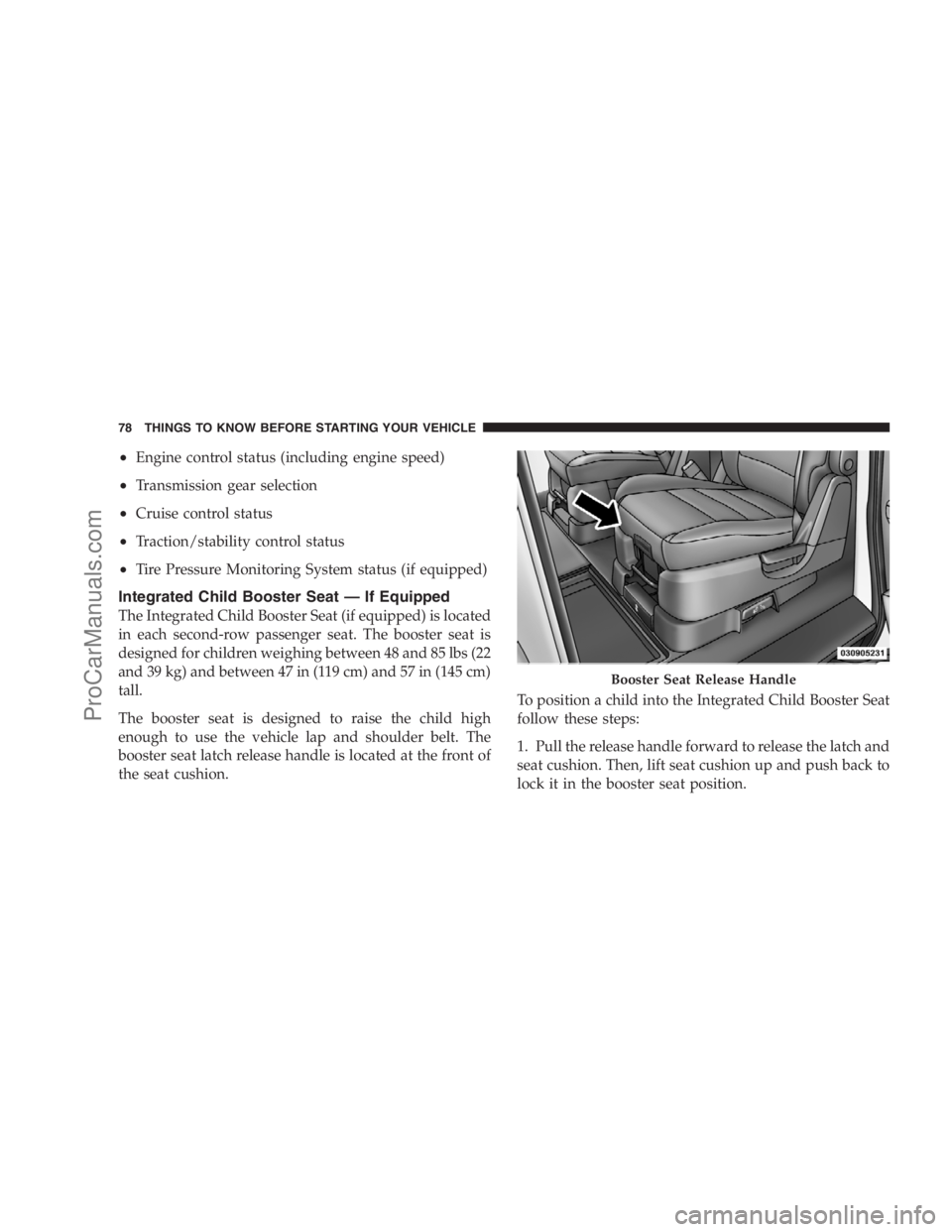
booster seat latch release handle is located at the front of
the seat cushion.To position a child into the Integrated Child Booster Seat
follow these steps:
1. Pull the release handle forward to release the latch and
seat cushion. Then, lift seat cushion up and push back to
lock it in the booster seat position.
Booster Seat Release Handle
78 THINGS TO KNOW BEFORE STARTING YOUR VEHICLE
ProCarManuals.com
Page 81 of 534
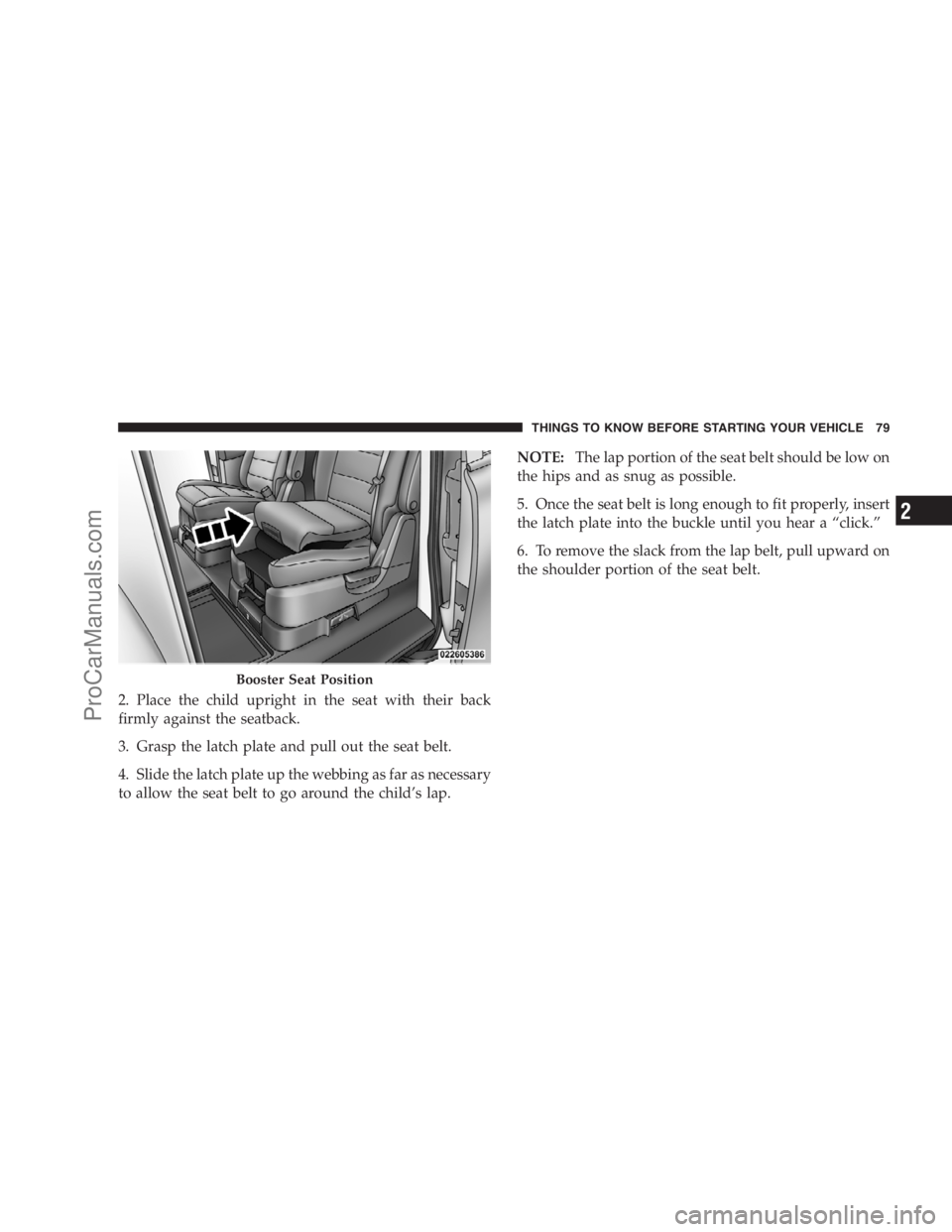
2. Place the child upright in the seat with their back
firmly against the seatback.
3. Grasp the latch plate and pull out the seat belt.
4. Slide the latch plate up the webbing as far as necessary
to allow the seat belt to go around the child’s lap.NOTE:The lap portion of the seat belt should be low on
the hips and as snug as possible.
5. Once the seat belt is long enough to fit properly, insert
the latch plate into the buckle until you hear a “click.”
6. To remove the slack from the lap belt, pull upward on
the shoulder portion of the seat belt.
Booster Seat Position
THINGS TO KNOW BEFORE STARTING YOUR VEHICLE 79
2
ProCarManuals.com
Page 82 of 534
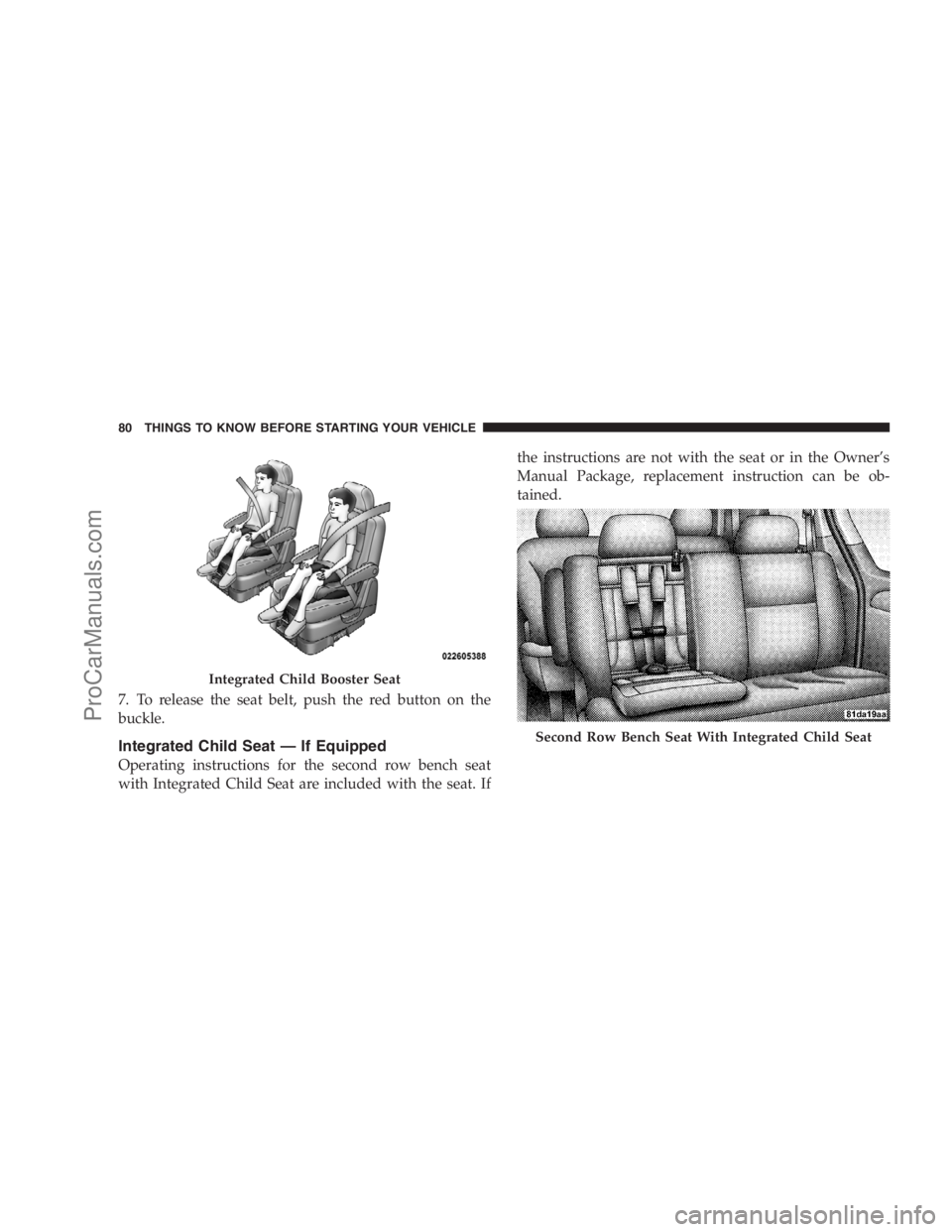
7. To release the seat belt, push the red button on the
buckle.
Integrated Child Seat — If Equipped
Operating instructions for the second row bench seat
with Integrated Child Seat are included with the seat. Ifthe instructions are not with the seat or in the Owner’s
Manual Package, replacement instruction can be ob-
tained.
Integrated Child Booster Seat
Second Row Bench Seat With Integrated Child Seat
80 THINGS TO KNOW BEFORE STARTING YOUR VEHICLE
ProCarManuals.com