2009 DODGE CARAVAN warning
[x] Cancel search: warningPage 83 of 534
To obtain Integrated Child Seat replacement instruc-
tions:Refer to the Publication order forms at the back of
this manual and specify publication number
81–226–0919.
Child Restraints
Everyone in your vehicle needs to be buckled up all the
time, including babies and children. Every state in the
United States and all Canadian provinces require that
small children ride in proper restraint systems. This is the
law, and you can be prosecuted for ignoring it.
Children 12 years and younger should ride properly
buckled up in a rear seat. According to crash statistics,
children are safer when properly restrained in the rear
seats rather than in the front.
WARNING!
In a collision, an unrestrained child, even a tiny baby,
can become a missile inside the vehicle. The force
required to hold even an infant on your lap could
become so great that you could not hold the child, no
matter how strong you are. The child and others
could be badly injured. Any child riding in your
vehicle should be in a proper restraint for the child’s
size.
Infants and Small Children
There are different sizes and types of restraints for
children from newborn size to the child almost large
enough for an adult safety belt. Always check the child
seat Owner’s Manual to ensure you have the right seat
for your child. Use the restraint that is correct for your
child.
THINGS TO KNOW BEFORE STARTING YOUR VEHICLE 81
2
ProCarManuals.com
Page 84 of 534
•Safety experts recommend that children ride
rearward-facing in the vehicle until they are at least
one year old and weigh at least 20 lbs (9 kg). Two types
of child restraints can be used rearward-facing: infant
carriers and convertible child seats. Both types of child
restraints are held in the vehicle by the lap/shoulder
belt or the LATCH child restraint anchorage system.
Refer to “Lower Anchors and Tether for CHildren
(LATCH)” later in this section.
•The infant carrier is only used rearward-facing in the
vehicle. It is recommended for children who weigh up
to about 20 lbs (9 kg). Convertible child seats can be
used either rearward-facing or forward-facing in the
vehicle. Convertible child seats often have a higher
weight limit in the rearward-facing direction than
infant carriers do, so they can be used rearward-facing
by children who weigh more than 20 lbs (9 kg) but are
less than one year old.
WARNING!
Rearward-facing child seats must NEVER be used in
the front seat of a vehicle with a front passenger
airbag. An airbag deployment could cause severe
injury or death to infants in this position.
•Rearward-facing child seats and infant carriers must
NEVERbe used while the second row Swivel ’n Go
seats are in the rearward-facing position.
WARNING!
Never place any child seat or infant carrier in the
Swivel ’n Go seat while it is in the rearward-facing
position. The swivel seat should be locked in the
forward position when using any child seat or infant
carriers, with the vehicle in motion. Failure to do so
could result in serious injury or even death.
82 THINGS TO KNOW BEFORE STARTING YOUR VEHICLE
ProCarManuals.com
Page 86 of 534
and use the lap belt. Never allow a child to put the
shoulder belt under an arm or behind their back.
NOTE:For additional information, refer to
www.seatcheck.org or call 1-866-SEATCHECK.
WARNING!
•Improper installation can lead to failure of an
infant or child restraint. It could come loose in a
collision. The child could be badly injured or
killed. Follow the manufacturer’s directions ex-
actly when installing an infant or child restraint.
•A rearward-facing child restraint should only be
used in a rear seat. A rearward-facing child re-
straint in the front seat may be struck by a deploy-
ing passenger airbag which may cause severe or
fatal injury to the infant.
(Continued)
WARNING! (Continued)
•Occupants riding in Swivel ’n Go seating must be
wearing their seat belt and the seat must be locked
in either the forward or rearward position. Failure
to do so could result in serious injury or even
death.
Here are some tips on getting the most out of your child
restraint:
•Before buying any restraint system, make sure that it
has a label certifying that it meets all applicable Safety
Standards. We also recommend that you make sure
that you can install the child restraint in the vehicle
where you will use it, before you buy it.
•The restraint must be appropriate for your child’s
weight and height. Check the label on the restraint for
weight and height limits.
84 THINGS TO KNOW BEFORE STARTING YOUR VEHICLE
ProCarManuals.com
Page 89 of 534
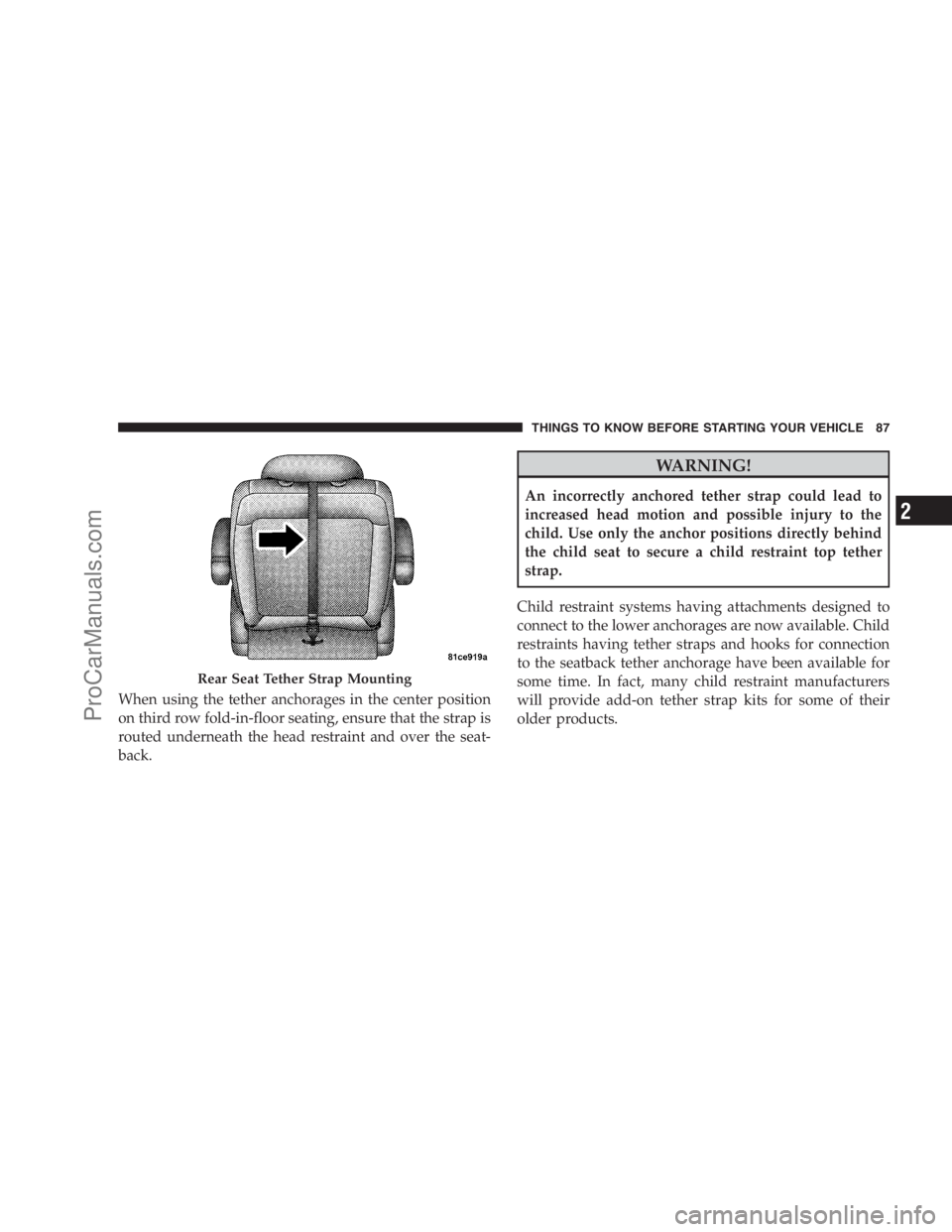
When using the tether anchorages in the center position
on third row fold-in-floor seating, ensure that the strap is
routed underneath the head restraint and over the seat-
back.
WARNING!
An incorrectly anchored tether strap could lead to
increased head motion and possible injury to the
child. Use only the anchor positions directly behind
the child seat to secure a child restraint top tether
strap.
Child restraint systems having attachments designed to
connect to the lower anchorages are now available. Child
restraints having tether straps and hooks for connection
to the seatback tether anchorage have been available for
some time. In fact, many child restraint manufacturers
will provide add-on tether strap kits for some of their
older products.
Rear Seat Tether Strap Mounting
THINGS TO KNOW BEFORE STARTING YOUR VEHICLE 87
2
ProCarManuals.com
Page 91 of 534
To install a child restraint, pull enough of the seat belt
webbing from the retractor to route it through the belt
path of the child restraint and slide the latch plate into the
buckle. Next, pull all the seat belt webbing, until it is fully
extracted, from the retractor. Allow the belt to return to
the retractor, pulling on the excess webbing to tighten the
lap portion about the child restraint. (Any seat belt
system will loosen with time, so check the belt occasion-
ally and pull it tight if necessary).
Installing the Child Restraint System
We urge that you carefully follow the directions of the
manufacturer when installing your child restraint. Many,
but not all restraint systems will be equipped with
separate straps on each side, with each having a hook or
connector and a means for adjusting the tension in the
strap. Forward-facing toddler restraints and some
rearward-facing infant restraints will also be equipped
with a tether strap, a hook and means for adjusting the
tension in the strap.In general, you will first loosen the adjusters on the lower
straps and tether straps so that you can more easily attach
the hook or connector to the lower anchorages and tether
anchorages. Then tighten all three straps as you push the
child restraint rearward and downward into the seat.
Not all child restraint systems will be installed as we
have described here. Again, carefully follow the instruc-
tions that come with the child restraint system.
WARNING!
Improper installation of a child restraint to the
LATCH anchorages can lead to failure of an infant or
child restraint. The child could be badly injured or
killed. Follow the manufacturer’s directions exactly
when installing an infant or child restraint.
THINGS TO KNOW BEFORE STARTING YOUR VEHICLE 89
2
ProCarManuals.com
Page 92 of 534
Transporting Pets
Airbags deploying in the front seat could harm your pet.
An unrestrained pet could be thrown about and possibly
injured, or injure a passenger during panic braking or in
a collision.
Pets should be restrained in the rear seat in pet harnesses
or pet carriers that are secured by seat belts.
REAR SEAT DELETE FEATURE (COMMERCIAL
VEHICLES ONLY) — IF EQUIPPED
Commercial cargo vehicles are not designed for use as a
family vehicle and are not intended for carrying children
in the front passenger seat. However, if you must carry a
child in a vehicle without a rear seat, the passenger seat
should be moved to the full rearward position and the
child must be in a proper restraint system based on its
age, size and weight.
WARNING!
NEVER carry a child in a rear facing infant carrier in
a vehicle without rear seats. In an accident, serious
injury or death may occur from the deploying pas-
senger airbag.
Commercial Child Restraint Tether Anchor
90 THINGS TO KNOW BEFORE STARTING YOUR VEHICLE
ProCarManuals.com
Page 93 of 534
This vehicle is equipped with a child restraint tether
anchor located on the lower rear of the front passenger
seat.Use this tether anchor to secure only forward-
facing child restraints equipped with an upper tether
strap.
WARNING!
Rearward-facing infant restraints must never be se-
cured in the passenger seat of a vehicle with a
passenger airbag. In an accident, a passenger airbag
may deploy causing severe injury or death to infants
riding in rearward-facing infant restraints.
Restraining Infants and Small Children with Seat
Delete Feature (Commercial Vehicles Only)
There are different sizes and types of restraints for
children from newborn size to the child almost large
enough for an adult safety belt. Use the restraint that is
correct for your child:
•The rearward-facing infant carrier is for babies weigh-
ing up to about 20 lbs (9 kg), and less than one year
old. THIS TYPE OF SEAT CANNOT BE USED IN A
VEHICLE EQUIPPED WITH THE REAR SEAT DE-
LETE FEATURE (Commercial Vehicles Only).
•The forward-facing child seat is for children from
about 20 to 40 lbs (9 to 18 kg), and more than one year
old.
•A convertible child seat, one that is designed to be
used for children who are too heavy for a rearward-
facing infant seat, may be used IN THE FORWARD
FACING POSITION ONLY, IT MUST NEVER BE
INSTALLED FACING TO THE REAR IN A VEHICLE
EQUIPPED WITH THE REAR SEAT DELETE FEA-
TURE (Commercial Vehicles Only). When a convert-
ible seat is properly installed facing forward, the
vehicle seat should be adjusted to therear most
position.
THINGS TO KNOW BEFORE STARTING YOUR VEHICLE 91
2
ProCarManuals.com
Page 95 of 534
WARNING!
The vehicle tether anchor is designed to be used with
a child restraint only. It should not be used for any
other purpose. Before use, inspect the tether anchor
strap for nicks, abrasions, discoloration, and loose
threads. If these or any other condition that might
affect the performance of the strap is observed, DO
NOT USE that strap. Personal injury may result.
Contact your authorized dealership for a replacement
part.
ENGINE BREAK-IN RECOMMENDATIONS
A long break-in period is not required for the engine in
your vehicle.
Drive moderately during the first 300 miles (500 km).
After the initial 60 miles (100 km), speeds up to 50 or
55 mph (80 or 90 km/h) are desirable.While cruising, brief full-throttle acceleration within the
limits of local traffic laws, contributes to a good break-in.
Wide-open throttle acceleration in low gear can be detri-
mental and should be avoided.
The engine oil installed in the engine at the factory is a
high-quality energy conserving type lubricant. Oil
changes should be consistent with anticipated climate
conditions under which vehicle operations will occur.
The recommended viscosity and quality grades are
shown under “Engine Oil”, under “Maintenance Proce-
dures” in section 7 of this manual. NON-DETERGENT
OR STRAIGHT MINERAL OILS MUST NEVER BE
USED.
A new engine may consume some oil during its first few
thousand miles (kilometers) of operation. This should be
considered as a normal part of the break-in and not
interpreted as an indication of difficulty.
THINGS TO KNOW BEFORE STARTING YOUR VEHICLE 93
2
ProCarManuals.com