Page 371 of 534
TIRE ROTATION
Tires on the front and rear axles of vehicles operate at
different loads and perform different steering, driving,
and braking functions. For these reasons, they wear at
unequal rates, and tend to develop irregular wear pat-
terns.
These effects can be reduced by timely rotation of tires.
The benefits of rotation are especially worthwhile with
aggressive tread designs such as those on All-Season type
tires. Rotation will increase tread life, help to maintain
mud, snow, and wet traction levels, and contribute to a
smooth, quiet ride.
Follow the recommended tire rotation intervals in the
“Maintenance Schedule” section of this manual. More
frequent rotation is permissible if desired. The reasons for
any rapid or unusual wear should be corrected prior to
rotation being performed.The suggested rotation method is the “forward-cross”
shown in the following diagram.
STARTING AND OPERATING 369
5
ProCarManuals.com
Page 397 of 534
that typically provides adjustable friction associated with
the telescoping motion to dampen any unwanted trailer
swaying motions while traveling.
Weight-Carrying Hitch
A weight-carrying hitch supports the trailer tongue
weight, just as if it were luggage located at a hitch ball or
some other connecting point of the vehicle. This type of
hitch is the most popular on the market today and is
commonly used to tow small- and medium-sized trailers.
Weight-Distributing Hitch
A weight-distributing system works by applying lever-
age through spring (load) bars. They are typically used
for heavier loads to distribute trailer tongue weight to the
tow vehicle’s front axle and the trailer’s axle(s). When
used in accordance with the manufacturer’s directions, it
provides for a more level ride, offering more consistent
steering and brake control thereby enhancing towing
safety. The addition of a friction/hydraulic sway controlalso dampens sway caused by traffic and crosswinds and
contributes positively to tow vehicle and trailer stability.
Trailer sway control and a weight distributing (load
equalizing) hitch are recommended for heavier tongue
weights (TW), and may be required depending on vehicle
and trailer configuration/loading to comply with gross
axle weight rating (GAWR) requirements.
WARNING!
An improperly adjusted weight-distributing hitch
system may reduce handling, stability, braking per-
formance, and could result in an accident.
Weight-distributing hitch systems may not be com-
patible with surge brake couplers. Consult with an
authorized hitch and trailer manufacturer or a repu-
table authorized Recreational Vehicle dealer for ad-
ditional information.
STARTING AND OPERATING 395
5
ProCarManuals.com
Page 403 of 534
WARNING! (Continued)
Make certain that the load is secured in the trailer
and will not shift during travel. When trailering
cargo that is not fully secured, dynamic load shifts
can occur that may be difficult for the driver to
control. You could lose control of your vehicle and
have an accident.
•When hauling cargo or towing a trailer, do not over-
load your vehicle or trailer. Overloading can cause a
loss of control, poor performance or damage to brakes,
axle, engine, transaxle, steering, suspension, chassis
structure or tires.
•Safety chains must always be used between your
vehicle and trailer. Always connect the chains to the
frame or hook retainers of the vehicle hitch. Cross the
chains under the trailer tongue and allow enough
slack for turning corners.
•Vehicles with trailers should not be parked on a grade.
When parking, apply the parking brake on the tow
vehicle. Put the tow vehicle automatic transmission in
PARK. Always, block or�chock�the trailer wheels.
•GCWR must not be exceeded.
•Total weight must be distributed between the tow
vehicle and the trailer such that the following four
ratings are not exceeded:
1. GVWR
2. GTW
3. GAWR
4. Trailer tongue weight rating for that trailer hitch.
(This requirement may limit the ability to always
achieve the 10% to 15% range of trailer tongue weight
as a percentage of total trailer weight.)
STARTING AND OPERATING 401
5
ProCarManuals.com
Page 429 of 534
FREEING A STUCK VEHICLE
If your vehicle becomes stuck in mud, sand or snow, it
can often be moved by a rocking motion. Turn your
steering wheel right and left to clear the area around the
front wheels. Then move the shift lever back and forth
between REVERSE and DRIVE. Usually the least amount
of accelerator pedal pressure to maintain the rocking
motion without spinning the wheels is most effective.
WARNING!
Fast spinning tires can be dangerous. Forces gener-
ated by excessive wheel speeds may cause tire dam-
age or failure. A tire could explode and injure some-
one. Do not spin your vehicle’s wheels faster than
35 mph (55 km/h) when you are stuck. Do not let
anyone near a spinning wheel, no matter what the
speed.
CAUTION!
Racing the engine or spinning the wheels too fast
may lead to transmission overheating and failure. It
can also damage the tires. Do not spin the wheels
above 35 mph (55 km/h).
TOWING A DISABLED VEHICLE
Towing With The Ignition Key
Your vehicle may be towed under the following condi-
tions:
•The shift lever must be in NEUTRAL, the distance to
be traveled must not exceed 100 miles (160 km), and
the towing speed must not exceed 44 mph (72 km/h).
Exceeding these towing limits may cause a transmis-
sion gear failure.
WHAT TO DO IN EMERGENCIES 427
6
ProCarManuals.com
Page 430 of 534
•If the transmission is not operative, or if the vehicle is
to be towed more than 100 miles (160 km), the vehicle
must be towed with the front wheels off the ground.
CAUTION!
•Do not attempt to tow this vehicle from the front
with sling-type towing equipment. Damage to the
front fascia will result.
•Always use wheel lift equipment when towing
from the front. The only other approved method of
towing is with a flatbed truck.
•Do not tow the vehicle from the rear. Damage to
the rear sheet metal, liftgate and fascia will occur.
•Do not push or tow this vehicle with another
vehicle as damage to the bumper fascia and trans-
mission may result.
(Continued)
CAUTION! (Continued)
•If the vehicle being towed requires steering, the
ignition switch must be in the OFF position, not in
the LOCK or ACC positions.
If it is necessary to use the accessories while being towed
(wipers, defrosters, etc.), the key must be in the ON
position, not the ACC position. Make certain the trans-
mission remains in NEUTRAL.
Towing Without The Ignition Key
Special care must be taken when the vehicle is towed
with the ignition in the LOCK position. The only ap-
proved method of towing without the ignition key is
with a flatbed truck. Proper towing equipment is neces-
sary to prevent damage to the vehicle.
428 WHAT TO DO IN EMERGENCIES
ProCarManuals.com
Page 433 of 534
MAINTAINING YOUR VEHICLE
CONTENTS
�Engine Compartment — 3.3/3.8L.......... 433
�Engine Compartment — 4.0L............. 434
�Onboard Diagnostic System — OBD II....... 435
▫Loose Fuel Filler Cap Message — Gascap . . . 435
�Emissions Inspection And Maintenance
Programs............................ 436
�Replacement Parts..................... 437
�Dealer Service........................ 438
�Maintenance Procedures................. 438▫Engine Oil......................... 438
▫Engine Oil Filter..................... 441
▫Engine Air Cleaner Filter............... 441
▫Exhaust System...................... 442
▫Maintenance-Free Battery............... 444
▫Air Conditioner Maintenance............ 446
▫Steering Shaft Seal.................... 448
▫Drive Shaft Universal Joints............. 448
▫Body Lubrication..................... 448
7
ProCarManuals.com
Page 435 of 534
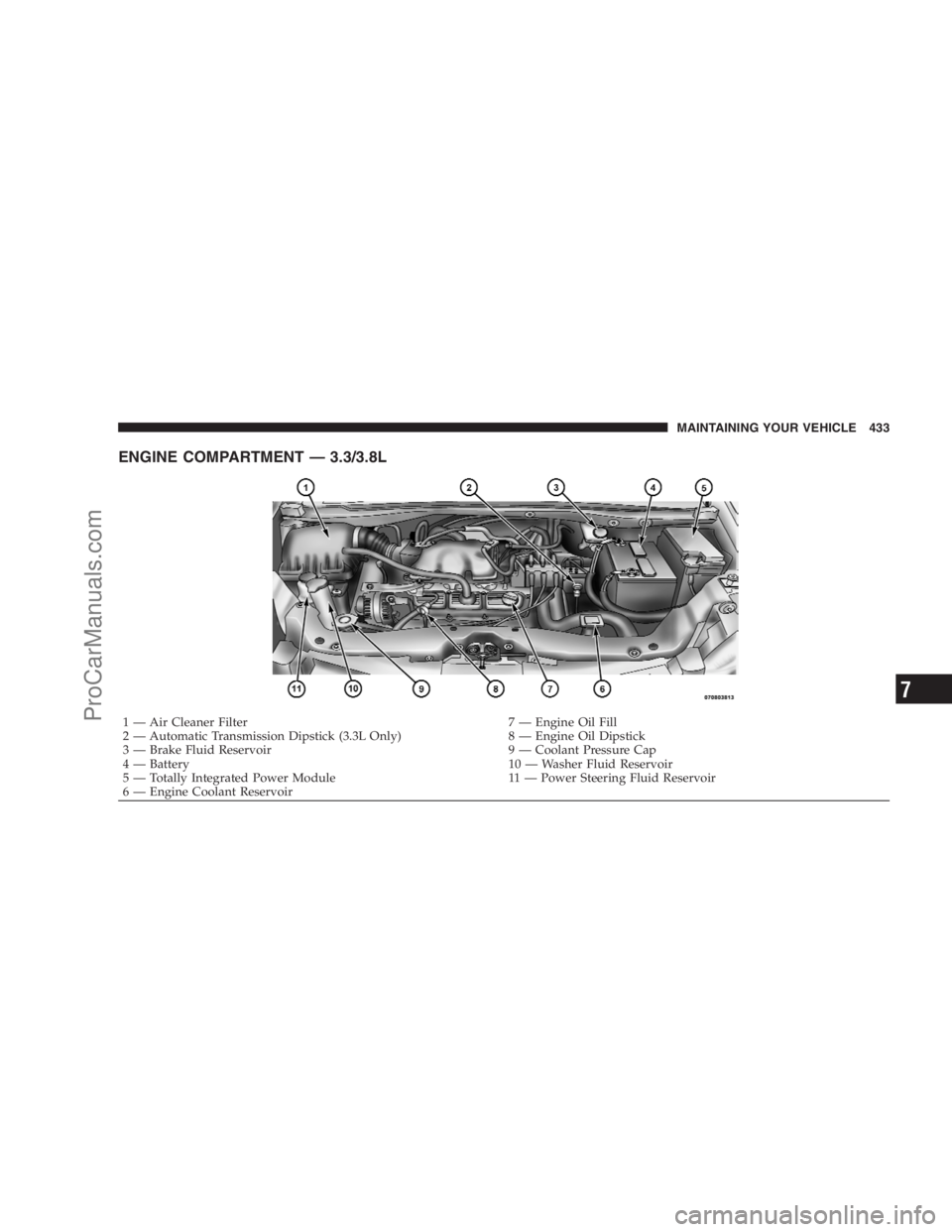
ENGINE COMPARTMENT — 3.3/3.8L
1 — Air Cleaner Filter 7 — Engine Oil Fill
2 — Automatic Transmission Dipstick (3.3L Only) 8 — Engine Oil Dipstick
3 — Brake Fluid Reservoir 9 — Coolant Pressure Cap
4 — Battery 10 — Washer Fluid Reservoir
5 — Totally Integrated Power Module 11 — Power Steering Fluid Reservoir
6 — Engine Coolant ReservoirMAINTAINING YOUR VEHICLE 433
7
ProCarManuals.com
Page 436 of 534
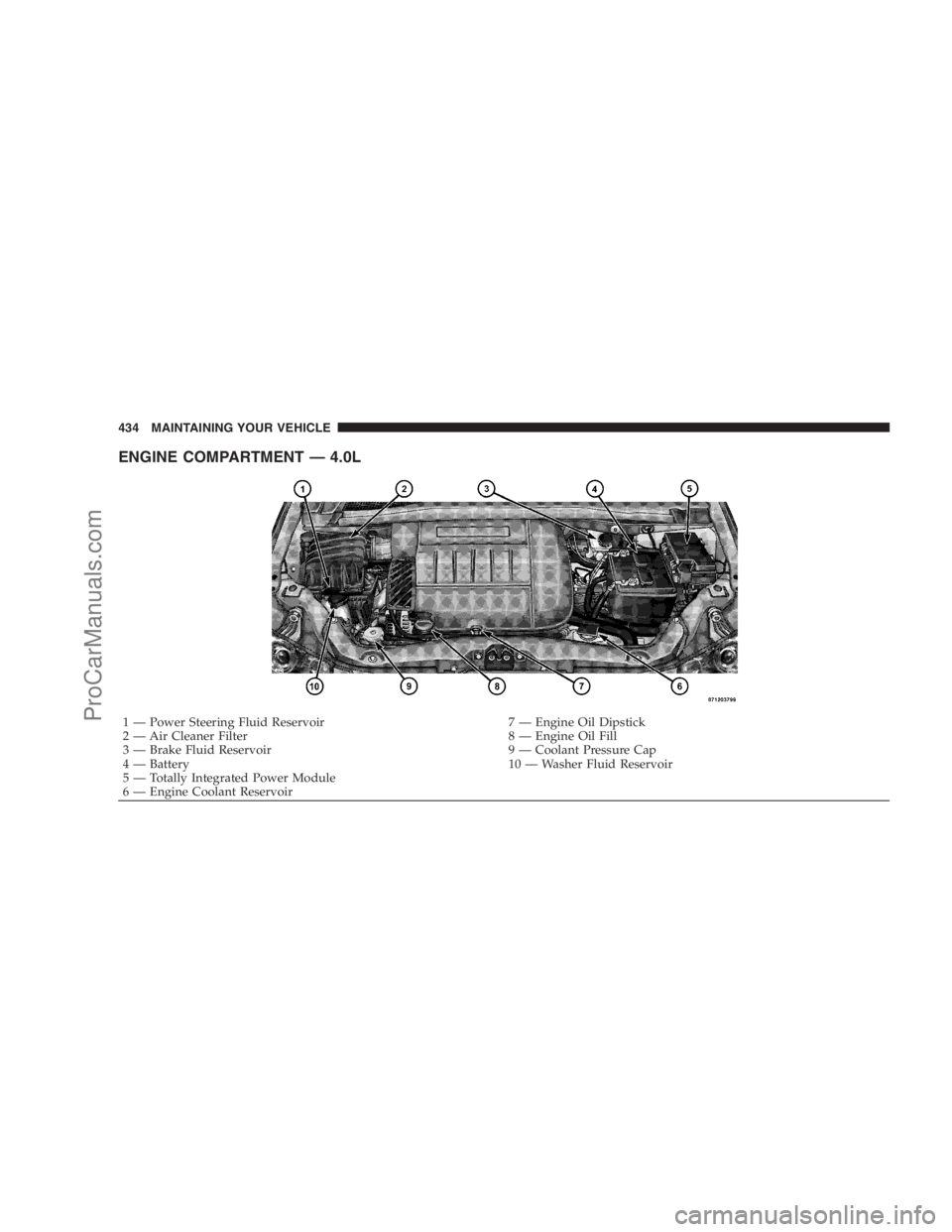
ENGINE COMPARTMENT — 4.0L
1 — Power Steering Fluid Reservoir 7 — Engine Oil Dipstick
2 — Air Cleaner Filter 8 — Engine Oil Fill
3 — Brake Fluid Reservoir 9 — Coolant Pressure Cap
4 — Battery 10 — Washer Fluid Reservoir
5 — Totally Integrated Power Module
6 — Engine Coolant Reservoir 434 MAINTAINING YOUR VEHICLE
ProCarManuals.com