Page 67 of 410
Here are some tips on getting the most out of your child
restraint:
•Before buying any restraint system, make sure that it
has a label certifying that it meets all applicable Safety
Standards. We also recommend that you make sure
that you can install the child restraint in the vehicle
where you will use it, before you buy it.
•The restraint must be appropriate for your child’s
weight and height. Check the label on the restraint for
weight and height limits.
•Carefully follow the instructions that come with the
restraint. If you install the restraint improperly, it may
not work when you need it.
The passenger seat belts are equipped with either
cinching latch plates or seat belt retractors that can be
switched to an Automatic Locking Mode, which are
designed to keep the lap portion tight around the childrestraint so that it is not necessary to use a locking clip.
If the seat belt has a cinching latch plate, pulling up on
the shoulder portion of the lap/shoulder belt will
tighten the belt. The cinching latch plate will keep the
belt tight; however, any seat belt system will loosen
with time, so check the belt occasionally and pull it
tight if necessary.
If the seat belt has a switchable retractor, please refer to
Automatic Locking Retractor (ALR) in this section.
•In the rear seat, you may have trouble tightening the
lap/shoulder belt on the child restraint because the
buckle or latch plate is too close to the belt path
opening on the restraint. Disconnect the latch plate
from the buckle and twist the short buckle end of the
belt several times to shorten it. Insert the latch plate
into the buckle with the release button facing out.
2
THINGS TO KNOW BEFORE STARTING YOUR VEHICLE 65
Page 68 of 410
•If the belt still can’t be tightened, or if pulling and
pushing on the restraint loosens the belt, disconnect
the latch plate from the buckle, turn the latch plate
around, and insert the latch plate into the buckle
again. If you still can’t make the child restraint secure,
try a different seating position.
•Buckle the child into the seat according to the child
restraint manufacturer’s directions.
•When your child restraint is not in use, secure it in the
vehicle with the seat belt or remove it from the vehicle.
Don’t leave it loose in the vehicle. In a sudden stop or
collision, it could strike the occupants or seat backs
and cause serious personal injury.
Automatic Locking Retractor (ALR)
To operate the switchable retractor, pull the belt from the
retractor until there is enough to pass it through the child
restraint and slide the latch plate into the buckle. Then
pull on the belt until it is fully extended from theretractor. Allow the belt to return into the retractor,
pulling on the excess webbing to tighten the lap portion
around the child restraint. Follow the instructions of the
child restraint manufacture.
NOTE:
To reset this feature you must let all of the belt
webbing return into the retractor. You will not be able to
pull out more webbing until all of the webbing has been
returned back into the retractor.
Lower Anchors and Tether for CHildren (LATCH)
Your vehicle is equipped with the child restraint anchor-
age system called LATCH, which stands for Lower
Anchors and Tether for CHildren. The LATCH system
provides for the installation of the child restraint without
using the vehicle seat belt. All three rear seating positions
have lower and tether anchorages that are capable of
accommodating LATCH-compatible child seats having
flexible, webbing-mounted lower attachments. Child
seats with fixed lower attachments must be installed in
66 THINGS TO KNOW BEFORE STARTING YOUR VEHICLE
Page 75 of 410

Airbag Warning Light
The light should come on and remain on for six to eight
seconds as a bulb check when the ignition switch is first
turned ON. If the light is not lit during starting, see your
authorized dealer. If the light stays on, flickers, or comes
on while driving, have the system checked by an autho-
rized dealer.
Defroster
Check operation by selecting the defrost mode and place
the blower control on high speed. You should be able to
feel the air directed against the windshield. See your
authorized dealer for service if your defroster is
inoperable.
Periodic Safety Checks You Should Make Outside
the Vehicle
Tires
Examine tires for excessive tread wear and uneven wear
patterns. Check for stones, nails, glass, or other objectslodged in the tread. Inspect the tread and sidewall for
cuts and cracks. Check the wheel nuts for tightness.
Check the tires (including spare) for proper pressure.
Lights
Have someone observe the operation of exterior lights
while you work the controls. Check turn signal and high
beam indicator lights on the instrument panel.
Door Latches
Check for positive closing, latching, and locking.
Fluid Leaks
Check area under vehicle after overnight parking for fuel,
engine coolant, oil, or other fluid leaks. Also, if gasoline
fumes are detected or if fuel, power steering fluid, or
brake fluid leaks are suspected, the cause should be
located and corrected immediately.
2
THINGS TO KNOW BEFORE STARTING YOUR VEHICLE 73
Page 119 of 410
WARNING! (Continued)
•Do not allow people to ride in any area of your
vehicle that is not equipped with seats and seat
belts.
•Be sure that everyone in your vehicle is in a seat
and using a seat belt properly.
NOTE:
•If the rear center lap/shoulder belt appears to be
locked into place, check to verify that the seatback is
fully latched.
•If the seatback is properly latched and the rear center
lap/shoulder belt still does not operate properly, check
and see if the Automatic Locking Retractor (ALR)
system is activated.
WARNING!
The rear center lap/shoulder belt is equipped with a
lockout feature to ensure that the seatback is in the
fully upright and locked position when occupied. If
the rear seatback is not fully upright and locked and
the rear center lap/shoulder belt can be pulled out of
the retractor, the vehicle should immediately be
taken to an authorized dealer for service. Failure to
follow this warning could result in serious or fatal
injury.
3
UNDERSTANDING THE FEATURES OF YOUR VEHICLE 117
Page 124 of 410
To reinstall the rear seat, insert the seat into the floor
attachments. Lower the release levers of the seat to latch
the front floor attachments and rotate the seat rearward
to latch the seat. Lift the seatback to its upright latched
position.
WARNING!
In an accident, you or others in your vehicle could be
injured if seats are not properly latched to their floor
attachments. Always be sure the seats are fully
latched.
EMERGENCY SEATBACK RELEASE
WARNING!
Do not allow children to have access to the liftgate
area with the rear shelf panel in position 1 (Top) or
position 2 (Middle), either by climbing into the
liftgate from outside, or through the inside of the
vehicle. Always close the liftgate when your vehicle
is unattended. Once in the liftgate area, young chil-
dren may not be able to escape, even if they entered
through the rear seat. If trapped in the liftgate,
children can die from suffocation or heat stroke.
As a security measure, a Seatback Emergency Release
lever is built into the left side rear seatback latching
mechanism. In the event of an individual being locked
inside the liftgate area with the rear shelf panel in
position 1 (Top) or position 2 (Middle), the left side rear
122 UNDERSTANDING THE FEATURES OF YOUR VEHICLE
Page 127 of 410
CAUTION!
To prevent possible damage, do not slam the hood to
close it. Lower the hood until it is open approxi-
mately 8 in (20 cm) and then drop it. This should
secure both latches. Never drive your vehicle unless
the hood is fully closed, with both latches engaged.
WARNING!
If the hood is not fully latched it could fly up when
the vehicle is moving and block your forward vision.
You could have a collision. Be sure all hood latches
are fully latched before driving.
LIGHTS
Map/Reading Lights
These lights are mounted between the sun visors above
the rearview mirror. Each light is turned on by pressingthe button. Press the button a second time to turn the
light off. The lights also come on when a door is opened
or the dimmer control is turned fully upward, past the
second detent.
Map Reading Lights
3
UNDERSTANDING THE FEATURES OF YOUR VEHICLE 125
Page 133 of 410

Intermittent Wiper System
The intermittent feature of this system was designed for
use when weather conditions make a single wiping cycle,
with a variable pause between cycles, desirable. For
maximum delay between cycles, rotate the control knob
into the upper end of the delay range.
The delay interval decreases as you rotate the knob until
it enters the low continual speed position.
WARNING!
Sudden loss of visibility through the windshield
could lead to an accident. You might not see other
vehicles or other obstacles. To avoid sudden icing of
the windshield during freezing weather, warm the
windshield with defroster before and during wind-
shield washer use.NOTE:
If the front wiper is operating when the ignition
is turned to LOCK, the wiper will automatically return to
the “Park” position. When the vehicle is restarted, the
wipers will resume operation.
CAUTION!
In cold weather, always turn off the wiper switch and
allow the wipers to return to the park position before
turning off the engine. If the wiper switch is left on
and the wipers freeze to the windshield, damage to
the wiper motor may occur when the vehicle is
restarted.
3
UNDERSTANDING THE FEATURES OF YOUR VEHICLE 131
Page 134 of 410
Windshield Washers
To use the washer, pull the control lever toward you and
hold while spray is desired. If the lever is pulled while in
the delay range, the wiper will operate in low-speed for
two wipe cycles after the lever is released, and then
resume the intermittent interval previously selected.
If the lever is pulled while in the off position, the wipers
will operate for two wipe cycles, then turn off.
Mist Feature
Push down on the wiper control lever to activate a single
wipe to clear the windshield of road mist or spray from
a passing vehicle. As long as the lever is held down, the
wipers will continue to operate.
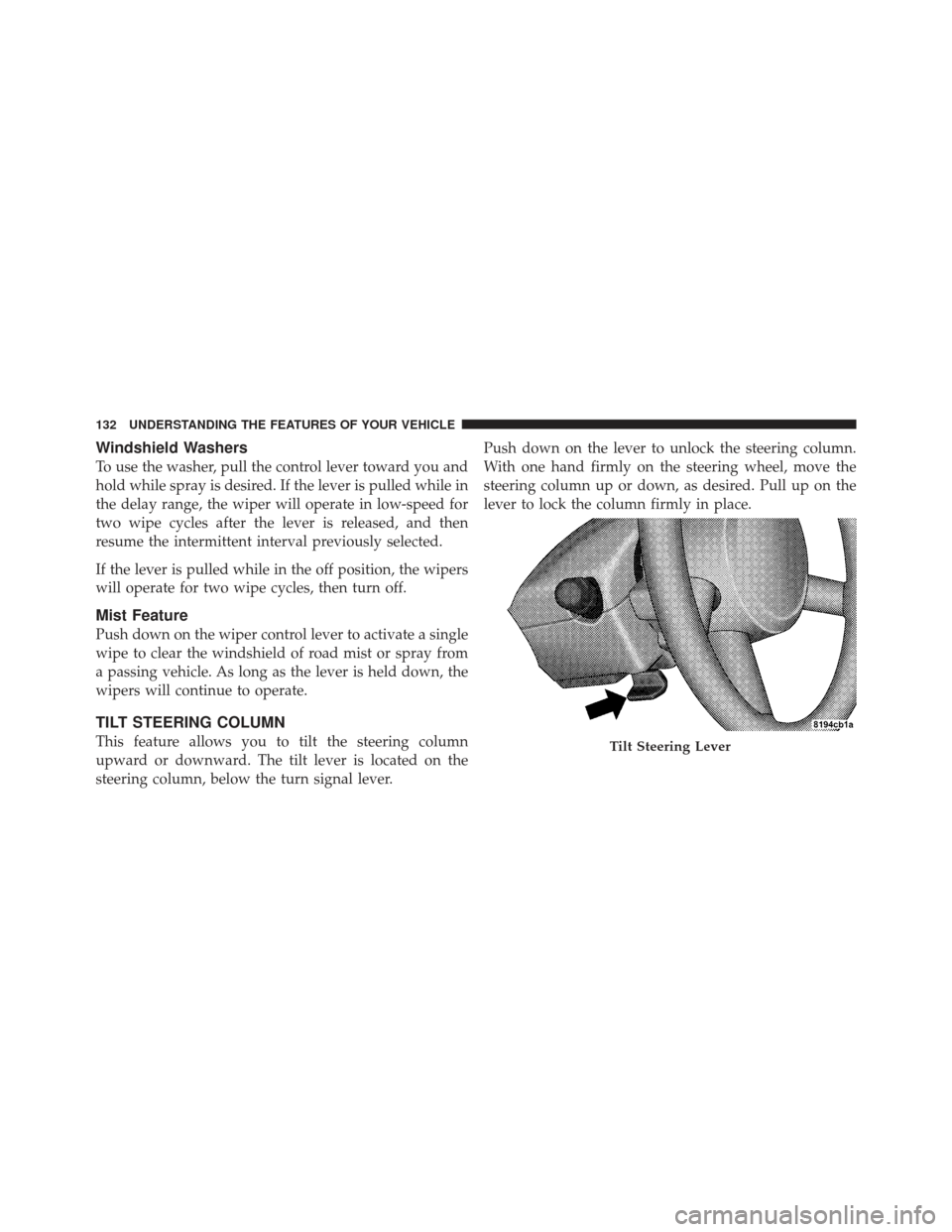
TILT STEERING COLUMN
This feature allows you to tilt the steering column
upward or downward. The tilt lever is located on the
steering column, below the turn signal lever.Push down on the lever to unlock the steering column.
With one hand firmly on the steering wheel, move the
steering column up or down, as desired. Pull up on the
lever to lock the column firmly in place.Tilt Steering Lever
132 UNDERSTANDING THE FEATURES OF YOUR VEHICLE