Page 315 of 410

The best time to check the engine oil level is about five
minutes after a fully warmed engine is shut off. Do not
check oil level before starting the engine after it has sat
overnight. Checking engine oil level when the engine is
cold will give you an incorrect reading.
Checking the oil while the vehicle is on level ground, will
improve the accuracy of the oil level readings. Maintain
the oil level between the MIN and MAX markings on the
dipstick. Adding one quart of oil when the reading is at
the MIN mark will result in a MAX reading on these
engines.
CAUTION!
Overfilling the crankcase as indicated by an oil level
above the “MAX” mark on the engine oil dipstick
will cause oil aeration, which can lead to loss of oil
pressure and an increase in oil temperature. This
could damage your engine.
Change Engine Oil
Road conditions and your kind of driving affects the
interval at which your oil should be changed. Check the
following list to decide if any apply to you.
•Day and night temperatures are below 32°F (0°C).
•Stop and go driving.
•Extensive engine idling.
•Driving in dusty conditions.
•Short trips of less than 10 miles (16 km).
•More than 50% of your driving is at sustained high
speeds during hot weather, above 90°F (32°C).
•Trailer towing.
•Taxi, Police, or delivery service (commercial service).
•Off-road or desert operation.
7
MAINTAINING YOUR VEHICLE 313
Page 325 of 410

To minimize the possibility of catalyst damage:
•Do not shut off the engine or interrupt the ignition
when the transaxle is in gear and the vehicle is in
motion.
•Do not try to start the engine by pushing or towing the
vehicle.
•Do not idle the engine with any spark plug wires
disconnected for a prolonged period.
Cooling System
WARNING!
•When working near the radiator cooling fan, dis-
connect the fan motor lead or turn the ignition
switch to the OFF position. The fan is temperature
controlled and can start at any time the ignition
switch is in the ON position.(Continued)
WARNING! (Continued)
•You or others can be badly burned by hot engine
coolant (antifreeze) or steam from your radiator. If
you see or hear steam coming from under the
hood, do not open the hood until the radiator has
had time to cool. Never try to open a cooling
system pressure cap when the radiator is hot.
Coolant Checks
Check engine coolant (antifreeze) protection every
12 months (before the onset of freezing weather, where
applicable). If the engine coolant (antifreeze) is dirty or
rusty in appearance, the system should be drained,
flushed and refilled with fresh engine coolant (anti-
freeze). Check the front of the A/C condenser for any
accumulation of bugs, leaves, etc. If dirty, clean by gently
spraying water from a garden hose vertically down the
face of the condenser.
7
MAINTAINING YOUR VEHICLE 323
Page 335 of 410

Fluid and Filter Changes
Automatic transmission fluid and filter should be
changed as follows:
Maintenance Schedule A — Non Turbocharged Engines
— No change necessary.
Maintenance Schedule A — Turbocharged Engines—
No change necessary.
Maintenance Schedule B — All Engines — Every
60,000 miles (100 000 km) change fluid and filter under
the following conditions:
•Police, taxi, limousine, commercial type operation, or
trailer towing where the vehicle is driven regularlyfor
more than 45 minutes of continuous operation.
Refer to the “Maintenance Schedules” in Section 8 for the
proper maintenance intervals.
Special Additives
Automatic Transmission Fluid (ATF) is an engineered
product and its performance may be impaired by supple-
mental additives. Therefore, do not add any fluid addi-
tives to the transaxle. The only exception to this policy is
the use of special dyes to aid in detecting fluid leaks. In
addition, avoid using transmission sealers as they may
adversely affect seals.
CAUTION!
Do not use chemical flushes in your transaxle as the
chemicals can damage your transaxle components.
Such damage is not covered by the New Vehicle
Limited Warranty.
7
MAINTAINING YOUR VEHICLE 333
Page 356 of 410
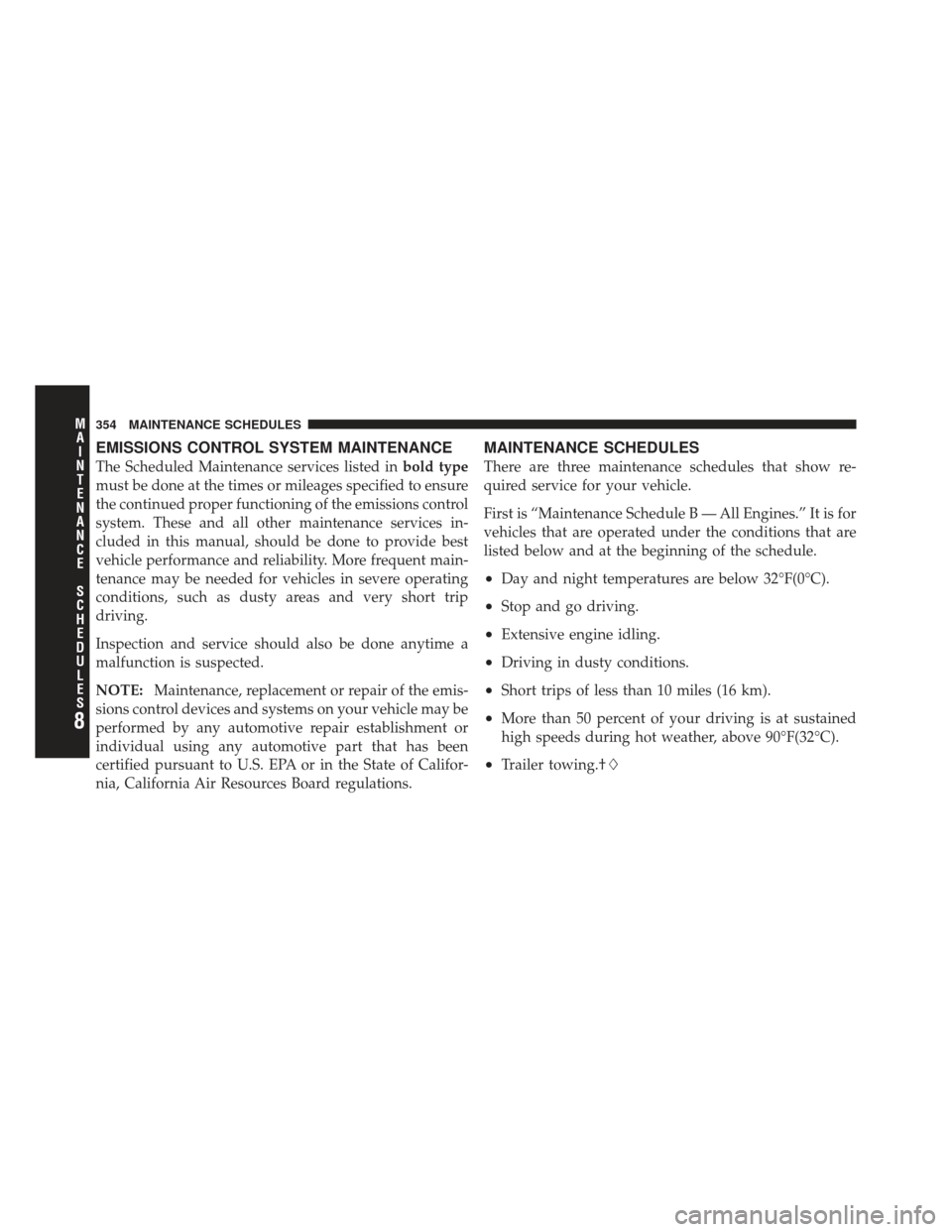
EMISSIONS CONTROL SYSTEM MAINTENANCE
The Scheduled Maintenance services listed inbold type
must be done at the times or mileages specified to ensure
the continued proper functioning of the emissions control
system. These and all other maintenance services in-
cluded in this manual, should be done to provide best
vehicle performance and reliability. More frequent main-
tenance may be needed for vehicles in severe operating
conditions, such as dusty areas and very short trip
driving.
Inspection and service should also be done anytime a
malfunction is suspected.
NOTE: Maintenance, replacement or repair of the emis-
sions control devices and systems on your vehicle may be
performed by any automotive repair establishment or
individual using any automotive part that has been
certified pursuant to U.S. EPA or in the State of Califor-
nia, California Air Resources Board regulations.
MAINTENANCE SCHEDULES
There are three maintenance schedules that show re-
quired service for your vehicle.
First is “Maintenance Schedule B — All Engines.” It is for
vehicles that are operated under the conditions that are
listed below and at the beginning of the schedule.
•Day and night temperatures are below 32°F(0°C).
•Stop and go driving.
•Extensive engine idling.
•Driving in dusty conditions.
•Short trips of less than 10 miles (16 km).
•More than 50 percent of your driving is at sustained
high speeds during hot weather, above 90°F(32°C).
•Trailer towing.†
8
M A I
N T
E
N A
N CE
S
C
H E
D
U L
E
S354 MAINTENANCE SCHEDULES
Page 359 of 410
Maintenance Schedule B — All Engines
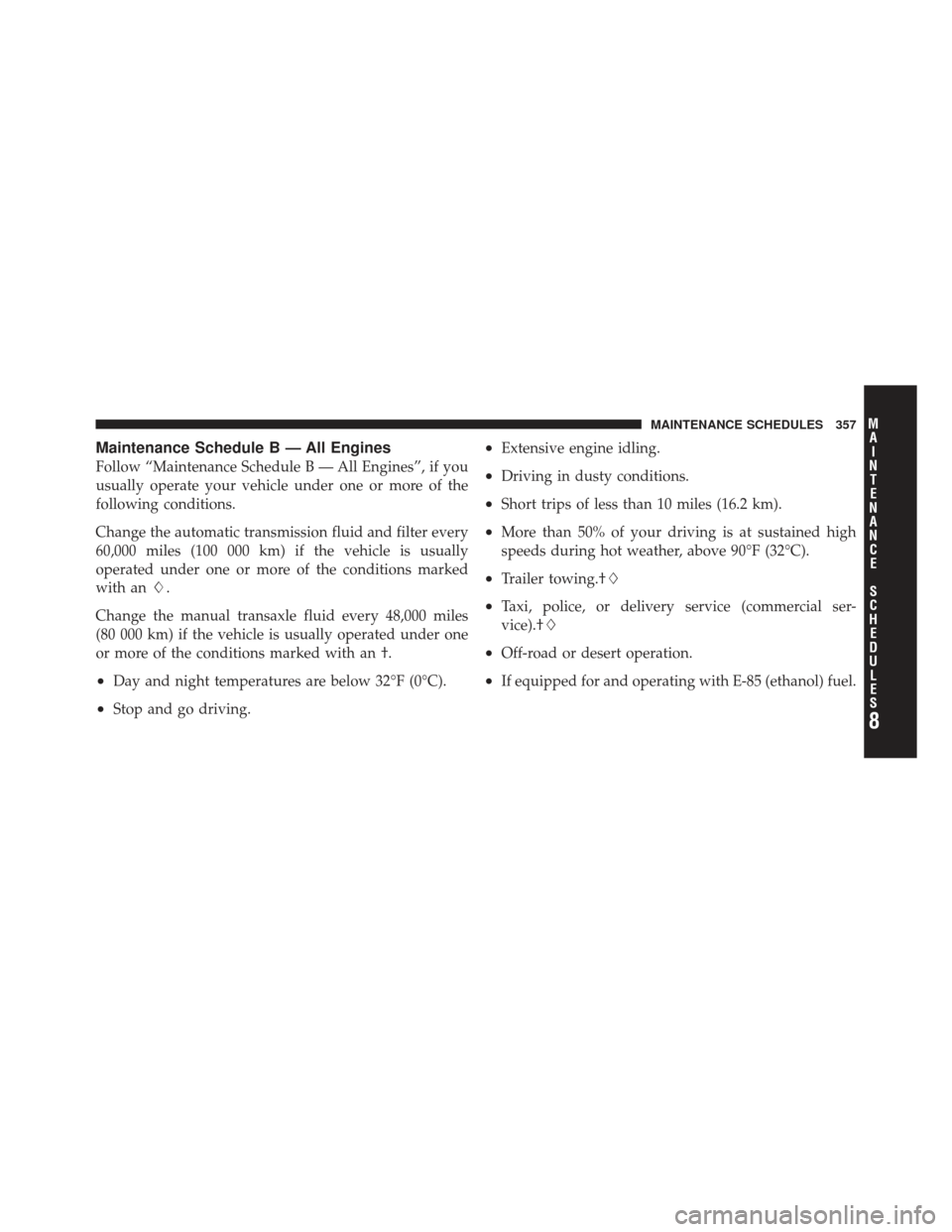
Follow “Maintenance Schedule B — All Engines”, if you
usually operate your vehicle under one or more of the
following conditions.
Change the automatic transmission fluid and filter every
60,000 miles (100 000 km) if the vehicle is usually
operated under one or more of the conditions marked
with an .
Change the manual transaxle fluid every 48,000 miles
(80 000 km) if the vehicle is usually operated under one
or more of the conditions marked with an †.
•Day and night temperatures are below 32°F (0°C).
•Stop and go driving.
•Extensive engine idling.
•Driving in dusty conditions.
•Short trips of less than 10 miles (16.2 km).
•More than 50% of your driving is at sustained high
speeds during hot weather, above 90°F (32°C).
•Trailer towing.†
•Taxi, police, or delivery service (commercial ser-
vice).†
•Off-road or desert operation.
•If equipped for and operating with E-85 (ethanol) fuel.
8
M A I
N T
E
N A
N CE
S
C
H E
D
U L
E
SMAINTENANCE SCHEDULES 357
Page 363 of 410
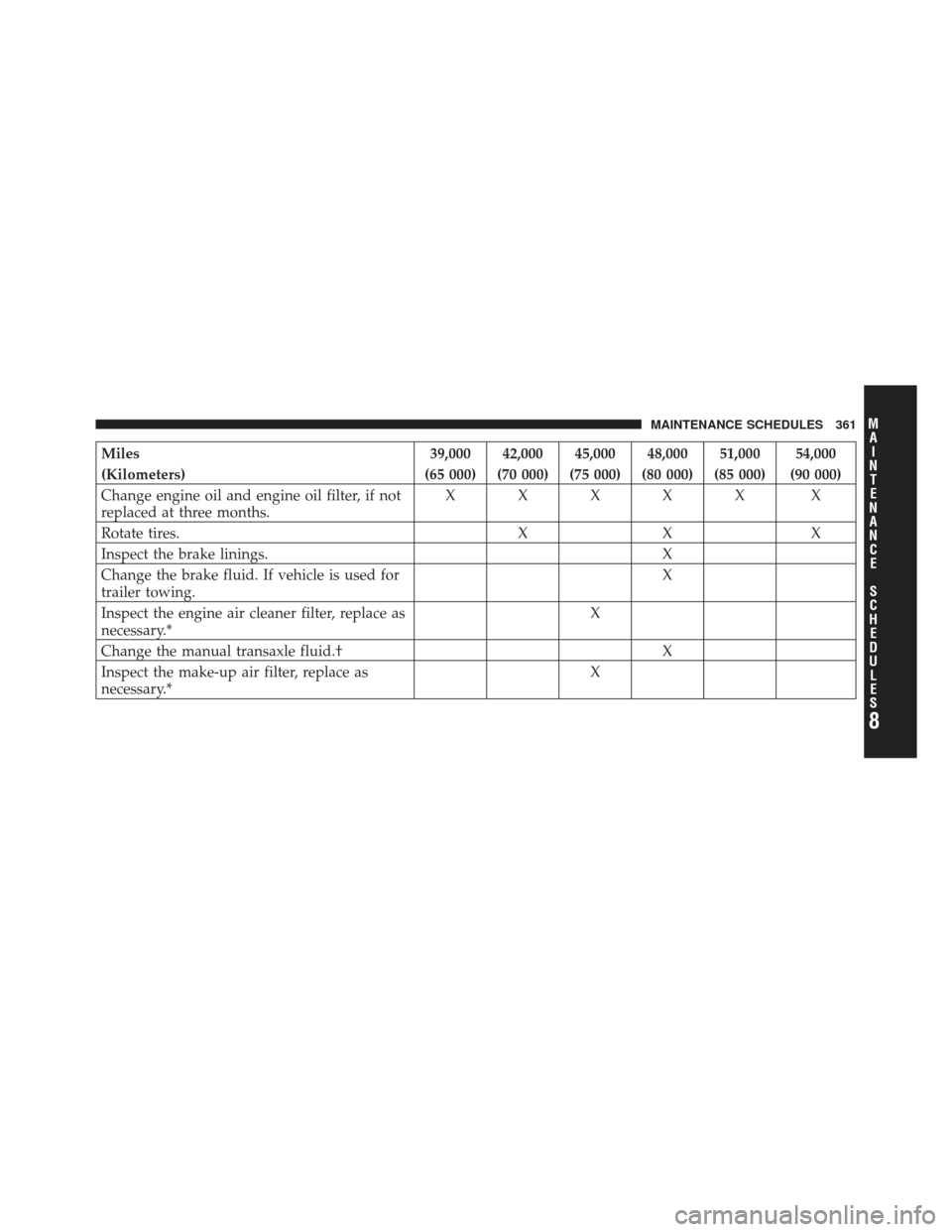
Miles39,000 42,000 45,000 48,000 51,000 54,000
(Kilometers) (65 000) (70 000) (75 000) (80 000) (85 000) (90 000)
Change engine oil and engine oil filter, if not
replaced at three months. XXXXX X
Rotate tires. XX X
Inspect the brake linings. X
Change the brake fluid. If vehicle is used for
trailer towing. X
Inspect the engine air cleaner filter, replace as
necessary.* X
Change the manual transaxle fluid.† X
Inspect the make-up air filter, replace as
necessary.* X
8
M
A I
N T
E
N A
N CE
S
C
H E
D
U L
E
SMAINTENANCE SCHEDULES 361
Page 366 of 410
Miles93,000 96,000 99,000 102,000 105,000
(Kilometers) (155 000) (160 000) (165 000) (170 000) (175 000)
Change engine oil and engine oil filter, if not
replaced at three months. XXXXX
Rotate tires. XX
Inspect the brake linings. X
Change the brake fluid if your vehicle is used for
trailer towing. X
Inspect the engine air cleaner filter, and replace as
necessary.* X
Change the manual transaxle fluid.† X
Replace the engine timing belt.* X
Flush and replace the engine coolant, if not
replaced at 60 months. X
Inspect the make-up air filter, replace as necessary.* X
8
M
A I
N T
E
N A
N CE
S
C
H E
D
U L
E
S364 MAINTENANCE SCHEDULES
Page 369 of 410

Miles138,000 141,000 144,000 147,000 150,000
(Kilometers) (230 000) (235 000) (240 000) (245 000) (250 000)
Change engine oil and engine oil filter, if not
replaced at three months. XXXXX
Rotate tires. XXX
Inspect the brake linings. X
Adjust parking brake on vehicles equipped with
four-wheel disc brakes. X
Replace the engine air cleaner filter.* X
Adjust the generator belt tension. X
Replace the spark plugs. X
Change the manual transaxle fluid.† X
Replace the make-up air filter.* X
* This maintenance is recommended by the manufacturer
to the owner, but is not required to maintain the emis-
sions warranty.
‡ This maintenance is not required if previously replaced.
† This maintenance is required only for police, taxi,
limousine-type operation, or trailer towing.
This maintenance is required only for police, taxi,
limousine-type operation, or trailer towing.
Inspection and service should also be performed anytime
a malfunction is observed or suspected. Retain all
receipts.
8
M A I
N T
E
N A
N CE
S
C
H E
D
U L
E
SMAINTENANCE SCHEDULES 367