Page 289 of 410
Towing Requirements — Trailer Lights And Wiring
Whenever you pull a trailer, regardless of the trailer size,
stop lights and turn signals on the trailer are required for
motoring safety.
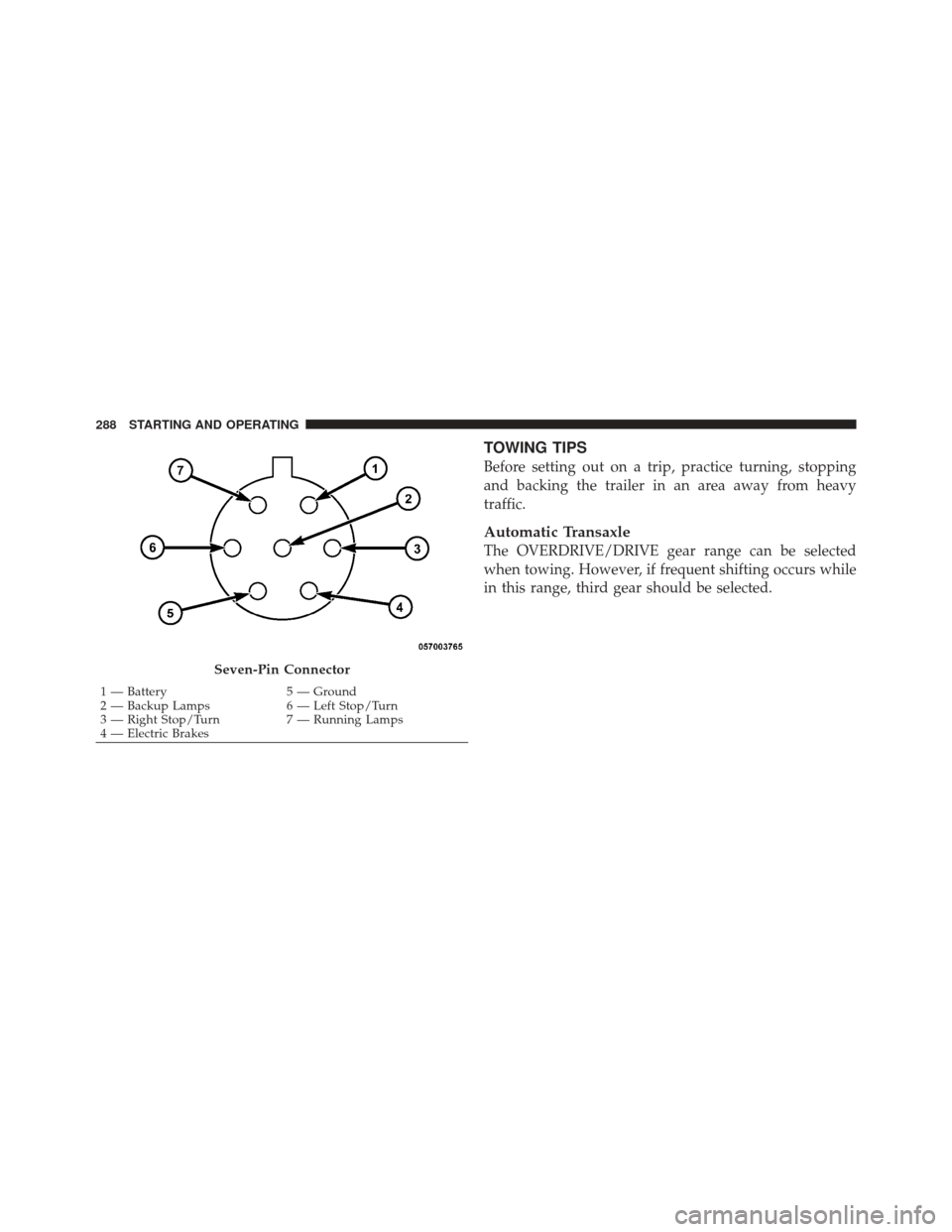
The Trailer Tow Package may include a four–or seven-pin
connector wiring harness. Use a factory approved trailer
harness and connector.
NOTE:Do not cut or splice wiring into the vehicles
wiring harness.
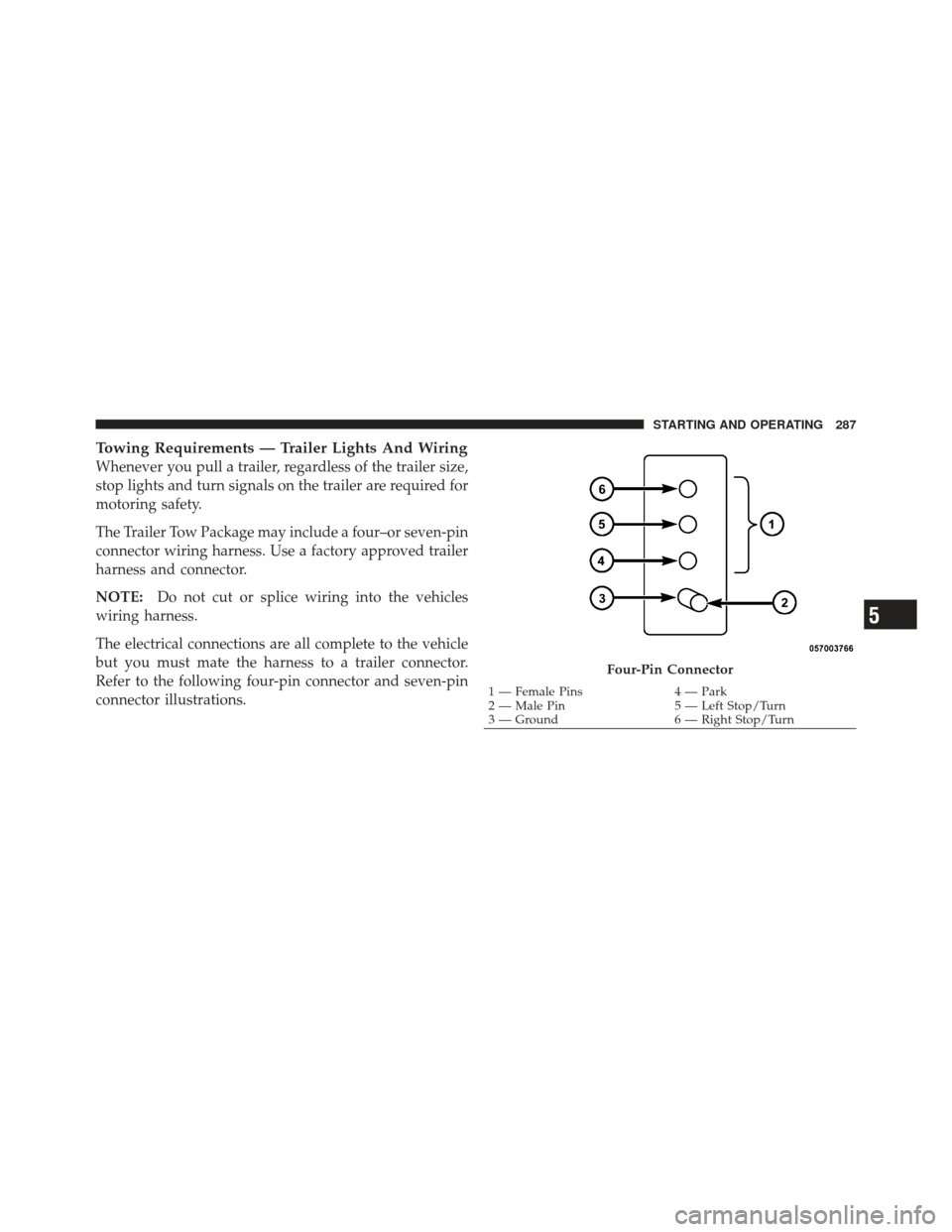
The electrical connections are all complete to the vehicle
but you must mate the harness to a trailer connector.
Refer to the following four-pin connector and seven-pin
connector illustrations.
Four-Pin Connector
1 — Female Pins 4 — Park
2 — Male Pin 5 — Left Stop/Turn
3 — Ground 6 — Right Stop/Turn
5
STARTING AND OPERATING 287
Page 290 of 410
TOWING TIPS
Before setting out on a trip, practice turning, stopping
and backing the trailer in an area away from heavy
traffic.
Automatic Transaxle
The OVERDRIVE/DRIVE gear range can be selected
when towing. However, if frequent shifting occurs while
in this range, third gear should be selected.
Seven-Pin Connector
1 — Battery5 — Ground
2 — Backup Lamps 6 — Left Stop/Turn
3 — Right Stop/Turn 7 — Running Lamps
4 — Electric Brakes
288 STARTING AND OPERATING
Page 291 of 410
NOTE:Using the third gear range while operating the
vehicle under heavy operating conditions will improve
performance and extend transmission life by reducing
excessive shifting and heat build up. This action will also
provide better engine braking.
The automatic transmission fluid and filter should be
changed if you REGULARLY tow a trailer for more than
45 minutes of continuous operation. Refer to the “Main-
tenance Schedule” in Section 8 for the proper mainte-
nance intervals.
NOTE: Check the automatic transmission fluid level
before towing.Electronic Speed Control — If Equipped
•
Do not use in hilly terrain or with heavy loads.
•When using the speed control, if you experience speed
drops greater than 10 mph (16 km/h), disengage until
you can get back to cruising speed.
•Use speed control in flat terrain and with light loads to
maximize fuel efficiency.
5
STARTING AND OPERATING 289
Page 292 of 410
Cooling System
To reduce potential for engine and transmission over-
heating, take the following actions:
•City Driving
When stopped for short periods of time, put transmission
in NEUTRAL but do not increase engine idle speed.
•Highway Driving
Reduce speed.
•Air Conditioning
Turn off temporarily.
RECREATIONAL TOWING (BEHIND
MOTORHOME, ETC.)
Towing — Manual Transaxle
If your vehicle is equipped with a manual transaxle, it
may be towed with all four wheels on the ground, in a
forward direction, at any legal highway speed, for any
distance, if the transaxle is in NEUTRAL.
Towing — Automatic Transaxle
CAUTION!
Recreational towing on vehicle’s equipped with a
automatic transaxle is not recommended.
NOTE: If the vehicle requires towing, make sure all four
wheels are off the ground.
290 STARTING AND OPERATING
Page 293 of 410
WHAT TO DO IN EMERGENCIES
CONTENTS
�Hazard Warning Flashers ................ 292
� If Your Engine Overheats ................ 292
� Jacking And Tire Changing ............... 294
▫ Jack Location ....................... 294
▫ Spare Tire Stowage ................... 295
▫ Spare Tire Removal ................... 295
▫ Preparations For Jacking ............... 296 ▫
Jacking Instructions ................... 296
� Jump-Starting Procedures ................ 300
� Freeing A Stuck Vehicle ................. 302
� Towing A Disabled Vehicle ............... 303
▫ Towing With The Key-In-Ignition ......... 303
▫ Towing Without The Key-In-Ignition ....... 304
6
Page 305 of 410

CAUTION!
Racing the engine or spinning the wheels too fast
may lead to transaxle overheating and failure. It can
also damage the tires. Do not spin the wheels above
30 mph (48 km/h).
TOWING A DISABLED VEHICLE
Towing With The Key-In-Ignition
Four-Speed Automatic Transaxle
Your vehicle may be towed under the following condi-
tions: The steering column must be unlocked and the
shift lever must be in NEUTRAL, the distance to betowed must not exceed 100 miles (160 km), and the
towing speed must not exceed 44 mph (72 km/h). If the
transaxle is not operative, or if the vehicle is to be towed
more than 100 miles (160 km), the vehicle must be towed
with the front wheels off the ground to avoid damage to
the transaxle.
Manual Transaxle
Your vehicle may be towed in a forward direction, with
all four wheels on the ground, and the shift lever in the
NEUTRAL position. If the transaxle is not operative, the
vehicle must be towed with the front wheels off the
ground.
6
WHAT TO DO IN EMERGENCIES 303
Page 306 of 410
All Transaxles
CAUTION!
If the vehicle being towed requires steering, the
ignition switch must be in the ACC position, not in
the LOCK position.
Do not attempt to use sling-type equipment when
towing. When securing the vehicle to a flatbed truck,
do not attach it to front or rear suspension compo-
nents. Damage to your vehicle may result from
improper towing.
If it is necessary to use the accessories while being towed
(wipers, defrosters, etc.), the key must be in the ON
position, not the ACC position. Make certain the trans-
axle remains in NEUTRAL.
Towing Without The Key-In-Ignition
Special care must be taken when the vehicle is towed
with the ignition in the LOCK position. A dolly should be
used under the front wheels if the rear wheels are raised.
Proper towing equipment is necessary to prevent dam-
age to the vehicle.
Towing Behind Another Vehicle (Flat Towing with
all four wheels on the ground)
If your vehicle is equipped with a manual transaxle, it
may be towed in a forward direction, at any legal
highway speed, for any distance, if the transaxle is in
NEUTRAL.
If the ignition key is not available, vehicles with auto-
matic transaxles can not be flat towed at any time.
304 WHAT TO DO IN EMERGENCIES
Page 311 of 410

ONBOARD DIAGNOSTIC SYSTEM — OBD II
Your vehicle is equipped with a sophisticated onboard
diagnostic system called OBD II. This system monitors
the performance of the emissions, engine, and automatic
transmission control systems. When these systems are
operating properly, your vehicle will provide excellent
performance and fuel economy, as well as engine emis-
sions well within current government regulations.
If any of these systems require service, the OBD II system
will turn on the Malfunction Indicator Light (MIL). OBD
II will also store diagnostic codes and other information
to assist an authorized service technician in making
repairs. Although your vehicle will usually be drivable
and not need towing, see your authorized dealer for
service as soon as possible.
Loose Fuel Filler Cap Message
After fuel is added, the vehicle diagnostic system can
determine if the fuel filler cap is loose, improperlyinstalled, or damaged. A “gASCAP” message will be
displayed in the instrument cluster. Tighten the gas cap
until a
�clicking� sound is heard. This is an indication that
the gas cap is properly tightened. Press the odometer
reset button to turn the message off. If the problem
persists, the message will appear the next time the
vehicle is started. This might indicate a damaged cap. If
the problem is detected twice in a row, the system will
turn on the MIL. Resolving the problem will turn the MIL
light off.
EMISSIONS INSPECTION AND MAINTENANCE
PROGRAMS
In some localities, it may be a legal requirement to pass
an inspection of your vehicle’s emissions control system.
Failure to pass could prevent vehicle registration.
For states that require an Inspection and Mainte-
nance (I/M), this check verifies the “Malfunction7
MAINTAINING YOUR VEHICLE 309