Page 217 of 410
NOTE:There is a difference in temperature between the
upper and lower outlets for added comfort. The warmer
air goes to the floor outlets. This feature gives improved
comfort during sunny but cool conditions.
Floor Air is directed through the floor outlets and side
window demist outlets with a small amount
through the defrost outlet.
Mix Air is directed through the floor, defrost and side
window demist outlets. This setting works best in
cold or snowy conditions that require extra heat at
the windshield. This setting is good for maintaining
comfort while reducing moisture on the windshield. Defrost
Air is directed through the windshield and side
window demist outlets. Use this mode with maxi-
mum fan and temperature settings for best windshield
and side window defrosting.
NOTE: The air conditioning compressor operates in
both Mix and Defrost or a blend of these modes even if
the A/C button has not been pressed and the indicator
lamp is off. This dehumidifies the air to help dry the
windshield. To improve fuel economy, use these modes
only when necessary.
4
UNDERSTANDING YOUR INSTRUMENT PANEL 215
Page 218 of 410
CAUTION!
If the Defroster is not working the windshield and
windows may become fogged, and your visibility
will be greatly diminished. See your authorized
dealer as soon as possible.
Air Outlets
The airflow from each of the instrument panel outlets can
be adjusted for direction and turned on or off to control
airflow.
NOTE:For maximum airflow to the rear seat passen-
gers, the center instrument panel outlets can be aimed, so
that the left center outlet is directed toward the right rear
passenger and the right center outlet is directed toward
the left rear passenger.
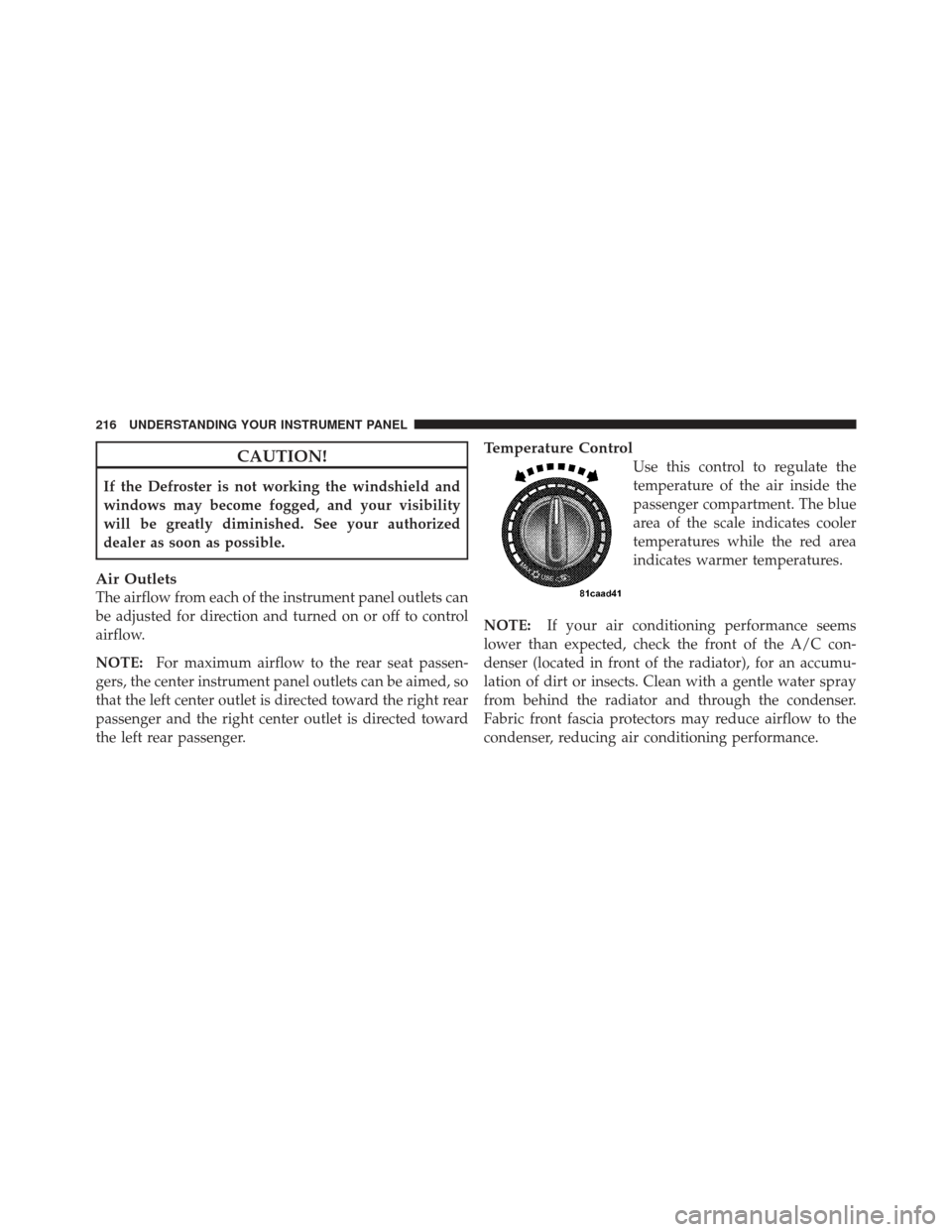
Temperature Control
Use this control to regulate the
temperature of the air inside the
passenger compartment. The blue
area of the scale indicates cooler
temperatures while the red area
indicates warmer temperatures.
NOTE: If your air conditioning performance seems
lower than expected, check the front of the A/C con-
denser (located in front of the radiator), for an accumu-
lation of dirt or insects. Clean with a gentle water spray
from behind the radiator and through the condenser.
Fabric front fascia protectors may reduce airflow to the
condenser, reducing air conditioning performance.
216 UNDERSTANDING YOUR INSTRUMENT PANEL
Page 219 of 410
Air Conditioning (A/C) — If Equipped
Press the A/C button to engage
the air conditioning. A lamp will
illuminate when the air condition-
ing system is engaged
NOTE: The air conditioning compressor will not engage
until the engine has been running for about 10 seconds.
MAX A/C
To quickly cool the vehicle interior
follow the steps listed below:
1. Set the Temperature Control to Max Cool.
2. Set the Mode Control to Panel or Bi-Level.
3. Press the Recirculation button and the A/C button.
4. Adjust the Fan Control to desired airflow setting.
4
UNDERSTANDING YOUR INSTRUMENT PANEL 217
Page 260 of 410

CAUTION!
After inspecting or adjusting the tire pressure, al-
ways reinstall the valve stem cap. This will prevent
moisture and dirt from entering the valve stem,
which could damage the valve stem.
Inflation pressures specified on the placard are always
“cold tire inflation pressure.” Cold tire inflation pressure
is defined as the tire pressure after the vehicle has not
been driven for at least three hours, or driven less than
1 mile (1.6 km) after a three-hour period. The cold tire
inflation pressure must not exceed the maximum infla-
tion pressure molded into the tire sidewall.
Check tire pressures more often if subject to a wide range
of outdoor temperatures, as tire pressures vary with
temperature changes. Tire pressures change by approximately 1 psi (7 kPa) per
12°F (7°C) of air temperature change. Keep this in mind
when checking tire pressure inside a garage, especially in
the Winter.
Example: If garage temperature = 68°F (20°C) and the
outside temperature = 32°F (0°C), then the cold tire
inflation pressure should be increased by 3 psi (21 kPa),
which equals 1 psi (7 kPa) for every 12°F (7°C) for this
outside temperature condition.
Tire pressure may increase from 2 to 6 psi (13 to 40 kPa)
during operation. DO NOT reduce this normal pressure
buildup or your tire pressure will be too low.
258 STARTING AND OPERATING
Page 271 of 410

NOTE:
1. The compact spare tire (if equipped) does not have a
TPMS Sensor. Therefore, the TPMS will not monitor the
pressure in the compact spare tire.
2. If you install the compact spare tire in place of a road
tire that has a pressure below the low-pressure warning
limit, upon the next ignition key cycle, a chime will
sound and the TPMS Telltale Light will turn ON due to
the low tire.
3. After driving the vehicle for up to 20 minutes above
15 mph (25 km/h), the TPMS Telltale Light will flash on
and off for 75 seconds and then remain on solid.
4. For each subsequent ignition key cycle, a chime will
sound and the TPMS Telltale Light will flash on and off
for 75 seconds and then remain on solid.5. Once you repair or replace the original road tire, and
reinstall it on the vehicle in place of the compact spare,
the TPMS will update automatically and the TPMS
Telltale Light will turn OFF, as long no tire pressure is
below the low-pressure warning limit in any of the four
active road tires. The vehicle may need to be driven for
up to 20 minutes above 15 mph (25 km/h) in order for the
TPMS to receive this information.
General Information
This device complies with part 15 of the FCC rules and
RSS 210 of Industry Canada. Operation is subject to the
following conditions:
•This device may not cause harmful interference.
•This device must accept any interference received,
including interference that may cause undesired
operation.
5
STARTING AND OPERATING 269
Page 272 of 410

The tire pressure sensors are regulated under one of the
following licenses:
United States..................... KR5S120123
Canada ........................ 2671-S120123
FUEL REQUIREMENTS
2.4L And 2.4L Turbo Engines
2.4L standard engines are designed to meet
all emission regulations and provide excel-
lent fuel economy and performance when
using high quality unleaded “regular”
gasolines having an octane rating of 87.
The use of premium gasoline is not recom-
mended. Under normal conditions, the use of premium
gasoline will not provide a benefit over high quality
unleaded “regular” gasolines, and in some circumstances
may result in poorer performance.
Reformulated Gasoline
Many areas of the country require the use of cleaner
burning gasoline referred to as “Reformulated Gasoline”.
Reformulated gasolines contain oxygenates, and are spe-
cifically blended to reduce vehicle emissions and im-
prove air quality.
The manufacturer supports the use of reformulated gaso-
lines. Properly blended reformulated gasolines will pro-
vide excellent performance and durability of engine and
fuel system components.
Gasoline/Oxygenate Blends
Some fuel suppliers blend unleaded gasoline with oxy-
genates such as 10% ethanol, MTBE, and ETBE. Oxygen-
ates are required in some areas of the country during the
winter months to reduce carbon monoxide emissions.
Fuels blended with these oxygenates may be used in
your vehicle.
270 STARTING AND OPERATING
Page 274 of 410

MMT In Gasoline
MMT is a manganese-containing metallic additive that is
blended into some gasoline to increase the octane num-
ber. Gasolines blended with MMT offer no performance
advantage beyond gasolines of the same octane number
without MMT. Gasolines blended with MMT have shown
to reduce spark plug life and reduce emissions system
performance in some vehicles. The manufacturer recom-
mends using gasolines without MMT. Since the MMT
content of gasoline may not be indicated on the pump,
you should ask your gasoline retailer if that gasoline
contains MMT.
It is even more important to look for gasolines without
MMT in Canada, because MMT can be used at levels
higher than those allowed in the United States.
MMT is prohibited in Federal and California reformu-
lated gasolines.
Materials Added to Fuel
All gasoline sold in the United States is required to
contain effective detergent additives. Use of additional
detergents or other additives is not needed under normal
conditions and would result in additional cost. Therefore
you should not have to add anything to the fuel.
Fuel System Cautions
Follow these guidelines to maintain your vehicle’s per-
formance:
CAUTION!
•The use of leaded gas is prohibited by Federal law.
Using leaded gasoline can impair engine perfor-
mance, damage the emission control system.(Continued)
272 STARTING AND OPERATING
Page 276 of 410
•Guard against carbon monoxide with proper mainte-
nance. Have the exhaust system inspected every time
the vehicle is raised. Have any abnormal conditions
repaired promptly. Until repaired, drive with all side
windows fully open.
•Keep the liftgate closed when driving your vehicle to
prevent carbon monoxide and other poisonous ex-
haust gases from entering the vehicle.
ADDING FUEL
The fuel tank filler tube has a restricting door about 2 in
(50 mm) inside the opening. If using a portable container,
it should have a flexible nozzle long enough to force open
the restricting door.
Fuel Filler Cap (Gas Cap)
The gas cap is behind the fuel filler door, on the passen-
ger’s side of the vehicle. If the gas cap is lost or damaged,
be sure the replacement cap is for use with this vehicle.NOTE:
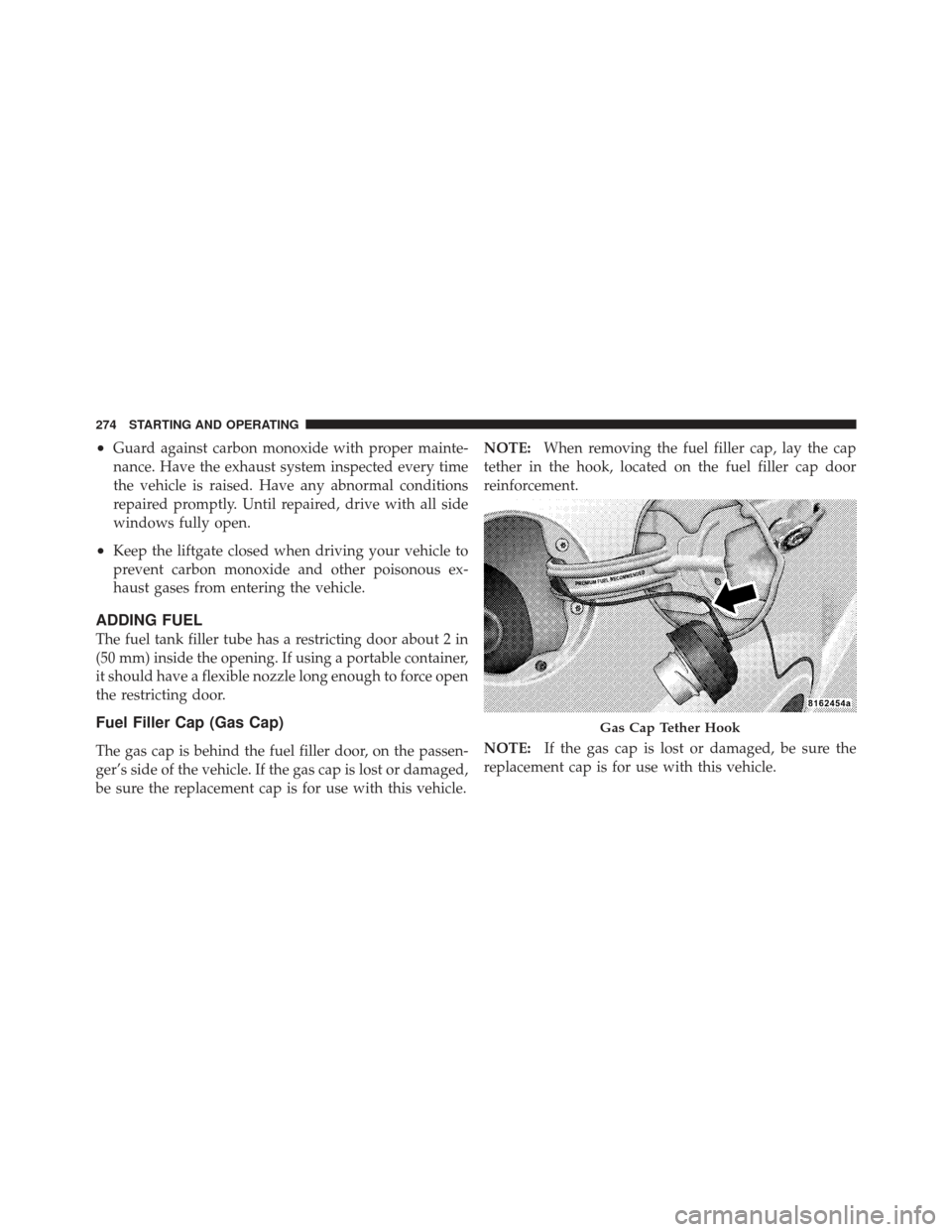
When removing the fuel filler cap, lay the cap
tether in the hook, located on the fuel filler cap door
reinforcement.
NOTE: If the gas cap is lost or damaged, be sure the
replacement cap is for use with this vehicle.
Gas Cap Tether Hook
274 STARTING AND OPERATING
