Page 40 of 493
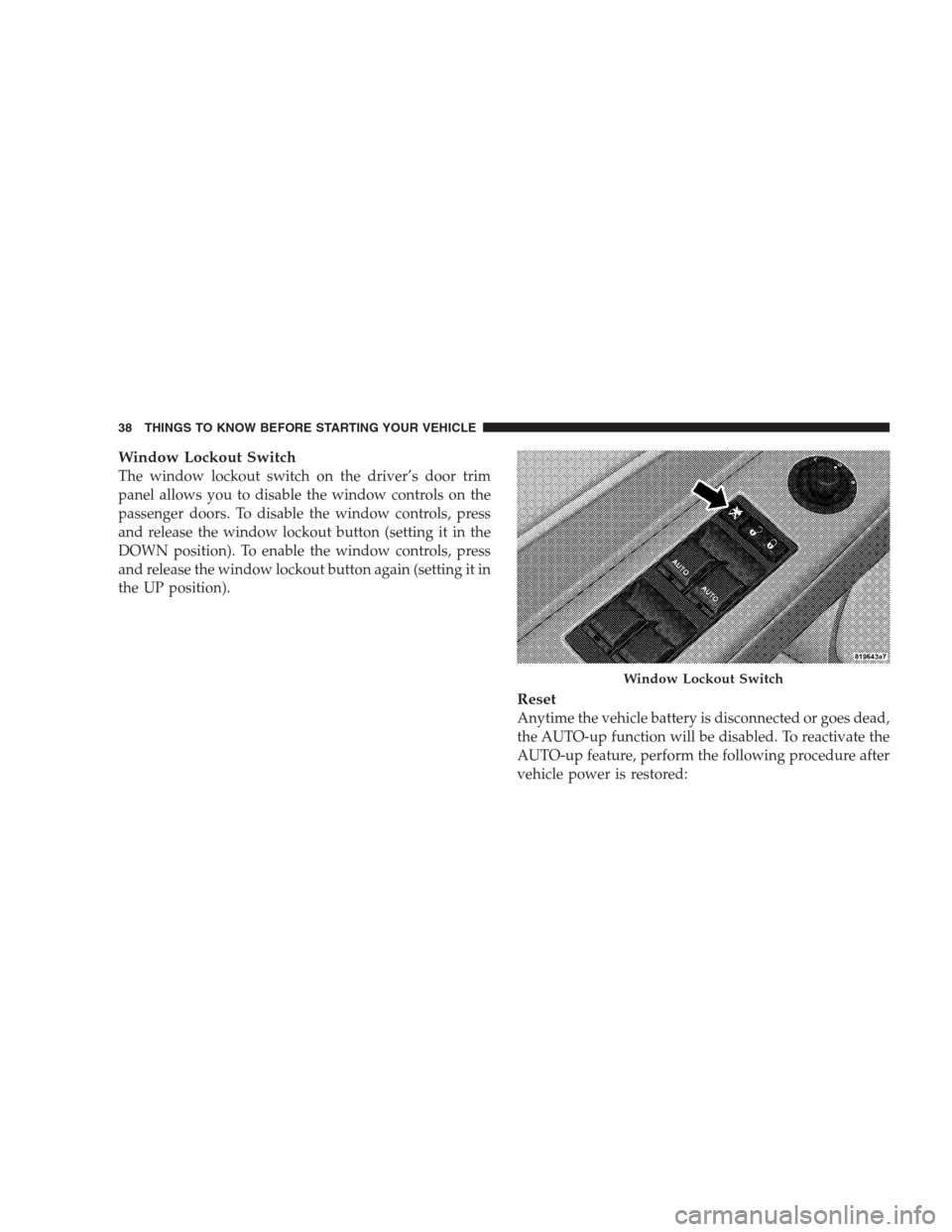
Window Lockout Switch
The window lockout switch on the driver’s door trim
panel allows you to disable the window controls on the
passenger doors. To disable the window controls, press
and release the window lockout button (setting it in the
DOWN position). To enable the window controls, press
and release the window lockout button again (setting it in
the UP position).
Reset
Anytime the vehicle battery is disconnected or goes dead,
the AUTO-up function will be disabled. To reactivate the
AUTO-up feature, perform the following procedure after
vehicle power is restored:
Window Lockout Switch
38 THINGS TO KNOW BEFORE STARTING YOUR VEHICLE
Page 41 of 493
1. Pull the window switch up to close window com-
pletely and continue to hold the switch up for an
additional two seconds after the window is closed.
2. Push the window switch down firmly to the second
detent to open the window completely and continue to
hold the switch down for an additional two seconds after
the window is fully open.
Wind Buffeting
Wind buffeting can be described as the perception of
pressure on the ears or a helicopter type sound in the
ears. Your vehicle may exhibit wind buffeting with the
windows down, or the sunroof (if equipped) in certain
open or partially open positions. This is a normal occur-
rence and can be minimized. If the buffeting occurs with
the rear windows open, then open the front and rear
windows together to minimize the buffeting. If the
buffeting occurs with the sunroof open, then adjust the
sunroof opening to minimize the buffeting.
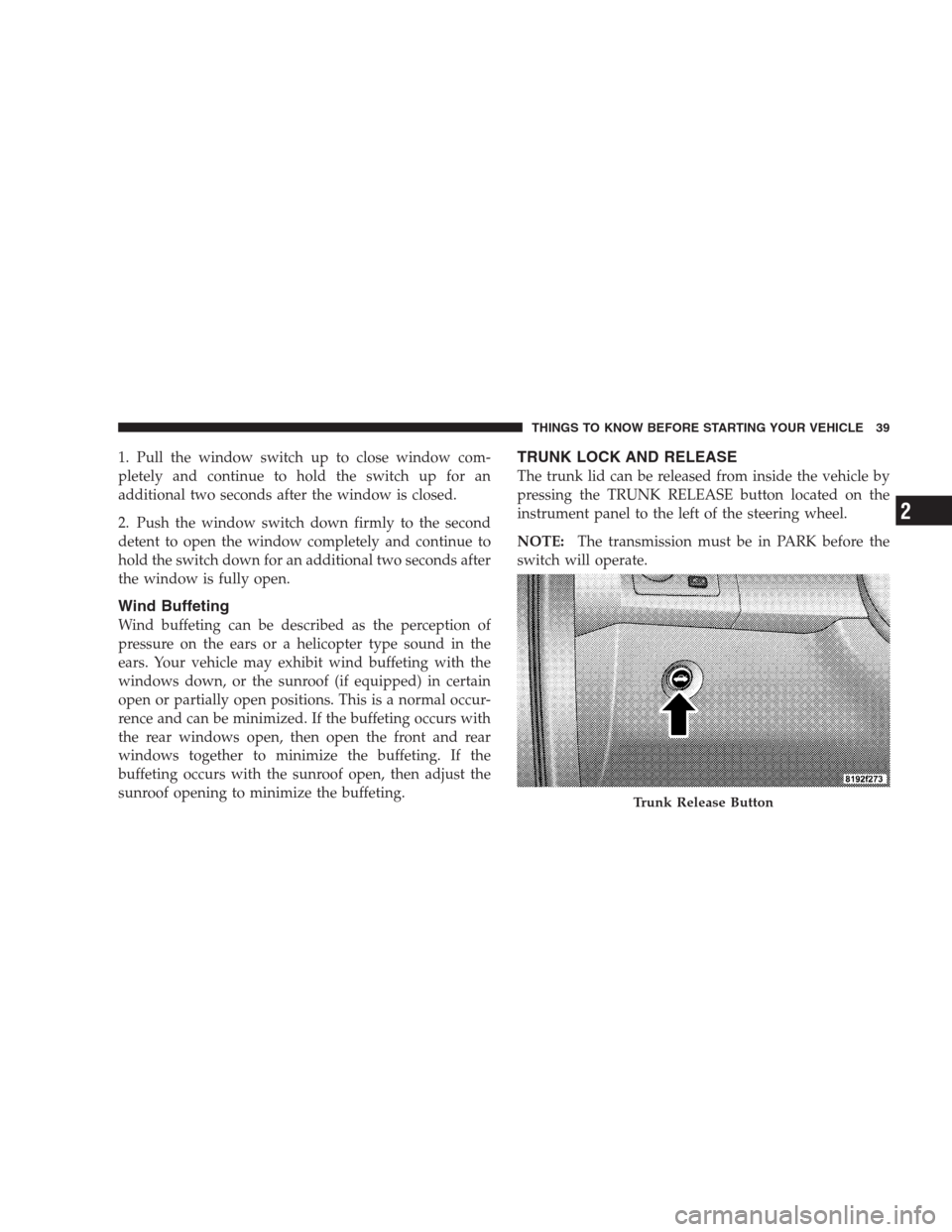
TRUNK LOCK AND RELEASE
The trunk lid can be released from inside the vehicle by
pressing the TRUNK RELEASE button located on the
instrument panel to the left of the steering wheel.
NOTE:The transmission must be in PARK before the
switch will operate.
Trunk Release Button
THINGS TO KNOW BEFORE STARTING YOUR VEHICLE 39
2
Page 42 of 493
The trunk lid can be released from outside the vehicle by
pressing the TRUNK button on the Remote Keyless Entry
(RKE) transmitter twice within five seconds.
With the ignition switch in the ON position, the Trunk
Open symbol will display in the instrument cluster
indicating that the trunk is open. The odometer display
will reappear once the trunk is closed.
With the ignition switch in the LOCK position or the key
removed from the ignition switch, the Trunk Open sym-
bol will display until the trunk is closed.TRUNK SAFETY WARNING
WARNING!
Do not allow children to have access to the trunk,
either by climbing into the trunk from outside, or
through the inside of the vehicle. Always close the
trunk lid when your vehicle is unattended. Once in
the trunk, young children may not be able to escape,
even if they entered through the rear seat. If trapped
in the trunk, children can die from suffocation or
heat stroke.
Trunk Emergency Release
The trunk of your vehicle is equipped with an emergency
release handle. It is located on the inside of the trunk lid,
near the latch, and is coated so that it glows in a darkened
trunk. Pull on the handle to open the trunk.
40 THINGS TO KNOW BEFORE STARTING YOUR VEHICLE
Page 44 of 493
Buckle up even though you are an excellent driver, even
on short trips. Someone on the road may be a poor driver
and cause a collision that includes you. This can happen
far away from home or on your own street.
Research has shown that seat belts save lives, and they
can reduce the seriousness of injuries in a collision. Some
of the worst injuries happen when people are thrown
from the vehicle. Seat belts reduce the possibility of
ejection and the risk of injury caused by striking the
inside of the vehicle.Everyone in a motor vehicle should
be belted at all times.Lap/Shoulder Belts
All seating positions in your vehicle are equipped with
lap/shoulder belts.
The belt webbing retractor is designed to lock during
very sudden stops or impacts. This feature allows the
shoulder part of the belt to move freely with you under
normal conditions. However, in a collision, the belt will
lock and reduce your risk of striking the inside of the
vehicle or being thrown out.
42 THINGS TO KNOW BEFORE STARTING YOUR VEHICLE
Page 50 of 493
you will prefer a higher position. When you release the
anchorage try to move it up and down to make sure that
it is locked in position.
In the rear seat, move toward the center of the seat to
position the belt away from your neck.
Lap/Shoulder Belt Untwisting Procedure
Use the following procedure to untwist a twisted lap/
shoulder belt.
1. Position the latch plate as close as possible to the
anchor point.
2. At about 6 to 12 in (15 to 30 cm) above the latch plate,
grasp and twist the belt webbing 180 degrees to create a
fold that begins immediately above the latch plate.
3. Slide the latch plate upward over the folded webbing.
The folded webbing must enter the slot at the top of the
latch plate.4. Continue to slide the latch plate up until it clears the
folded webbing.
Seat Belt Pretensioners
The seat belts for both front seating positions are
equipped with pretensioning devices that are designed to
remove any slack from the seat belts in the event of a
collision. These devices improve the performance of the
seat belt system by assuring that the belt is tight around
the occupant in a collision. Pretensioners work for all size
occupants, including those in child restraints.
NOTE:These devices are not a substitute for proper seat
belt placement by the occupant. The seat belt still must be
worn snugly and positioned properly.
48 THINGS TO KNOW BEFORE STARTING YOUR VEHICLE
Page 52 of 493
3. Within 60 seconds of turning the ignition switch to the
ON position, unbuckle and then re-buckle the driver’s
seat belt at least three times within 10 seconds, ending
with the seat belt buckled.
NOTE:Watch for the Seat Belt Reminder Light to turn
on while unbuckling the seat belt and turn off while
re-buckling the seat belt. It may be necessary to retract
the seat belt.
4. Turn the ignition switch to the LOCK position. A
single chime will sound to signify that you have success-
fully completed the programming.
BeltAlert�can be reactivated by repeating this procedure.
NOTE:Although BeltAlert�has been deactivated, the
Seat Belt Reminder Light will continue to illuminate as
long as the driver’s seat belt is unbuckled.Automatic Locking Mode — If Equipped
In this mode, the shoulder belt is automatically pre-
locked. However, the belt will still retract to remove slack
in the shoulder belt. Use the Automatic Locking mode
any time a child safety seat is installed in a seating
position that has a seat belt with this feature. Seat belts
that have the Automatic Locking mode feature have a
distinctive label on the webbing. Children 12 years old
and younger should be properly restrained in the rear
seat whenever possible.
How to Engage the Automatic Locking Mode
1. Buckle the combination lap and shoulder belt.
2. Grasp the shoulder portion and pull downward until
the entire belt is extracted.
3. Allow the belt to retract. As the belt retracts, you will
here a clicking sound. This indicates the safety belt is
now in the Automatic Locking mode.
50 THINGS TO KNOW BEFORE STARTING YOUR VEHICLE
Page 53 of 493

How to Disengage the Automatic Locking Mode
Unbuckle the combination lap and shoulder belt and
allow it to retract completely to disengage the Automatic
Locking mode and activate the Vehicle Sensitive (Emer-
gency) Locking mode.
Seat Belts and Pregnant Women
We recommend that pregnant women use the seat belts
throughout their pregnancy. Keeping the mother safe is
the best way to keep the baby safe.
Pregnant women should wear the lap part of the belt
across the thighs and as snug across the hips as possible.
Keep the belt low so that it does not come across the
abdomen. That way the strong bones of the hips will take
the force if there is a collision.
Seat Belt Extender
If a seat belt is too short even when fully extended and
when the adjustable upper shoulder belt anchorage (if so
equipped) is in its lowest position, your authorizeddealer can provide you with a seat belt extender. This
extender should be used only if the existing belt is not
long enough. When it is not required, remove the ex-
tender and store it.
WARNING!
Using a seat belt extender when not needed can
increase the risk of injury in a collision. Only use
when the seat belt is not long enough when it is worn
low and snug and in the recommended seating posi-
tions. Remove and store the extender when not
needed.
Driver and Front Passenger Supplemental
Restraint System (SRS) - Airbag
This vehicle has front airbags for both the driver and
front passenger as a supplement to the seat belt restraint
systems. The driver’s airbag is mounted in the center of
the steering wheel. The passenger’s front airbag is
THINGS TO KNOW BEFORE STARTING YOUR VEHICLE 51
2
Page 57 of 493
WARNING! (Continued)
•If your vehicle is equipped with supplemental
side curtain airbags, do not stack luggage or other
cargo up high enough to block the location of the
side curtain airbag. The area where the side cur-
tain airbag is located should remain free from any
obstructions.
•If your vehicle is equipped with supplemental
side curtain airbags, do not have any accessory
items installed which will alter the roof, including
adding a sunroof to your vehicle. Do not add roof
racks that require permanent attachments (bolts or
screws) for installation on the vehicle roof. Do not
drill into the roof of the vehicle for any reason.
NOTE:Do not use a clothing bar mounted to the coat
hooks in this vehicle. A clothing bar will impede the
proper performance of the curtain airbags.Along with the seat belts, front airbags work with the
instrument panel knee bolsters to provide improved
protection for the driver and front passenger. Side curtain
and seat airbags also work with seat belts to improve
occupant protection.
While the seat belts are designed to protect you in many
types of collisions, the front airbags will deploy in
moderate to severe frontal collisions. For vehicles so
equipped, the supplemental side curtain airbag and front
seat-mounted side airbag on the crash side of the vehicle
will also trigger in moderate to severe side collisions.
However, even in collisions where the airbags deploy,
you need the seat belts to keep you in the correct position
for the airbags to protect you properly.
Here are some simple steps you can take to minimize
the risk of harm from a deploying airbag.
1. Children 12 years old and younger should ride buck-
led up in the rear seat.
THINGS TO KNOW BEFORE STARTING YOUR VEHICLE 55
2