2009 CHRYSLER 300 traction control
[x] Cancel search: traction controlPage 338 of 526
WARNING! (Continued)
•The capabilities of an ABS equipped vehicle must
never be exploited in a reckless or dangerous
manner that could jeopardize the user’s safety or
the safety of others.
All vehicle wheels and tires must be the same size and
type and tires must be properly inflated to produce
accurate signals for the computer.
ELECTRONIC BRAKE CONTROL SYSTEM
Your vehicle is equipped with an advanced electronic
brake control system that include ABS (Anti-Lock Brake
System), TCS (Traction Control System), BAS (Brake
Assist System), and ESP (Electronic Stability Program).
All four of these systems work together to enhance
vehicle stability and control in various driving condi-
tions.
Anti-Lock Brake System (ABS)
This system aids the driver in maintaining vehicle control
under adverse braking conditions by controlling hydrau-
lic brake pressure. This prevents wheel lock-up to help
avoid skidding on slippery surfaces during braking.
Refer to “Anti-Lock Brake System” in Section 5 of this
manual.
336 STARTING AND OPERATING
Page 339 of 526
WARNING!
The ABS cannot prevent the natural laws of physics
from acting on the vehicle, nor can it increase the
traction afforded by prevailing road conditions. The
ABS cannot prevent accidents, including those re-
sulting from excessive speed in turns, driving on
very slippery surfaces, or hydroplaning. Only a safe,
attentive, and skillful driver can prevent accidents.
The capabilities of an ABS-equipped vehicle must
never be exploited in a reckless or dangerous manner
that could jeopardize the user’s safety or the safety of
others.
Traction Control System (TCS)
This system monitors the amount of wheel spin of each
driven wheel. If wheel spin is detected, brake pressure is
applied to the slipping wheel(s) and engine power is
reduced to provide enhanced acceleration and stability.
Brake Assist System (BAS)
This system complements the ABS by optimizing the
vehicle braking capability during emergency brake ma-
neuvers. This system detects an emergency braking situ-
ation by sensing the rate and amount of brake application
and then applies optimum pressure to the brakes. This
can help reduce braking distances.
Applying the brakes very quickly results in the best BAS
assistance. To receive the benefits of this system, you
must apply continuous brake pedal pressure during the
stopping sequence. Do not reduce brake pedal pressure
unless braking is no longer desired. Once the brake pedal
is released, the BAS is deactivated.
STARTING AND OPERATING 337
5
Page 340 of 526

WARNING!
The BAS cannot prevent the natural laws of physics
from acting on the vehicle, nor can it increase the
traction afforded by prevailing road conditions. The
BAS cannot prevent accidents, including those re-
sulting from excessive speed in turns, driving on
very slippery surfaces, or hydroplaning. Only a safe,
attentive, and skillful driver can prevent accidents.
The capabilities of a BAS-equipped vehicle must
never be exploited in a reckless or dangerous manner
that could jeopardize the user’s safety or the safety of
others.
Electronic Stability Program (ESP)
This system enhances directional control and stability of
the vehicle under various driving conditions. The ESP
corrects for oversteering and understeering the vehicle
by applying the brake of the appropriate wheel. Enginepower may also be reduced to assist in counteracting the
condition of oversteer or understeer and help the vehicle
maintain the desired path.
The ESP uses sensors in the vehicle to determine the path
that the driver intends to steer the vehicle and compares
it to the actual path of the vehicle. When the actual path
does not match the intended path, the ESP applies the
brake of the appropriate wheel to assist in counteracting
the condition of oversteer or understeer.
•Oversteer - when the vehicle is turning more than
appropriate for the steering wheel position.
•Understeer - when the vehicle is turning less than
appropriate for the steering wheel position.
The ESP/TCS Indicator Light located in the
instrument cluster, starts to flash as soon as the
tires lose traction and the ESP system becomes
active. The ESP/TCS Indicator Light also
338 STARTING AND OPERATING
Page 360 of 526
WARNING! (Continued)
•Failure to equip your vehicle with tires having
adequate speed capability can result in sudden tire
failure and loss of vehicle control.
CAUTION!
Replacing original tires with tires of a different size
may result in false speedometer and odometer read-
ings.
SELF-SEALING TIRES — IF EQUIPPED
A non-hardening viscous sealant applied to the inner
liner of each tire fills punctures up to 0.19 in (5 mm) to
minimize the loss of air pressure. This contributes to the
safety of the vehicle by significantly reducing the prob-
ability of a roadside stop due to a flat tire.
TIRE CHAINS
Use only compact chains or other traction aids that meet
SAE type “Class S” specifications. Chains must be the
proper size for the vehicle, as recommended by the chain
manufacturer. In addition, only install tire chains on
P215/65 R17 and P225/60 R18 size tires. The P245/45
R20 size tires do not provide adequate clearance for tire
chains.
NOTE:Do not use tire chains on a compact spare tire.
CAUTION!
To avoid damage to your vehicle or tires, observe the
following precautions:
(Continued)
358 STARTING AND OPERATING
Page 413 of 526
the instrument cluster) remains on continuously after
starting the engine of the vehicle with the discharged
battery.
8. When removing the jumper cables, reverse the above
sequence exactly. Be careful of the moving belts and fan.
WARNING!
Any procedure other than above could result in:
•Personal injury caused by electrolyte squirting out
the battery vent
•Personal injury or property damage due to battery
explosion
•Damage to charging system of booster vehicle or
of immobilized vehicle
FREEING A STUCK VEHICLE
If your vehicle becomes stuck in mud, sand, or snow, it
can often be moved by a rocking motion. Turn yoursteering wheel right and left to clear the area around the
front wheels. Then shift back and forth between RE-
VERSE and DRIVE. Usually, the least accelerator pedal
pressure to maintain the rocking motion without spin-
ning the wheels is most effective.
NOTE:Turn OFF the Electronic Stability Program (ESP)
— if equipped, or Traction Control System (TCS) — if
equipped before rocking the vehicle. Refer to “Electronic
Stability Program” or “Traction Control System” in Sec-
tion 5.
CAUTION!
•When “rocking” a stuck vehicle by moving be-
tween 1st and REVERSE, do not spin the wheels
faster than 15 mph (24 km/h), or drivetrain damage
may result.
(Continued)
WHAT TO DO IN EMERGENCIES 411
6
Page 501 of 526
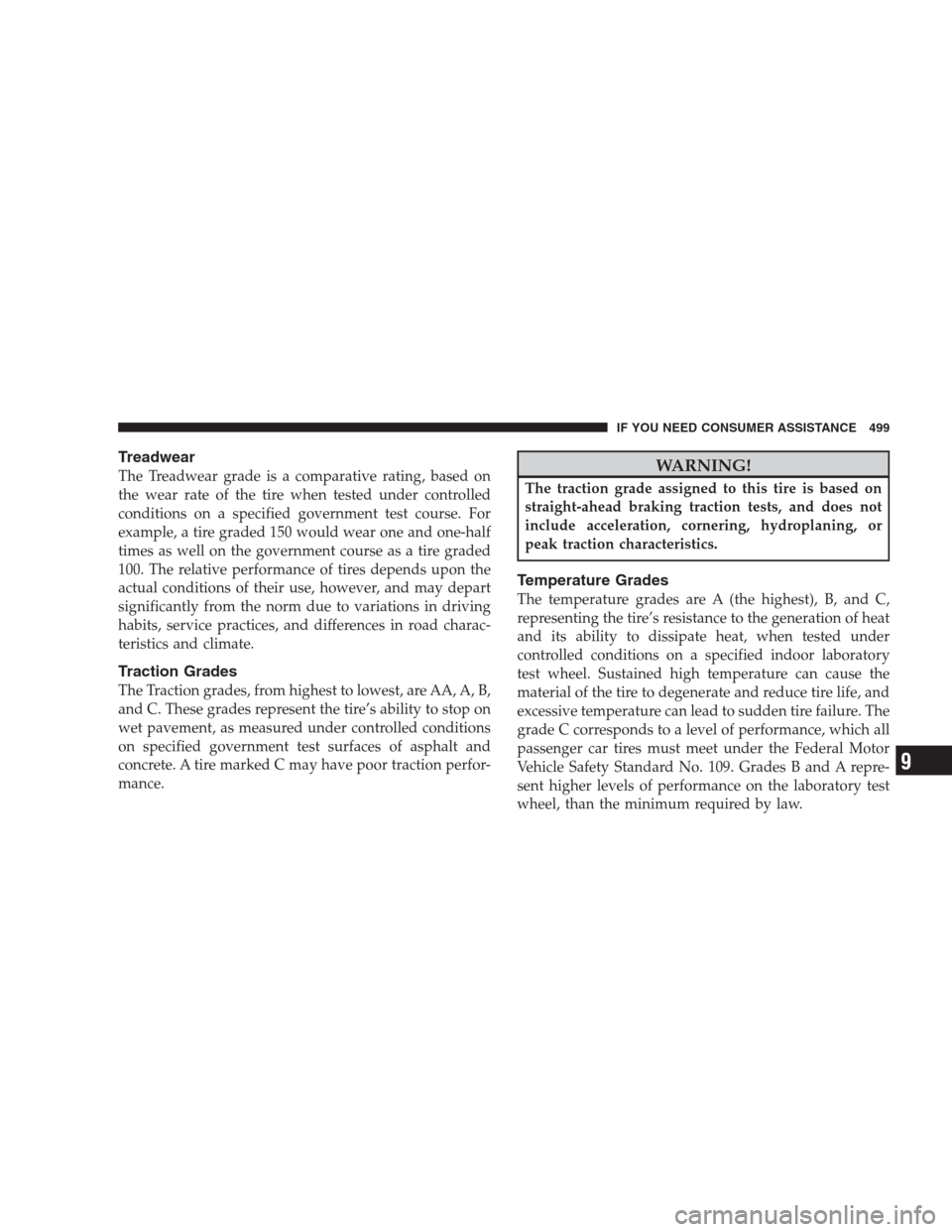
Treadwear
The Treadwear grade is a comparative rating, based on
the wear rate of the tire when tested under controlled
conditions on a specified government test course. For
example, a tire graded 150 would wear one and one-half
times as well on the government course as a tire graded
100. The relative performance of tires depends upon the
actual conditions of their use, however, and may depart
significantly from the norm due to variations in driving
habits, service practices, and differences in road charac-
teristics and climate.
Traction Grades
The Traction grades, from highest to lowest, are AA, A, B,
and C. These grades represent the tire’s ability to stop on
wet pavement, as measured under controlled conditions
on specified government test surfaces of asphalt and
concrete. A tire marked C may have poor traction perfor-
mance.
WARNING!
The traction grade assigned to this tire is based on
straight-ahead braking traction tests, and does not
include acceleration, cornering, hydroplaning, or
peak traction characteristics.
Temperature Grades
The temperature grades are A (the highest), B, and C,
representing the tire’s resistance to the generation of heat
and its ability to dissipate heat, when tested under
controlled conditions on a specified indoor laboratory
test wheel. Sustained high temperature can cause the
material of the tire to degenerate and reduce tire life, and
excessive temperature can lead to sudden tire failure. The
grade C corresponds to a level of performance, which all
passenger car tires must meet under the Federal Motor
Vehicle Safety Standard No. 109. Grades B and A repre-
sent higher levels of performance on the laboratory test
wheel, than the minimum required by law.
IF YOU NEED CONSUMER ASSISTANCE 499
9
Page 508 of 526
Daytime Brightness, Interior Lights........... 143
Daytime Running Lights................... 140
Dealer Service.......................... 422
Deck Lid, Emergency Release................ 40
Deck Lid, Power Release................... 39
Defroster, Rear Window................... 198
Defroster, Windshield................78,295,301
Delay (Intermittent) Wipers................. 144
Diagnostic System, Onboard................ 420
Dimmer Switch, Headlight................. 142
Dipsticks
Oil (Engine).......................423,424
Power Steering........................ 332
Disabled Vehicle Towing................... 412
Disposal
Antifreeze (Engine Coolant)............... 439
Engine Oil........................... 426
Door Locks............................. 28
Door Locks, Automatic.................... 30Door Opener, Garage..................... 181
Driving
On Slippery Surfaces................... 327
Through Flowing, Rising, or Shallow
Standing Water........................ 328
DVD Player (Video Entertainment System™).... 288
Electric Rear Window Defrost............... 198
Electric Remote Mirrors.................... 88
Electrical Power Outlets................... 191
Electronic Brake Control System............. 336
Anti-Lock Brake System................. 336
Brake Assist System.................... 337
Electronic Stability Program............... 338
Traction Control System................. 337
Electronic Power Distribution Center (Fuses).... 449
Electronic Speed Control (Cruise Control)....150,154
Electronic Stability Program (ESP)............ 338
Electronic Throttle Control Warning Light...... 216
506 INDEX
Page 514 of 526
Bulb Replacement...................456,458
Courtesy/Reading...................142,181
Cruise.............................. 208
Daytime Running...................... 140
Dimmer Switch, Headlight.............140,142
Electronic Stability Program (ESP) Indicator . . . 341
Electronic Throttle Control Warning......... 216
Engine Temperature Warning.............. 211
Exterior.............................. 78
Fog .............................140,208
Hazard Warning Flasher................. 396
Headlight Switch...................... 136
Headlights........................136,460
Headlights On Reminder................. 140
Headlights On With Wipers............137,145
High Beam........................142,215
High Beam Indicator.................... 215
High Beam/Low Beam Select............. 142
Illuminated Entry....................... 20Instrument Cluster..................136,208
Intensity Control...................... 143
Interior..........................142,181
License............................. 467
Lights On Reminder.................... 140
Low Fuel............................ 208
LowTire ............................ 217
Malfunction Indicator (Check Engine)........ 219
Map Reading......................142,181
Oil Pressure.......................... 219
Parade Mode (Daytime Brightness)......... 143
Passing............................. 142
Reading..........................142,181
Seat Belt Reminder..................... 216
Service...........................456,458
Service Engine Soon (Malfunction Indicator) . . . 219
SmartBeams.......................... 138
Tire Pressure Monitoring (TPMS)........217,361
Traction Control....................... 341
512 INDEX