Page 443 of 526
WARNING!
Riding the brakes can lead to brake failure and
possibly an accident. Driving with your foot resting
or riding on the brake pedal can result in abnormally
high brake temperatures, excessive lining wear, and
possible brake damage. You wouldn’t have your full
braking capacity in an emergency.
Master Cylinder - Brake Fluid Level Check
Check the fluid level in the master cylinder immediately
if the brake system warning light indicates system fail-
ure.
Check the fluid level in the master cylinder when per-
forming underhood services.
Clean the top of the master cylinder area before removing
the cap. Add fluid to bring the level up to the top of the
“FULL” mark on the side of the master cylinder reservoir.Add enough fluid to bring the level up to the require-
ments described on the brake fluid reservoir. With disc
brakes, fluid level can be expected to fall as the brake
pads wear. However, low fluid level may be caused by a
leak and a checkup may be needed.
Use only manufacturer’s recommended brake fluid. Re-
fer to “Fluids, Lubricants, and Genuine Parts” in this
section for the correct fluid type.WARNING!
•Overfilling the brake fluid reservoir can result in
spilling brake fluid on hot engine parts and the
brake fluid catching fire.
•Use of a brake fluid that may have a lower initial
boiling point, or is unidentified as to specification,
may result in sudden brake failure during hard
prolonged braking. You could have an accident.
MAINTAINING YOUR VEHICLE 441
7
Page 445 of 526
Fluid and Filter Changes
Refer to the “Maintenance Schedule” in Section 8 for
proper maintenance intervals.
If the transmission is disassembled for any reason, the
fluid and filter should be changed.
Selection of Lubricant
It is important that the proper lubricant is used in the
transmission to assure optimum transmission perfor-
mance. Use only manufacturer ’s recommended transmis-
sion fluid. Refer to “Fluids, Lubricants, and Genuine
Parts” in this section for the correct fluid type. It is
important that the transmission fluid be maintained at
the prescribed level using the recommended fluid. No
chemical flushes should be used in any transmission;
only the approved lubricant may be used.
Special Additives
Automatic Transmission Fluid (ATF) is an engineered
product and its performance may be impaired by supple-
mental additives. Therefore, do not add any fluid addi-
tives to the transmission. The only exception to this
policy is the use of special dyes to aid in detecting fluid
leaks. In addition, avoid using transmission sealers as
they may adversely affect seals.
All Wheel Drive (AWD) — If Equipped
The all wheel drive system consists of a transfer case and
front differential. The exterior surface of these compo-
nents should be inspected for evidence of fluid leaks.
Confirmed leaks should be repaired as soon as possible.
The transfer case fluid fill/inspection plug is located in
the middle of the rear housing. To inspect the transfer
case fluid level, remove the fill/inspection plug. The
fluid level should be even with the bottom of the hole.
Use this plug to add fluid as required.
MAINTAINING YOUR VEHICLE 443
7
Page 451 of 526
FUSES
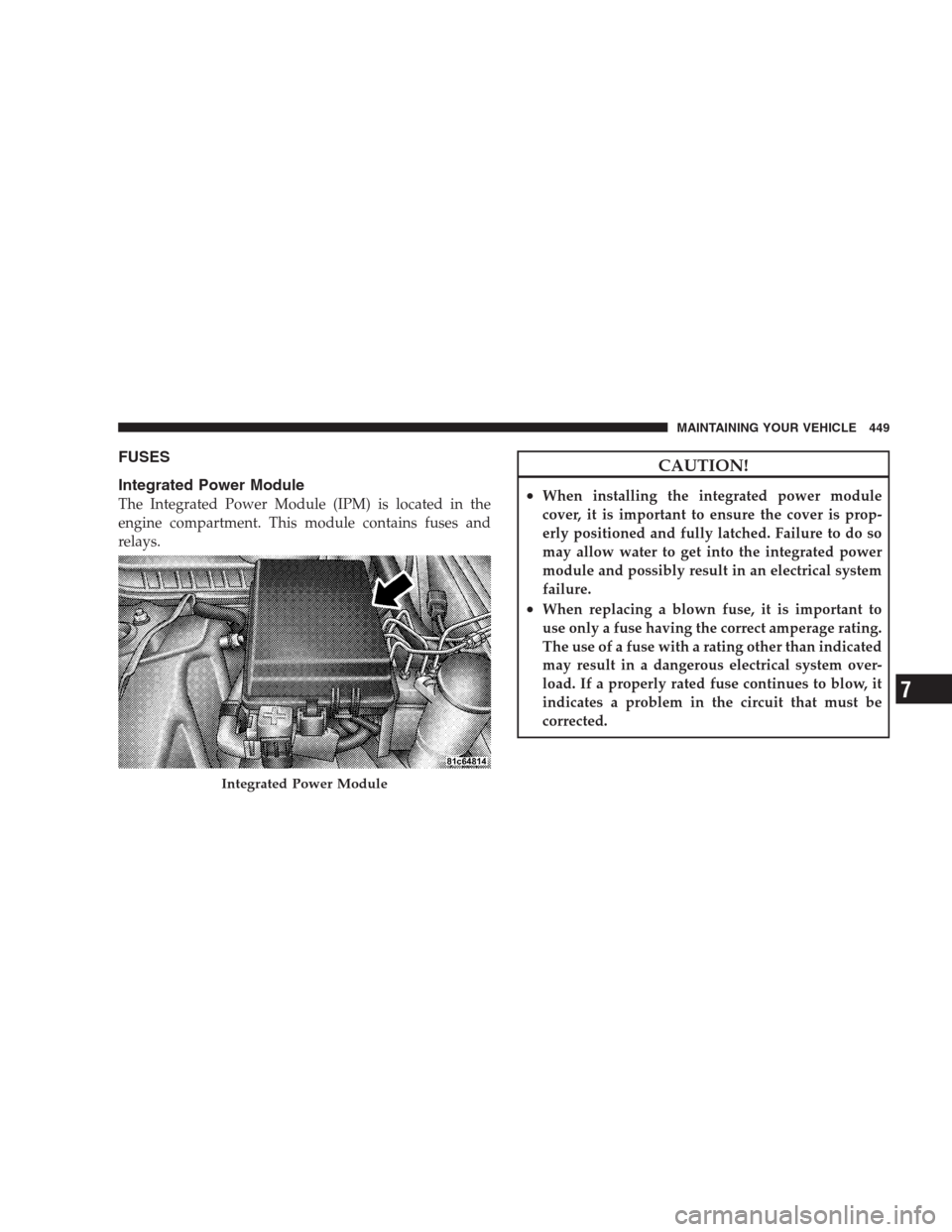
Integrated Power Module
The Integrated Power Module (IPM) is located in the
engine compartment. This module contains fuses and
relays.
CAUTION!
•When installing the integrated power module
cover, it is important to ensure the cover is prop-
erly positioned and fully latched. Failure to do so
may allow water to get into the integrated power
module and possibly result in an electrical system
failure.
•When replacing a blown fuse, it is important to
use only a fuse having the correct amperage rating.
The use of a fuse with a rating other than indicated
may result in a dangerous electrical system over-
load. If a properly rated fuse continues to blow, it
indicates a problem in the circuit that must be
corrected.
Integrated Power Module
MAINTAINING YOUR VEHICLE 449
7
Page 470 of 526
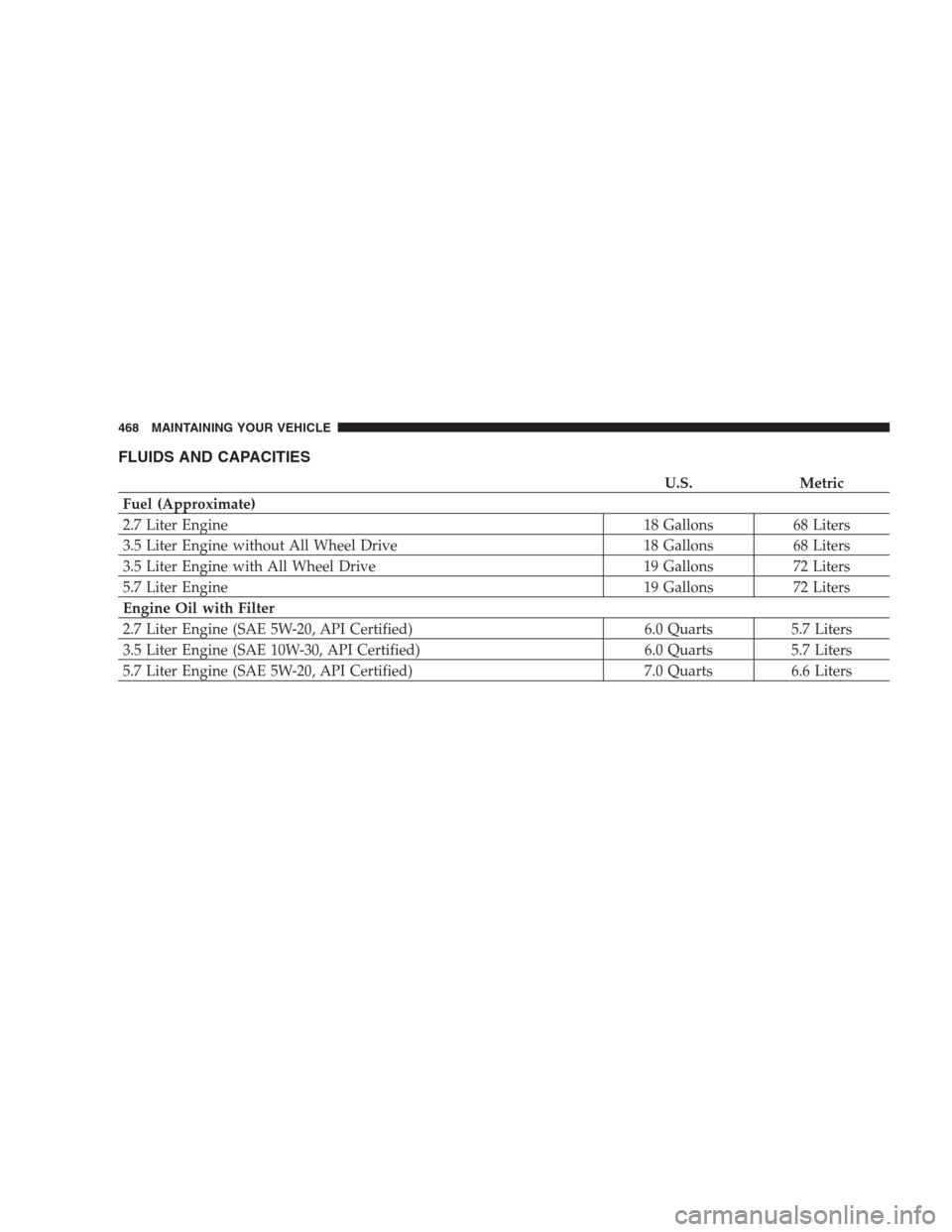
FLUIDS AND CAPACITIES
U.S. Metric
Fuel (Approximate)
2.7 Liter Engine 18 Gallons 68 Liters
3.5 Liter Engine without All Wheel Drive 18 Gallons 68 Liters
3.5 Liter Engine with All Wheel Drive 19 Gallons 72 Liters
5.7 Liter Engine 19 Gallons 72 Liters
Engine Oil with Filter
2.7 Liter Engine (SAE 5W-20, API Certified) 6.0 Quarts 5.7 Liters
3.5 Liter Engine (SAE 10W-30, API Certified) 6.0 Quarts 5.7 Liters
5.7 Liter Engine (SAE 5W-20, API Certified) 7.0 Quarts 6.6 Liters
468 MAINTAINING YOUR VEHICLE
Page 471 of 526
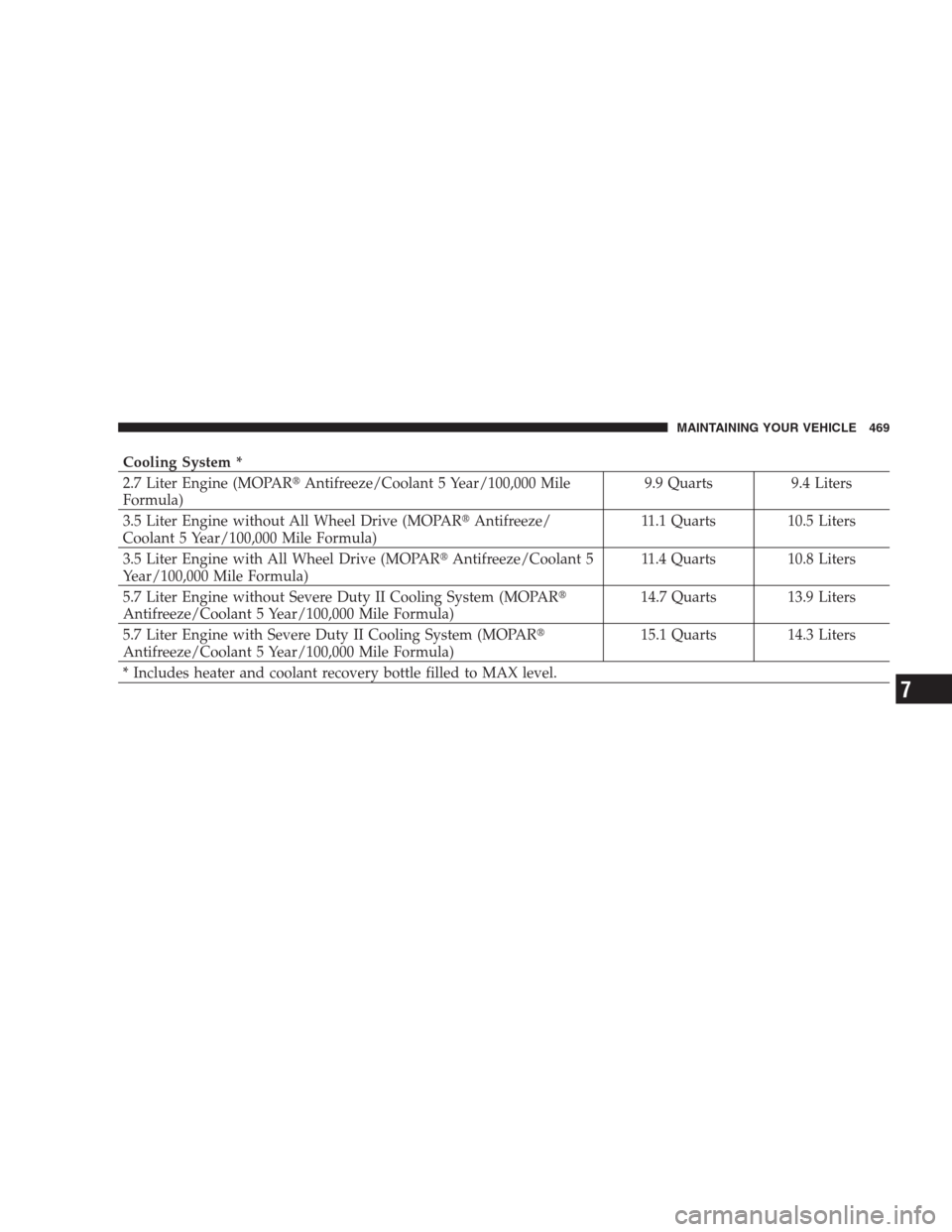
Cooling System *
2.7 Liter Engine (MOPAR�Antifreeze/Coolant 5 Year/100,000 Mile
Formula)9.9 Quarts 9.4 Liters
3.5 Liter Engine without All Wheel Drive (MOPAR�Antifreeze/
Coolant 5 Year/100,000 Mile Formula)11.1 Quarts 10.5 Liters
3.5 Liter Engine with All Wheel Drive (MOPAR�Antifreeze/Coolant 5
Year/100,000 Mile Formula)11.4 Quarts 10.8 Liters
5.7 Liter Engine without Severe Duty II Cooling System (MOPAR�
Antifreeze/Coolant 5 Year/100,000 Mile Formula)14.7 Quarts 13.9 Liters
5.7 Liter Engine with Severe Duty II Cooling System (MOPAR�
Antifreeze/Coolant 5 Year/100,000 Mile Formula)15.1 Quarts 14.3 Liters
* Includes heater and coolant recovery bottle filled to MAX level.
MAINTAINING YOUR VEHICLE 469
7
Page 472 of 526
FLUIDS, LUBRICANTS, AND GENUINE PARTS
Engine
Component Fluid, Lubricant, or Genuine Part
Engine Coolant MOPAR�Antifreeze/Coolant 5 Year/100,000 Mile Formula HOAT (Hybrid
Organic Additive Technology) or equivalent
Engine Oil (2.7L Engine) Use API Certified SAE 5W-20 Engine Oil, meeting the requirements of
Chrysler Material Standard MS-6395. Refer to the engine oil fill cap for cor-
rect SAE grade.
Engine Oil (3.5L Engine) Use API Certified SAE 10W-30 Engine Oil, meeting the requirements of
Chrysler Material Standard MS-6395. Refer to the engine oil fill cap for cor-
rect SAE grade.
Engine Oil (5.7L Engine) Use API Certified SAE 5W-20 Engine Oil, meeting the requirements of
Chrysler Material Standard MS-6395. Refer to the engine oil fill cap for cor-
rect SAE grade.
Spark Plugs (2.7L Engine) TE10MCC5 (Gap 0.050 in [1.27 mm])
Spark Plugs (3.5L Engine) ZFR5LP–13G (Gap 0.050 in [1.27 mm])
Spark Plugs (5.7L Engine) LZFR5C–11 (Gap 0.043 in [1.1 mm])
470 MAINTAINING YOUR VEHICLE
Page 473 of 526
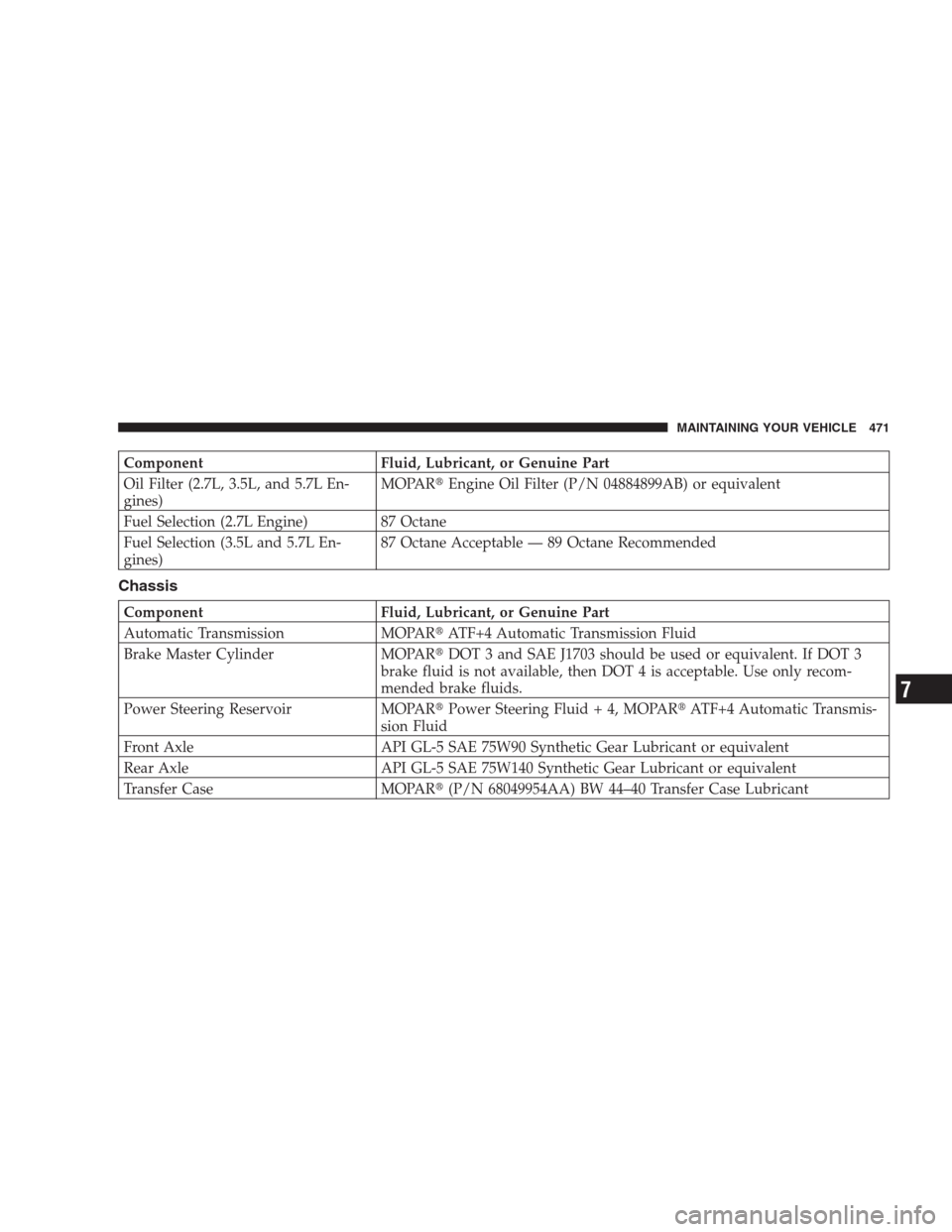
Component Fluid, Lubricant, or Genuine Part
Oil Filter (2.7L, 3.5L, and 5.7L En-
gines)MOPAR�Engine Oil Filter (P/N 04884899AB) or equivalent
Fuel Selection (2.7L Engine) 87 Octane
Fuel Selection (3.5L and 5.7L En-
gines)87 Octane Acceptable — 89 Octane Recommended
Chassis
Component Fluid, Lubricant, or Genuine Part
Automatic Transmission MOPAR�ATF+4 Automatic Transmission Fluid
Brake Master Cylinder MOPAR�DOT 3 and SAE J1703 should be used or equivalent. If DOT 3
brake fluid is not available, then DOT 4 is acceptable. Use only recom-
mended brake fluids.
Power Steering Reservoir MOPAR�Power Steering Fluid + 4, MOPAR�ATF+4 Automatic Transmis-
sion Fluid
Front Axle API GL-5 SAE 75W90 Synthetic Gear Lubricant or equivalent
Rear Axle API GL-5 SAE 75W140 Synthetic Gear Lubricant or equivalent
Transfer Case MOPAR�(P/N 68049954AA) BW 44–40 Transfer Case Lubricant
MAINTAINING YOUR VEHICLE 471
7
Page 476 of 526
EMISSIONS CONTROL SYSTEM MAINTENANCE
The Scheduled Maintenance services listed inbold type
must be done at the times or mileages specified to ensure
the continued proper functioning of the emissions control
system. These and all other maintenance services in-
cluded in this manual, should be done to provide best
vehicle performance and reliability. More frequent main-
tenance may be needed for vehicles in severe operating
conditions, such as dusty areas and very short trip
driving.
Inspection and service should also be done anytime a
malfunction is suspected.
NOTE:Maintenance, replacement or repair of the emis-
sions control devices and systems on your vehicle may be
performed by any automotive repair establishment or
individual using any automotive part that has been
certified pursuant to U.S. EPA or in the State of Califor-
nia, California Air Resources Board regulations.
MAINTENANCE SCHEDULE
The oil change indicator system will remind you that it is
time to take your vehicle in for scheduled maintenance.
On Electronic Vehicle Information Center (EVIC)
equipped vehicles, “Oil Change Required” will be dis-
played in the EVIC and a single chime will sound,
indicating that an oil change is necessary.
On Non-EVIC equipped vehicles, “Change Oil” will flash
in the instrument cluster odometer and a single chime
will sound, indicating that an oil change is necessary.
Based on engine operation conditions, the oil change
indicator message will illuminate. This means that ser-
vice is required for your vehicle. Have your vehicle
serviced as soon as possible, within the next 500 miles
(805 km).
474 MAINTENANCE SCHEDULES
8
M
A
I
N
T
E
N
A
N
C
E
S
C
H
E
D
U
L
E
S