2009 CHEVROLET TRAVERSE brakes
[x] Cancel search: brakesPage 310 of 422
Brake Adjustment
Every time the brakes are applied,
with or without the vehicle moving,
the brakes adjust for wear.
Replacing Brake System Parts
The braking system on a vehicle is
complex. Its many parts have to be
of top quality and work well together
if the vehicle is to have really good
braking. The vehicle was designed
and tested with top-quality brake
parts. When parts of the braking
system are replaced — for example,
when the brake linings wear down
and new ones are installed — be
sure to get new approved
replacement parts. If this is not
done, the brakes might not work
properly. For example, if someone
puts in brake linings that are
wrong for the vehicle, the balance
between the front and rear brakes
can change — for the worse. The
braking performance expected can
change in many other ways if the
wrong replacement brake parts are
installed.
Battery
This vehicle has a maintenance free
battery. When it is time for a new
battery, see your dealer/retailer for
one that has the replacement
number shown on the original
battery’s label.
For battery replacement, see your
dealer/retailer or the service manual.
To purchase a service manual,
seeService Publications Ordering
Information on page 7-15.
Warning:Battery posts, terminals,
and related accessories contain
lead and lead compounds,
chemicals known to the State of
California to cause cancer and
reproductive harm. Wash hands
after handling.
Vehicle Storage
{CAUTION
Batteries have acid that can burn
you and gas that can explode.
You can be badly hurt if you are
not careful. SeeJump Starting
on page 5-29for tips on working
around a battery without
getting hurt.
Infrequent Usage: If the vehicle is
driven infrequently, remove the
black, negative (−) cable from the
battery. This helps keep the battery
from running down.
Extended Storage: For extended
storage of the vehicle, remove the
black, negative (−) cable from the
battery or use a battery trickle
charger. This helps maintain the
charge of the battery over an
extended period of time.
5-28 Service and Appearance Care
Page 321 of 422
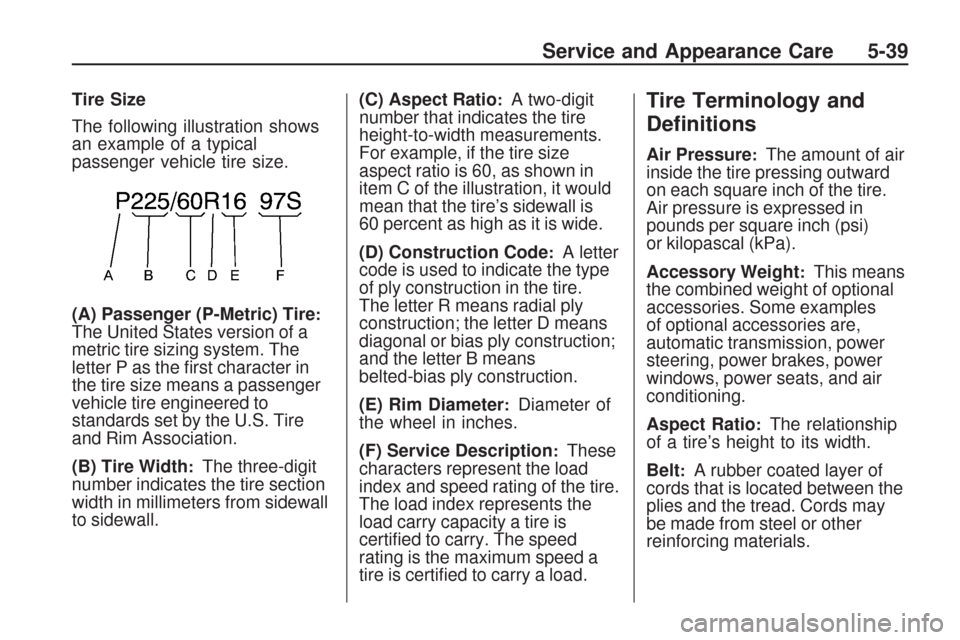
Tire Size
The following illustration shows
an example of a typical
passenger vehicle tire size.
(A) Passenger (P-Metric) Tire
:The United States version of a
metric tire sizing system. The
letter P as the rst character in
the tire size means a passenger
vehicle tire engineered to
standards set by the U.S. Tire
and Rim Association.
(B) Tire Width
:The three-digit
number indicates the tire section
width in millimeters from sidewall
to sidewall.(C) Aspect Ratio
:A two-digit
number that indicates the tire
height-to-width measurements.
For example, if the tire size
aspect ratio is 60, as shown in
item C of the illustration, it would
mean that the tire’s sidewall is
60 percent as high as it is wide.
(D) Construction Code
:A letter
code is used to indicate the type
of ply construction in the tire.
The letter R means radial ply
construction; the letter D means
diagonal or bias ply construction;
and the letter B means
belted-bias ply construction.
(E) Rim Diameter
:Diameter of
the wheel in inches.
(F) Service Description
:These
characters represent the load
index and speed rating of the tire.
The load index represents the
load carry capacity a tire is
certied to carry. The speed
rating is the maximum speed a
tire is certied to carry a load.
Tire Terminology and
Denitions
Air Pressure:The amount of air
inside the tire pressing outward
on each square inch of the tire.
Air pressure is expressed in
pounds per square inch (psi)
or kilopascal (kPa).
Accessory Weight
:This means
the combined weight of optional
accessories. Some examples
of optional accessories are,
automatic transmission, power
steering, power brakes, power
windows, power seats, and air
conditioning.
Aspect Ratio
:The relationship
of a tire’s height to its width.
Belt
:A rubber coated layer of
cords that is located between the
plies and the tread. Cords may
be made from steel or other
reinforcing materials.
Service and Appearance Care 5-39
Page 334 of 422
Non-TPC Spec rated tires may
give a low-pressure warning that
is higher or lower than the proper
warning level you would get with
TPC Spec rated tires. SeeTire
Pressure Monitor System on
page 5-43.
Your vehicle’s original equipment
tires are listed on the Tire and
Loading Information Label.
SeeLoading the Vehicle on
page 4-16, for more information
about the Tire and Loading
Information Label and its location
on your vehicle.
Different Size Tires and
Wheels
If you add wheels or tires that are a
different size than your original
equipment wheels and tires, this
could affect the way your vehicle
performs, including its braking, ride
and handling characteristics,
stability, and resistance to rollover.Additionally, if your vehicle has
electronic systems such as anti-lock
brakes, rollover airbags, traction
control, and electronic stability
control, the performance of these
systems can be affected.
{CAUTION
If you add different sized wheels,
your vehicle may not provide an
acceptable level of performance
and safety if tires not
recommended for those wheels
are selected. You may increase
the chance that you will crash and
suffer serious injury. Only use GM
specic wheel and tire systems
developed for your vehicle, and
have them properly installed by a
GM certied technician.
SeeBuying New Tires on page 5-50
andAccessories and Modifications
on page 5-3for additional
information.
Uniform Tire Quality
Grading
Quality grades can be found
where applicable on the tire
sidewall between tread shoulder
and maximum section width.
For example:
Treadwear 200 Traction AA
Temperature A
The following information relates
to the system developed by the
United States National Highway
Traffic Safety Administration
(NHTSA), which grades tires
by treadwear, traction, and
temperature performance.
This applies only to vehicles
sold in the United States.
5-52 Service and Appearance Care
Page 337 of 422
Notice:The wrong wheel can
also cause problems with bearing
life, brake cooling, speedometer
or odometer calibration, headlamp
aim, bumper height, vehicle
ground clearance, and tire or tire
chain clearance to the body and
chassis.
SeeChanging a Flat Tire on
page 5-65for more information.
Used Replacement Wheels
{CAUTION
Putting a used wheel on the
vehicle is dangerous. You cannot
know how it has been used or
how far it has been driven. It
could fail suddenly and cause a
crash. If you have to replace a
wheel, use a new GM original
equipment wheel.
Tire Chains
{CAUTION
Do not use tire chains. There is not
enough clearance. Tire chains
used on a vehicle without the
proper amount of clearance can
cause damage to the brakes,
suspension or other vehicle parts.
The area damaged by the tire
chains could cause you to lose
control of the vehicle and you or
others may be injured in a crash.
(Continued)
CAUTION (Continued)
Use another type of traction
device only if its manufacturer
recommends it for use on the
vehicle and tire size combination
and road conditions. Follow that
manufacturer’s instructions. To
help avoid damage to the vehicle,
drive slowly, readjust or remove
the device if it is contacting the
vehicle, and do not spin the
vehicle’s wheels. If you do nd
traction devices that will t, install
them on the front tires.
Service and Appearance Care 5-55
Page 407 of 422

Service Publications
Ordering Information
Service Manuals
Service Manuals have the diagnosis
and repair information on engines,
transmission, axle suspension,
brakes, electrical, steering, body, etc.
Service Bulletins
Service Bulletins give additional
technical service information needed
to knowledgeably service General
Motors cars and trucks. Each bulletin
contains instructions to assist in
the diagnosis and service of your
vehicle.
Owner Information
Owner publications are written
specically for owners and intended
to provide basic operational
information about the vehicle.The owner manual includes the
Maintenance Schedule for all
models.
In-Portfolio: Includes a Portfolio,
Owner Manual, and Warranty
Booklet.
RETAIL SELL PRICE:
$35.00 (U.S.) plus processing fee
Without Portfolio: Owner
Manual only.
RETAIL SELL PRICE:
$25.00 (U.S.) plus processing fee
Current and Past Model
Order Forms
Technical Service Bulletins and
Manuals are available for current
and past model GM vehicles.
To request an order form, specify
year and model name of the vehicle.ORDER TOLL FREE:
1-800-551-4123 Monday-Friday
8:00 AM - 6:00 PM Eastern Time
For Credit Card Orders Only
(VISA-MasterCard-Discover), visit
Helm, Inc. on the World Wide
Web at: helminc.com
Or you can write to:
Helm, Incorporated
P.O. Box 07130
Detroit, MI 48207
Prices are subject to change
without notice and without incurring
obligation. Allow ample time for
delivery.
Note to Canadian Customers: All
listed prices are quoted in U.S.
funds. Canadian residents are to
make checks payable in U.S. funds.
Customer Assistance Information 7-15
Page 412 of 422

B
Battery...............................5-28
Electric Power
Management.................3-15
Run-Down Protection.........3-16
Belt Routing, Engine.............6-15
Blind Spot Mirrors................2-34
Bluetooth
®.........................3-103
Brake
Emergencies...................... 4-5
Brake Fluid.........................5-25
Brakes...............................5-25
Antilock............................. 4-4
Parking...........................2-27
System Warning Light.......3-36
Braking................................ 4-3
Braking in Emergencies.......... 4-5
Break-In, New Vehicle..........2-20
Bulb Replacement................5-34
Fog Lamp ........................3-13
Halogen Bulbs..................5-33
Headlamp Aiming..............5-33
Headlamps......................5-33
Taillamps, Turn Signal,
Stoplamps and
Sidemarker Lamps.........5-33
Buying New Tires.................5-50
C
Calibration..........................3-54
California
Perchlorate Materials
Requirements................. 5-4
California Fuel....................... 5-5
California Proposition
65 Warning........................ 5-4
Camera, Rear Vision............2-38
Canadian Owners..................... ii
Capacities and
Specications...................5-92
Carbon Monoxide.................2-11
Engine Exhaust................2-30
Liftgate............................2-10
Winter Driving..................4-14
Care of
Safety Belts.....................5-80
Cargo
Tie Downs .......................2-55
Cargo Cover.......................2-55
Cargo Management System . . . 2-55
CD, MP3 ....................3-92, 3-96
Center Console Storage........2-52
Chains, Tire........................5-55
Charging System Light..........3-34Check
Engine Lamp...................3-39
Checking Things Under
the Hood ........................... 5-9
Chemical Paint Spotting........5-84
Child Restraints
Infants and Young
Children.......................1-29
Lower Anchors and Tethers
for Children..................1-35
Older Children..................1-27
Securing a Child Restraint
in a Rear Seat Position....1-41
Securing a Child Restraint
in the Right Front Seat
Position.......................1-43
Systems..........................1-32
Where to Put the
Restraint......................1-33
Circuit Breakers...................5-86
Cleaning
Aluminum or Chrome-Plated
Wheels........................5-83
Exterior Lamps/Lenses......5-81
Fabric/Carpet...................5-79
Finish Care......................5-81
i-2 INDEX