2009 CHEVROLET TRAVERSE lock
[x] Cancel search: lockPage 271 of 422

Notice:If the vehicle is
towed without performing
each of the steps listed under
“Dinghy Towing,” the automatic
transmission could be damaged.
Be sure to follow all steps of the
dinghy towing procedure prior to
and after towing the vehicle.
Notice:If 65 mph (105 km/h) is
exceeded while towing the
vehicle, it could be damaged.
Never exceed 65 mph (105 km/h)
while towing the vehicle.Once the destination is reached:
1. Set the parking brake.
2. Reinstall the 50 amp BATT1 fuse
to the underhood fuse block.
3. Shift the transmission to P (Park),
turn the ignition to LOCK/OFF
and remove the key from
the ignition.
4. Disconnect the vehicle from the
towing vehicle.
Notice:Do not tow a vehicle
with the front drive wheels on the
ground if one of the front tires
is a compact spare tire. Towing
with two different tire sizes on the
front of the vehicle can cause
severe damage to the
transmission.Dolly Towing (All-Wheel-Drive
Vehicles)
All-wheel-drive vehicles must not be
towed with two wheels on the
ground. To properly tow these
vehicles, they should be placed on
a platform trailer with all four
wheels off of the ground or dinghy
towed from the front.
Driving Your Vehicle 4-23
Page 278 of 422
Safety Chains
Always attach chains between the
vehicle and the trailer. Cross the
safety chains under the tongue
of the trailer to help prevent the
tongue from contacting the road
if it becomes separated from the
hitch. Instructions about safety
chains may be provided by the
hitch manufacturer or by the
trailer manufacturer. Follow the
manufacturer’s recommendation for
attaching safety chains and do not
attach them to the bumper. Always
leave just enough slack so the rig
can turn. Never allow safety chains
to drag on the ground.
Trailer Brakes
A loaded trailer that weighs more
than 1,000 lbs (450 kg) needs to
have its own brake system that
is adequate for the weight of the
trailer. Be sure to read and follow the
instructions for the trailer brakes so
they are installed, adjusted and
maintained properly.
Because the vehicle has antilock
brakes, do not try to tap into the
vehicle’s hydraulic brake system.
If you do, both brake systems will
not work well, or at all.
Driving with a Trailer
Towing a trailer requires a certain
amount of experience. Get to know
the rig before setting out for the open
road. Get acquainted with the feel of
handling and braking with the added
weight of the trailer. And always keep
in mind that the vehicle you are
driving is now longer and not as
responsive as the vehicle is by itself.Before starting, check all trailer
hitch parts and attachments, safety
chains, electrical connectors, lamps,
tires and mirror adjustments. If the
trailer has electric brakes, start the
vehicle and trailer moving and then
apply the trailer brake controller by
hand to be sure the brakes are
working. This checks the electrical
connection at the same time.
During the trip, check occasionally to
be sure that the load is secure, and
that the lamps and any trailer brakes
are still working.
Following Distance
Stay at least twice as far behind the
vehicle ahead as you would when
driving the vehicle without a trailer.
This can help to avoid situations that
require heavy braking and sudden
turns.
4-30 Driving Your Vehicle
Page 284 of 422

Different Size Tires and
Wheels.............................5-52
Uniform Tire Quality
Grading............................5-52
Wheel Alignment and Tire
Balance............................5-54
Wheel Replacement.............5-54
Tire Chains.........................5-55
If a Tire Goes Flat...............5-56
Tire Sealant and
Compressor Kit..................5-57
Tire Sealant and
Compressor Kit Storage......5-64
Changing a Flat Tire............5-65
Removing the Spare Tire
and Tools.........................5-66
Removing the Flat Tire
and Installing the
Spare Tire........................5-68
Secondary Latch System......5-72
Storing a Flat or Spare
Tire and Tools...................5-74
Compact Spare Tire.............5-77
Appearance CareInterior Cleaning..................5-78
Fabric/Carpet......................5-79
Leather..............................5-80Instrument Panel, Vinyl,
and Other Plastic
Surfaces...........................5-80
Care of Safety Belts............5-80
Weatherstrips......................5-81
Washing Your Vehicle..........5-81
Cleaning Exterior Lamps/
Lenses.............................5-81
Finish Care.........................5-81
Windshield, Backglass, and
Wiper Blades....................5-82
Aluminum or Chrome-Plated
Wheels and Trim................5-83
Tires..................................5-83
Sheet Metal Damage...........5-84
Finish Damage....................5-84
Underbody Maintenance.......5-84
Chemical Paint Spotting........5-84
Vehicle IdenticationVehicle Identication
Number (VIN)....................5-85
Service Parts Identication
Label...............................5-85
Electrical SystemHigh Voltage Devices and
Wiring..............................5-85
Add-On Electrical
Equipment........................5-86
Windshield Wiper Fuses.......5-86
Power Windows and Other
Power Options...................5-86
Fuses and Circuit Breakers. . .5-86
Instrument Panel
Fuse Block.......................5-86
Underhood Fuse Block.........5-88
Capacities and SpecicationsCapacities and
Specications....................5-92
5-2 Service and Appearance Care
Page 285 of 422
Service
For service and parts needs, visit
your dealer/retailer. You will receive
genuine GM parts and GM-trained
and supported service people.
Genuine GM parts have one
of these marks:
Accessories and
Modications
When non-dealer/non-retailer
accessories are added to the vehicle,
they can affect vehicle performance
and safety, including such things
as airbags, braking, stability, ride
and handling, emissions systems,
aerodynamics, durability, and
electronic systems like antilock
brakes, traction control, and stability
control. Some of these accessories
could even cause malfunction or
damage not covered by the vehicle
warranty.
Damage to vehicle components
resulting from the installation or use
of non-GM certied parts, including
control module modications, arenot covered under the terms of the
vehicle warranty and may affect
remaining warranty coverage for
affected parts.
GM Accessories are designed to
complement and function with other
systems on the vehicle. Your GM
dealer/retailer can accessorize
the vehicle using genuine GM
Accessories. When you go to your
GM dealer/retailer and ask for
GM Accessories, you will know that
GM-trained and supported service
technicians will perform the
work using genuine GM
Accessories.
Also, seeAdding Equipment to Your
Airbag-Equipped Vehicle on
page 1-58.
Service and Appearance Care 5-3
Page 289 of 422
Filling the Tank
{CAUTION
Fuel vapor burns violently and a
fuel re can cause bad injuries.
To help avoid injuries to you and
others, read and follow all the
instructions on the pump island.
Turn off the engine when you are
refueling. Do not smoke if you are
near fuel or refueling the vehicle.
Do not use cellular phones. Keep
sparks, ames, and smoking
materials away from fuel. Do not
leave the fuel pump unattended
when refueling the vehicle. This is
against the law in some places.
Do not re-enter the vehicle while
pumping fuel. Keep children away
from the fuel pump; never let
children pump fuel.
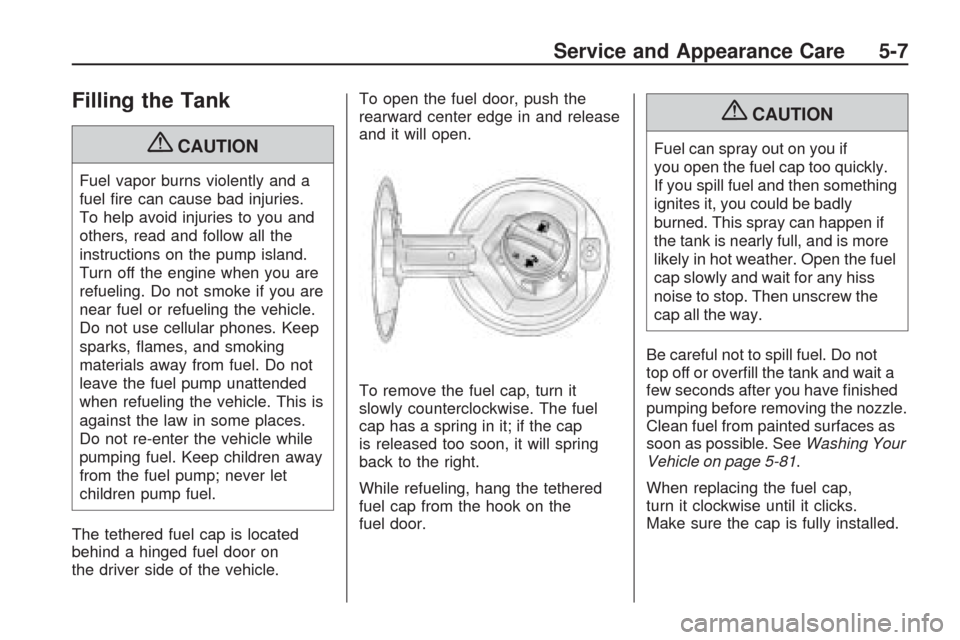
The tethered fuel cap is located
behind a hinged fuel door on
the driver side of the vehicle.To open the fuel door, push the
rearward center edge in and release
and it will open.
To remove the fuel cap, turn it
slowly counterclockwise. The fuel
cap has a spring in it; if the cap
is released too soon, it will spring
back to the right.
While refueling, hang the tethered
fuel cap from the hook on the
fuel door.
{CAUTION
Fuel can spray out on you if
you open the fuel cap too quickly.
If you spill fuel and then something
ignites it, you could be badly
burned. This spray can happen if
the tank is nearly full, and is more
likely in hot weather. Open the fuel
cap slowly and wait for any hiss
noise to stop. Then unscrew the
cap all the way.
Be careful not to spill fuel. Do not
top off or overll the tank and wait a
few seconds after you have nished
pumping before removing the nozzle.
Clean fuel from painted surfaces as
soon as possible. SeeWashing Your
Vehicle on page 5-81.
When replacing the fuel cap,
turn it clockwise until it clicks.
Make sure the cap is fully installed.
Service and Appearance Care 5-7
Page 293 of 422

A. Radiator Pressure Cap. See
Cooling System on page 5-17.
B. Engine Coolant Recovery Cap.
SeeCooling System on
page 5-17.
C. Remote Negative (−) Terminal.
SeeJump Starting on page 5-29.
D.Underhood Fuse Block on
page 5-88.
E. Remote Positive (+) Terminal.
SeeJump Starting on page 5-29.
F.Power Steering Fluid on
page 5-24.
G. Engine Oil Fill Cap. See “When
to Add Engine Oil” underEngine
Oil on page 5-11.H. Engine Oil Dipstick. See
“Checking Engine Oil” under
Engine Oil on page 5-11.
I. Automatic Transmission
Fluid Dipstick. See “Checking
the Fluid Level” underAutomatic
Transmission Fluid on page 5-16.
J. Brake Master Cylinder Reservoir.
See “Brake Fluid” underBrakes
on page 5-25.
K.Engine Air Cleaner/Filter on
page 5-15.
L. Windshield Washer Fluid
Reservoir. See “Adding Washer
Fluid” underWindshield
Washer Fluid on page 5-24.Engine Oil
Checking Engine Oil
It is a good idea to check the engine
oil level at each fuel ll. In order to
get an accurate reading, the oil must
be warm and the vehicle must be on
level ground.
The engine oil dipstick handle
is a yellow loop. SeeEngine
Compartment Overview on
page 5-10for the location of the
engine oil dipstick.
1. Turn off the engine and give the
oil several minutes to drain back
into the oil pan. If this is not
done, the oil dipstick might not
show the actual level.
2. Pull out the dipstick and clean it
with a paper towel or cloth, then
push it back in all the way.
Remove it again, keeping the tip
down, and check the level.
Service and Appearance Care 5-11
Page 296 of 422

When the system has calculated
that oil life has been diminished,
it indicates that an oil change is
necessary. A CHANGE ENGINE OIL
SOON message comes on. Change
the oil as soon as possible within
the next 600 miles (1 000 km). It is
possible that, if driving under the best
conditions, the oil life system might
not indicate that an oil change is
necessary for over a year. However,
the engine oil and lter must be
changed at least once a year and at
this time the system must be reset.
Your dealer/retailer has trained
service people who will perform this
work using genuine parts and reset
the system. It is also important to
check the oil regularly and keep it at
the proper level.If the system is ever reset
accidentally, the oil must be
changed at 3,000 miles (5 000 km)
since the last oil change. Remember
to reset the oil life system whenever
the oil is changed.
How to Reset the Engine Oil
Life System
The Engine Oil Life System
calculates when to change the
engine oil and lter based on vehicle
use. Whenever the oil is changed,
reset the system so it can calculate
when the next oil change is required.
If a situation occurs where the oil
is changed prior to a CHANGE
ENGINE OIL SOON message being
turned on, reset the system.If the vehicle does not have Driver
Information Center (DIC) buttons:
1. Turn the ignition to ON/RUN, with
the engine off. The vehicle must
be in P (Park) to access this
display. Press the trip odometer
reset stem until OIL LIFE
REMAINING displays.
2. Press and hold the trip
odometer reset stem until OIL
LIFE REMAINING shows 100%.
Three chimes sound and the
CHANGE ENGINE OIL SOON
message goes off.
3. Turn the key to LOCK/OFF.
If the CHANGE ENGINE OIL
SOON message comes back on
when the vehicle is started, the
engine oil life system has not
reset. Repeat the procedure.
5-14 Service and Appearance Care
Page 297 of 422

If the vehicle has Driver Information
Center (DIC) buttons:
1. Turn the ignition to ON/RUN,
with the engine off.
2. Press the vehicle information
button until OIL LIFE
REMAINING displays.
3. Press and hold the set/reset
button until 100% is displayed.
Three chimes sound and
the CHANGE ENGINE OIL
SOON message goes off.
4. Turn the key to LOCK/OFF.
If the CHANGE ENGINE OIL SOON
message comes back on when the
vehicle is started, the engine oil life
system has not reset. Repeat the
procedure.What to Do with Used Oil
Used engine oil contains certain
elements that can be unhealthy for
your skin and could even cause
cancer. Do not let used oil stay on
your skin for very long. Clean your
skin and nails with soap and water,
or a good hand cleaner. Wash or
properly dispose of clothing or rags
containing used engine oil. See the
manufacturer’s warnings about the
use and disposal of oil products.
Used oil can be a threat to the
environment. If you change your own
oil, be sure to drain all the oil from the
lter before disposal. Never dispose
of oil by putting it in the trash, pouring
it on the ground, into sewers, or into
streams or bodies of water. Recycle
it by taking it to a place that collects
used oil.
Engine Air Cleaner/Filter
When to Inspect the Engine
Air Cleaner/Filter
Inspect the air cleaner/lter at the
MaintenanceIIintervals and replace
it at the rst oil change after each
50,000 mile (80 000 km) interval.
SeeScheduled Maintenance on
page 6-3for more information. If you
are driving in dusty/dirty conditions,
inspect the lter at each engine oil
change.
SeeEngine Compartment Overview
on page 5-10for the location of
the engine air cleaner/lter.
How to Inspect the Engine Air
Cleaner/Filter
To inspect the air cleaner/lter,
remove the lter from the vehicle and
lightly shake the lter (away from
vehicle) to release loose dust and
dirt. If the lter remains caked with
dirt, a new lter is required.
Service and Appearance Care 5-15