Page 354 of 434
Wheel Alignment and Tire Balance
The tires and wheels on your vehicle were aligned and
balanced carefully at the factory to give you the longest
tire life and best overall performance. Adjustments to
wheel alignment and tire balancing will not be necessary
on a regular basis. However, if you notice unusual tire
wear or your vehicle pulling to one side or the other, the
alignment might need to be checked. If you notice your
vehicle vibrating when driving on a smooth road, the
tires and wheels might need to be rebalanced. See your
dealer/retailer for proper diagnosis.
Wheel Replacement
Replace any wheel that is bent, cracked, or badly
rusted or corroded. If wheel nuts keep coming loose, the
wheel, wheel bolts, and wheel nuts should be replaced.
If the wheel leaks air, replace it (except some aluminum
wheels, which can sometimes be repaired). See your
dealer/retailer if any of these conditions exist.
Your dealer/retailer will know the kind of wheel
you need.Each new wheel should have the same load-carrying
capacity, diameter, width, offset, and be mounted
the same way as the one it replaces.
If you need to replace any of your wheels, wheel
bolts or wheel nuts, replace them only with new GM
original equipment parts. This way, you will be sure
to have the right wheel, wheel bolts, and wheel nuts
for your vehicle.
{CAUTION:
Using the wrong replacement wheels, wheel bolts,
or wheel nuts on your vehicle can be dangerous.
It could affect the braking and handling of your
vehicle, make your tires lose air and make you
lose control. You could have a collision in which
you or others could be injured. Always use the
correct wheel, wheel bolts, and wheel nuts for
replacement.
5-82
Page 355 of 434
{CAUTION:
Putting a used wheel on the vehicle is dangerous.
You cannot know how it has been used or how
far it has been driven. It could fail suddenly and
cause a crash. If you have to replace a wheel,
use a new GM original equipment wheel.
Notice:The wrong wheel can also cause problems
with bearing life, brake cooling, speedometer or
odometer calibration, headlamp aim, bumper height,
vehicle ground clearance, and tire clearance to
the body and chassis.
{CAUTION:
Rust or dirt on a wheel, or on the parts to
which it is fastened, can make wheel nuts
become loose after a time. The wheel could
come off and cause a crash. When you
change a wheel, remove any rust or dirt from
places where the wheel attaches to the
vehicle. In an emergency, you can use a cloth
or a paper towel to do this; but be sure to use a
scraper or wire brush later, if you need to, to
get all the rust or dirt off.
5-83
Page 356 of 434
Tightening Wheel Lug Nuts
{CAUTION:
Never use oil or grease on studs or the threads
of the wheel nuts. If you do, the wheel nuts might
come loose and the wheel could fall off, causing
a crash.
{CAUTION:
Incorrect wheel nuts or improperly tightened wheel
nuts can cause the wheel to become loose and
even come off. This could lead to a crash. Be sure
to use the correct wheel nuts. If you have to replace
them, be sure to get new GM original equipment
wheel nuts.Notice:Improperly tightened wheel nuts can lead
to brake pulsation and rotor damage. To avoid
expensive brake repairs, evenly tighten the wheel
nuts in the proper sequence and to the proper
torque specication.
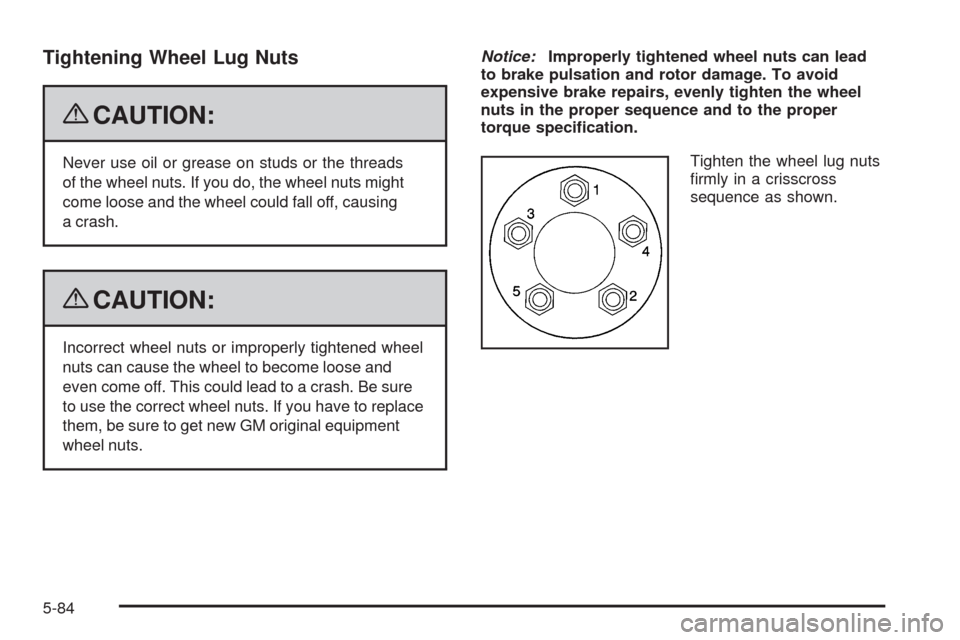
Tighten the wheel lug nuts
rmly in a crisscross
sequence as shown.
5-84
Page 357 of 434
Tire Chains
{CAUTION:
Do not use tire chains. There is not enough
clearance. Tire chains used on a vehicle without
the proper amount of clearance can cause damage
to the brakes, suspension, or other vehicle parts.
The area damaged by the tire chains could cause
you to lose control of the vehicle and you or others
may be injured in a crash. Use another type of
CAUTION: (Continued)
CAUTION: (Continued)
traction device only if its manufacturer
recommends it for use on the vehicle and tire
size combination and road conditions. Follow that
manufacturer’s instructions. To help avoid damage
to the vehicle, drive slowly, re-adjust or remove
the device if it is contacting the vehicle, and do not
spin the wheels. If you do nd traction devices that
will t, install them on the rear tires.
5-85
Page 358 of 434
Lifting the Vehicle
{CAUTION:
Lifting a vehicle can cause an injury. The vehicle
can slip off the jack and roll over you or other
people. You and they could be badly injured.
Find a level place to lift your vehicle. To help
prevent the vehicle from moving:
1. Set the parking brake rmly.
2. Put an automatic transmission shift lever in
P (Park), or shift a manual transmission to
1 (First) or R (Reverse).
3. Turn off the engine.
To be even more certain the vehicle won’t move,
you can put blocks in front of and behind the
wheels.
{CAUTION:
Getting under a vehicle when it is jacked up is
dangerous. If the vehicle slips off the jack, you
could be badly injured or killed. Never get under
a vehicle when it is supported only by a jack.
{CAUTION:
Raising the vehicle with the jack improperly
positioned can damage the vehicle or the vehicle
may fall and cause your or others injury.
5-86
Page 362 of 434
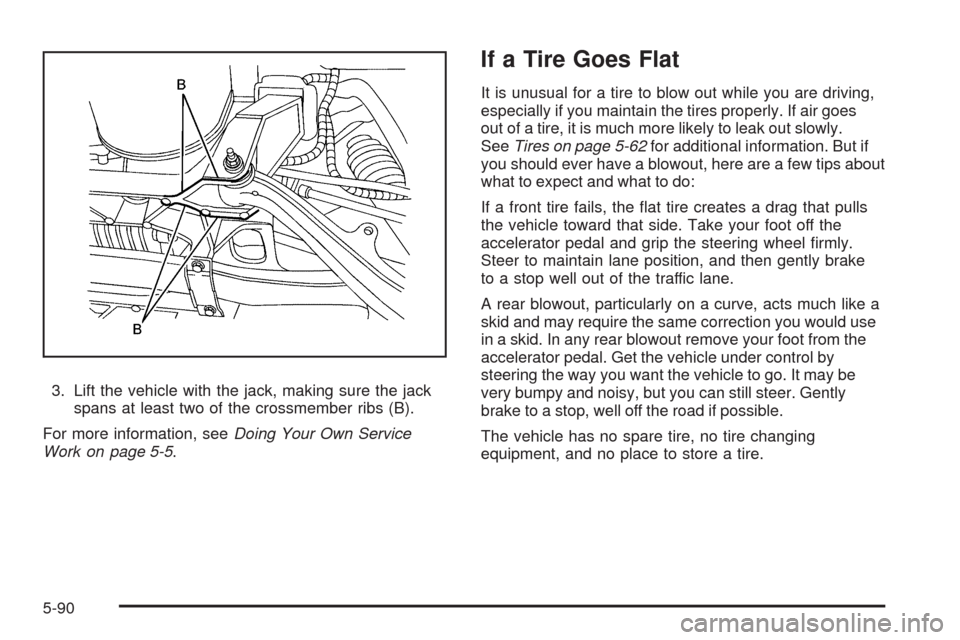
3. Lift the vehicle with the jack, making sure the jack
spans at least two of the crossmember ribs (B).
For more information, seeDoing Your Own Service
Work on page 5-5.
If a Tire Goes Flat
It is unusual for a tire to blow out while you are driving,
especially if you maintain the tires properly. If air goes
out of a tire, it is much more likely to leak out slowly.
SeeTires on page 5-62for additional information. But if
you should ever have a blowout, here are a few tips about
what to expect and what to do:
If a front tire fails, the at tire creates a drag that pulls
the vehicle toward that side. Take your foot off the
accelerator pedal and grip the steering wheel rmly.
Steer to maintain lane position, and then gently brake
to a stop well out of the traffic lane.
A rear blowout, particularly on a curve, acts much like a
skid and may require the same correction you would use
in a skid. In any rear blowout remove your foot from the
accelerator pedal. Get the vehicle under control by
steering the way you want the vehicle to go. It may be
very bumpy and noisy, but you can still steer. Gently
brake to a stop, well off the road if possible.
The vehicle has no spare tire, no tire changing
equipment, and no place to store a tire.
5-90
Page 368 of 434
Dry the nish with a soft, clean chamois or an all-cotton
towel to avoid surface scratches and water spotting.
Notice:If you drive the vehicle through an
automatic car wash that does not have enough
clearance for the wide rear tires and wheels, you
could damage the vehicle. Verify with the manager
of the car wash that the vehicle will t before
entering the car wash or use a touchless car wash.
High pressure car washes may cause water to enter the
vehicle. Avoid using high pressure washes closer than
12 inches (30 cm) to the surface of the vehicle. Use of
power washers exceeding 1,200 psi (8 274 kPa) can
result in damage or removal of paint and decals.
Cleaning Exterior Lamps/Lenses
Use only lukewarm or cold water, a soft cloth and a
car washing soap to clean exterior lamps and lenses.
Follow instructions underWashing Your Vehicle on
page 5-95.
Finish Care
Occasional waxing or mild polishing of the vehicle by
hand may be necessary to remove residue from the paint
nish. Approved cleaning products can be obtained from
your dealer/retailer.
If the vehicle has a basecoat/clearcoat paint nish,
the clearcoat gives more depth and gloss to the colored
basecoat. Always use waxes and polishes that are
non-abrasive and made for a basecoat/clearcoat
paint nish.
Notice:Machine compounding or aggressive
polishing on a basecoat/clearcoat paint nish
may damage it. Use only non-abrasive waxes and
polishes that are made for a basecoat/clearcoat
paint nish on the vehicle.
Foreign materials such as calcium chloride and other
salts, ice melting agents, road oil and tar, tree sap, bird
droppings, chemicals from industrial chimneys, etc., can
damage the vehicle’s nish if they remain on painted
surfaces. Wash the vehicle as soon as possible. If
necessary, use non-abrasive cleaners that are marked
safe for painted surfaces to remove foreign matter.
Exterior painted surfaces are subject to aging, weather
and chemical fallout that can take their toll over a period
of years. To help keep the paint nish looking new, keep
the vehicle garaged or covered whenever possible.
5-96
Page 371 of 434
Aluminum or Chrome-Plated Wheels
and Trim
The vehicle may have either aluminum or chrome-plated
wheels.
Keep the wheels clean using a soft clean cloth with mild
soap and water. Rinse with clean water. After rinsing
thoroughly, dry with a soft clean towel. A wax may
then be applied.
Notice:Chrome wheels and other chrome trim may
be damaged if the vehicle is not washed after driving
on roads that have been sprayed with magnesium,
calcium or sodium chloride. These chlorides are
used on roads for conditions such as ice and dust.
Always wash the vehicle’s chrome with soap and
water after exposure.
Notice:Using strong soaps, chemicals, abrasive
polishes, cleaners, brushes, or cleaners that contain
acid on aluminum or chrome-plated wheels, could
damage the surface of the wheel(s). The repairs
would not be covered by the warranty. Use only
approved cleaners on aluminum or chrome-plated
wheels.
The surface of these wheels is similar to the painted
surface of the vehicle. Do not use strong soaps,
chemicals, abrasive polishes, abrasive cleaners,cleaners with acid, or abrasive cleaning brushes
on them because they could damage the surface.
Do not use chrome polish on aluminum wheels.
Notice:Using chrome polish on aluminum wheels
could damage the wheels. The repairs would not
be covered by the warranty. Use chrome polish on
chrome wheels only.
Use chrome polish only on chrome-plated wheels, but
avoid any painted surface of the wheel, and buff off
immediately after application.
Notice:Driving the vehicle through an automatic
car wash that has silicone carbide tire cleaning
brushes, could damage the aluminum or
chrome-plated wheels. The repairs would not be
covered by the warranty. Never drive a vehicle
equipped with aluminum or chrome-plated wheels
through an automatic car wash that uses silicone
carbide tire cleaning brushes.
Tires
To clean the tires, use a stiff brush with tire cleaner.
Notice:Using petroleum-based tire dressing
products on the vehicle may damage the paint nish
and/or tires. When applying a tire dressing, always
wipe off any overspray from all painted surfaces
on the vehicle.
5-99