2009 CADILLAC STS service
[x] Cancel search: servicePage 403 of 514

Uniform Tire Quality Grading
Quality grades can be found where applicable
on the tire sidewall between tread shoulder
and maximum section width. For example:
Treadwear 200 Traction AA
Temperature A
The following information relates to the system
developed by the United States National Highway
Traffic Safety Administration (NHTSA), which
grades tires by treadwear, traction, and
temperature performance. This applies only to
vehicles sold in the United States. The grades are
molded on the sidewalls of most passenger car
tires. The Uniform Tire Quality Grading (UTQG)
system does not apply to deep tread, winter-type
snow tires, space-saver, or temporary use
spare tires, tires with nominal rim diameters
of 10 to 12 inches (25 to 30 cm), or to some
limited-production tires.While the tires available on General Motors
passenger cars and light trucks may vary with
respect to these grades, they must also conform
to federal safety requirements and additional
General Motors Tire Performance Criteria (TPC)
standards.
Treadwear
The treadwear grade is a comparative rating
based on the wear rate of the tire when tested
under controlled conditions on a specied
government test course. For example, a tire
graded 150 would wear one and a half (1.5) times
as well on the government course as a tire
graded 100. The relative performance of tires
depends upon the actual conditions of their use,
however, and may depart signicantly from the
norm due to variations in driving habits, service
practices, and differences in road characteristics
and climate.
5-77
Page 410 of 514

Lifting From the Rear
The rear lifting points can be accessed from either side
of your vehicle, in front of the rear tires.
1. Locate the rear lifting points using the diagram
above. The rear lifting location is about 7 inches
(17 cm) from the front edge of the rear wheel well.2. Place a block or pad between the jack and the
vehicle.
3. Lift the vehicle with the jack, making sure the jack
is centered on the rear lifting point.
SeeDoing Your Own Service Work on page 5-4.
If a Tire Goes Flat
It is unusual for a tire to blowout while you are driving,
especially if you maintain your tires properly. SeeTires
on page 5-54. If air goes out of a tire, It is much more
likely to leak out slowly. But if you should ever have a
blowout, here are a few tips about what to expect and
what to do:
If a front tire fails, the at tire will create a drag that
pulls the vehicle toward that side. Take your foot off
the accelerator pedal and grip the steering wheel rmly.
Steer to maintain lane position, and then gently brake
to a stop well out of the traffic lane.
5-84
Page 412 of 514

Run-Flat Tires (STS-V)
If this vehicle has run-at tires, there is no spare tire
and no tire changing equipment. Run-at tires can
operate effectively with no air pressure for a limited
distance and speed. These tires perform so well without
any air pressure that a Tire Pressure Monitor (TPM)
is used to alert you when there is a low tire condition.
{CAUTION:
When the low tire warning light is displayed
on the instrument panel cluster, your vehicle’s
handling capabilities will be reduced during severe
maneuvers. If you drive too fast, you could lose
control of your vehicle. You or others could be
injured. Do not drive over 55 mph (90 km/h)
when the low tire warning light is displayed.
Drive cautiously and check your tire pressures
as soon as you can.SeeRun-Flat Tires (STS-V) on page 5-62andTire
Pressure Monitor System on page 5-66, for additional
information.
{CAUTION:
Special tools and procedures are required to
service a run-at tire. If these special tools and
procedures are not used you or others could
be injured and the vehicle could be damaged.
Always be sure the proper tools and procedures,
as described in the service manual, are used.
To order a service manual seeService Publications
Ordering Information on page 7-15.
5-86
Page 414 of 514

{CAUTION:
Idling a vehicle in an enclosed area with poor
ventilation is dangerous. Engine exhaust may
enter the vehicle. Engine exhaust contains Carbon
Monoxide (CO) which cannot be seen or smelled.
It can cause unconsciousness and even death.
Never run the engine in an enclosed area that has
no fresh air ventilation. For more information, see
Engine Exhaust on page 2-36.
{CAUTION:
Over-inating a tire could cause the tire to rupture
and you or others could be injured. Be sure to
read and follow the tire sealant and compressor kit
instructions and inate the tire to its recommended
pressure. Do not exceed the recommended
pressure.
{CAUTION:
Storing the tire sealant and compressor kit or
other equipment in the passenger compartment of
the vehicle could cause injury. In a sudden stop or
collision, loose equipment could strike someone.
Store the tire sealant and compressor kit in its
original location.
If this vehicle has a tire sealant and compressor kit,
there may not be a spare tire, tire changing equipment,
and on some vehicles there may not be a place to
store a tire.
The tire sealant and compressor can be used to
temporarily seal punctures up to
14inch (6 mm) in the
tread area of the tire. It can also be used to inate
an under inated tire.
If the tire has been separated from the wheel, has
damaged sidewalls, or has a large puncture, the tire is
too severely damaged for the tire sealant and
compressor kit to be effective. SeeRoadside Service on
page 7-7.
5-88
Page 417 of 514

7. Start the vehicle. The vehicle must be running while
using the air compressor.
8. Press the on/off (D) button to turn the tire sealant
and compressor kit on.
The compressor will inject sealant and air into
the tire.
The pressure gage (E) will initially show a high
pressure while the compressor pushes the sealant
into the tire. Once the sealant is completely
dispersed into the tire, the pressure will quickly drop
and start to rise again as the tire inates with air only.
9. Inate the tire to the recommended ination
pressure using the pressure gage (E). The
recommended ination pressure can be found
on the Tire and Loading Information label.
SeeInflation - Tire Pressure on page 5-64.
The pressure gage (E) may read higher than the
actual tire pressure while the compressor is on.
Turn the compressor off to get an accurate pressure
reading. The compressor may be turned on/off
until the correct pressure is reached.Notice:If the recommended pressure cannot be
reached after approximately 25 minutes, the vehicle
should not be driven farther. The tire is too severely
damaged and the tire sealant and compressor kit
cannot inate the tire. Remove the power plug from
the accessory power outlet and unscrew the inating
hose from the tire valve. SeeRoadside Service on
page 7-7.
10. Press the on/off button (D) to turn the tire sealant
and compressor kit off.
The tire is not sealed and will continue to leak
air until the vehicle is driven and the sealant is
distributed in the tire, therefore, Steps 11 through 17
must be done immediately after Step 10.
Be careful while handling the tire sealant and
compressor kit as it could be warm after usage.
11. Unplug the power plug (C) from the accessory
power outlet in the vehicle.
12. Turn the sealant/air hose (F) counterclockwise to
remove it from the tire valve stem.
13. Replace the tire valve stem cap.
14. Replace the sealant/air hose (F), and the power
plug (C) back in their original location.
5-91
Page 418 of 514
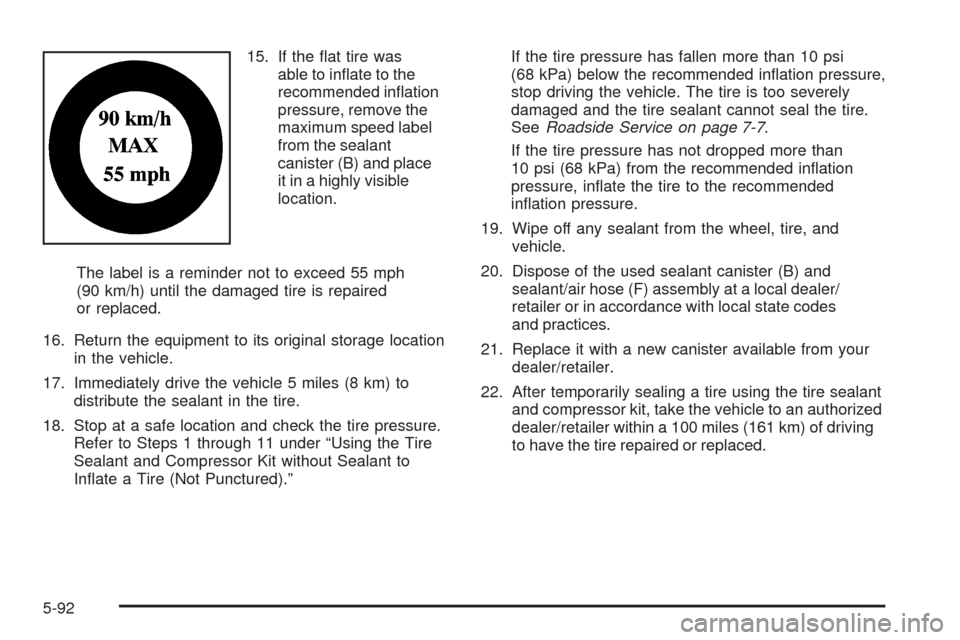
15. If the at tire was
able to inate to the
recommended ination
pressure, remove the
maximum speed label
from the sealant
canister (B) and place
it in a highly visible
location.
The label is a reminder not to exceed 55 mph
(90 km/h) until the damaged tire is repaired
or replaced.
16. Return the equipment to its original storage location
in the vehicle.
17. Immediately drive the vehicle 5 miles (8 km) to
distribute the sealant in the tire.
18. Stop at a safe location and check the tire pressure.
Refer to Steps 1 through 11 under “Using the Tire
Sealant and Compressor Kit without Sealant to
Inate a Tire (Not Punctured).”If the tire pressure has fallen more than 10 psi
(68 kPa) below the recommended ination pressure,
stop driving the vehicle. The tire is too severely
damaged and the tire sealant cannot seal the tire.
SeeRoadside Service on page 7-7.
If the tire pressure has not dropped more than
10 psi (68 kPa) from the recommended ination
pressure, inate the tire to the recommended
ination pressure.
19. Wipe off any sealant from the wheel, tire, and
vehicle.
20. Dispose of the used sealant canister (B) and
sealant/air hose (F) assembly at a local dealer/
retailer or in accordance with local state codes
and practices.
21. Replace it with a new canister available from your
dealer/retailer.
22. After temporarily sealing a tire using the tire sealant
and compressor kit, take the vehicle to an authorized
dealer/retailer within a 100 miles (161 km) of driving
to have the tire repaired or replaced.
5-92
Page 423 of 514

{CAUTION:
Idling a vehicle in an enclosed area with poor
ventilation is dangerous. Engine exhaust may
enter the vehicle. Engine exhaust contains Carbon
Monoxide (CO) which cannot be seen or smelled.
It can cause unconsciousness and even death.
Never run the engine in an enclosed area that has
no fresh air ventilation. For more information, see
Engine Exhaust on page 2-36.
{CAUTION:
Over-inating a tire could cause the tire to rupture
and you or others could be injured. Be sure to
read and follow the tire sealant and compressor kit
instructions and inate the tire to its recommended
pressure. Do not exceed the recommended
pressure.
{CAUTION:
Storing the tire sealant and compressor kit or
other equipment in the passenger compartment of
the vehicle could cause injury. In a sudden stop or
collision, loose equipment could strike someone.
Store the tire sealant and compressor kit in its
original location.
If this vehicle has a tire sealant and compressor kit,
there may not be a spare tire, tire changing equipment,
and on some vehicles there may not be a place to
store a tire.
The tire sealant and compressor can be used to
temporarily seal punctures up to
14inch (6 mm) in the
tread area of the tire. It can also be used to inate
an under inated tire.
If the tire has been separated from the wheel, has
damaged sidewalls, or has a large puncture, the tire is
too severely damaged for the tire sealant and
compressor kit to be effective. SeeRoadside Service on
page 7-7.
Read and follow all of the tire sealant and compressor
kit instructions.
5-97
Page 426 of 514

8. Turn the selector switch (A) counterclockwise to the
Sealant + Air position.
9. Press the on/off (B) button to turn the tire sealant
and compressor kit on.
The compressor will inject sealant and air into
the tire.
The pressure gage (C) will initially show a high
pressure while the compressor pushes the sealant
into the tire. Once the sealant is
completelydispersed into the tire, the pressure will
quickly drop and start to rise again as the tire
inates with air only.
10. Inate the tire to the recommended ination pressure
using the pressure gage (C). The recommended
ination pressure can be found on the Tire and
Loading Information label. SeeInflation - Tire
Pressure on page 5-64.
The pressure gage (C) may read higher than the
actual tire pressure while the compressor is on. Turn
the compressor off to get an accurate pressure
reading. The compressor may be turned on/off until
the correct pressure is reached.Notice:If the recommended pressure cannot be
reached after approximately 25 minutes, the vehicle
should not be driven farther. The tire is too
severely damaged and the tire sealant and
compressor kit cannot inate the tire. Remove the
power plug from the accessory power outlet
and unscrew the inating hose from the tire valve.
SeeRoadside Service on page 7-7.
11. Press the on/off button (B) to turn the tire sealant
and compressor kit off.
The tire is not sealed and will continue to leak air
until the vehicle is driven and the sealant is
distributed in the tire, therefore, Steps 12 through
18 must be done immediately after Step 11.
Be careful while handling the tire sealant and
compressor kit as it could be warm after usage.
12. Unplug the power plug (H) from the accessory
power outlet in the vehicle.
13. Turn the sealant/air hose (F) counterclockwise to
remove it from the tire valve stem.
14. Replace the tire valve stem cap.
15. Replace the sealant/air hose (F), and the power
plug (H) back in their original location.
5-100