2009 CADILLAC CTS instrument panel
[x] Cancel search: instrument panelPage 165 of 490

Headlamps
The exterior lamp control is located towards the end of
the turn signal/multifunction lever.
O(Exterior Lamp Control):Turn the band with this
symbol on it to operate the exterior lamps.
The exterior lamp control has four positions:
O(Off):Turns off all lamps, except the Daytime
Running Lamps (DRL).
AUTO (Automatic):Turns the headlamps on and off
automatically, depending upon how much light is
available outside of the vehicle.
;(Parking Lamps):Turns on the parking lamps
together with the following:
Sidemarker Lamps
Taillamps
License Plate Lamps
Instrument Panel Lights
5(Headlamps):Turns on the headlamps, together
with the previously listed lamps and lights.
Wiper Activated Headlamps
This feature activates the headlamps and parking
lamps after the windshield wipers have been in use
for about six seconds. For this feature to work,
the exterior lamp control must be in AUTO.
The wiper-activated headlamps immediately turn off,
when the ignition is turned to LOCK/OFF or the
windshield wiper control is turned off.
Headlamps on Reminder
A warning chime will sound if the exterior lamp control
is left on in either the headlamp or parking lamp position
and the driver’s door is opened with the ignition off.
SeeLights On Reminder on page 3-48for additional
information.
3-17
Page 166 of 490

Daytime Running Lamps (DRL)
Daytime Running Lamps (DRL) can make it easier for
others to see the front of your vehicle during the day.
Fully functional daytime running lamps are required on
all vehicles rst sold in Canada.
The DRL system will make either the reduced intensity
low-beam headlamps or dedicated DRL’s come on
when the following conditions are met:
It is still daylight and the ignition is in ON/RUN
or START.
The exterior lamp control is in off or AUTO and the
headlamps are off.
The automatic transmission is not in P (Park).
When DRL’s are on, only the reduced intensity
low-beam headlamps or dedicated DRL’s will be on.
The other exterior lamps and the instrument panel
cluster will not be on.When the exterior lamp control is in AUTO and it is dark
enough outside, the DRL turns off and the low-beam
headlamps will turn on. When it is bright enough outside,
the low-beam headlamps will go off, and the DRL will
turn back on. If the vehicle is started in a dark garage,
the automatic headlamp system comes on immediately.
Once the vehicle leaves the garage, it takes about
one minute for the automatic headlamp system to
change to DRL if it is light outside. During that delay,
the instrument panel cluster may not be as bright
as usual. Make sure the instrument panel brightness
lever is in the full bright position. SeeInstrument Panel
Brightness on page 3-20.
Turning the exterior lamp control to off or to the
low-beam headlamp position will turn off the DRL.
If the parking lamps or the fog lamps were turned on
instead, the DRL will still turn off.
This will work regardless of gear position and whether
or not the parking brake is set.
3-18
Page 167 of 490

Light Sensor
The light sensor for the
DRL and AUTO headlamp
feature is located on
top of the instrument panel.
If the sensor is covered, it will prevent it from sensing
light, and the exterior lamps or the Headlamps Suggested
message will appear on the DIC whenever the ignition
is on.
Adaptive Forward Lighting System
The Adaptive Forward Lighting System (AFL) pivots
the headlamps horizontally to provide greater road
illumination while turning. To enable AFL, set the
exterior lamp switch on the multifunction lever to the
AUTO position. Moving the switch out of the AUTOposition will deactivate the system. AFL will operate
when the vehicle speed is greater than 2 mph (3 km/h).
AFL will not operate when the transmission is in
R (Reverse). AFL is not immediately operable after
starting the vehicle; driving a short distance is required
to calibrate the AFL. SeeHeadlamps on page 3-17.
Fog Lamps
Use the fog lamps for better vision in foggy or misty
conditions. The fog lamp control is located on the turn
signal/multifunction lever.
#(Fog Lamps):Turn the fog lamp band on the
lever up to
#and release it, to turn the fog lamps on
or off. The band will return to its original position.
The parking lamps must be on for the fog lamps to work.
If the high-beam headlamps are turned on, the fog
lamps will also turn off. They will turn back on again
when you change back to low-beam headlamps.
Some localities have laws that require the headlamps to
be on along with the fog lamps.
3-19
Page 168 of 490
Exterior Lighting Battery Saver
The exterior lamps turn off about 10 minutes after the
ignition is turned to LOCK/OFF, if the parking lamps
or headlamps have been left on. This protects against
draining the battery. The battery saver does not work
if the headlamps are turned on after the ignition is turned
to LOCK/OFF.
To keep the lamps on for more than 10 minutes, turn
the lamps back on with the exterior lamp control.
Instrument Panel Brightness
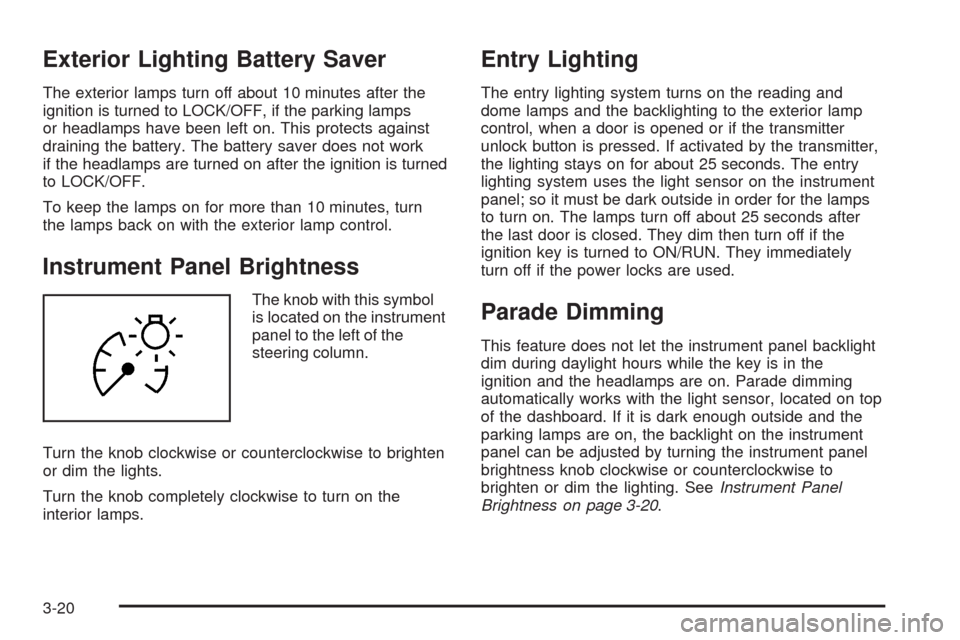
The knob with this symbol
is located on the instrument
panel to the left of the
steering column.
Turn the knob clockwise or counterclockwise to brighten
or dim the lights.
Turn the knob completely clockwise to turn on the
interior lamps.
Entry Lighting
The entry lighting system turns on the reading and
dome lamps and the backlighting to the exterior lamp
control, when a door is opened or if the transmitter
unlock button is pressed. If activated by the transmitter,
the lighting stays on for about 25 seconds. The entry
lighting system uses the light sensor on the instrument
panel; so it must be dark outside in order for the lamps
to turn on. The lamps turn off about 25 seconds after
the last door is closed. They dim then turn off if the
ignition key is turned to ON/RUN. They immediately
turn off if the power locks are used.
Parade Dimming
This feature does not let the instrument panel backlight
dim during daylight hours while the key is in the
ignition and the headlamps are on. Parade dimming
automatically works with the light sensor, located on top
of the dashboard. If it is dark enough outside and the
parking lamps are on, the backlight on the instrument
panel can be adjusted by turning the instrument panel
brightness knob clockwise or counterclockwise to
brighten or dim the lighting. SeeInstrument Panel
Brightness on page 3-20.
3-20
Page 171 of 490
Ashtray(s) and Cigarette Lighter
The vehicle may have two removable ashtrays and
cigarette lighters. One ashtray can be placed into the
instrument panel storage compartment and the other
into the center console rear compartment. To use
the lighter, push it in all the way and let go. When it is
ready, it will pop back out by itself.
To empty the ashtrays, hold on to the edges of the bin
and pull straight out. To reinstall, push the tray back
into place.
Notice:Holding a cigarette lighter in while it is
heating does not let the lighter back away from the
heating element when it is hot. Damage from
overheating can occur to the lighter or heating
element, or a fuse could be blown. Do not hold a
cigarette lighter in while it is heating.
Notice:If papers, pins, or other ammable items
are put in the ashtray, hot cigarettes or other
smoking materials could ignite them and possibly
damage the vehicle. Never put ammable items
in the ashtray.
Analog Clock
The analog clock is located on the instrument panel
above the radio. The clock is not connected with
any other vehicle system and runs by itself. To adjust
the clock:
1. Locate the adjustment buttons directly below the
clock face.
2. Push and hold the right adjustment button to move
the clock hands forward or the left adjustment
button to make the clock hands go backward.
Holding either button down will cause the clock to
advance faster. Release the button before the
desired time is reached.
3. Push and release either button to adjust the time by
one minute increments until the desired time is
reached.
3-23
Page 174 of 490

The outboard air outlets always receive some airow in
every mode, except defrost.
To change the current mode, select one of the following:
Y(Vent):Air is directed to the instrument panel outlets.
\(Bi-Level):Air is divided between the instrument
panel outlets and the oor outlets. In automatic
operation, cooler air is directed to the upper outlets
and warmer air to the oor outlets.
[(Floor):Air is directed to the oor outlets, with
some air directed to the windshield and outboard outlets.
-(Defog):This mode clears the windows of fog or
moisture. Air is directed to the windshield, oor and side
window outlets. When this mode is selected, the system
turns off recirculation and runs the air-conditioning
compressor unless the outside temperature is at or below
freezing. If recirculation is selected while in defog mode,
it is cancelled after 10 minutes.
0(Defrost):This mode clears the windshield of fog
or frost more quickly. Air is directed to the windshield,
with some air directed to the side windows. In this mode,
the system automatically turns off recirculation and runs
the air-conditioning compressor, unless the outside
temperature is at or below freezing.
This mode can also cause the fan speed and air
temperature to increase.
#(Air Conditioning):Press to turn the air conditioning
system on or off and override the automatic system.
When in AUTO, the air conditioning compressor comes
on automatically, as needed.
The air conditioning system removes moisture from
the air, so a small amount of water might drip under the
vehicle while idling or after turning off the engine.
This is normal.
3-26
Page 176 of 490

Heated and Ventilated Seats:Press to heat or
ventilate the seat. SeeHeated and Ventilated Seats
on page 1-7.
_(Heated Windshield Washer, If Equipped):
For more information, seeWindshield Washer on
page 3-12.
Remote Start Climate Control Operation:For
vehicles with remote vehicle start feature and it is
activated, the climate control system heats and cools
the inside of the vehicle using the previous settings
of the system before the vehicle was turned off.
SeeRemote Vehicle Start on page 2-14.
The windshield defroster and/or rear window defogger
turn on if it is cold outside. If the vehicle has heated
seats, they turn on if the temperature inside the
vehicle is cooler than 54°F (12.5°C) or if the outside
temperature is cooler than 48°F (9°C).
Sensors
The solar sensor located
on the instrument panel,
near the windshield,
monitors the solar heat.
The interior temperature
sensor located on the
instrument panel to
the right of the steering
wheel, measures the
temperature of the
air inside the vehicle.
3-28
Page 177 of 490

The climate control system uses the information from
these sensors to adjust the fan speed and the air
delivery, in order to maintain the selected temperature.
The system may also supply cooler air to the side of
the vehicle facing the sun. The recirculation mode
will also be activated, as necessary.
Do not cover the sensors or the automatic climate
control system will not work properly.
Outlet Adjustment
Use the air outlets located in the center and on the side
of the instrument panel to direct the airow. Use the
thumbwheels near the air outlets to open or close off the
airow.
Operation Tips
Clear away any ice, snow, or leaves from air inlets
at the base of the windshield that could block the
ow of air into the vehicle.
Keep the path under the front seats clear of objects
to help circulate the air inside of the vehicle more
effectively.
Use of non-GM approved hood deectors can
adversely affect the performance of the system.
Check with your dealer/retailer before adding
equipment to the outside of the vehicle.
Passenger Compartment Air Filter
The passenger compartment air lter traps most of
the dust and pollen from the air entering the vehicle.
The lter will need to be changed periodically.
SeeScheduled Maintenance on page 6-4.
Using the climate control system without the passenger
air lter installed could let water or other debris enter
the system. This could cause a water leak or noises.
Make sure a new air lter is installed after removing the
old one.
The passenger compartment air lter is located under
the hood below the windshield wiper arm and the screen
on the passenger side of the vehicle. SeeEngine
Compartment Overview on page 5-14for more
information on location.
3-29