2009 AUDI TT COUPE ECU
[x] Cancel search: ECUPage 177 of 316

rest in the area that the guidance fixtures were installed. The uphol
stery would also be permanently stretched around the guidance
fixtures. This applies especially to leather seats.
[ i J Tips
• Always remove the guidance fixtures when not in use .
• Please keep the guidance fixtures in a safe place with the vehicle
when not in use.•
Installing a child restraint using the lovver
anchorages of the LATCH system
Child safety seats equipped with the LATCH system can
quickly and easily be secured to the rear seats.
Safety first
Fig . 126 LATCH-type
seat with both rigid
latch bars extended
Child Safety
Fig. 127 Installation of
child safety seat with
rigid latches on bars
Whenever you install a child restraint always refer to the
child restraint manufacturer's instructions.
- Make sure the seat back of the rear seat bench is in the
upright position and securely latched in place.
- Install the guidance fixtures==>
page 173.
Insert the latches onto the lower anchorages==> fig. 127.
- Make sure you hear the child restraint click securely into
place. This indicates that the seat is securely mounted on
the anchors.
- Pull on the child restraint once you have mounted it to
make sure it is secure.
& WARNING
Improper use of the LATCH system can increase the risk of serious
personal injury and death in an accident.
• These anchors were developed solely for child safety seats
using the "LATCH" system.
• Never attach other child safety seats, belts or other objects to
these anchors.
• Always make sure that you hear a click when latching the seat
in place. If you do not hear a click the seat is not secure and could .,
Vehicle care I I irechnical data
Page 178 of 316
___ C_h_ i_ld _ S_ a_ f_ e_ t-= y'------------------------------------------------
& WARNING (continued)
fly forward and hit the interior of the vehicle, or be ejected from
the vehicle.
& WARNING
Improper installation of child restraints will increase the risk of
injury in an accident.
• Always follow the child restraint system manufacturer's
instructions for proper installation of the child restraint system
and proper use of tether straps as well as the lower anchorages or
safety belts in your vehicle.
• Always read and heed the important information and WARN
INGS about child safety and the installation of child restraint
systems =>
page 157, "Child Safety" .•
Mounting and releasing the anchorage hook
If you use a child restraint system with hooks or other
latches attached to adjustable straps.
Mounting
Press the anchorage hook with the spring catch release
onto the lower anchorage so that the anchorage hook
locks into place.
Pull on the anchorage hook to make sure that it has
securely engaged the lower anchorage .
Tighten the strap following the child restraint manufac
turer's instructions.
Releasing
- Loosen the tension on the strap following the child
restraint manufacturer's instructions. -
Depress the spring catch on the hook.
- Hold the spring catch in depressed posit ion .
- Move the hook in the direction of the vehicle floor so that
there is enough space to release the anchorage hook
from the lower anchorage.
& WARNING
• Improper installation of child restraints will increase the risk of
injuries in a crash.
• Always refer to the child restraints manufacturer's instructions
for proper installation of the child restraint and proper use of the
lower anchorages or safety belts in your vehicle.
ti
Tether strap
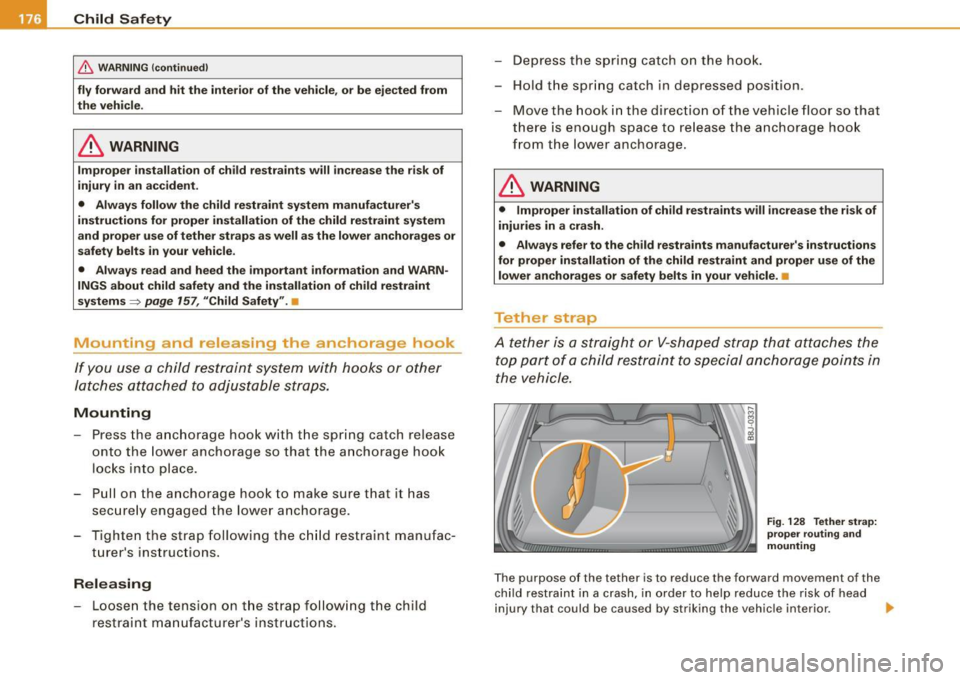
A tether is a straight or V-shaped strap that attaches the
top part of a child restraint to special anchorage points in
the vehicle.
Fig. 128 Tether strap:
proper routing and
mounting
Th e purpose of the tether is to reduce the forward movement of the
child restraint in a crash, in order to help reduce the risk of head
injury that could be caused by striking the vehicle int eri or. .,
Page 179 of 316

Fo rw ard facing child r estra ints manufactu red after September 1,
1 999, a re requ ired by U .S. f edera l r eg ulations to com ply wi th child
head movement pe rformance requ irements. These new perfo r
m ance req uir e m ent s m ake a tethe r neces sary on mos t new child
safety seats.
& WARNING
Improper installation of child restraints will increase the risk of
injury in a crash .
• Never attach a child safety seat tether strap to a tie-down hook
in the luggage compartment.
• Never secure or attach any luggage or other items to the LATCH
lower anchorages or to the tether.
• If a tether or other strap is used to attach a child restraint to the
front passenger seat , make sure that it is not so tight , that it
causes the weight-sensing mat to measure more weight than is
actually on the seat.
• The heavier weight registered can make the system work as
though an adult were on the seat and deploy the Advanced Airbag
when it must be suppressed causing serious or even fatal injury to
the child .•
Using tethers on rear-facing child restraint
systems
Curr ently, few r ear -facing chi ld restraint systems come with a tether.
P lease read and heed the c hild restrai nt s ystem manufac tu re r's
instructions careful ly to determine how to proper ly instal l the
tethe r.
Safety first
Child Safety
& WARNING
A child in a rearward -facing child safety seat installed on the front
passenger seat will be seriously injured and can be killed if the
front airbag inflates -even with an Advanced Airbag System .
• The inflating airbag will hit the child safety seat or infant
carrier with great force and will smash the ch ild safety seat and
child against the backrest , or door .
• A tight tether or other strap on a rearward-facing child restraint
attached to the front passenger seat can put too much pressure
on the weight-mat in the seat and register a heavier weight in the
Advanced Airbag System. The heavier weight registered can make
the system work as though an adult were on the seat and deploy
the Advanced Airbag when it must be suppressed causing serious or even fatal injury to the child.
• If you must install a rearward facing child safety seat on the
front passenger seat because of exceptional circumstances and
the PASSENGER AIR BAG OFF light does not come on and stay on ,
immediately install the rear-facing child safety seat in a rear
seating posit ion and have the airbag system inspected by your
Audi dealer . •
Securing the upper tether strap to the anchor
bracket
Vehicle care I I
Fig . 129 Tether strap:
prope r routing and
mounting ..
irechnical data
Page 219 of 316

___________________________________________ C_ h_e _c_ k_ i_n _g _ a_n _d_ f_il _li _n _g __ fflllll
•
Closing the engine hood
- Pull the hood down until the pressure from the struts is
reduced .
- Let the hood
drop down and latch in place. Do not try to
push it shut;
it may fail to engage => &.
& WARNING
A hood that is not completely latched could fly up and block your
view while driving.
• When you close the engine hood, check it to make sure the
safety catch has properly engaged. The hood should be flush with
the surrounding vehicle body parts.
• If you notice while driving that the hood is not secured prop
erly, stop at once and close it. •
Working in the engine compartment
Be especially careful whenever you work in the engine
compartment!
Whenever you must perform any work in the engine compartment,
for example checking and filling the different fluids, there is a risk of injury, burns and accidents. To prevent personal injury always
observe the following WARNINGS. The engine compartment of any
vehicle is a hazardous area!
~ &
& WARNING
To help avoid injury, before you check anything under the hood :
• Switch off the engine.
• Remove the ignition key.
• Apply the parking brake .
& WARNING (continued)
• Move selector lever of automatic transmission to "P" (Park);
put manual transmission in Neutral .
• Always let the engine cool down. Hot components will burn
skin on contact.
• To reduce the risk of being burned, never open the hood if you
see or hear steam or coolant escaping from the engine compart
ment. Wait until no steam or coolant can be seen or heard before
carefully opening the hood .
• Keep children away from the engine compartment.
• Never spill fluids on hot engine components . They can cause a
fire.
• Never touch the radiator fan. The auxiliary electric fan is
temperature controlled and can switch on suddenly.
• Never open the coolant reservoir cap when the engine is still
warm. The coolant system is pressurized and hot coolant could
spray out.
• Protect your face, hands and arm from steam or hot engine
coolant by placing a thick rag over the cap when you open the
coolant reservoir.
• If work on the fuel system or the electrical system is necessary:
- Always disconnect the battery.
- Never smoke or work near heaters or open flames. Fluids in
the engine compartment could start a fire .
- Keep an approved fire extinguisher immediately available.
• To avoid electrical shock and personal injury while the engine
is running or being started, never touch :
- Ignition cables
- Other components of the high voltage electronic ignition
system.
• If you must perform a check or repair with the engine running: ..,
Vehicle care
I t •
Page 225 of 316

Checking and filling -
--------------~-
•
-Screw the ca p back o n the filling h ole and sli de th e oil
dips tick in as far as it wil l g o .
& WARNING
• While topping off , the oil must not come in contact with hot
engine parts -fire haz ard!
• The oil filler cap must be properly secured to prevent oil from
being sprayed on the hot engine and exhaust system when the
engine is running -fire hazard!
• If your skin has come in contact with the engine oil , you must
subsequently cleanse it thoroughly.
0 Note
• T he oil level must not be above ran ge @ -da nge r of co nverter or
engine damage! Contact an authorized dealership to draw off oi l, if
n ec essary.
• Audi does not recommend the use of oil additives . They may
damage the engine and adversely affect your New Vehicle Warranty.
W For the sake of the environment
• Unde r no circumstances can the o il come in co ntact w ith the
sewage network or the soil.
• Observe an d follow le gal regulat io n s when d ispos ing o f empty
oi l containers. •
Changing the engine oil
We recom men d th at ha ve yo ur oil c hang ed by an a utho
r iz ed A ud i dealer o r a qualified servi ce s tatio n.
Befo re yo u ch ec k anything in the e ngine compa rtment, always read
and heed all WARNINGS=>
& in "Work ing in the en gine compart
ment" on
page 217 .
The engine oi l must be changed according to the interva ls specified
i n yo ur War ra n ty
& M ain te na n ce booklet . This is very i mportant
because the lubricating properties of oi l d iminish g radua lly during
no rma l vehicle use .
U nde r some circu msta nces the e ng in e o il s hou ld be cha nged mo re
frequently. Change oil more often if yo u drive most ly short
dista nces, opera te th e ve hicle i n dusty areas or under predo mi
nantly stop -and-go traffic conditions, or have your vehicle where
t empe ra tu re s rema in bel ow free zin g for e xtended per iods .
De tergent additives in th e oil will make fr esh oi l loo k dar k aft er the
eng ine ha s been ru nning f or a sho rt ti me. T his i s no rm al and is not
a reason to c hange th e o il more ofte n than reco mme nde d.
Because of the problem of proper disposal, along with the spec ial
to ols an d necessa ry ex pertise requ ired, we stro ngly reco mmend
that you have your oi l cha nged by an authorized
Audi dealer or a
q ua lif ied serv ice s ta tio n.
If you choose to change your oil yourself , please note the following
impo rtant infor mati on:
& WARNING
To reduce the risk of personal injury if you must change the engine
oil in your vehicle yourself :
• Wear eye protection .
• To reduce the risk of burns from hot engine oil , let the engine
cool down to the touch.
• When removing the oil drain plug with your fingers , stay as far
away as possible . Always keep your forearm parallel to the ground
to help prevent hot oil from running down your arm .
• Drain the oil into a container designed for this purpose, one
large enough to hold at least the total amount of oil in your engine .
• Engine oil is poisonous . Keep it well out of the reach of children . _,,,
Vehicle care
I t •
Page 231 of 316

_____________________________________________ C_h_ e_ c _ k_in -= g_a _ n_d _ f_il _li _n ..;::g =--____.""
When instal ling the battery, make sure the ignition and all electrica l
consumers are switched off~
0.
We recommend that you use maintenance -free or c yc le-re sis
tant/leak -proof
batteries according to the standards TL 825 06 (from
December 1997) and VW 7 50 73 (from August 2001 ) .
Rep lacing the battery should be carried by a qualified workshop .
Please follow the instruct ions on the battery cover.
0 Note
• All work on the battery requ ires technical knowledge . Please
contact an Audi dealership or another authorized facility for ques
t ions about the battery -dange r of acid burns and explosion hazard!
• T he battery must not be opened! Do not try to change the
battery 's liquid level, otherwise detona ting gas will escape from the
battery -explosion hazard I
• The AGM battery in the luggage compartmen t cannot lea k,
because the electrolyte for this battery is absorbed into a special
glass mat. Th is leak -proof battery must not be replace with a
conventional battery .
• Make sure the ventilation hose on the side of the battery is
connected, otherwise fumes or battery acid can leak out.
• Battery holder and term inals a lways have to be secured correctly.
• Before all work on the battery follow the
warnings below ~ & in
"Wor king on the battery" on
page 229 .
ci' For the sake of the environment
Because of the proble m of proper d isposal of a battery, we recom
mend your authorized Audi dealer change the battery for you.
Batteries contain sul furic acid and lead and m ust always be
disposed of properly in compliance with all environmenta l regula
t ions. Disposing of vehic le batteries improperly is ve ry dangerous to
the environment . Make sure that the removed battery cannot over
balance, otherwise su lfur ic ac id might escape!
[ i ] Tip s
If your vehic le is left standing for severa l weeks at extreme ly low
temperatures, the vehicle battery should be removed and stored
where it will not freeze. Th is will prevent it from being damaged and
having to be replaced .•
Working on the battery
Be especially ca ref ul when w orking on o r near the
battery!
F ig . 144 Luggag e
co mp artment :
AGM
battery
T h e ba ttery is loca ted in t he lug gage compartmen t.
Swing up the luggage compartment floor .
Remove the cover plate by t urning the thumb wheel.
The positive ( +l battery termina l is protected by a plastic cover. This
cover must be removed to access the posit ive ( +l terminal when
connecting jumper cab les to start the engine.
Always heed the
safety warning s, when working on the vehicle
battery or the vehicle e lectrica l system to prevent injury.
Vehic le care I I irechnical data
Page 244 of 316

-~_T_ ir_e_ s_ a_ n_d _ w_ h_ e_e _l_s _________________________________________________ _
When should I check the tir e pressure?
The correct ti re pressure is especially i mpor tant a t high speeds . The
pressure should therefore be checked at least o nce a month and
a lways before star tin g a j ourn ey.
When should I adjust the tire pressures?
Adjust the tire pres sure to the loa d you are ca rrying. After changing
a wheel
or replacing whee ls you have to adjust the tire pressures on
a ll whee ls. In addition, y ou must the n ini tia lize the new tire pres
sures in the tire pressu re monitoring system*:::::,
page 253.
& WARNING
Incorrect tire pressures and /or underinflation can lead sudden tire
failure, loss of control , collision, serious personal injury or even
death .
• When the warning symbol appears in the instrument
cluster , stop and in spect the tire s.
• Incorrect tire pressure and /or underinflation can cause
increased tire wear and can affect the handling of the vehicle and
stopping ability.
• Incorre ct t ire pressures and /or underinflation can also lead to
sudden tire failure, including a blowout and sudden deflation,
causing loss of vehicle control.
• The driver is responsible for the correct tire pre ssure s for all
tires on the vehicle . The appli cable pressure values are located on
a sticker on the driver' s side B -pillar.
• Onl y when all tires on the vehicle are filled to the correct pres
sure , the tire pre ssure monitoring system* can work correctly .
• The use of incorrect tire pressure values can lead to accidents
or other damage. Therefore it is essential that the driver observe
the spe cified tire pressure values for the tires and the correct pres
sures for the function of the tire pre ssure monitoring sy stem *.
• Always inflate tires to the recommended and correct tire pres
sure before driving off.
& WARNING (continued )
• Driving with underinflated tires bend more , letting them get
too hot re sulting in tread separation, sudden tire failure and lo ss
of control .
• Excessive speed and /overloading can cause heat build -up ,
sudden tire failure and loss of control.
• If the tire pressure is too low or too high , the tires will wear
prematurely and the vehicle will not handle well.
• If the tire is not flat and you do not have to change a wheel
immediately, drive at reduced speed to the nearest servi ce station
to che ck the tire pres sure and add air as required .
0 Note
Driving without valve stem caps can cause damage to the tire
va lves. To prevent this, always ma ke sure that fac tor y in st alled va lve
stem caps on all wh eels are securely mounted on the valv e.
'£> For the sake of the environment
Underinflated tires w ill also increase the fue l consumption. •
Tires and vehicle load limits
There are limits to the amount of load or weight that any vehic le and
any tire can ca rry. A vehicle that is overloaded wil l not handle wel l
and is more difficu lt to stop . Overloading can not on ly lead to loss
of vehic le contro l, but can also damage important parts of the
ve hicle a nd can l ead to sudden t ire fa ilure, i nclud ing a b lowout an d
sudden deflation that can cause the vehicle to crash .
Yo ur sa fety an d that o f yo ur passenge rs als o dep ends on making
sure that load limits are not exceeded . Vehicle load includes every -
b ody and eve rythi ng in and on the vehic le . These loa d limits are
~
Page 250 of 316

-~_T_ ir_e_ s_ a_ n_d _ w_ h_ e_e _l_s _________________________________________________ _
ture. For example, the numbers 2209 mean that the tire was
produced in the 22th week of 2009. The other numbers are
marketing codes that may or may not be used by the tire manufac
turer. This information is used to contact consumers if a tire defect
requires a recall.
Tire ply composition and materials used
The number of plies indicates the number of layers of rubber-coated
fabric in the tire. In general, the greater the number of plies, the
more weight a tire can support. Tire manufacturers also must indi
cate the materials in the tire, which include steel, nylon, polyester,
and others .
Maximum Load Rating
This number indicates the maximum load in kilograms and pounds
that can be carried by the tire.
Tire quality grading for treadwear, traction, and
temperature resistance
Tread wear, traction and temperature grades => page 249.
Maximum Permissible Inflation Pressure
This number is the greatest amount of air pressure that should ever
be put in the tire under normal driving conditions.
Replacing tires or rims on vehicles equipped with tire
pressure monitoring system*
The wheels on your vehicle are equipped with a sensor which
constantly monitors the air pressure inside the tire, and then trans
mits this information to the tire pressure monitoring system *. If you
are going to replace the wheel rims on your vehicle, make sure the
new rims also have these sensors . The sensors must be compatible
with the tire pressure monitoring system * on your vehicle.
If the sensors are to be installed on different rims , the seal, washer ,
and valve cap for each sensor must be replaced.
If you install rims, which do not have the sensors, or have sensors
which are not compatible, then the tire pressure monitoring system* will not work properly.
In this case, the tire pressure moni
toring system * would not be able to monitor the tire pressure or
warn you if it is necessary .
• The battery inside of the tire pressure sensor has a limited
service life.
• Always drive with the valve stem caps securely mounted. We
recommend using factory installed valve stem caps. Ask your autho
rized Audi dealer to replace lost valve stem caps.
The installation of replacement tires with steel cord body plies in
the tire sidewall may cause malfunction of the tire pressure moni
toring system*, and is not recommended (cord material information
in molded on the tire sidewall) .
Always check your tire pressure monitoring system* indicator after
replacing one or more tires on your vehicle. If the tire pressure
monitoring system* indicator flashes, or is on, your system is not
working properly. Your replacement tire might be incompatible with
your tire pressure monitoring sys tem* , or some component o f the
tire pressure monitoring system* may be damaged.
& WARNING
• Using incorrect or unmatched tires and/ or wheels or improper
tire and wheel combinations can lead to loss of control, collision
and serious personal injury.
• Always use tires, rims and wheel bolts that meet the specifica
tions of original factory-installed tires or other combinations that
have been specifically approved by the vehicle manufacturer .
• Tires age even if they are not being used and can fail suddenly,
especially at high speeds. Tires that are more than 6 years old can
only be used in an emergency and then with special care and at
lower speeds.
• Never mount used tires on your vehicle if you are not sure of
their "previous history." Old used tires may have been damaged
even though the damage cannot be seen that can lead to sudden
tire failure and loss of vehicle control. .,_