2009 AUDI TT COUPE air condition
[x] Cancel search: air conditionPage 137 of 316

Airbag system -----------------=~-
Airbag system
Important things to know
Importance of wearing safety belts and
sitting properly
Airbags are only supplemental restraints. For airbags to
do their job, occupants must always properly wear their
safety belts and be in a proper seating position.
For your safety and the safety of your passengers, before
driving off, always:
- Adjust the driver's seat and steering wheel properly
~ page 116,
-Adjust the front passenger's seat properly~ page 70,
-Wear safety belts properly~ page 128,
- Always properly use the proper child restraint to protect
children~
page 157.
In a collision airbags must inflate within the blink of an eye and with
considerable force. The supplemental airbags can cause injuries if
the driver or the front seat passenger are not seated properly. There
fore in order to help the airbag to do its job, it is important, both as
a driver and as a passenger to sit properly at all times.
By keeping room between your body and the steering wheel and the
front of the passenger compartment, the airbag can inflate fully and
completely and provide supplemental protection in certain frontal
collisions =>
page 116, "Proper occupant seating positions". For
details on the operation of the seat adjustment controls=>
page 70
and=> page 71.
It's especially important that children are properly restrained
=>
page 157.
Controls and equip ment Safety first Vehicle operation
There is a lot that the driver and the passengers can and must do to
help the individual safety features installed in your Audi work
together as a system.
Proper seating position is important so that the front airbag on the
driver side can do its job. If you have a physical impairment or
condition that prevents you from sitting properly on the driver seat
with the safety belt properly fastened and reaching the pedals, or if
you have concerns with regard to the function or operation of the
Advanced Airbag System, please contact your authorized Audi
dealer or qualified workshop, or call Audi Customer CARE at 1-800-
822 -2834 for possible modifications to your vehicle.
When the airbag system deploys, a gas generator will fill the
airbags, break open the padded covers, and inflate between the
steering wheel and the driver and between the instrument panel
and the front passenger. The airbags will deflate immediately after
deployment so that the front occupants can see through the wind
shield again without interruption.
All of this takes place in the blink of an eye, so fast that many people don't even realize that the airbags have deployed. The airbags also
inflate with a great deal of force and nothing should be in their way
when they deploy. Front airbags in combination with properly worn
safety belts slow down and limit the occupant's forward movement .
Together they help to prevent the driver and front seat passenger
from hitting parts of the inside the vehicle while reducing the forces acting on the occupant during the crash. In this way they help to
reduce the risk of injury to the head and upper body in the crash.
Airbags do not protect the arms or the lower parts of the body.
Both front airbags will not inflate in all frontal collisions. The trig
gering of the airbag system depends on the vehicle deceleration
rate caused by the collision and registered by the electronic control
unit. If this rate is below the reference value programmed into the
control unit, the airbags will not be triggered, even though the car
may be badly damaged as a result of the collision. Vehicle damage,
9J),
Vehicle care Do-it-yourself service Technical data
Page 142 of 316

___ A_ i_r _b _a _ g~ s_ y_ s_t _e _m ___________________________________________________ _
& WARNING (continued)
• Airbag work most effectively when used with properly worn
safety belts .
• Therefore, always wear your safety belts and make sure that
everybody in your vehicle is properly restrained .
& WARNING
A person on the front passenger seat, especially infants and small
children, will receive serious injuries and can even be killed by
being too close to the airbag when it inflates .
• Although the Advanced Airbag System in your vehicle is
designed to turn off the front passenger airbag if an infant or a
small child is on the front passenger seat, nobody can absolutely
guarantee that deployment under these special conditions is
impossible in all conceivable situations that may happen during
the useful life of your vehicle.
• The Advanced Airbag System can deploy in accordance with
the "low risk" option under the U.S. Federal Standard if a child that
is heavier than the typical one-year old child is on the front
passenger seat and the other conditions for airbag deployment
are met.
• Accident statistics have shown that children are generally safer
in the rear seat area than in the front seating position.
• For their own safety, all children, especially 12 years and
younger, should always ride in the back properly restrained for
their age and size . •
Advanced front airbag system
Your vehicle is equipped with a front Advanced Airbag System in
compliance with United States Federal Motor Vehicle Safety Stan
dard 208 as applicable at the time your vehicle was manufactured. The
front Advanced Airbag System supplements the safety belts to
provide additional protection for the driver's and front passenger's
heads and upper bodies in frontal crashes . The airbags inflate only
in frontal impacts when the vehicle deceleration is high enough.
The front Advanced Airbag System for the front seat occupants is
not a substitute for your safety belts . Rather, it is part of the overall
occupant restraint system in your vehicle. Always remember that
the airbag system can only help to protect you, if you are sitting
upright, wearing your safety belt and wearing it properly. This is why
you and your passengers must always be properly restrained, not
just because the law requires you to be.
The Advanced Airbag System in your vehicle has been certified to
meet the "low risk" requirements for 3 and 6 year -old children on the
passenger side and very small adults on the driver side. The low risk
deployment criteria are intended to help reduce the risk of injury
through interaction with the front airbag that can occur, for
example, by being too close to the steering wheel and instrument
panel when the airbag inflates.
In addition, the system has been certified to comply with the
"suppression" requirements of the Safety Standard, to turn off the
front airbag for infants 12 months old and younger who are
restrained on the front passenger seat in child restraints that are
listed in the Standard=>
page 159, "Child restraints and Advanced
Airbags" .
"Suppression" requires the front airbag on the passenger side to be
turned off if:
• a child up to about one year of age is restrained on the front
passenger seat in one of the rear-facing or forward-facing infant
restraints listed in Federal Motor Vehicle Safety Standard 208 with
which the Advanced Airbag System in your vehicle was certified. For
a listing of the child restraints that were used to certify your
vehicle's compliance with the US Safety Standard=>
page 159,
• weight less than a threshold level stored in the control unit is
detected on the front passenger seat. .,
Page 143 of 316

__________________________________________________ A_ i_ r _b _a...; g::- s_ y=--- s_t _e _m __ lllll
Whe n a person is detected on the front passenger seat, weighing
more than the to tal weight of a child t hat is about 1 year old
restrained in one of the rear-facing or forward -facing infant
restraints (listed in Federa l Motor Vehicle Safety Standard 208 with
which the Advanced Airbag System in your vehicle was certified), the front airbag on the passenger side may or may not deploy .
The
PA SSENGER AIR BAG OFF light comes on when the e lectronic
control unit detects a total weight on the front passenger seat that
requires the front a irbag to be turned off . If the
PA SSENGER AIR BAG
O FF
light does not come on, the front airbag on the passenger side
has not been tu rned off by the contro l u nit and can dep loy if the
control unit senses an impact that meets the conditions stored in its
memory .
I f the total weight on the front passenger seat is more than that o f
a typical
1 year -old, but less than the we ight of a small adult, the
front airbag on the passenger side may dep loy (the
PA SS ENGER AIR
BAG OFF
l ight does not come on).
For example , the airbag may deploy if :
• a small ch ild that is heavier than a typ ical 1 year-o ld child is on
the front passenger seat (regardless of whether the child is in one
of the child sa fety seats listed ~ page
159),
• a child who has outgrown child res traints is on the front
passenger seat.
I f the front passenger airbag is turned off, the
PASSENGER AIR BAG
O FF
light in the cen ter of the instrument panel wi ll co me on and stay
on .
T he front airbag on the passenge r side may
not deploy (the
PASS ENGER AIR BAG OFF light does not illuminate and stay lit) if:
• a small adult or teenager is on the front passenger seat
• a passenger who is not sitting upright with their back against a
non -reclined backrest with their feet on the vehicle floor in front of
the seat is on the front passenger seat.
I f the front passenger airbag dep loys, the Federal Standard requires
the airbag t o meet the "low risk" deployment criteria to help reduce
Controls and equip ment Safety first Vehicle operation the risk of injury through interaction with the airbag
. "Low risk"
dep loyment occurs in those crashes that ta ke place at l ower decel
erations as defined in the electronic control unit~ page
146.
Alway s remembe r: Even though your vehicle is equipped with
Advanced Airbags, the safes t place for chi ldren is properly
restrained on the back seat. Please be sure to read the important
informat ion in t he sections tha t follow a nd be sure to heed a ll of the
WARNINGS.
& WARNING
To reduce the risk of injury when an airbag inflates , always wear
s afety belts prope rly.
• If you are unrestrained , leaning forward , sitt ing s ideways or out
of position in any w ay, your risk of injury i s mu ch higher .
• You will al so receive se riou s injurie s and could even be killed if
you are up against the airbag or too clo se t o it when it inflate s -
even with an Advanced Airbag => page 135 .
& WARNING
A child in a rearward -facing child safety seat in stalled on the front
pa ssenge r seat will be ser iou sly injured and can be killed if the
front airb ag inflate s -even with an Advanced Airbag System .
• Although the Advan ced Airbag S ystem in your vehicle is
de signed to turn off the front airbag when a rearward -fa cing child
restraint h as been in stalled on the front pa ssenger seat , nobod y
c an ab solutely guarantee that deployment i s impo ssible in all
c onceivable situations that may happen during the useful life of
your vehicle .
• The inflating airbag will hit the ch ild s afety seat or inf ant
c arrier with great force and will smash the chi ld safety seat and
c hild ag ains t the ba ckre st, door , or roof .
• Always in stall rearward -facing child re straint s in the back seat ....
Vehicle care Do-it-yourself service Technical data
Page 148 of 316

___ A_ ir_ b_ a-g _ s_y _s_ t_ e_ m _________________________________________________ _
& WARN ING (continued )
airbag during br aking or in a sudden m aneuver . Obje cts near the
airbags can become proje ctiles and cause injury , parti cularly when
the seat is re clined .
• Never tilt the front p assenger seat ba ckrest forward when the
vehi cle is moving . An inflating airbag will force the backrest back
ward and can injure rear seat occupant s.
& WARNING
The fine dust created when airbags deploy can cause breathing
problems for people with a h istory of asthma or other breathing
conditions.
• To reduce the risk of breathing problems , those with asthma or
other respiratory conditions should get fresh air right away by
getting out of the veh icle or opening windows or doors .
• If you are in a collision in which airbags deploy , wash your
hands and face with mild soap and water before eating .
• Be c areful not to get the dust into your eyes , or into any cuts o r
scratches .
• If the residue should get into your eyes , flush them with
water .•
Monitoring the Advanced Airbag
System
Airbag monitoring indicator light :~
Two separ ate indi ca tor s m onitor the functi on of the
A dvance d Airbag Sys tem: th e air bag monitor ing i ndic ator
lig ht and t he
PASSENGER AIR BAG OFF light.
The Advanced Airbag Sys tem ( includ ing t he e lectronic co ntrol unit,
sensor circuits and system wiring ) is monito red continuous ly to ma
ke sure tha t it is functioning properly whenever the ignition is on .
Eac h tim e yo u turn o n the igniti on, the ai rbag m onito ring indica to r
li ght ~ wi ll come on for a few seconds (self diagnost ics).
The system must be inspected when the indicator light
m :
• does not co me o n w hen the igni tion is switche d on,
• does not go out a few seconds after you have switched on the
ig niti on, or
• comes on whi le driving.
If an a irbag sys tem malfu nction i s dete cted, the in dica tor lig ht will
first start f lashing to catch the driver 's attention and then stay on
c o nti nuou sly to serve as a c ons tan t re mind er to have the sys tem
inspected immediately.
I f a malfunction occu rs that turns the front airbag on the passenger
side o ff, the PASSENGER AIR BAG OF F lig ht w ill come on and stay on
whenever the ignition is on.
& WARNING
An airbag system that is not functioning properly cannot provide
supplemental protection in a frontal crash.
• If the airbag indicator light comes on , it means that there may
be something wrong with the Ad vanced Airbag System. It is
possible that the airbag will inflate when it is not supposed to , or
will not inflate when it should .
• Have the airbag system inspected immediately by your Audi
dealer .•
Page 149 of 316

PASSENGER AIR BAG OFF light
)
Fig. 113 Sec tion fr om
th e inst rum ent p anel :
PASSE NGER AIR B AG
OFF ligh t
The PASS ENGER AI R BAG OFF light is located in the center of the
instrument pane l
=> fig. 113.
The
PA SSE NGE R AIR BAG O FF light wil l come on and stay on to tell
you when the front Advanced Airbag on the passenger side has
been turned off by the electron ic control unit . Each time you turn on
the ignition, the
PA SS ENGER AIR BAG OFF light wi ll flash for a few
seconds and :
• will stay on if the front passenger seat is not occupied,
• will stay on if there is a small child or chi ld restra int on the front
passenger seat,
• will go out if the front passenger seat is occupied by an adult as
registered by the weight -sensing mat.
The
PAS SENGER AIR BAG OFF light mu st come on and stay on if the
ignition is on and
• a car bed has been instal led on the front seat, o r
• a rearward-facing child restraint has been installed on the front
passenger seat, or
• a forward-facing child restraint has been instal led on the front
passenger sea t, or
• the weight registered on the front passenger seat is equa l to or
less than the combined weigh t of a typica l 1 year-old restra ined in
Safety first
Airb ag sy ste m
one of the rear-facing or forward -facing infant restraints listed in
Federa l Motor Veh icle Safety S tandard 208 with which the Advanced
A irbag System in your vehicle was certified .
I f the front passenger seat is not occupied, the front airbag will not
deploy, and the
PASSEN GER AIR BA G OFF light will stay on . Never
install a rearward -facing child restraint on the front passenger seat,
t he sa fest place for a child in any kind of child restraint is at one of
the seating positions on the rear seat=>
page 137, "Child restraints
on the front seat- so me important things to know" and=>
page 157,
"Child Safety" .
If the PASSENGER AIR BAG OFF light come s on when one of the
conditions listed above is met, be sure to check the light regu lar ly
to make certain that the
PA SS ENGER AIR BAG OFF light stays on
continuously whenever the igni tion is on . If the
PA SS ENGER AIR
BAG OFF
light does not appear and not stay on all the time, stop as
soon as it is safe to do so and
• reactivate the system by turning the ignition off and then turning
it on again;
• remove and reinstall the child restraint. Make sure that the child
restraint is proper ly instal led and that the safety belt for the front
passenger seat has been correctly routed around the child restraint
as described in the child restraint manufacturer's instructions;
• make sure that the convertible locking feature on the safety belt
fo r the front passenger seat has been activated and that the safety
belt has been pulled tight . The belt must not be loose or have loops
of slack so that the sensor below the safety belt latch on the seat can
do its job
=> page 168.
• make sure that things that may increase the weight of the child
and child safety seat are not being transported on the front
passenger seat;
• make sure that the safety belt tension sensor is not blocked.
Shake the safety belt latch on the front passenger seat back and
forth;
• If a strap or te ther is being used to tie the child sa fety seat to the
front passenger seat, make sure that it is not so tight that it causes
~
Vehicle care I I irechnical data
Page 184 of 316
___ ln_ t _e_ ll_,ig ..,_ e_ n_t _t_ e_ c_ h_ n_o _ l_o ..:-g"'-' y'- -------------------------------------------
Intelligent technology
Notice about data recorded by
vehicle control modules
Your vehicle is not equipped with an Event Data Recorder (EDR),
installed by some manufacturers for the express purpose of
capturing data for retrieval after an accident or crash event . EDR's
are sometimes called "crash recorders".
Some state laws restrict the retrieval or downloading of data stored
by EDR's that were installed in a vehicle for the express purpose of
retrieving data after an accident or crash event w ithout the owner's
consent.
Although your vehicle is not equipped with an EDR, it is equipped
with a number of electronic control modules for various vehicle systems such as, for example, engine function, emission control, as
well as for the airbags and safety belts.
These electronic control modules also record vehic le-related data
during norma l vehicle opera tion for diagnostic and repair purposes .
The recording capacity of the electronic control modules is limited
to data (no sound is recorded) and only a small amount of data is
actually recorded over a very limited period of time and stored when
a system fault or other condition is sensed by a control unit. Some
of the data then stored may relate to vehic le speed, direction,
braking as well as restraint system use and performance in the
even t of a crash or other condition . Stored data can only be read and
downloaded with special equipment.
Electronic Stabilization Program (ESP)
Genel'61
The Electronic Stability Program increases driving
sta bility.
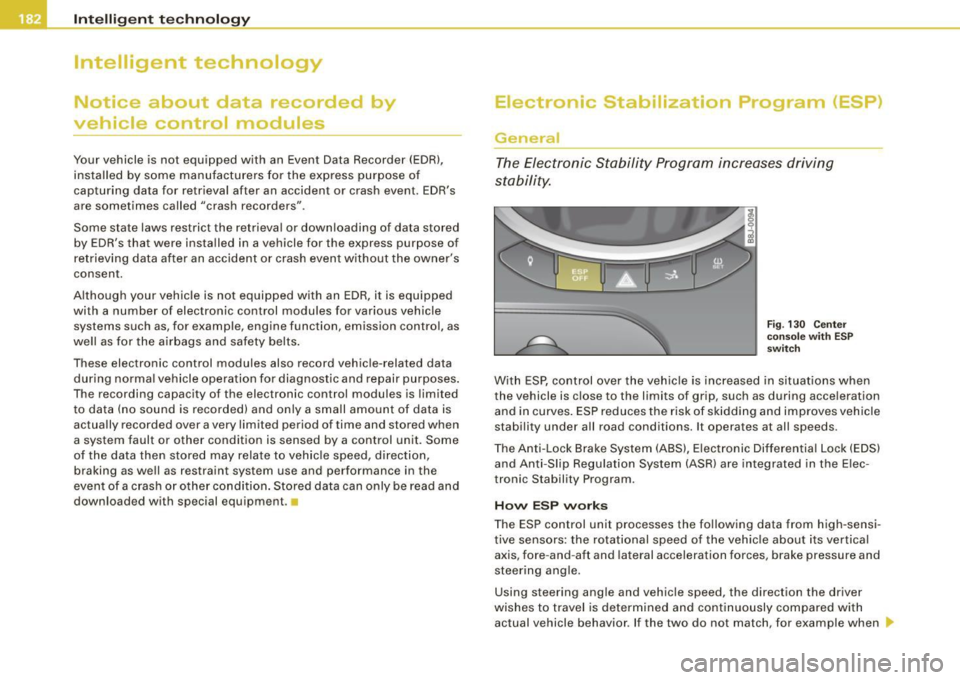
Fig . 13 0 Cente r
cons ole with ESP
sw itch
With ESP, control over the veh icle is increased in situations when
the vehicle is close to the limits of grip, such as during acce leration
and in curves. ESP reduces the risk of skidding a nd improves vehicle
stability under all road conditions . It operates at all speeds .
The Anti-Lock Brake System (ABS), E lec tronic Differentia l Lock (EDS)
and Anti-Slip Regulation System (ASR) are integrated in the Elec
tronic Stability Program .
H ow ESP work s
The ESP control unit processes the following data from high-sensi
tive sensors: the rotational speed of the vehicle about its vertica l
axis, fore -and -aft and lateral acceleration forces, brake pressure and
steering angle.
Using steering ang le and vehicle speed, the direction the driver
wishes to travel is determined and continuously compared with
actual vehicle behavior . If the two do not match, for example when
Page 188 of 316

-Intelligent t echnology
-- -""'------------ ....::....:...:~---------------------------
After 15 cycles (deploy and retract) , manual operation is suspended
f o r up t o 2.5 minutes . Above 75 mph (120 km/h), operation swi tches
to automatic mode .
& WARNING
Driving at higher speeds witho ut the re ar spoiler deployed can
impair handling characteri stics, making the vehicle harder to
c ontrol.
• Always make sure that the spoiler i s deployed when driving at
speeds over 85 mph (140 k m/h). If the rear spoiler warning /ind i
c ator light in the in strument clu ster come s on , the rear spoiler
may not have deployed .
• Never drive at speed s higher than 85 mph (140 km /h ) if the
spoiler is not deployed . Have the spoiler inspe cted as soon as
po ssible by an authorized Audi dealer or qualified workshop.
• Always obey speed limits and other traff ic law s.
& WARNING
Improper operation of the rear spoiler can cause crushing injuries.
• Always make su re that nobody , especially children , is in the
way when the rear spoiler is deployed or retracted.
0 Note
Never push the vehicle or a pply force to the rear spoi ler -it cou ld be
damaged .
[ i ] Tips
Clean the spoi ler compartment every 2 to 3 months . The spoiler
compa rtment must always be free of ice, snow, leaves or other
debris .•
Braking
General "nformation
W hat aff ects braking effi cie ncy?
Operating condition s and driving habits
The brakes on today's automob iles a re sti ll sub ject to wea r,
depending large ly o n operati ng co nditions and driving habits~& .
On vehicles that are either driv en mostly in stop -and -go city traffic
or are driven hard, the brake pads shou ld be c hecked by you r au tho
ri ze d Audi dea ler mor e often than sp ecified in the
Warranty & Main
tenance booklet.
Fai lure to have your brake pads inspected can
resu lt in reduced brake performance.
On s teep sl opes, you should use the braking effec t of the engine .
T his way, you prevent unnecessary wear on the brake sys tem . If you
must use your brakes, do not hold the brakes down continuous ly.
P ump t he b rakes a t interva ls.
Moi sture or road salt
Under certa in conditions, for example , when driving through water
or
ve ry heavy rai n, o r even afte r washing you r ve hicle, the brak ing
e ff ect can be reduced due to moisture (or in freezing cond it io ns ice)
on the brake pads . A few cautious brake applications should dry off
the brake pads or remove any ice coat ings.
T he effectiveness of the brakes can be reduced when the vehic le is
driven on a sa lt-c o ve re d r oad and the brake s are not used . Likew ise,
you clean off accumulated sa lt coat ing from brake discs and pads
wit h a few cau tious applica tions of t he brake ~& .
Corrosion
There may be a tendency for d irt to buil d up o n the b rake pads a nd
corrosion to form on the discs if the car is not driven regular ly or
only for sho rt trips wi th lit t le use of the brakes. ._
Page 189 of 316

If t he brakes ar e not used frequently , or if corrosion has for med on
th e d iscs, i t is adv isa ble to cl ean off the pads a nd disc s by braki ng
firm ly a f ew times from a moderate ly high speed=:> &.
Faults in the brake system
I f yo u shou ld notice a
sudden i ncrease in bra ke pedal trave l, then
o ne of th e two b rake c ircui ts may hav e fa iled =:>& .
Low brake fluid level
M alf unc tions ca n occu r in the br ake system if th e b ra ke flu id leve l is
too low . Th e brake fluid level is monitored e lectronica lly.
Brake lining wear status
B ra ke l inin g wea r may be c hec ked by v is u al inspection of the condi
tion o f the b rake pads t hrou gh the ope ning s in th e wheel. If neces
sary, the wheel may be removed for this inspection=:> page 268,
' 'W hat s hou ld I be aw are o f wh en ch ang ing a ti re ?".
Brake power assist unit
T he bra ke po wer assist unit increas es the pressure that you
generate with the b ra ke peda l. It work s only when the engine is
r u n nin g.
& WARNING
• You should perform braking maneuvers for the purpose of
cleaning the brake system only if road conditions permit . Other
road users must not be put at risk -you may cause an accident!
• Before descending a steep grade , reduce speed and shift trans
mission into a lower gear or lower driving position . Do not ride the
brakes or hold the pedal down too long or too often. This could
cause the brakes to get hot and diminish braking efficiency .
• Do not "ride the brakes " by resting your foot on the pedal when
you do not intend to brake . This may cause the brakes to overheat ,
premature wear and increased stopping distance .
• Under certain climatic and operating conditions such as
passing through water , driving in heavy rain or after washing the
Controls and equip ment Safety first Vehicle operation
Intelligent technology
& WARNING
(continued )
vehicle, the effectiveness of the brakes can be reduced . In winter ,
ice can accumulate on the brake pads , linings , discs and drums .
Cautiously apply brakes for a test. Brakes will dry and ice coatings
will be cleaned off after a few cautious brake applications.
• Driving for an extended period of time on salt-covered roads
without using your brakes can also affect braking efficiency. Clean off accumulated salt coating from brake discs and pads with a few
cautious brake applications.
• If you damage the front spoiler , or if you install a different
spoiler, be sure the air flow to the front brakes is not obstructed.
Otherwise the brake system could overheat reducing the effective
ness of the entire brake system.
• Failure of one brake circuit will impair the braking capability
resulting in an increased stopping distance. Avoid driving the
vehicle and have it towed to the nearest Audi dealer or qualified
workshop.
• Never let the veh icle roll to a stop with the engine shut off .
• If the brake booster is not working, for example when towing
your vehicle , or because the brake booster has somehow been
damaged , the brake pedal must be pre ssed considerably harder to
make up for the lack of booster assistance . •
Anti- lock brake system CABS)
ABS preve nts th e wheels from lo cking under br aking.
The anti -loc k brake syste m (ABS) makes a major contribution to
i nc reas ing active d rivi ng sa fety . You s ho ul d not e xp e ct that braki ng
distances wi ll be
shortened und er all circumstances with ABS .
B ra kin g dis tance may even become s omewhat lon ger, for exa mple,
on gravel or in new snow on s lippery ground, even if you are driving
c aref ully a nd s lowly .
Vehicle care Do-it-yourself service Technical data