2009 AUDI TT COUPE air condition
[x] Cancel search: air conditionPage 200 of 316

___ C _l_e _a _ n_ in_g ~_ a_n _ d ___ p ___ r_ o _t _e _c_ t_ i_o _ n _____________________________________________ _
Cleaning and protection
General information
Regular care preserves vehicle value.
Any automobile is exposed to industrial fumes, corrosive road salt,
muddy dog feet, etc . A wel l cared for Audi can look like new many
years after purchase. Regu lar and correct ca re will contribute to
maintaining the beauty and value of your Audi.
Furthermore, good care may be a conditi on for substantiating a
war ranty claim should co rros ion d amage or p aint defec ts occur .
Your authorized Audi dealer has a variety of dedi cated vehicle- care
product s
and can advise whic h ones to use for cleaning the exterior
and interior of your vehicle.
Whether you use p roducts recommended by Audi or other commer
cially availab le cleaning agents , please make sure you apply them
correctly.
& WARNING
• Cleaning agents may be poisonous . Keep them out of the reach
of ch ildren .
• Heed all caution label s.
• Alway s read directions on the contai ner before u sing any
produ ct. Follow the di rection s carefull y.
• Most chemical cleaner s are concentrated and have to be
d iluted .
• Use s pot removing fluids only in well ventilated area s.
• Do not us e gasoline , ker osene , die sel fuel , nail polish rem over
or oth er volatile fluid s. They may be toxi c, flammable or ha zardous
in other way s. Do n ot w ash, wa x or dry the vehicle w it h the igni
tion on or the engine running.
& WA RNIN G (conti nued)
• Do not clean the under side s of chassis , fe nder s, wheel cove rs,
etc . without protecting your hands and arm s. You may cut yourself
on sha rp -edg ed metal part s.
• Moisture and ice on brakes may impair braking eff iciency
=> page 186 , "General info rm ation ". Test the brake s carefully each
time you wa sh the vehicle.
~ For the sake of the environment
Se lect only environmenta lly friend ly c leaning products . Leftover
clean ing products should not disposed of in the household waste. •
Care of exterior
Washing
Frequent washing protects the vehicle.
Th e best protection against envi ronmental influences is frequent
washing and waxing .
H ow often t his is required depends on:
• H ow much the vehic le is used
• Where the vehicle is pa rked (garage, in the open under t rees,
etc.)
• The seasonal and weather conditions
• Environmental influences
T he longer bird droppings, insects, tree resin, road a nd industrial
grime, tar, soot, road salt and other materials remain on the vehicle
p aint, the more lasting their dest ructive effects will be . _,,,
Page 205 of 316

____________________________________________ _:C ::,: l~ e :,: a~ n:....:..:..: in~ g~ a~n .:.:d:!...! p~ r ~o~ te~ c~t ~io ~ n'....__lftlll
•
T he best way to remove snow from windows and mirrors is to use a
brush . Use a non -abrasive
pla stic ice scraper -better still, a spray
deicer -to remove
ice from w indows and mirrors .
The windows must not be cleaned with insect remover or wax since
these can inter fere with the function of the w inds hie ld w iper blades
(chatter).
Oil, grease o r sil icone residue can be removed with
glass cleaner or
s ilicone remover . However, wax residue requires the use of a
spec ially for mulated solvent . Please contact your Audi dealer for
advice on safe products for wax removal.
Windows should also be c leaned on the inside at regular intervals .
Never dry windows with the same chamois that you use to dry
painted surfaces . Wax residue on the chamois can impair vision
t hrough the windows.
& WARNING
• The windshield mu st not be treated with water -repellent mate
rials. They c an incre ase gl are under poor v isibility conditions such
a s wetne ss, darkne ss, or when the sun i s low on the hori zon. In
addition , they can cause the wind shield wipers to chatter .
• Alway s read and heed all WARNINGS and other information
~ page 198.
0 Note
• Never use warm or hot water to remove snow and ice from
windows a nd mirrors . This could cause the glass to crack.
• T o prevent damage to the wires of the rear defogger, do not place
any adhesive stickers on the inside of the rear window over the
wires.
• T o he lp prevent dirt from scratching the window, always scrape
in a forward direction -pushing the scraper away from you -never
back and forth. •
Weatherstrips
Complete car car e includes the we atherst rip s as well .
App ly a suitable rubbe r con ditioner to the weatherstr ips
f ro m time to tim e.
To be able sea l properly, the weatherstrips around the hood, doors,
rear lid, etc . must remain pliable. Spray the weatherstrips with sili
co ne or coat them w ith ta lcum powder or glycer ine to retain the
f lexibility of the rubber and to protect them against freezing in the
winte r.
& WARNING
Alway s read and heed all WARNINGS and the information
~ page 198.
[ i ] Tip s
Keep si licone sprays off the windshield to avoid wiper smear in
ra in .•
App lies to veh icles : with steel whee ls
Steel wheels
The wheels also h ave to be cleaned.
- Alw ays in clude the hu b caps and whee l rims when
washing yo ur vehi cle to remove road dir t, sal t sprays an d
b rake dust.
If necessary, use a commercial whee l cleaner to remove accumu
lated brake dust.
The wheel rims are easier to keep clean if they are reg ula rly coa ted
with l iquid wax. ..
Vehicle care I t •
Page 208 of 316
-~_C_ l_ e _a _n_ in_g=- a _n_d__, p,__ ro_ t_e _c_ t_ i_o _n _____________________________________________ _
In the case of general soiling of the upho lstery and cover material,
we recommend hiring a s pecialis t tha t has the equ ip m ent to c lean
the seat covers and other fabric surfaces by shampooing and spray
e xtraction .
& WARNING
Always read and heed all WARNINGS and the information
~ page 198 .
[ i ] Tip s
Open Ve lcro fasteners on your clothing can damage the seat cover.
Please make sure that Velc ro fas tene rs a re c losed. •
Plastic parts and instrument panel
Always us e a clea n clo th mo isten ed in cl ear wa ter t o clean thes e
areas . For persistent dirt use an Audi approved
solvent -free plastic
cleane r/ p rotec tan t.
& WARNING
Solvent s can change the propertie s of some plastic s and make it
h arder for the airbag to deploy .
• Never clean the instrument panel or the surface of Airbag
modules with cleaning produ cts that contain solvents .
• Products containing so lvents will make the surface of this part
porous.
• Serious injur ies can re sult if plastic part s come loose when the
airbag is deployed.
• Always read and heed all WARNINGS and the infor mation
~ page 198 .
0 Note
Cleaning agents co ntaini ng so lvents wil l attack t he ma ter ial and can
change the way it behaves .•
Instrument cluster glass
- Clea n the glass w it h a soft, damp clot h.
In order to preserve the anti -glare properties of the instrument
clus ter g lass, it sho uld only be clea ned w ith a soft , dam p clo th .•
Ap plies to vehicl es: w ith n atu ra l le ath er
Natural leather
A udi make s gr eat effo rts to maintai n the pro perti es ,
n at ura l look an d feel of int erior leather.
General
We offer many different types of lea ther on our veh icles . M ost are
different types of nappa leather, which has a smooth surface and
comes in va rious co lors .
Th e intensity o f the color de termi nes the visua l character istics a nd
appearance . If the surface of the leather has a typica l natural look,
t hen the leat her is a nappa leather tha t has been left in a re la tively
natural condition. This leather offers particu lar ly good comfort and
b rea thes well. Fi ne veins, closed grains, insect bi tes, skin fol ds, and
subt le variations in color remain visible. These characteristics
dem onstra te that the mater ial is natura l.
Natura l nappa leather is not covered by a color fin is h . It is therefo re
more sensitive to soiling and wear, which is something you need to
conside r if c hild ren, a nimals o r other factors migh t prove to be
particularly hard on the leather.
By c ontrast, lea ther types that a re covere d by a colo red fini sh layer
are more durable . This has a positive effect on the leather's resis -
~
Page 222 of 316

-~_C_ h_e _c _ k_ i_n ...:::g::;...._ a_n_ d_ f_ i_ll _in -'g:::;.._ ___________________________________________ _
At the time of printing, engine oils available in the U.S. and Canada
that meet the exacting specifications of Audi oil standard VW 502 00
are synthetic engine oils. This does not mean, however, that every
synthetic engine oil will meet Audi oil standard VW 502 00. So
always be sure that you use an approved oil.
To help prevent the formation of harmful deposits use only oil with
the follow ing specifications printed on the oil container:
Audi oil standard VW 502 00
Oil container labels may carry the specification singly or in combi
nation with other designations and oil quality standards.
Viscosity
Engine oils are graded according to their viscosity. The proper
viscosity grade oil for your engine depends on climactic or seasonal conditions where you drive . You can use oil with a viscosity grade of
SAE 5W40 across all temperature ranges for normal driving condi
tions.
However, if engine oil viscosity grade SAE 5W40 is not available, you
can also use viscosity grade SAE 5W -30 or SAE 0W-40 as long as it
meets Audi oil quality standard VW 502 00 specifications.
Because engine oil that meets the Audi oil standard may not be
available everywhere when you need it, we strongly recommend
that you always carry with you an extra quart (liter) of oil that
e xpr ess ly conforms to the VW 502 00 specification, in case you have
to top off the oil while on the road.
Only if the level of the oil is at or below the minimum mark on the
oil dipstick -and no oil that expressly conforms to Audi oi l standard
VW 502 00 specifications is available -may you top off with a high
quality engine oi l, preferably synthetic-based, that meets ACEA A3,
ACEA A5 or ACEA B5, API SL or ILSAC GF-3 specifications, but even
then, only in viscosity grades SAE 5W -40, SAE 5W -30, or SAE 0W -40 .
However, during the entire time between oil change intervals, never
top off with more than a total of 0.5 qt/liter engine oil that does not
conform to Audi oi l specification VW 502 00. For
more information about engine oil that has been approved for
your vehicle, please contact either your authorized Audi dealer or
Audi Customer Relations at 1 (800) 822-2834 or visit our web site at
www .audiusa.com or www .audicanada.ca. Here you will also find a
current list of oils (manufacturers, brand names etc.) that conform
to Audi oil standard VW 502 00.
Changing the engine oil
The engine oil and oil filter must be changed according to the
mileage (kilometers) and time intervals specified in your vehicle's
Warranty
& Maintenance booklet. Do not exceed these intervals -
harmful deposits from old engine oil can reduce engine perfor
mance and can lead to expensive engine repairs.
Changing the oil at the recommended intervals is so very important
because the lubricating properties of oi l decrease gradually during
normal vehicle use. If you are not sure when you have your oil
changed, ask your authorized Audi Service Advisor .
Under some circumstances the engine oil should even be changed
more frequently. Change oil more often if you drive mostly short
distances, operate the vehicle in dusty areas or mostly under stop
and -go traffic conditions, or when you use your vehicle where
temperatures stay below freezing point for long periods.
Deterge nt additives in the oil will make fresh oil look dark after the
engine has been running for a short time . This is normal and is not
a reason to change the oil more often than recommended.
Damage or malfunctions due to lack of ma intenance
It is essential that you change your oil at the recommended interva ls
using only engine oil that complies with Audi oil standard
VW 502 00. Your Limited New Vehicle Warranty does not cover
damage or malfunctions due to failure to follow recommended
maintenance and use requirements as set forth in the Audi Owner's
Manual and Warranty
& Maintenance booklet. Your dea ler will have
to deny warranty coverage unless you present to the dealer proof in
the form of Service or Repair Orders that all schedu led maintenance
was performed in a timely manner. •
Page 230 of 316

-~_C_ h_e _c _ k_ i_n ...:::g::;...._ a_n_d _ f_ i_ll _in -'g:::;.._ ___________________________________________ _
& WARNING
• Bra ke fluid i s poiso nou s. It must be stor ed only in the clo se d
original container out of the rea ch of children!
• Bra ke failure can re sult from old or inappropri ate br ake fluid .
Ob serve the se pre cauti ons:
- Use o nly br ake fluid th at m eets S AE spe cific ation
J 1703 and
co nform s to Fed era l Mo tor Vehic le Standard 11 6. Alway s check
w ith your authori zed Aud i de aler to mak e sure y ou are usi ng
the correc t brake fluid. The corre ct type of brake flu id i s also
indica ted on the br ake fl uid re se rvoi r.
- The brake fluid mu st be new . Heavy u se of the brake s can
ca use a vapor lock if th e bra ke fluid is left in the system too
long. Thi s can seriou sly affect the effic iency of the brake s as
w ell as y our safet y. T his c ould re s u lt in an a ccident .
0 Note
Brake fluid wil l damage the paint of your vehicle .
~ For the sake of the environment
Because of the problem of proper disposal of brake fluid as well as
the special tools required and the necessary expertise, we recom
mend that you have the brake fluid changed by your authorized Audi
dea ler. •
Battery
General information
Your vehicle is equipped with a specia l battery, an AGM battery. This
ba ttery is loca ted in the luggage compar tment and must be
replaced with an original equipment battery. Under normal oper
ating conditions, the battery is
ma inten anc e-free .
Have the battery checked when you take your vehicle in for service .
You a re well advised to replace a battery that is o lder than 5 years .
Disconn ecting th e batt ery te rmin als
Some vehicle functions (power w indow regulators, for example) are
lost if the battery terminals are disconnected. These functions have
to be relearned after the battery terminals are connected again. To prevent this, the battery should only be disconnected from the
vehic le electrical sys tem when abso lutely necessary for repairs .
Vehi cles not dri ven for lo ng p eriods
If you are going to let your vehic le stand for a long time and n ot
drive it, you should remember there are e lectrica l components
whic h are still functioning and they will draw energy from the
battery and drain it, for example, the engine immobilizer. To prevent
t his, you can eithe r charge the batte ry occasionally to keep it in
good working condition or you can disconnect the negative cable
on the battery.
W int er op erati on
During the winter months, batte ry capacity tends to decrease as
temperatures drop . This is because more power is also consumed
whi le starting, and the headlights, rear window defogger, etc ., are
used more often.
Avoid unnecessary power consumption, particularly in city traffic or
when trave ling o nly short distances . Let your authorized Audi dealer
check the capacity of the vehicle battery before winter sets in
~ page 232. A we ll charged battery will not only preven t starting
problems when the weather is cold, but will also last longer.
Repla cing batter y
The new battery must hav e the same capacity, voltage ( 12 volts),
amperage, construction and p lug sea ling, as the orig inal battery .
Specifications are listed on the battery housing. Batteries specia lly
developed by Aud i fulfill the main tenance, output, and safe ty
requirements. ...,
Page 241 of 316

________________________________________________ T_ i _r_e _s_ a_n_ d_ w_ h_ e_e _ l_s __ l'III
•
If yo u w is h to impr ove com fort when operat ing the vehi cle at
nor mal load (up t o 2 occupant s), you c an adju st tire pres sur es to
th ose spe cified f or norm al v ehi cle lo ad . B efo re op era tin g the vehicle
at maximum load , you mu st in crease the tire pre ssure s to tho se
s pe cifi ed for m aximum vehi cle lo ad =>
& .
Bear in mind that the tire pressure mon itor ing syst em * can only
monitor the tire pressures you have stored. The system does not
recogni ze th e load cond ition o f you r vehicle .
T he effec tiveness of the tire pressu re monitoring system * will be
impaired if you store no rmal load pressures bu t then operate the
vehicle at its maximum load=>& . See the
illustra tion=>
page 238, fig . 148 for the location of the label
on driver's side 8 -pillar (co lor of the actual label and exact location
on the vehic le wi ll vary slightly).
Note that the following tab le is accurate at the time of going to
press and is subject to change . In the event of discrepancies, the t ire
pressure label (on dr iver's side 8 -pillar) always takes precedence .
The table below lists the recommended cold tire i nflation pressures
for the Audi mode l covered by your Owner 's Litera ture at the
vehicle's capacity weight and the tire sizes insta lled on the respec
tive models as original equipment , or as a factory option .
Engine
(displ ace
m ent in
liter ) Tir
e design ation Tire pr es sur e front Tire press ure re ar
4 -c ylinder
2 .0 225
/55 R16 95H All Se ason
225 /50 R17 94H All S eason
2 2 5/5 0 R17 94W XL High Perf orma nce
245 /45 R17 95H All Sea son
2 45 /45 R17 95 V XL High Perform ance
245 /40 R18 93H All Se ason
245 /40 R18 93V XL High P erformance
255 /35 R19 96V XL High Perform ance
normal lo ad
conditi on (up to
2 occup ant s)
PSI kPA
32 220
32 220
32 220
32 220
32 220
32 220
32 220
32 220
full load
c ondition
PSI kPA
32 220
32 220
32 220
32 220
32 220
32 220
32 220
32 2 20
Vehicle care
n o rm al l oa d
full load
co ndition (up
condition
to 2 o ccupant s)
PSI kPA PSI kPA
29 200 29 200
29 200 29 200
29 200 29 200
29 200 29 200
29 200 29 200
29 200 29 200
29 200 29 200
29 200 29 200
I t •
Page 248 of 316
___ T_ i_ r_e _s_ a_ n_ d_ w_ h_ e_ e _ ls _________________________________________________ _
New tires and replacing tires and wheels
New tires and wheels have to be broken in.
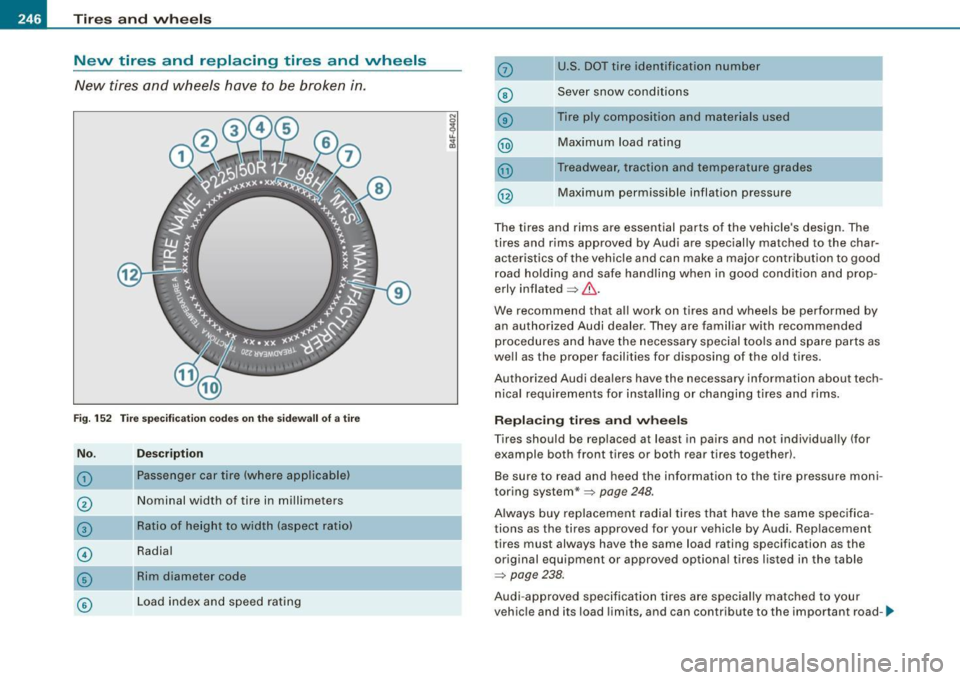
F ig . 1 52 Tir e spec ifi cati on co des o n the sid ewa ll of a t ire
No . Desc ription
G)
®
©
©
©
©
Passenger car tire (where a pplicable)
Nominal width of tire in mi llimeters
Ratio of he ight to width (aspect ratio)
Radial
Rim diameter code
Load index and speed rating
0
©
©
@
@
U.S. DOT tire identification number
Sever snow conditions
Tire ply composition and materials used
Maximum load rating
Treadwear, traction and temperature grades
@ Maximum permissible inflation pressure
The tires and rims are essential parts of the vehicle's design. The
tires and rims approved by Audi are special ly matched to the char
acteristics of the vehicle and can make a major contribution to good
road ho lding and safe hand ling when in good cond ition and prop
erly inflated
~ & .
We recommend that all work on tires and wheels be performed by
an authorized Audi dealer . They are familiar with recommended
procedures and have the necessary special too ls and spare parts as
well as the proper facilities for disposing of the old tires.
Authorized Audi dea lers have the necessary information about tech
n ical requirements for insta lling or changing tires and rims .
Replacing tires and wheel s
Tires should be replaced at least in pairs and not individual ly (for
example both front tires or both rear tires together) .
Be sure to read and heed the information to the tire pressure moni
toring system *~ page
248 .
Always buy replacement radial tires tha t have the same specifica
tions as the tires approved for your vehicle by Audi . Replacement
tires must always have the same load rating specification as the
original equipment or approved optiona l tires listed in the table
~ page 238.
Audi -app roved specification tires are specially ma tched to your
vehic le and its load limits, and can contribute to the important road-~
Page 250 of 316

-~_T_ ir_e_ s_ a_ n_d _ w_ h_ e_e _l_s _________________________________________________ _
ture. For example, the numbers 2209 mean that the tire was
produced in the 22th week of 2009. The other numbers are
marketing codes that may or may not be used by the tire manufac
turer. This information is used to contact consumers if a tire defect
requires a recall.
Tire ply composition and materials used
The number of plies indicates the number of layers of rubber-coated
fabric in the tire. In general, the greater the number of plies, the
more weight a tire can support. Tire manufacturers also must indi
cate the materials in the tire, which include steel, nylon, polyester,
and others .
Maximum Load Rating
This number indicates the maximum load in kilograms and pounds
that can be carried by the tire.
Tire quality grading for treadwear, traction, and
temperature resistance
Tread wear, traction and temperature grades => page 249.
Maximum Permissible Inflation Pressure
This number is the greatest amount of air pressure that should ever
be put in the tire under normal driving conditions.
Replacing tires or rims on vehicles equipped with tire
pressure monitoring system*
The wheels on your vehicle are equipped with a sensor which
constantly monitors the air pressure inside the tire, and then trans
mits this information to the tire pressure monitoring system *. If you
are going to replace the wheel rims on your vehicle, make sure the
new rims also have these sensors . The sensors must be compatible
with the tire pressure monitoring system * on your vehicle.
If the sensors are to be installed on different rims , the seal, washer ,
and valve cap for each sensor must be replaced.
If you install rims, which do not have the sensors, or have sensors
which are not compatible, then the tire pressure monitoring system* will not work properly.
In this case, the tire pressure moni
toring system * would not be able to monitor the tire pressure or
warn you if it is necessary .
• The battery inside of the tire pressure sensor has a limited
service life.
• Always drive with the valve stem caps securely mounted. We
recommend using factory installed valve stem caps. Ask your autho
rized Audi dealer to replace lost valve stem caps.
The installation of replacement tires with steel cord body plies in
the tire sidewall may cause malfunction of the tire pressure moni
toring system*, and is not recommended (cord material information
in molded on the tire sidewall) .
Always check your tire pressure monitoring system* indicator after
replacing one or more tires on your vehicle. If the tire pressure
monitoring system* indicator flashes, or is on, your system is not
working properly. Your replacement tire might be incompatible with
your tire pressure monitoring sys tem* , or some component o f the
tire pressure monitoring system* may be damaged.
& WARNING
• Using incorrect or unmatched tires and/ or wheels or improper
tire and wheel combinations can lead to loss of control, collision
and serious personal injury.
• Always use tires, rims and wheel bolts that meet the specifica
tions of original factory-installed tires or other combinations that
have been specifically approved by the vehicle manufacturer .
• Tires age even if they are not being used and can fail suddenly,
especially at high speeds. Tires that are more than 6 years old can
only be used in an emergency and then with special care and at
lower speeds.
• Never mount used tires on your vehicle if you are not sure of
their "previous history." Old used tires may have been damaged
even though the damage cannot be seen that can lead to sudden
tire failure and loss of vehicle control. .,_