2009 AUDI S6 warning
[x] Cancel search: warningPage 290 of 398
___ C_ le_ a _ n_i_n ~g _ a_ n_ d __ p_r _o _t _e _c_ t_ i_o _n ___________________________________________ _
brake dust is also corrosive. If left on for too long, brake dust can
cause pitting.
Use on ly specia l
acid-free cleaners formulated for a lloy r ims . Safe
products are available at your Audi dealer. Never leave the cleaner
on the ri ms longer than specified on the label. If not rinsed of f
promptly, the acid contained in some c leaners can attack the
threads o n the wheel bo lts .
Never use abrasive or metal po lishing c leaning agents. If the protec
tive coating has been chipped, e.g . by kicked up road dirt, touch i t
up as soon as poss ible .
& WARNING
• Moisture and i ce on b rake s may affe ct b raking effi cien cy
~ page 26 5, "General information ". Te st the brake s carefully ea ch
t ime you wa sh the vehi cle .
• Always read and heed all WARNINGS and other information
~ pag e 282. •
Body cavity sealing
T he body cavity sealing does not nee d to be checked .
All body cavities which could be affected by corrosion have been
t horoughly pr otected a t the factory .
This sealing does not require any inspection or additional treat
ment . If any wax should seep out of the cavity when the ambient
temperature is high, it can be removed with a plastic scraper and a suitable solvent .
& WARNING
Solvents can be dangerous.
• Ben zine is fla mmab le and to xic . If you use be nzine fo r removing
the wax , keep sparks, f lame and lighted cigarettes away . Never
& W ARN ING (continued )
dump benz ine on the ground , into open streams or down sewage
dra in s.
• Be sure to observe all safety and env ironmental regulat ions .
Follow all in struction s on the cont ainer .
• Alway s read and heed all WARNINGS and other inform ation
~ page 282 .•
Chassis
Have the u nderc oating c hecked for dama ge from tim e to
time.
T he lower body shell of your Audi is also thoroughly protected
aga inst corrosion .
Any damage to the undercoat ing caused by road hazards shou ld be
repaired promptly.
& WARNING
Too much undercoating in the wrong place s can cau se a fire .
• Do not app ly addition al und ercoating or rustproofing on or
near the exhaust manifold , exhau st pipe s, catalytic converter or
he at shield s. While dr iving , the sub stance used for underco ating
could overhe at and cau se a fire .
• Alwa ys read and heed all WARNINGS and other info rm ation
=> page282 .•
Page 291 of 398

_____________________________________________ C_ l_ e _a_ n_ in_ g_a _ n_d_ p_ r_ o_ t _e_ c_t _io _ n __ lR
•
Care of interior
MMI display
- Clean th e MMI display with a soft c lean cloth and an LCD
cl eane r.
The MM I disp lay can be cleaned with a professional ly available "LCD
cleaner". The cloth should be s lightly dampened with the c leaning
fluid to clean the display.
0 Note
T o avoid scra tching the MMI display, you should never c lean it dry .•
MMI terminal
- First clean the MMI terminal with a brush to remove dust
from the housing.
- T hen wipe the MMI terminal wit h a clea n, soft, s lig htly
damp cloth .
The MMI terminal shou ld be c leaned with a brush first so that no
dirt is trapped between the buttons and the housing. We recom
mend giving the MM I terminal a final wipe with a c loth moistened
with water and dish washing dete rgent.
0 Note
To prevent damage, make sure that no flu id ever gets into the M MI
terminal. •
Aluminum trim
Use only neutral-pH products to remove spots and deposits from
a lum inum surfaces . C hro me care products an d alka line cleaners
wi ll attack aluminum surfaces and can damage them over time.
& WARNING
Always read and heed all WARNINGS and other information
~ page 282 .•
Fabrics and fabric coverings
Fabrics and fabric coverings (e.g . seats, door trim panels, etc.l
shou ld be c leaned at regular intervals with a vacuum cleaner . This
re moves surface dirt partic les which could become embedded in
the fabric through use. Steam cleaners shou ld not be used, because
t he steam tends to push the d irt deeper into the fabric and lock it
there.
Normal cl eaning
Genera lly, we recommend using a soft sponge or a lint -free
microf iber c loth to the clean fabric . Brushes should on ly be used for
carpets and floor mats, since other fabric surfaces could be harmed
by brushes.
Norma l surface stains can be cleaned using a commercially avail
able foam cleaner. Spread the foam on the surface of the fabric with
a soft sponge and work it in gent ly. Do not saturate the fabric . Then
pat the foam dry using absorbent, d ry cloths (e.g. microfiber cloth)
and vacuum it a fter it has dried completely .
Cleaning stains
Stains caused by beverages (e.g. coffee, fruit juice, etc.) can be
treated with a mild detergent so lution . Apply the detergent so lution
with a sponge. In the case of stubborn stains, a detergent paste can be applied direct ly to the stain and worked into the fabric. After -.,.
Vehicle care I t •
Page 292 of 398
___ C_ le_ a _ n_i_n ~g _ a_ n_ d __ p_r _o _t _e _c_ t_ i_o _n ___________________________________________ _
wards, use copious amounts of clean water to remove the
rema ining detergen t. App ly the wa ter w ith a damp cloth or sponge
and pat the fabric dry with an absorbent, dry c loth.
Stains from choco late or makeup should have detergent paste (e.g .
ox -ga ll soap) rubbed into them. A fterwards, remove the soap w it h
water (damp sponge).
A lcoh ol can be us ed t o t rea t sta ins fro m grease, oil, lipstick o r a ba ll
point pen. Melted grease or dye must be patted off using absorbent
ma te ri al. It may be neces sary to retreat the a reas w ith de tergent
paste and water .
In the case of genera l soiling of the upho lstery and cover material,
we recommend h ir ing a specialis t that has the equ ip m ent to c lea n
the seat covers and other fabric surfaces by shampooing and spray
e xt rac tion.
& WARNING
Always read and heed all WARNINGS and the information
~ page 282 .
[ i] Tips
Open Ve lcro fasteners on your clothing can damage the seat cover.
Please make sure that Velcro fas tene rs a re c losed .•
Plastic parts and instrument panel
A lways use a clean cloth mo iste ned in cl ear wa ter to clean these
areas . For persistent dirt use an Audi approved
solvent-free plastic
cleaner/ protectant.
in. WARNING
Solvents can change the properties of some plastics and make it
harder for the airbag to deploy.
& WARNING (continued )
• Never clean the instrument panel or the surface of airbag
modules with cleaning products that contain solvents .
• Products containing solvents will make the surface of this part
porou s.
• Serious injuries can result if plastic parts come loose when the
airbag is deployed .
• Alway s read and heed all WARNINGS and other information
~ page 282.
0 Note
Cleaning agents containing so lvents wil l attack the material and can
c hange t he way it behave s.•
App lies to vehicles: with natu ra l l eathe r
Natural leather
Aud i mak es gr eat effo rts to main ta in the p roperties ,
n atu ra l look an d fee l of interior le athe r.
General
We offe r ma ny diff erent typ es of leather on our v ehicles . M ost ar e
different types of nappa leather, which has a smooth surface and
comes in va rious co lors .
T he intens ity o f the color de termi nes t he visua l character ist ics a nd
appearance. If the surface of the leather has a typica l natural look,
th en the leathe r is a nappa leather t hat has bee n l eft in a re lat ive ly
natural condition. This leather offers particu lar ly good comfort and
b reathes well. Fi ne vei ns, closed g ra ins, ins ect bit es, ski n folds, a nd
subt le variations in color remain visib le. These character istics
dem onstrate tha t the mate rial is natural.
Natura l nappa leather is not covered by a color finis h. It is therefo re
more sens itive to so iling and wea r, which is something you need to ...
Page 294 of 398
___ C_ le_ a _ n_i_n ~g _ a_ n_ d __ p_r _o _t _e _c_ t_ i_o _n ___________________________________________ _
Cleaning spots
- Remove fresh water-based spots (such as coffee, tea,
juices, blood) with an absorbent cloth or paper towel.
- Remove fresh
grease or oil-based spots (such as butter,
mayonnaise, chocolate) with an absorbent cloth or paper
towel, or use the cleaner from the leather care kit if the
spot has not yet penetrated into the surface of the
leather.
- Use an oil/grease dissolving spray, if
oil/grease spots
have dried on.
- Remove specific kinds of spots (ballpoint pen, felt
marker, fingernail polish, water-based paint, shoe polish,
etc.) with a spot remover specifically formulated for leather.
Leather care
- Every half year use an approved leather care product
(available from your Audi dealer) to care for the leather.
- Apply the product very sparingly.
- Wipe it off with a damp cloth.
If you have any questions about cleaning and caring for the leather
in your vehicle, it is best to contact your authorized Audi dealer, who
will be glad to help you and tell you about our full range of leather
care products, such as:
• Leather cleaning and care kit
• Creams to care for colored leather
• Spot removers for ballpoint pens, shoe polish, etc .
• Oil/grease dissolving spray
• New and upcoming products.
& WARNING
Always read and heed all WARNINGS and other information
=> page 282.
0 Note
• Never use chemical solvents (e.g. lighter fluid, turpentine),
waxes, shoe polish or similar products on the leather surfaces in
your Audi.
• To avoid damage, have stubborn stains removed by a commer
cial cleaning specialist. •
Applies to ve hicle s : with A lc a nt ara up ho lst ery
Cleaning Alcantara ® (synthetic suede)
Removing dust and dirt
- Moisten a cloth, squeeze out excess water and wipe down
the seat surfaces.
Removing stains
- Moisten a cloth with lukewarm water or with diluted
ethyl (rubbing) alcohol.
- Dab at the stain. Start at the outside and work inwards.
- Once the stain is no longer visible, use a soft dry cloth or
tissue to soak up the moisture.
Do not use leather cleaning products on Alcantara .
You may use a suitable shampoo for removing dust and dirt.
Dust and grit in the pores and seams can scratch and damage the
surface . If the car is left standing in the sun for long periods , the
Alcantara should be protected against direct sunlight to prevent it .,.
Page 295 of 398

_____________________________________________ C_ l_ e _a_ n_ in_ g_a _ n_d_ p_ r_ o_ t _e_ c_t _io _ n __ l'III
•
from fading. Slight color variations will develop in normal use and
are not an indication of material deterioration.
0 Note
• Never use chemical solvents (e.g. lighter fluid, turpentine),
waxes, shoe polish or similar products on Alcantara ® surfaces.
• To avoid damage, have stubborn stains removed by a commer
cial cleaning specialist.
• Do not use brushes, stiff sponges or similarly abrasive cleaning
aids .•
Safety belts
Only well-maintained safety belts work reliably when
needed.
- Keep belts clean.
- For cleaning, use a mild soap and water solution . Let
belts dry thoroughly and away from direct sunlight .
- Do not allow inertia reel safety belts to retract before
they are completely dry.
- Check the condition of your safety belts
regularly.
Heavily soiled safety belts may not retract properly.
& WARNING
Damaged safety belts can break in a crash.
• Anything that might damage your safety belts could mean that
you and your passengers would not be adequately protected in an
accident.
• Safety belt performance depends on correct installation. Never
remove belts from the vehicle to clean them.
& WARNING (continued)
• Do not use chemical cleaning agents, bleach or dyes. They have
corrosive properties which weaken the webbing.
• When cleaning your safety belts, inspect them for damage. If
you discover damage, see your Audi dealer.
• Always read and heed all WARNINGS and other information
~ page282. a
Engine compartment
Be especially careful when cleaning the engine compart
ment.
Always switch off the ignition before cleaning the engine ~ &.
Plenum panel
Remove leaves from the plenum panel in front of the windshield
under the engine hood. This prevents the water drain holes from
becoming blocked, and it prevents debris from entering the vehicle
interior through the heating and ventilation ducts.
Corrosion protection
The engine compartment and transmission have been corrosion
protected at the factory.
Good anti -corrosion treatment is very important, particularly in the
winter. If the vehicle is frequently driven on salt treated roads, the
entire engine compartment and plenum panel should be thor
oughly cleaned at the end of winter and retreated to prevent salt
damage. At the same time, the underside of the vehicle should be
washed as well.
If the engine compartment is cleaned at any time with grease
removing solutions
2 l, or if you have the engine washed, the anti
corrosion treatment is almost always removed as well. It is therefore .,_
21 Use only th e correct cleaning solut ions. N ev er use gasolin e or di ese l fu el.
Vehicle care I t •
Page 296 of 398
___ C_ le_ a _ n_i_n ~g _ a_ n_ d __ p_r _o _t _e _c_ t_ i_o _n ___________________________________________ _
essential to have a long-lasting corrosion protection reapplied to al l
s urf aces, sea ms, joi nts a nd compo nents i n th e en gine c om par t
m ent .
& WARNING
Be aware: The engine compartment of any motor vehicle is a
potentially hazardous area.
• Before working in the engine compartment , be sure to read the
information
=> page 293.
• Before reaching into the front plenum panel, always remove the
ignition key . Otherwise, the windshield wipe r system could unin
tentionally be switched on , possibly causing personal in jury from
the moving wiper linkage .
• Never reach into the area around or touch the radiator fan . The
auxiliary fan is temperature controlled and can switch on suddenly
- even when the ignition is off.
• Do not wash, wax or dry the engine with the engine running .
Moving or hot parts could injure you .
• Do not clean the underside of the chassis , fenders, wheel
covers, or other hard to reach parts without protecting your hands
and arms. You may cut yourself on sharp -edged metal parts.
• Always read and heed all WARNINGS and other information
=> page 282 . •
Page 299 of 398
The labe l on the inside of the fuel filler flap tel ls you the correct fuel
fo r your vehicle . For mo re information about fuel specifications, see
=> page 295.
Your vehicle fuel tank has an on -board refuelling vapor recovery
sys tem. Th is feature helps to prevent fue l vapors from escapin g
from the tank and polluting the environment wh ile you refue l your
veh ic le . I n order to fill the tank properly while protecti ng the envi
ronment, please follow this refuel ing procedure carefully .
& WARNING
Under normal operating conditions , never carry additional fuel
c ontainers in your car . Ga s canister s and other containers used to
transport fuel can be dangerous . Such conta iners , full or empty,
may leak and could cause a fire in a collision . If you mu st transport
fuel to use for your lawn mower , snow blower , etc. , be very c areful
and always ob serve local and state laws regarding the u se , tran s
port ation and storage of su ch fuel containers . Make certain the
c ontainer meets industry standard s (ANSI/ASTM F852 · 86 1.
0 Note
Neve r d rive your vehicle until the fuel tank is completely emp ty . The
irregular supp ly of fuel can cause misfiring . Gasoline could enter
t he e xhaus t system and damage the cataly tic converter. •
Fuel supply and filling your fuel tank
Refuelling
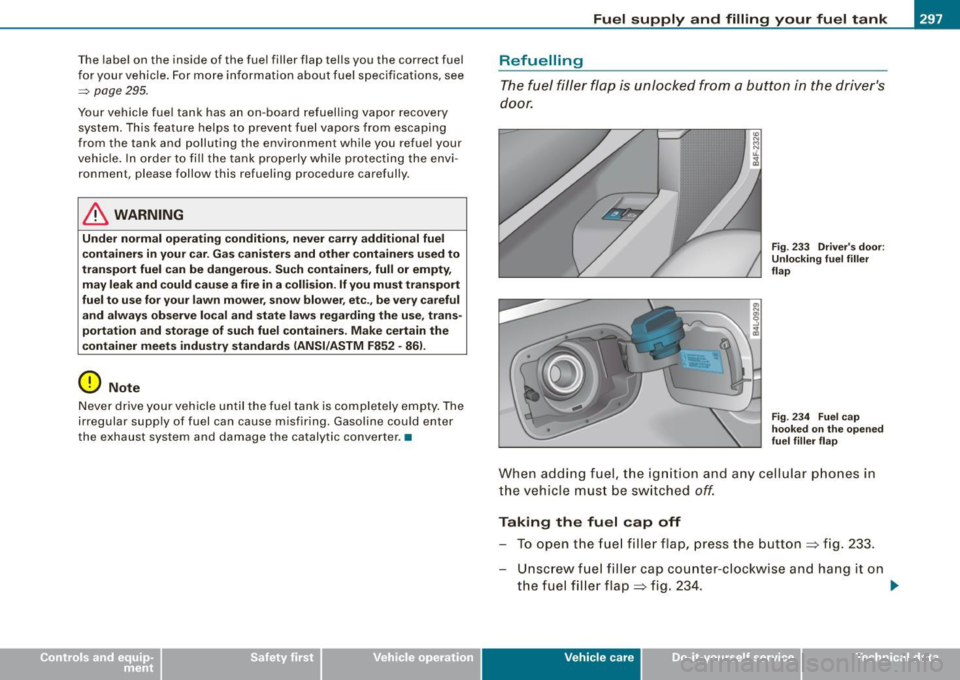
The fuel filler fl ap is unl ocked f rom a but ton i n the driver' s
door.
F ig . 2 33 Driver 's do or:
Unlo cking fuel filler
flap
F ig . 234 Fue l cap
ho oked on th e op ened
fuel fi ller flap
W hen a dding f uel, the ig nitio n and a ny c ellu lar phones in
th e ve hicl e m ust b e sw it c hed
off.
Taking the fuel cap off
To open t he fue l fille r flap, press the button ~ fig. 233 .
Unsc rew f ue l filler cap co unter-c lockwise and hang it on
the fue l fi ller flap ~ fig. 234 . ..,
Vehicle care I I irechnical data
Page 300 of 398
Fuel supply and filling your fuel tank Refuelling procedure
- Insert the fuel nozzle from the gasoline pump into the
fuel filler neck as far as it will go.
- Select a medium refuelling rate so that the nozzle switches off automatically when the tank is full.
Putting the fuel cap back on
- After filling your tank, twist the fuel filler cap clockwise
until you hear a definite click.
Close the fuel filler flap.
To avoid fuel spilling or evaporating from the fuel tank always close
fuel filler cap properly and completely. An improperly closed fuel
filler cap may also cause the MIL lamp=>
page 27to come on.
& WARNING
Improper refueling or handling of fuel can cause fire, explosion
and severe burns.
• Fuel is highly flammable and can cause severe burns and other
injuries.
• Failure to shut the engine off while refueling and/or to insert
the pump nozzle fully into the fuel filler neck could cause fuel to spray out of filler neck or to overflow. Fuel spray and overflowing
fuel can cause a fire.
• Never use a cellular telephone while refueling . The electromag
netic radiation can cause sparks that can ignite fuel vapors and
cause a fire.
• Never get back into your vehicle while refueling. If in excep
tional circumstances you must get back in your vehicle while refu
eling, make certain that you close the door and touch metal to
discharge static electricity before touching the filler nozzle again.
Static electricity can cause sparks that can ignite fuel vapors
released during refueling .
& WARNING (continued)
• Never smoke or have an open flame anywhere in or near your
vehicle when refueling or filling a portable fuel container.
• For your safety, we strongly recommend that you do not travel
with a portable fuel container in your vehicle. The container, full or
empty may leak and could cause a fire, especially in a crash.
• If, under exceptional circumstances, you must transport a
portable fuel container, please observe the following:
-Never fill a portable fuel container while it is anywhere in or
on the vehicle (for example, in the luggage compartment, or on
the trunk). Static electricity can build up while filling and can
ignite fuel vapors causing a fire.
- Always place a portable fuel container on the ground before
filling.
- Always keep the filler nozzle completely inside the portable
container before and during filling.
- If filling a portable container made of metal, the filler nozzle
must always be in contact with the container. This will help
prevent static electricity from discharging and cause a fire.
- Never spill fuel inside the vehicle or luggage compartment. Fuel vapors are highly flammable .
- Always observe local and state/provincial laws regarding the
use, storage and transportation of fuel containers.
- Make certain the fuel container meets industry standards
(ANSI / ASTM F852-86l.
0 Note
If any fuel has spilled onto the car, it should be removed immedi -
ately to prevent damage to the paint. _.,