2009 AUDI S6 warning
[x] Cancel search: warningPage 318 of 398
___ C_h_ e_ c_k _in --=:: g;__ a_n _d_ f_il _li _n ..:g:a.- ___________________________________________ _
0 Note
Make sure the ventilation hose on the side of the battery is
connected, otherwise fumes or battery acid can leak out.
mend your authorized Audi dea ler change the battery for you.
Batteries contain sulfuric acid and lead and must always be
disposed of properly in compliance with all environmental regula
tions . Disposing of vehicle batteries improperly is very dangerous to
t he environment. •
Windshield/headlight washer
container
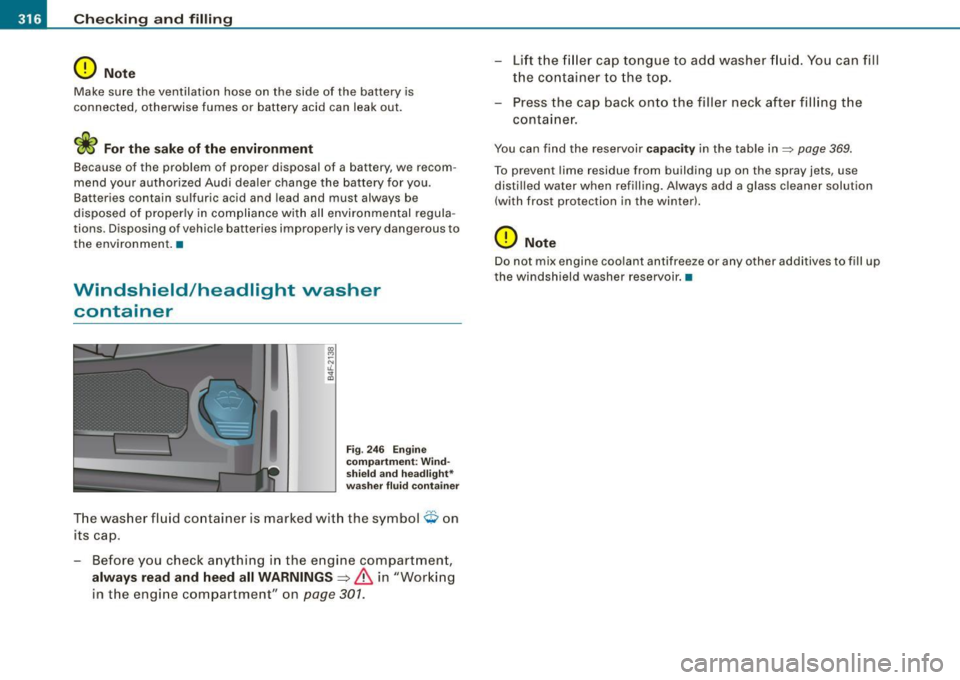
Fig . 246 Engine
compartment: Wind
s hie ld and headlight*
washer fluid container
The washer fluid container is marked with the symbol O on
its cap.
- Before you check anything in the engine compartment,
always read and heed all WARNINGS :::> & in "Working
in the engine compartment" on page
301 .
-Lift the fille r cap tongue to add washer fluid. You can fill
the container to the top.
- Press the cap back onto the filler neck after filling the
container.
You can find the reservoir capacity in the table in=> page 369.
To prevent lime residue from building up on the spray jets, use
distilled water when refilling. Always add a gla ss cleaner solution
(with frost protection in the winter).
0 Note
Do not mix engine coolant antifreeze or any other additives to fill up
the windshield washer reservoir.•
Page 319 of 398

________________________________________________ T_ i _r_e _s_ a_n_ d_ w_ h_ e_e _ l_s __ lllll
•
Tires and wheels
Tires
General notes
Tires may be the least appreciated and most abused parts
of a motor vehicle.
Tires may be the least appreciated and most abused parts of a
motor vehicle. Tires are, however, one of the most important parts
of a vehicle, particularly considering the comparative ly sma ll patch
of rubber on each tire that assures that all- important contact
between you, your vehicle and the road .
Maintaining the correct tire pressure, making sure that your vehicle
and its tires do not have to carry more weight than they can safely
handle, avoiding damage from road hazards and regu lar ly
inspecting tires for damage inc luding cuts , slashes irregular wear
and overa ll condition are the most important things that you can do
to help avoid sudden tire failure including tread separation and
b lowouts .
Avoiding dama ge
If you have to drive over a curb or similar obstacle, drive very slow ly
and as close as possible at a right angle to the curb.
A lways keep chemica ls includ ing grease, oil, gasoline and brake
f luid off the tires.
I nspec t the tires regularly for damage (cuts, cracks or blis ters, etc.l.
Remove any foreign bodies embedded in the treads.
Storing tires
Mark tires when you remove them to indicate the direction of rota
tion . This ensu res you to be ab le to mount them correctly when you
reinstal l them. When removed, the wheels or tires shou
ld be stored in a coo l, dry
and preferably dark place.
St ore t ires in a vertical posit ion if they a re not mounted on rims, in
a horizontal position if they are mounted on rims.
New tire s
New tires have to be broken in~&.
The tread dep th of new tires may va ry, according to the type and
make of tire and the tread pattern.
Hidden d ama ge
Damage to tires and rims is often not readily visible. If you notice
unusua l vibration or the vehicle pul ls to one side, this may indicate
that one of the tires has been damaged . The tires must be checked
immed iately by an authorized Audi dealer or qualified workshop .
Unidire ction al tir es
A unidirectio nal tire can be iden tif ied by arrows on the s idewa ll, that
point in the direction the tire is designed to rotate. You must follow
the specified direction of ro tation . This is necessary so that these
tires can deve lop their optimum characteristics regarding grip, road
noise, wear and hydroplaning resistance . For more information
~ page 349.
in. WARNING
Ne w tire s or tire s that are old , worn or damaged cann ot pro vide
m aximum cont rol and braking ability.
• New tire s tend to be slippe ry and m ust be broken in . To redu ce
the risk of losing control, a colli sion and seriou s per sonal injurie s,
drive with speci al care for t he fi rst 350 m ile s ( 560 km l.
• Driving with worn or damaged t ire s can lead to lo ss of co ntrol ,
s udd en tire failure , in clu ding a blowout a nd sudden deflation , .,,_
Vehicle care
I t •
Page 320 of 398
-~_T_ ir_e_ s_ a_ n_d _ w_ h_ e_e _l_s _________________________________________________ _
& WARNING (continued)
crashes and serious personal injuries . Have worn or damaged tires
replaced immediately.
• Tires age even if they are not being used and can fail suddenly,
especially at high speeds. Tires that are more than 6 years old can
only be used in an emergency and then with special care and at
low speed.
Glossary of tire and loading terminology
Accessory weight
means the combined weight (in excess of those standard items
which may be replaced) of automatic transmission, power steering,
power brakes, power windows, power seats, radio, and heater, to
the extent that these items are available as factory-installed equip
ment (whether installed or not).
Aspect ratio means the ratio of the height to the width of the tire in percent.
Numb ers of 55 or lower indicate a low sidewall for improved
steering response and better overall handling on dry pavement.
Bead
means the part of the tire that is made of steel wires, wrapped or reinforced by ply cords and that is shaped to fit the rim.
Bead separation means a breakdown of the bond between components in the bead.
Cord
means the strands forming the plies in the tire.
& WARNING (continued)
• Never mount used tires on your vehicle if you are not sure of
their "previous history." Old used tires may have been damaged
even though the damage cannot be seen that can lead to sudden
tire failure and loss of vehicle control.
• If you notice unusual vibration or if the vehicle pulls to one side
when driving, always stop as soon as it is safe to do so and check
the wheels and tires for damage . •
Cold tire inflation pressure
means the tire pressure recommended by the vehicle manufacturer
for a tire of a designated size that has not been driven for more than
a couple of miles (kilometers) at low speeds in the three hour period
before the tire pressure is measured or adjusted .
Curb weight means the weight of a motor vehicle with standard equipment
including the maximum capacity of fuel, oil, and coolant, air condi
tioning and additional weight of optional equipment.
Extra load tire
means a tire designed to operate at higher loads and at higher infla
tion pressures than the corresponding standard tire . Extra load tires
my be identified as "XL",
"xi", "EXTRA LOAD", or "RF" on the side
wall.
Gross Axle Weight Rating ("GAWR")
means the load-carrying capacity of a single axle system, measured
at the tire -ground interfaces .
Gross Vehicle Weight Rating ("GVWR"l
means the maximum total loaded weight of the vehicle.
Page 322 of 398
-~_T_ ir_e_ s_ a_ n_d _ w_ h_ e_e _l_s _________________________________________________ _
Sidewall
means that portion of a tire between the tread and bead.
Speed rating
extended periods of time. The ratings range from 93 mph (150 km/h)
to 186 mph (298 km/h)=>
page 330. You may not find this informa
tion on a ll tires because it is not required by law.
The speed rating letter code, where applicable, is molded on the tire sidewa ll and indicates the maximum perm issible road speeds =>
&
in "Winter tires" on page 333.
Tire pressure monitoring system
means a system that detects when one or more of a vehicle 's tires
are under inflated and illuminates a low tire pressure warning te ll
tale.
Tread
means that portion of a tire that comes into contact with the road.
Tread separation
means pu lling away of the tread from the tire carcass.
Treadwear indicators (TWI)
means the projections within the principa l grooves designed to give
a visual indication of the degrees of wear of the tread . See
=>
page 327, "Tread Wear Indicator (TWI)" for more information on
measuring tire wear .
Uniform Tire Quality Grading
is a tire information system developed by the United States National
Highway Traffic Safety Adm inistration (NHTSA) that is designed to
help buyers make relative comparisons among tires. The UTQG is
not a safety rati ng and not a guarantee that a tire will last for a
prescribed number of miles or perform in a certain way . It simply
gives tire buyers additiona l information to comb ine with other
considerations, such as price, brand loyalty and dealer recommen- dations
. Under UTQG, tires are graded by the tire manufacturers in
t hree areas : treadwear, traction and temperature resistance. The
UTQG information on the tires, molded into the sidewalls.
U .S . DOT Tire Identification Number (TIN )
This is the tire's "seria l number" It begins with the letters "DOT" and
indicates that the tire meets a ll federal standards. The next two
numbers or letters indicate the plant where it was manufactured,
and the last four numbers represent the week and year of manufac
ture. For example,
DOT ... 2208 ...
means that the tire was produced in the 22nd week of 2008. The
other numbers are marketing codes that may or may not be used by
the tire manufacturer. This information is used to contac t
consumers if a tire defect requires a reca ll.
Vehicle capacity weight
means the rated cargo and luggage load plus 150 lbs . (68 kilograms)
t imes the vehicle's tota l seating capacity as listed on the label
located on the driver's side 8-pillar.
Vehicle maximum load on the tire
means that load on an individual tire that is determined by distrib
uting to each ax le its share of the maximum loaded vehicle weight
and dividing by two.
Vehicle normal load on the tire
means that load on an individual tire that is determined by distrib
uting to each axle its share of the curb weight, accessory we ight,
and normal occupant weight (distributed in accordance with table
below =>
page 327) and divid ing by two. ~
Page 325 of 398
Tires and wheels -
----------------
•
The correct tire pressure for the spare wheel is located on a label on
the driver's side 8 -pillar.
Because technical changes may be made to vehicle equipment
during the mode l year, always compare the tire size designation on
the tire pressure label on your vehicle with the tires on your vehicle.
Make sure that the tire size information on the vehicle label is the
same as the size of the tires on the vehicle. This is especially impor
tant if the vehicle belongs to someone else or you bought the
vehic le with different rims/tires or you bought the vehicle as a previ
ously owned vehicle.
Remember, your safety and that of your passengers also depends
on making sure that load l imits are not exceeded. Vehicle load
includes everybody and everything in and on the vehicle . These load
limits are techn ically referred to as the vehicle's Gross Veh icle
Weight Rating ("GVWR"l. The Gross Axle Weight Rating ("GAWR"l is
the maximum load that can be applied at each of the vehicle's two
axles. The Gross Vehicle Weight Rating and the Gross Axle Weight
Rating are listed on the safety compliance sticker label located on
the driver's side 8-pillar. The tire pressure label on your Audi lists
the maximum comb ined weight of all of the occupants and luggage
or other cargo that the vehicle can carry. For the location of the tire
pressure label =>
page 327, fig. 247.
& WARNING
Overloading a vehicle can cause loss of vehicle control, a crash or
other accident , serious personal injury, and even death .
• Carrying more weight than your vehicle was designed to carry
will prevent the vehicle from handling properly and increase the
risk of a loss of vehicle control.
• The brakes on a vehicle that has been overloaded may not be
able to stop the vehicle within a safe distance.
• Tires on a vehicle that has been overloaded can fail suddenly
causing loss of control and a crash.
& WARNING (continued)
• Always make sure that the total load being transported -
including the weight of a trailer hitch and the tongue weight of a
loaded trailer -does not make the vehicle heavier than the
vehicle's Gross Vehicle Weight Rating .
& WARNING
• Incorrect tire pressures and/or underinflation can lead to a
serious or fatal accident.
• Incorrect tire pressures and/or underinflation cause increased
tire wear and can affect the handling of the vehicle.
• Incorrect tire pressures and/or underinflation can also lead to
sudden tire failure, including a blowout and sudden deflation,
causing loss of vehicle control. •
Checking tire pressure
The correct tire pressure for the tires originally installed
on your vehicle is listed on the tire pressure label located
on driver's side 8-pillar.
The recommended tire pressures are on the tire pressure label and
in the table=>
page 327, "Cold tire inflation pressure". This means
that the pressure must be checked and adjusted when the tire has
not been driven for more than a couple of mi les (kilometers) at low
speeds during the previous three hours. Air in the tires expands
when the tire heats up as a result of internal friction as it flexes in
use. The tire pressure is higher when the tire has warmed up than
when it is "cold ."
It is the inflation pressure in a "cold" tire that counts. Therefore, you
should never let air out of a warm tire to match "Cold tire inf lation
pressure" recommendations=>
page 327. The tires wou ld then be
underinflated and could fail suddenly. .,_
Vehicle care I t •
Page 326 of 398
--~_T_ ir_e_ s_ a_ n_d _ w_ h_ e_e _l_s _________________________________________________ _
The tire pressure label on your Audi lists the recommended cold tire
in flatio n press ures f or the new, original equipment tires that were
on your vehic le at the time it was manufactured. For the location of
the label =>
page 321, fig. 247.
Most tires lose air natural ly over time. They can a lso lose some air if
you drive over a pothole or hit a curb while parking. It is usually not
possible to see whether the radial t ires used today are underinflated
just by looking at them.
Therefore, be sure to check tire pressures at least once a month and always before going on a long trip. Make sure to take the number of
people and the amount of luggage into account when adjusting tire
pressure for a trip - even one that you would not consider to be
"long." See =>
page 325, "Tires and vehicle load limits" for more
important information .
Always use an accurate tire pressure gauge when checking and adjusting inflation pressures. Check a ll of the tires and be sure not
to forget the spare tire . If the pressure in any tire is too high when
the tire is "cold," let air out of the tire s lowly with the edge of the tire
gauge and keep checking the pressure until you reach the pressure
that is correct for the load (passengers and luggage) and kind of
driving you p lan to do.
If the pressure in any tire is too low, note the difference between the
press ure in the cold t ire and the pressure you need and add the air
that you need to reach the correct pressure for the vehicle load
(passengers and luggage) for the tires on your vehicle as listed on
the on your vehicle and in this manual and the kind of driving you p lan to do .
Nev er e xce ed the m aximum i nflation pr essure listed on the tir e
s ide wall for any rea so n .
Remember that the veh ic le manufacturer, not the tire manufacturer,
determines the correct tire pressure for the tires on your vehicle .
It is important to check the tire pressure when the tires are cold.
• Read the required tire pressure from the tire pressure label. The
tire pressure label is located on the driver's side B -pillar. • T
urn the valve stem cap counter -clockwise to remove it from the
t ire valve .
• Place the air pressure gauge on the valve.
• T he tire pressures should only be checked and adjus ted when
the tires are cold. The s lightly raised pressures of warm tires must
not be reduced.
• Adjust the tire pressure to the load you are carrying.
• Reinstall the valve stem cap on the valve .
When should I check the tir e pre ssure?
The correct tire pressure is especially important at high speeds . T he
p ressure should therefore be checked at least once a month and
always before starting a journey. Do not forget to check the tire pres
sure for the spare whee l =>
page 343.
Wh en shoul d I adj us t th e tir e pre ssu res?
Adjust the tire pressure to the load you are ca rrying . Af ter changing
a wheel
o r replacing wheels you have to adjust the tire pressures on
a ll whee ls . In add ition, you must then store the new tire pressures
in the tire pressure monitoring system=>
page 338 .
& WARNING
Incor re ct t ire pre ssure s and /or und erinf latio n can le ad sudden t ire
failure , los s of control , collision , seriou s per son al injury or even
death .
• When the warning symbol
t appe ars in the in strumen t
c luste r, sto p a nd in spe ct the tire s.
• Incor rect tire pre ssure and /or underi nflati on can cause
i ncrea sed tire wear and can affe ct the h andl ing of the veh icle an d
s topping abil ity .
• Incorre ct t ire pres sur es a nd/or und erinflat ion c an a lso lead to
s udden tir e failure , including a blowout and sudden deflat ion ,
ca usin g lo ss of vehicle control . .,_
Page 327 of 398
Tires and wheels -
----------------
•
& WARNING (continu ed )
• The driver is respon sible for the correct tire pres sures for all
tire s on the vehicle . The applicable pre ssure values are located on
a sticker on the driver 's side B-pillar .
• Only when all tires on the veh icle are filled to the correct pre s
sure , the tire pressure monitoring system can work correctly .
• The use of incorre ct t ire pressure values can lead to a ccidents
or other damage. Therefore it is essential that the driver observe
the specified tire pressure values for the tires and the correct pre s
sures for the function of the tire pressure monitor ing system.
• Always inflate tires to the recommended and corre ct tire pres
sure before driving off.
• Driving with underinflated tires bend more , letting them get
too hot resulting in tread separation, sudden tire failure and loss
of control.
• Excessive speed and /overloading can cause heat build-up ,
sudden tire failure and loss of control.
• If the tire pre ssure is too low or too high, the tires will wear
prematurely and the vehicle will not handle well .
• If the tire is not flat and you do not have to change a wheel
immed iately , drive at reduced speed to the nearest service stat ion
to check the tire pres sure and add air as required.
0 Note
Dr iving w ithout valve s tem caps can cause damage to the t ire
valves . To prevent this, a lways make sure that factory installed valve
stem caps on a ll whee ls are securely mounted o n the va lve.
For the sake of the environment
Unde rin fla ted tires will a lso increase the f uel c onsump tion .•
Tires and vehicle load limits
There are limits to the amount of load or weight that any vehic le and
any t ir e can carry. A veh icle that is overloaded w il l not handle wel l
and is more difficu lt to stop. Overloading can not only lead to loss
o f veh ic le control, but ca n also damage impor ta nt parts of the
vehic le and can lead to sudden tire failure, inc luding a blowout and
sudde n defla tion that can cause the vehic le to crash .
Your sa fety and that o f your passen gers also depends on mak ing
sure that load limits are not e xceeded. Vehicle load includes every
body and everythi ng in and on the veh ic le. T hese load lim its a re
technica lly referred to as the vehicle's
Gross Vehi cle We ight Rating
(" GVWR") .
T he "GVWR" includes the weight of the basic vehic le, all factory
insta lled acces so ries, a ful l ta nk of fuel, oil, coolant an d othe r flui ds
p lus maximum load. The maximum load inc ludes the number o f
p asse ngers that the vehicle is inte nded t o carry ("sea ting capacity")
w ith an assu med we ight o f 150 l bs (68 kg) fo r each passe nger at a
designated seating position and the total weight of any luggage in
t he vehicle. If you tow a trailer, the we ig ht o f the tra iler h itch an d th e
tongue weight of the loaded trailer must be included as part of the
ve hicle l oad.
The
Gross Axle Weight Rating !"GAWR") is t he maximum load that
can be applied a t each of the vehicle's two ax les.
The Gross Veh icle Weig ht Rating and t he G ross Axle Weig ht Rat ing
are listed on the safety comp liance sticker labe l located on the
d river 's s ide B -pi llar . Y o ur Au di h as 5 s eating positi ons, 2 i n the fro nt
and 3 in the rear for total seating capacity of 5 . Each seating position
has a safe ty bel t~
page 205, "Safe ty belts".
The fact that th ere is an upper limit to your vehicle's Gross Vehicle
Weight Rating means that the total weight of whatever is being
carried in the vehic le (includ ing the we ight of a trai ler hitch and the
tong ue weight of the loaded trai ler) is limited. The more passengers
i n the v ehicle or pass engers wh o are heavie r than t he sta nd ard
we ights assumed mean that less weight can be ca rried as luggage . .,_
Vehicle care I t •
Page 328 of 398
ll'JI Tires and wheels
The tire pressure labe l on your Audi also lists the maximum
c o m bined w eigh t of all o f th e occ upant s a nd l uggage o r oth e r ca rgo
that the vehicl e can carry . For the location of the label~
page 3 21,
fig . 247 .
& WARNING
Overloading a vehicle can cause loss of vehicle control , a crash or
other accident , serious personal injury , and even death .
• Carrying more weight than your vehicle was designed to carry
will prevent the vehicle from handling properly and increase the
risk of the loss of vehicle control.
• The brakes on a vehi cle that has been overloaded may not be
able to stop the vehicle within a safe distance.
• Tires on a vehicle that has been overloaded can fail suddenly ,
including a blowout and sudden deflation , causing loss of control
and a crash .
• Always make sure that the total load being transported -
including the weight of a trailer hitch and the tongue weight of a
loaded trailer -does not make the vehicle heavier than the
vehicle's Gross Vehicle Weight Rating .•
Determining correct load limit
Use the example below to calculate the
total weight of the passengers and luggage or other things that you plan to
transport so that you can make sure that
your vehicle will not be overloaded.
Steps for Determining Correct
Load Limit
1. Locate the statement "THE COMBINED
WEIGHT OF OCCUPANTS AND CARGO SHOULD NEVER EXCEED XXX KG OR XXX
LBS"on your vehicle's placard (tire infla
tion pressure label)=>
page 321 , fig. 247.
2. Determine the combined weight of the driver and passengers that will be riding
in your vehicle.
3 . Subtract the combined weight of the
driver and passengers from
"XXX" kilo
grams or
"XXX" pounds shown on the
sticker=>
page 321 , fig. 247.
4. The resulting figure equals the available amount of cargo and luggage load capacity. For example, if the
" XXX"
amount equals 1400 lbs. and there will
be five 150 lbs. passengers in your
vehicle, the amount of available cargo
and luggage load capacity is 650 lbs. (1400 -750 (5
X 150) = 650 lbs.) t,,,