2009 AUDI S6 warning
[x] Cancel search: warningPage 257 of 398

--------------------------------------------=C :....:. h..:..: i..:.... ld :.:.......;. S_a_ f_e ....:.t ~y __ lJIII
Inst alling th e guidan ce fixtur es
- Push down on the seat cushion so t hat the lower anchor
ages are v isib le.
- Hold t he guidance fixt ure with the part number facing
downward and push it in the direction of the arrow on to
the anchorage => page
254, fig. 226.
- Make sure that each of the two guidance fixtures per seat
snaps into place.
Removing the guidance fixtures
- Remove the child restrai nt according the c hild restraint
m an ufacturer's instr uctions.
- Pu sh down on the seat cushion so t hat the lower anchor
ages are v isible.
- Pu ll off the gu idance fixtures from the lowe r anc horages.
- Always remove the guidance fixt ure s an d keep them in a
safe p lace when not in use.
You may find it easier to insta ll chi ld restraints equipped with hooks
attached to straps without the guidance fixtures in place. If this is
the case, remove the guidance fixtures by pu lling them off the
anchorages . However, the guidance fix tures can he lp you to locate
the
LATCH anchorages.
& WARNING
Improper use of teth er anchorage s or lowe r anchorages can caus e
s erio us personal inju ry
in a cra sh .
• Alway s carefully follow the child re straint manufa cturer' s
in struct ions for proper inst allati on a nd u se of ch ild re straint
sy stems .
Controls and equip ment Safety first Vehicle operation
& W
AR N IN G ( continued )
• Never use the LATCH or tether an chorage s to att ach safety
b elt s or other kinds of o ccup ant re str aints .
• Child restraint tether attachment s and lower atta chments are
onl y designed to secure a child re str aint th at h as been equipped
to u se these anchorages.
• Tether anchor age s a nd lower an chorages are de signed to with
s tand only those loads impos ed by correctly fitted child r estraints.
Unde r no circum stan ces can they be u sed safel y for adult or child
safety belt s or harne sses .
• Neve r mount more than one ch ild rest raint to a single tether or
to a lower anchorage point . Atta ching two child r estraints to a
s ingle an chorage point can cause the anchorage to fail and cause
s erio us per sonal injury in a crash .
0 Note
• Remove the guidance fixtures before folding the rear seatback to
prevent damaging the seat cushion.
• I f you leave the guidance fixtures insta lled for several days, they
cou ld leave a mark on the upholstery on the seat cushion and back
rest in the area that the guidance fi xtures were insta lled . The uphol
stery would also be permanently stretched around the guidance
fixtures. This applies especially to leather seats.
[ i ] Tip s
• Always remove the guidance fixtures when not in use.
• Please keep the guidance fixtures in a safe place with the vehicle
when not in use .•
Vehicle care Do-it-yourself service Technical data
Page 258 of 398
___ C_h_ i_ ld _ S_ a_ f_ e_ t--= y'------------------------------------------------
Install ing a chi ld restraint using the lower
anc horages of the LA TCH system
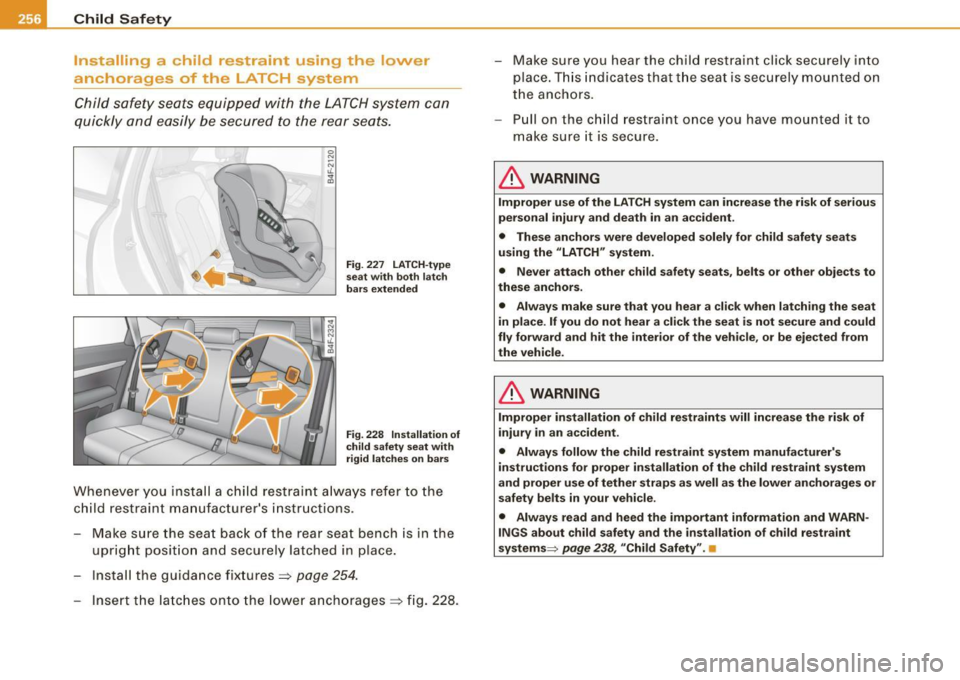
Child safety seats equipped with the LATCH system can
quickly and easily be secured to the rear seats.
0 N ;::; ,L
i
Fig. 227 LATCH-type
seat with both latch
bars extended
Fig. 228 Installation of
child safety seat with
rigid latches on bars
Whenever you install a child restraint always refer to the
child restraint manufacturer's instructions.
Make sure the seat back of the rear seat bench is in the
upright position and securely latched in place.
I nstall the guidance fixtures==>
page 254.
- Insert the latches onto the lower anchorages ==> fig. 228 . - Make sure you hear the child restra
int click securely into
place. This indicates that the seat is securely mounted on
the anchors.
- Pull on the child restraint once you have mounted it to
make sure it is secure .
& WARNING
Improper use of the LATCH system can increase the risk of serious
personal injury and death in an accident.
• These anchors were developed solely for child safety seats
using the "LATCH" system.
• Never attach other child safety seats, belts or other objects to
these anchors.
• Always make sure that you hear a click when latching the seat
in place. If you do not hear a click the seat is not secure and could
fly forward and hit the interior of the vehicle, or be ejected from
the vehicle.
& WARNING
Improper installation of child restraints will increase the risk of
injury in an accident.
• Always follow the child restraint system manufacturer's
instructions for proper installation of the child restraint system
and proper use of tether straps as well as the lower anchorages or
safety belts in your vehicle.
• Always read and heed the important information and WARN
INGS about child safety and the installation of child restraint
systems :::> page
238, "Child Safety". •
Page 259 of 398
Mounting and releasing the anchorage hook
If you use a child restraint system with hooks or other
latches attached to adjustable straps.
Mounting
- Press the anchorage hook wit h the spring catch re lease
onto the lower anchorage so that the anchorage hook locks into place .
- Pull on the anchorage hook to make sure that it has
securely engaged the lower anchorage.
- Tighten the strap following the child restraint manufac
turer 's instructions.
Releasing
- Loosen the tens ion on the strap following the child
restraint manufacturer's instructions .
- Depress the spring catch on the hook. - Hold the spring catch in depressed posit ion .
- Move the hook in the direction of the vehicle floor so that
there is enough space to release the anchorage hook
from the lower anchorage.
& WARNING
• Improper installation of child restraints will increase the risk of
injuries in a crash.
• Always refer to the child restraints manufacturer's instructions
for proper instaHation of the child restraint and proper use of the
lower anchorages or safety belts in your vehicle. •
Safety first
Tether anchors
Child Safety
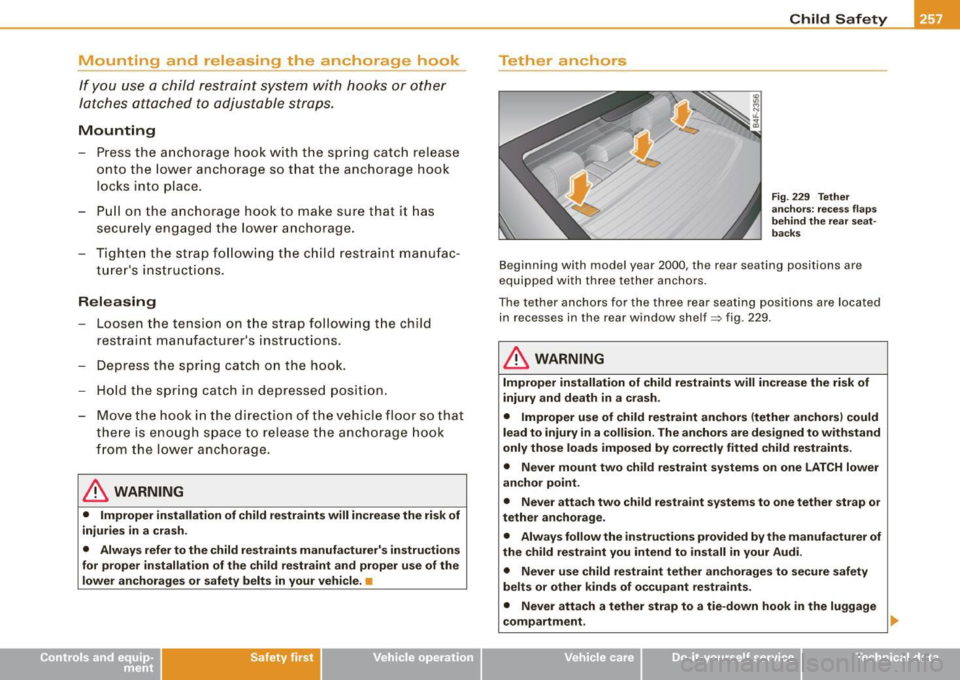
Fig. 229 Tether
anchors: recess flaps
behind the rear seat
backs
B eginning with mod el year 2000 , th e re ar sea ting posi tions are
equipped with three tether anchors.
The tether anchors for the three rear seating positions are located in r ecess es in the r ear window shelf~ fig . 229.
& WARNING
Improper installation of child restraints will increase the risk of
injury and death in a crash.
• Improper use of child restraint anchors (tether anchors) could
lead to injury in a collision. The anchors are designed to withstand
only those loads imposed by correctly fitted child restraints.
• Never mount two child restraint systems on one LATCH lower
anchor point.
• Never attach two child restraint systems to one tether strap or
tether anchorage.
• Always follow the instructions provided by the manufacturer of
the child restraint you intend to install in your Audi.
• Never use child restraint tether anchorages to secure safety
belts or other kinds of occupant restraints.
• Never attach a tether strap to a tie-down hook in the luggage
compartment.
Vehicle care I I irechnical data
Page 260 of 398
___ C_h_ i_ld _ S_ a_ f_ e_ t-= y'------------------------------------------------
& W ARNING (continued )
• Never secure or attach any luggage or other items to the LATCH
lower anchorages or to the tether anchors.
• If a tether or other strap is used to attach a child restraint to the
front passenger seat, make sure that it is not so tight, that it
causes the weight-sensing mat to measure more weight than is
actually on the seat .
• The heavier weight registered can make the system work as
though an adult were on the seat and deploy the Advanced Airbag
when it must be suppressed causing serious or even fatal injury to
the child .•
T et her strap
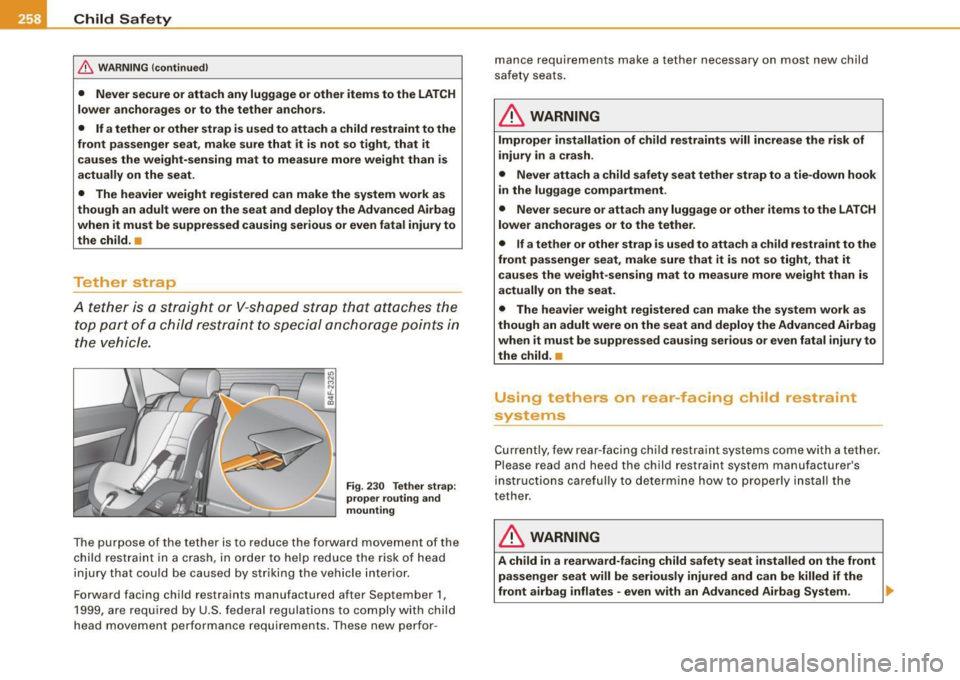
A tether is a stra ig h t or V-shape d strap that atta ches the
top part of a ch ild restraint to sp ecial anchorage po ints in
th e v ehicl e.
Fig . 230 Tether strap :
prope r routing and
mounting
T he purpose of the tether is to reduce the forward movement of t he
ch ild res trai nt in a cras h, in or der t o help re duce t he risk o f head
injury that cou ld b e caused by str ikin g th e vehicl e interior.
Forward facing child rest raint s manufactured after Septe mber 1,
19 99, are require d b y U.S . f edera l reg ulatio ns to comp ly with c hild
head movement performance requirements . These new pe rfor- mance requirements ma
ke a tether necessary on most new child
sa fe ty seats .
& WARNING
Improper installation of child restraints will increase the risk of
injury in a crash .
• Never attach a child safety seat tether strap to a tie -down hook
in the luggage compartment .
• Never secure or attach any luggage or other items to the LATCH
lower anchorages or to the tether.
• If a tether or other strap is used to attach a child restraint to the
front passenger seat , make sure that it is not so tight , that it
causes the weight-sensing mat to measure more weight than is
actually on the seat.
• The heavier weight registered can make the system work as
though an adult were on the seat and deploy the Advanced Airbag
when it must be suppressed causing serious or even fatal injury to
the child .•
Us ing tethe rs on rear.facing chi ld restra int
systems
C ur rently , few r ear-faci ng child re stra int s ystems co me with a tether.
P lease read and heed the ch ild restra int system manufactur er's
i n str uct ions care full y to d ete rmin e ho w to prop erly i nsta ll th e
tether.
& WARNING
A child in a rearward-facing child safety seat installed on the front
passenger seat will be seriously injured and can be killed if the
front airbag inflates -even w ith an Advanced Airbag System . ._
Page 261 of 398
& WARNING !continued)
• The inflating airbag will hit the child safety seat or infant
carrier with great force and will smash the child safety seat and
child against the backrest, center arm rest, or door .
• A tight tether or other strap on a rearward-facing child restraint
attached to the front passenger seat can put too much pressure
on the weight -mat in the seat and register a heavier weight in the
Advanced Airbag System. The heavier weight registered can make
the system work as though an adult were on the seat and deploy
the Advanced Airbag when it must be suppressed causing serious
or even fatal injury to the child.
• If you must install a rearward facing child safety seat on the
front passenger seat because of exceptional circumstances and
the PASSENGER AIR BAG OFF light does not come on and stay on,
immediately install the rear-facing child safety seat in a rear
seating position and have the airbag system inspected by your
Audi dealer. •
Securing the upper tether strap to the anchor
bracket
Safety first
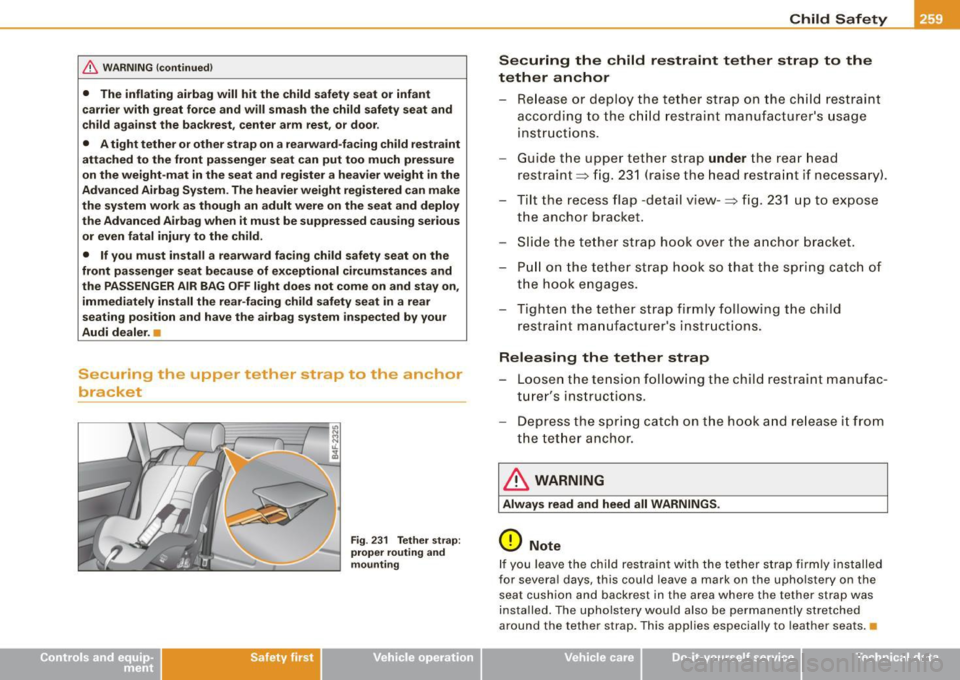
Fig. 231 Tether strap:
proper routing and
mounting
Child Safety
Securing the child restraint tether strap to the
tether anchor
- Release or deploy the tether strap on the child restraint
according to the child restraint manufacturer's usage
instructions.
Guide the upper tether strap
under the rear head
restraint ~ fig. 231 (raise the head restraint if necessary) .
- Tilt the recess flap -detail view-:::;, fig. 231 up to expose
the anchor bracket .
- Slide the tether strap hook over the anchor bracket.
- Pull on the tether strap hook so that the spring catch of
the hook engages.
- Tighten the tether strap f irmly following the child
restraint manufacturer's instructions.
Releasing the tether strap
- Loosen the tension following the child restraint manufac
turer's instructions.
- Depress the spring catch on the hook and release it from
the tether anchor.
& WARNING
Always read and heed all WARNINGS.
0 Note
If you leave the child restraint with the tether strap firmly installed
for several days, this could leave a mark on the upholstery on the seat cushion and backrest in the area where the tether strap was
installed. The upholstery would also be permanently stretched
around the tether strap. This applies especially to leather seats.•
•
Vehicle care I I irechnical data
Page 265 of 398

The direction in which the driver wishes to travel is determined with
t he aid of the steering angle and vehicle speed and is continua lly
compared with the actual behavior of the vehicle. If the two do not
match, for example, when the vehic le starts hydrop laning on a wet
road, ESP will automatically brake the appropriate whee l to correct
the prob lem.
The vehicle is then stab ilized by the forces acting on the whee l
during braking. If the vehicle is
oversteering (rear tends to skid out
of the turn), the brakes are mainly app lied on the wheel that is on
the outside of the curve. In the case of a vehicle that is
understeering
(tendency to sl ide out of the curve), the brakes are applied at the
rear wheel that is on the inside of the curve . An acoustic signal indi
cates when ESP brake application cuts in
~ & .
The system operates across the entire speed range in combination
with the ABS system
~ page 266 . If the Anti -Lock Brake System
(ABS) malfunctions, the ESP wi ll be out of action as well.
Ac tivat ing
When you turn on the eng ine, ESP will automatically be activated
and will perform a se lf -test . As soon as the test is comp leted, the
system is in norma l operating mode.
You can activate a deactivated ESP or deactivated ESP/ASR if required by pressing the~
page 262, fig. 232 button . When they are
activated, the message
E S P/AS R on appears briefly in the display.
D eactiv ating
The ESP should normally be activated al l the time . If necessary, you
can deactivate An ti- Slip Regulation (ASR) or the E lectronic Stabiliza
tion Program (ESP) by pressing the button~
page 262, fig. 232 .
• Dea ct iv at ing A SR: Tap the button . In certain exceptional situa
tions (e.g. driving with t ire chains) , the Anti-Sl ip Regulation (ASR)
can be deactivated ~
page 264. The message ASR off appears in the
display as we ll.
• Dea ctiv at ing E SP/ASR Press the button for more than 3 seconds.
With the ESP/ASR deactivated, the ESP check light comes on, see
Controls and equip
ment Safety first Vehicle operation
In
te llig ent tec hn olo gy
~ page 18 . The message ES P sw itched off appears in the disp lay as
we ll.
& WARNING
The Electroni c Stabili zation Program i s never thele ss subject to the
la ws o f physics . It is p articularl y import ant t o pay a ttent ion t o th is
f a ct on wet and slippery road s. It is ther efore important tha t y ou
a lw ays a dapt your dr iving to the c ondit ion of th e ro ad and t raffi c
c ondition s. Do n ot allow the inc rea sed safety pro vided b y th e Elec
tr on ic S ta bili zatio n Pr ogram sys tem to lull you in to acc epting
add iti onal safet y risk s. C
Electronic differential tock (EDL)
The electronic differential lock monitors the rotational
speed of the drive wheels.
Gener al note s
The electronic differential lock (EDU helps the car to start moving,
accelerate and c limb a gradient on surfaces providing poor or
almost no grip . Without EDL, this would be difficult, if not impos
sib le .
How th e sys te m wo rk s
The EDL operates automatical ly . It monitors the rotational speed of
the drive wheels on an axle with the he lp of the ABS sensors
~ page 266 . If a noticeable difference in rotational speed between
the drive wheels on one axle is detected (e.g. on slippery ground
on
one side),
the spinning wheel is braked, thereby transferring power
to the other drive wheel or whee ls (a ll -whee l drive) . Th is is done up
to a speed of about 60 mph ( 100 km/h). Noises from the brake
system signal that wheel spin is being control led .
Dr iving off
When driving off , always be sure to keep road conditions in mind as
you accelerate. If one drive wheel spins because it is on a surface
Iii>
Vehicle care Do-it-yourself service Technical data
Page 266 of 398

___ ln_ t _e_ ll-'"ig ...,_ e_ n_t _t_ e_ c_ h _ n_o _ l_o _,.g= y,_ __________________________________________ _
with less grip, gradually increase the pressure on the accelerator
pedal until the car starts to move.
Overheating of brakes
To prevent the disc brake of the braked wheel from overheating if
subjected to excessive loads on this wheel, the EDL cuts out tempo
rarily. The vehicle remains operational and behaves in the same way
as a vehicle without EDL.
As soon as the brake has cooled down, EDL switches on again auto
matically.
& WARNING
• When accelerating on slippery surfaces, such as on ice or snow,
always be careful when depressing the accelerator pedal. Even
with the EDL working, the drive wheels can spin and reduce your
ability to control your car. Risk of crash!
• The increased safety afforded by EDL does not mean that you
can take safety risks. Always adapt your driving style to the road
conditions and traffic situation.
[ i] Tips
If a fault occurs in the ABS, the EDL is also not functioning. This is
indicated by the ABS warning light=>
page 21. •
Ant"-Slip Regulation System (ASR)
The Anti-Slip Regulation System prevents the driven
wheels from spinning when the car is accelerating.
General notes
The Anti-Slip Regulation System (ASR) is integrated in the electronic
stabilization program (ESP). When the vehicle starts up and acceler
ates, the wheels are prevented from spinning by adjusting the engine power to match the amount of grip available from the road
surface.
How the system works
ASR
performs automatically, i.e. without the driver's intervention.
With the aid of the ABS sensors=>
page 266, ASR monitors the
speed of the driven wheels. If the wheels start to spin, the engine
torque is reduced automatically until the tires find enough grip to
lock onto the road surface. The system is active across the entire
speed range.
Th e ASR works in conjunction with the ABS. If a malfunction should
occur in the ABS, the ASR will also be out of action.
Activating
The ESP is automatically activated when the engine is started and it
performs a self -test . You can activate a deactivated ASR if required
by pressing the =>
page 262, fig. 232 button . When it is activated,
the message
ESP/ASR on appears briefly in the display. Vehicles
with front-wheel drive a deactivated ASR automatically re-activates
itself at a speed of 40 mph (70 km/h) .
Deactivating
You can deactivate the ASR if required by pressing the button (for
less than 3 seconds)=>
page 262, fig. 232. With the ASR deactivated,
the ESP check light comes on, see=>
page 18. The message ASR off
appears in the display as well. On vehicles with front-wheel drive:
deactivation is possible only up to 30 mph (50 km/h) for safety
reasons . Vehicles with all -wheel drive: the ASR can be deactivated
at any speed .
The ASR should normally be activated all the time. Only in certain
exceptional situations when some slip is desirable does it make
sense to deactivate the ASR. Examples:
• when driving with tire chains
• when driving in deep snow or on loose ground and
• when rocking the vehicle loose after it has become stuck .
Page 267 of 398

When the abnormal situation is over, you should activate the ASR
again.
& WARNING
The increased safety afforded by ASR does not mean that you can
take safety risks. Always adapt your driving style to the road
conditions and traffic situation.
[ i] Tips
To ensure that the ASR works properly, all four wheels must be fitted
with identical tires. Any differences in rolling radius of the tires can
cause the system to reduce engine power when this is not desired.
See also~
page 329, "New tires and replacing tires and wheels". •
Braking
General information
What affects braking efficiency?
Operating conditions and driving habits
The brakes on today's automobiles are still subject to wear,
depending largely on operating conditions and driving habits~& .
On vehicles that are either driven mostly in stop-and-go city traffic
or are driven hard, the brake pads should be checked by your autho
rized Audi dealer more often than specified in the
Warranty & Main
tenance booklet.
Failure to have your brake pads inspected can
result in reduced brake performance.
On steep slopes, you should use the braking effect of the engine .
This way, you prevent unnecessary wear on the brake system. If you
must use your brakes, do not hold the brakes down continuously.
Pump the brakes at intervals.
Controls and equip
ment Safety first Vehicle operation
Intelligent technology
Moisture or road salt
If
you are driving faster than 50 mph (80 km/h) and the windshield
wipers are on, the brake pads will briefly touch the brake discs in regular intervals so as to improve reaction time when braking on
wet surfaces. You, the driver, will not notice anything.
Under certain conditions, for example, when driving through water
or very heavy rain, or even after washing your vehicle, the braking
effect can be reduced due to moisture (or in freezing conditions ice)
on the brake pads. A few careful brake applications should dry off
the brake pads or remove any ice coatings .
The effectiveness of the brakes can be reduced when the vehicle is driven on a salt-covered road and the brakes are not used. Here too,
you should clean off accumulated salt coating from brake discs and
pads with a few careful applications of the brake ~& .
Corrosion
There may be a tendency for dirt to build up on the brake pads and
corrosion to form on the discs if the car is not driven regularly or
only for short trips with little use of the brakes.
If the brakes are not used frequently, or if corrosion has formed on
the discs, it is advisable to clean off the pads and discs by braking
firmly a few times from a moderately high speed~&.
Faults in the brake system
If you should notice a sudden increase in brake pedal travel, then
one of the two brake circuits may have failed~& .
Low brake fluid level
Malfunctions can occur in the brake system if the brake fluid level is
too low . The brake fluid level is monitored electronically .
Brake lining wear status
Brake lining wear may be checked by visual inspection of the condi
tion of the brake pads through the openings in the wheel. If neces
sary, the wheel may be removed for this inspection
~ page 344,
"Changing a wheel". ._.
Vehicle care Do-it-yourself service Technical data