2009 AUDI S6 ignition
[x] Cancel search: ignitionPage 310 of 398
lffl __ C _h_ e_ c_k _in --== g'-- a_n _d_ f_il _li _n ..:::g:::..- ___________________________________________ _
models; 60% for Canadian models). This mixture both assures the
necessary frost protection and protects metal components in the
engine's cooling system from corrosion and scaling. It also raises
the boiling point of the coolant.
Do not reduce the concentration of the coolant in the summer by
adding plain water.
Th e pro port io n of coo la nt additi ve mu st be at
lea st 50 % but n ot mor e th an 60 %
to maintai n ant ifreeze protection
and cooling efficiency. If the coolant frost protection is too low , the
coolant could free ze and damage the veh icle heating and engine
cooling system .
For year-round driving , antifreeze is added at the factory for temper
atures down to:
• -31 °F ( -35 °c1 usA
• - 40 °F ( - 40 °C) Canada.
You can mix the
Gl 2+ + coolant additive with other additives (G12+
or G12). Always check w ith your authorized Audi dealer.
& WARNING
B efo re you che ck anyt hing in th e eng ine compartmen t, alway s
re ad a nd he ed all WARN ING S~
& in " Working in the engine
c ompar tm ent " on
page 30 1.
0 Not e
• Before winter sets in, have the coolant checked to see if the
coo lant additive in your vehicle is sufficient to meet the climate
conditions. This is especia lly important if you live in a region where
the winter is extremely cold . If necessary, increase the proportion of
coolant additive to 60%.
• When adding coolan t additive to your coo ling system,
remember:
-We recommend using only coolant additive
G12+ + (check the
label) for your vehicle. This coolant additive is avai lable at autho
riz ed Audi dealers. Other types of antifreeze can significantly reduce corrosion protection. The resulting corrosion can cause a
loss of coolant and serious engine damage.
• Do not add any type of radiator leak sealant to your vehicle's
engine coolan t. Adding radiator repair fluid may adversely affect the
function and performance of your cooling system and could result
in damage not covered by your New Vehicle Limited Warranty. •
Checking the engine coolant level
The engine coolant level can be checked with a quick
glance.
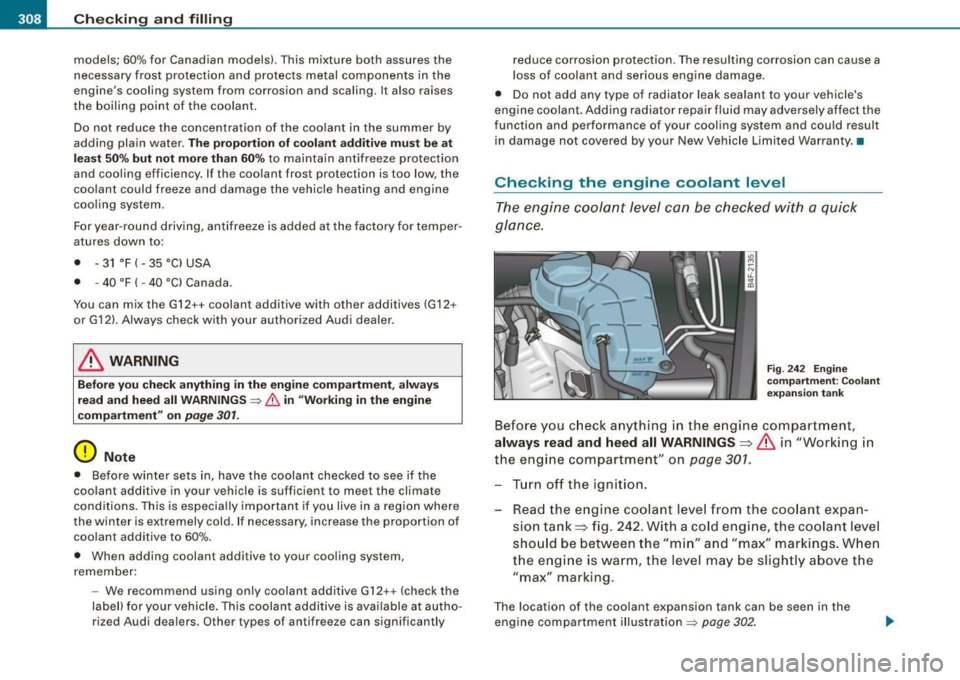
F ig . 2 42 E ngin e
com partm ent : Cool ant
ex pans io n tank
Before you check anything in the engine compartment,
alw ays read and h eed all WARNINGS ~ & in "Working in
the eng ine compartment" on page 301.
- Turn off the ignition.
- Read the e ngine coo lant level from the coo lant expan -
sion tank~ fig. 242. With a cold engi ne, the coolant level
sho uld be between the "min" and "max" markings. W hen
the engine is warm, the level may be slightly above the
"max" marking .
The location of the coolant expansion tank can be seen in the
engine compartment illustration~
page 302.
Page 312 of 398

--~C~h.!. e~ c~k ~in ~ g~ a~n ~d~ f~il ~li~ n~gL ___________________________________________ _
& WARNING (continued )
• Antifreeze is poi sonous. Alway s store antifreeze in its original
container and well out of the rea ch of children.
• If you drain the coolant , it must be caught and safely stored in
a proper container clea rly marked "poi son ".
0 Note
• Coo lant po llutes the env ironment and could cause an engine
fire . Excess coolant will be forced out through the pressure relief
valve in the cap when the engine becomes hot.
• If, in an emergency, on ly wa ter ca n be added, the correc t rati o
between water and antifreeze=>
page 307 must be restored as soon
as possible .
~ For the sake of the environment
Drained coolant should not be reused. Always dispose of used
co olant whi le observ ing all e nvir o nmen tal regula tions .•
Radiator fan
The radi ator fan s wit ches on automa tically by i tsel f.
The radiator fan is driven by t he engine v ia the V -belt. The v iscous
clutch regulates the speed of the fan according to the temperature
of the coo lant .
An aux iliary e lectric radiator fan* switches on and off depending on
c oo lant temperature and other vehicle opera tin g co ndi tions.
After you switch the engine off, the aux iliary fan can continue
running for up to 10 minutes -even with the ignition off. It can even
switc h on again later by itself=>&, if
• the temperature of the engine coolant rises due to the heat
bui ld-up fr om the eng ine in the engine c ompartmen t, or •
the engine compartment heats up because the vehicle is parked
in in tense s un ligh t.
& WARNING
• To reduce the ri sk of personal injury never touch the radiator
fan .
• The auxiliary e lectric fan is temperature controlled and can
switch on suddenly even when the engine is not running .
• The au xiliary radiator fan switches on automatic ally when the
engine coolant reaches a ce rtain temperature and will continue to
run until the coolant temperature d rops .•
Brake fluid
Checking brake fluid level
T he brak e fluid level can be checked wit h a quick glance.
F ig . 243 Engine
c o mp artment : B ra ke
fluid re servoir
Befo re you c heck anything in the e ngi ne compartme nt,
always read and heed all WARNINGS=> & in "Working in
t h e e ngin e com part ment" on
page 30 1. ~
Page 314 of 398

-Checking
and filling
---=---------------
checked by a service facility . The electrolyte level should also be
checked each time the battery is charged
~ page 314.
Have the battery checked when you take your vehicle in for service.
You are well advised to replace a battery that is older than 5 years.
With certain types of airbag deployment, the battery is discon nected from the vehicle electrical system for safety reasons~
& in
"Repair, care and disposal of the airbags" on
page 229.
Disconnecting the battery terminals
Some vehicle functions (power window regulators, for example) are
lost if the battery terminals are disconnected . These functions have
to be relearned after the battery terminals are connected again . To
prevent this, the battery should only be disconnected from the
vehicle electrical system when absolutely necessary for repairs.
Vehicles not driven for long periods
If you do not drive your vehicle over a period of several days or
weeks, electrical components are gradually cut back or switched off.
This reduces energy consumption and maintains starting capability
over a longer period
~ page 269.
Take into consideration that when you unlock your vehicle, some
convenience functions , such as the master key remote function or
power seat adjustment, may not be available. The convenience
functions will be available again when you turn on the ignition and
start the engine.
Winter operation
During the winter months, battery capacity tends to decrease as
temperatures drop . This is because more power is also consumed
while starting, and the headlights, rear window defogger, etc., are
used more often.
Avoid unnecessary power consumption, particularly in city traffic or
when traveling only short distances. Let your authorized Audi dealer
check the capacity of the vehicle battery before winter sets in
~ page 314. A well charged battery will not only prevent starting
problems when the weather is cold , but will also last longer .
[ i] Tips
If your vehicle is left standing for several weeks at extremely low
temperatures, the vehicle battery should be removed and stored
where it will not freeze. This will prevent it from being damaged and
having to be replaced. •
Working on the battery
Be especially careful when working on or near the battery.
Fig. 244 Luggage
compartment : Battery
The battery is located in the luggage compartment under
the floor. Before you check anything in the luggage
compartment,
read and heed all WARNINGS=>& .
Lift the floor by the plastic handle.
Hook the handle into the luggage compartment weather
strip.
Always heed the safety warnings, when working on the vehicle
battery or the vehicle electrical system to prevent injury.
Page 315 of 398
__________________________________________ C_ h _ e_c _k _in _ g =- a_ n __ df _i_ lli _n ___ g __ fflllll
•
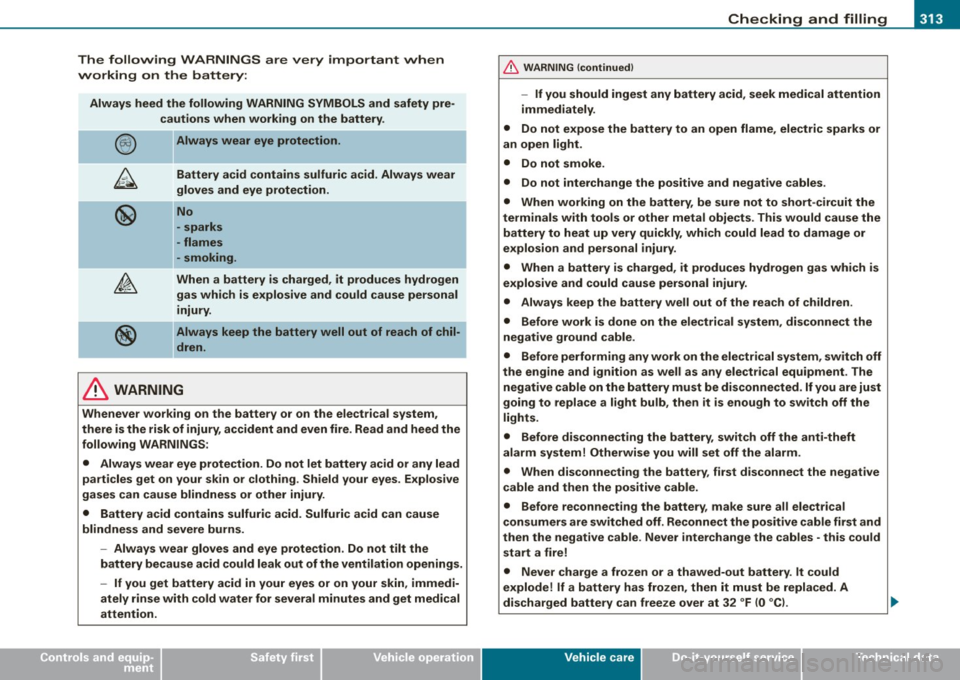
The following WARNINGS are very important when
working on the battery:
Always heed the following WARNING SYMBOLS and safety pre
cautions when working on the battery .
Always wear eye protection.
Battery acid contains sulfuric acid. Always wear
gloves and eye protection.
No
- sparks
- flames
- smoking.
When a battery is charged, it produces hydrogen
gas which is explosive and could cause personal
injury.
Always keep the battery well out of reach of chil
dren.
& WARNING
Whenever working on the battery or on the electrical system,
there is the risk of injury, accident and even fire. Read and heed the
following WARNINGS:
• Always wear eye protection. Do not let battery acid or any lead
particles get on your skin or clothing. Shield your eyes. Explosive
gases can cause blindness or other injury.
• Battery acid contains sulfuric acid. Sulfuric acid can cause
blindness and severe burns.
- Always wear gloves and eye protection. Do not tilt the
battery because acid could leak out of the ventilation openings.
- If you get battery acid in your eyes or on your skin, immedi
ately rinse with cold water for several minutes and get medical
attention.
& WARNING (continued)
-If you should ingest any battery acid, seek medical attention
immediately.
• Do not expose the battery to an open flame, electric sparks or
an open light.
• Do not smoke.
• Do not interchange the positive and negative cables .
• When working on the battery, be sure not to short -circuit the
terminals with tools or other metal objects. This would cause the battery to heat up very quickly, which could lead to damage or
explosion and personal injury.
• When a battery is charged, it produces hydrogen gas which is
explosive and could cause personal injury.
• Always keep the battery well out of the reach of children.
• Before work is done on the electrical system, disconnect the
negative ground cable.
• Before performing any work on the electrical system, switch off
the engine and ignition as well as any electrical equipment. The
negative cable on the battery must be disconnected.
If you are just
going to replace a light bulb, then it is enough to switch off the
lights.
• Before disconnecting the battery, switch off the anti-theft
alarm system! Otherwise you will set off the alarm.
• When disconnecting the battery, first disconnect the negative
cable and then the positive cable.
• Before reconnecting the battery, make sure all electrical
consumers are switched off. Reconnect the positive cable first and
then the negative cable . Never interchange the cables - this could
start a fire!
• Never charge a frozen or a thawed-out battery. It could
explode! If a battery has frozen, then it must be replaced. A
discharged battery can freeze over at 32 °F (0 °CI. .,,_
Vehicle care
I t •
Page 316 of 398

llffl __ C _h_ e_ c_k _in --== g'-- a_n _d_ f_il _li _n ..:::g:::..- ___________________________________________ _
& WARNING (continued)
• Make sure the vent hose is always attached to the opening on
the side of the battery.
• Never use batteries which are damaged . There is the danger of
an explosion! Always replace a damaged battery.
& WARNING
California Proposition 65 Warning :
• Battery posts, terminals and related accessories contain lead
and lead compounds, chemicals known to the State of California
to cause cancer and reproductive problems. Wash hands after
handling .
0 Note
• Do not disconnect the vehicle battery when the ignition is
switched on or when the engine is running, otherwise, you will
damage electronic components in the electrical system .
• If your vehicle is going to stand for a long period of time without
being driven, protect the battery from "freezing", otherwise it will
be damaged and will then have to be replaced. •
Battery charging
Starting the engine requires a well charged battery.
Fig. 245 Engine
compartment : Connec
tors for charger and
jumper cables
Always read and heed all WARNINGS below=> & and=> &
in "Working on the battery" on page 312.
- Turn off the ignition and all electrical consumers.
- Make sure the area is well ventilated when you charge
the battery.
- Open the hood => page
300.
-Open the red cover on the positive pole=> fig. 245.
- Connect the charger connectors according to the instruc-
tions to the
jump start bolts. (Bolts under the red cover=
" posit ive", Bolts with hex head= "negative").
- Only now plug the mains lead for the charging equip
ment into the wall outlet and turn it on =>& .
-Make sure the charging rate is not over 30 amps/14.8
Volt.
- When the battery is fully charged: Turn the charging
equipment off and remove the mains lead from the wall
outlet. .,_
Page 317 of 398

Checkin g and fillin g -
--------------~-
•
-Now remove the clamps fo r the charging eq uipment.
- Close t he red cover on the positive pole.
- Close the hood~
page 301.
A discharged battery can freeze at temperatures of only O °C. A llow
a frozen battery to thaw completely before attempting to charge it
~ & .However, we recommend not using a thawed battery again
because the battery casing can be cracked due to ice formation and
can leak battery acid.
Batt ery c harg ing (Ma ximum ch arging rate of 30
a mps /14 .8 Volt )
When charging at /ow voltages (e.g. with a trickle charg er), the
ba ttery cables do not have to be disconnected first. The battery caps
should
not be opened when charging a battery.
I t is not necessary to remove the battery from the luggage compart
ment .
Fa st cha rging the batt ery (chargi ng ra te ab ove 14 .8
Volt s)
For technical reasons do not use a battery charger that uses vo ltage
greater than 14.8 Volts to charge your vehic le's battery.
& WARNING
C harging a battery can be d angerou s.
• Alwa ys follo w the oper ating instruct ions pro vided b y the
battery charger manuf acturer when charging your b attery .
• Neve r charge a frozen battery. It m ay explode be cau se of gas
tr apped in the i ce. Allow a frozen battery to thaw out fir st.
• Do not reuse batteries wh ich were fro zen. The battery housing
m ay hav e crac ked and wea kened when the b atte ry fro ze .
• Charge the battery in a well ventilated area. Keep away from
open fla me or ele ctri cal s par k. Do not smok e. Hydrogen ga s gener
ated by the battery is explo sive.
&_ W ARN ING (c ontinued )
• To redu ce the danger of explo sion, never connect or d isconnect
c h ar ger cable s while the charger is ope rat ing .
• Batte ry acid that may spill durin g charging should be w ashed
off with a sol ution of warm water and b aking soda to neutralize
the acid .
0 Note
Never use a fast charger as a booster to start the engine . This wi ll
seriously damage sensitive electronic components, such as control
units, re lays, radio, etc ., as well as the battery charger. •
Battery replacement
The new battery must have the same specifications and
dimensions as the original equipment battery.
Intelligent energy management in your vehicle is responsib le for
distributing the e lectrica l energy throughout your vehicle
~ page 269 . The intelligent energy management system will keep
the engine battery charged better then vehicles without this system.
To make sure the additional electrical energy is availab le once again
after you have changed the battery, we recommend that you insta ll
batteries of the same type and manufacture only (the same as those
insta lled at the t ime your vehicle was de livered). Specif ications are
listed on the battery housing . Your authorized Audi dealer wi ll then
code the battery management con trol unit.
I f it is not possib le to use a battery of this type, the new battery must
have the same capacity, voltage (12 volts), amperage, construction
and p lug sealing .
When installing the battery, make sure the ignition and all electrical consumers are tur ned off.
~
Vehicle care I t •
Page 353 of 398

Fuses and bul bs -
------------------
Fuses and bulbs
Fuses
Replacing a fuse
A problem in the electrical system may be caused by a
blown fuse.
Fig . 2 65 Instru ment
pa nel left: Face c over
F ig . 266 I nst ru me nt
pa nel left: Co ntent
F ac e cover
- Locate the fuse which belongs to the component which
failed.
- Switch off the ignition and the e lectr ica l component
affected. - Care
fully p ry t he face cover off the instr umen t pane l
using the ignition key or a screwdriver~ fig. 265.
- Rem ove the plastic clip @ from i ts retainer in the face
cove r~ fig. 266, place i t over the questionable fuse and
remove the fuse.
- Replace a blow n fuse (recogniza ble by the melted metal
str ip inside) wi th a f use of the
same amperage.
The individual circuits are protected by fuses. T he fuse panels with
the fuses are located on the left and right front faces of the instru
ment pane l behind a cover and in the right storage area in the
luggage compartment.
There is a plastic clip @ in the cover on the lef t side of the instru
ment pane l, which can be used to remove the fuses. The crank © is
used for emergency operation of the power roof*. You will also find
a label on both covers in the instrument panel with the fuse layout
© for the corresponding fuse panel.
& WARNING
Nev er replac e a fuse with on e that ha s a high er amperag e rating .
• A fu se w ith a t oo high ampe rage could damage the ele ctr ical
pa rt a nd cause a fire .
0 Note
• On no account should fuses be repaired (e .g. patched up wi th tin
foil or wire) as this may cause serious damage elsewhere in the e lec
trica l circuit o r cause fire.
• I f a fuse blows repeatedly, do not keep replacing it. Instead, have
the cause of the repea ted short circuit or overload located and fixed.
ti>
Vehicle care Do-it-yourself service Technical data
Page 355 of 398

Fuses and bul bs -_____________ -----=----.;....:..::.:....:.::;______J
No. Equipm ent
29 Not used
30 Not used
31 Back-up light switch, transmission, engine
components
Intelligent power mo dule driver (footwell l ight
32 and front headlights, horn, wiper system, elec
trically adjusta ble steering wheel)
33 Intelligent power modu le driver
(lights left-side)
---,--
34
35
36
37
38
39
I nte lligent power module driver
(lights right-side)
Not used
Headlight washer system
E lectronic Stabilization Program (ESP)
Wip er system
Door control module left -side
Horn
41 Heater fan
42 Control module electronic ignition lock/electri
cally adjustable steering wheel
43 Rear windsh iel d wiper (Avant)
44 Power window opener (left-side) Amps
15
30
25
25
30 25
30
15
25
40
30
15
35
-
•
Fuse Location , Instrument Panel right
Fig. 2 68 F use pan el
la yo ut
Some of the equipment items listed are optional or on ly available on
certain model configu rations.
Note that the following table is ac curate at the time of g oing to
press and is subject t o change . In the eve nt of d iscrepan cies , th e
l a b el on t he in side of the cover alw ay s take s prec eden ce.
The power seats are protected by cir cuit breaker s, which automati
ca lly reset after a few seconds a fter the ove rload has been reme
died.
No . Equipment Amps
Fu se holder (bla ck )
1 Control module Convenience key 15
2
Cigarette lighter front 20
3
Tire pressure moni tor ing system 5
4 E lectrica l outlet front (center conso le) 20
5
Intelligent power module passenger 15 (glove box lock)
6 Door control module right -side 15
Sunroof 20
Vehicle care Do-it-yourself service irechnical data