2009 AUDI Q7 steering
[x] Cancel search: steeringPage 191 of 426
_________________________________________________ A_ u_t_ o_ m_ a_t _i _ c _ t _ra_ n_s_ m __ is_s_ io_ n _ __.11111
Ap plies to vehi cles : wi th tip troni c-st eerin g wh eel
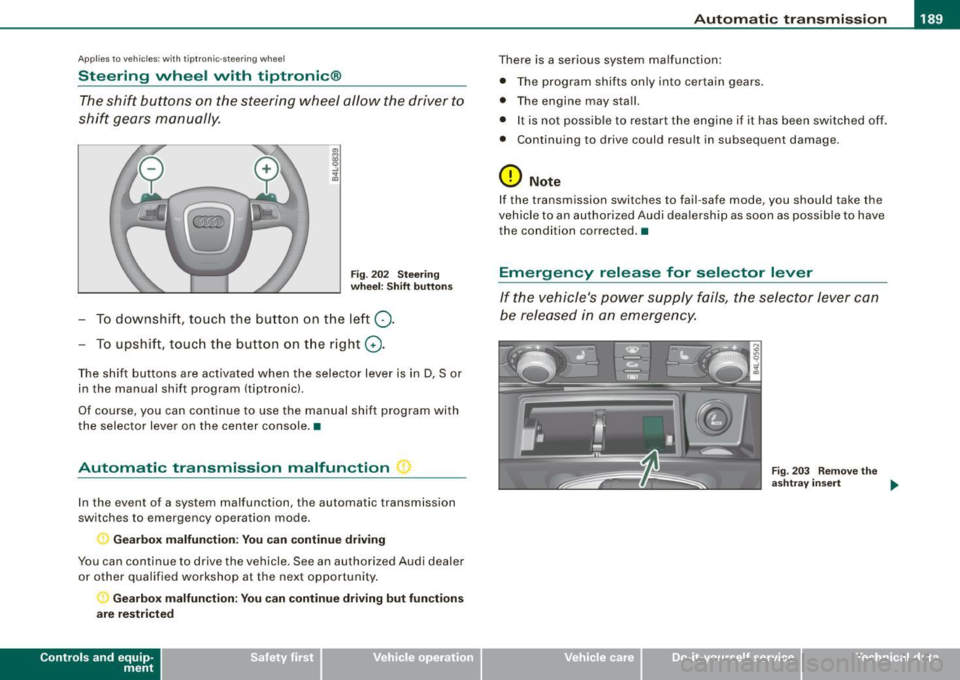
Steering wheel with tiptronic ®
The shift buttons on the steering wheel allow the driver to
shift gears manually.
Fig . 202 Steering
wheel: Shift buttons
- To downshift, touch the button on the left Q.
- To upshift , touch the button on the right G) .
The shift buttons are activated when the selector lever is in D, Sor
in the manual shift program (tip tronic) .
Of course, you can continue to use the manual shift program with
the selector lever on the center console .•
Automatic transmission malfunction ~
In the event of a system malfunction, the automatic transmission
switches to emergency operation mode.
Gearbox malfunction: You can continue driving
You can continue to drive the vehicle. See an authorized Audi dealer or other qualified workshop at the next opportunity.
Gearbox malfunction: You can continue driving but functions
are restricted
Con tro ls and eq uip
ment
There is a serious system malfunction:
• The program shifts only into certain gears.
• The engine may stall.
• It is not possible to restart the engine if it has been switched off .
• Continuing to drive could result in subsequent damage .
0 Note
If the transmission switches to fail -safe mode , you should take the
vehicle to an authorized Audi dealership as soon as possible to have
the condition corrected .•
Emergency release for selector lever
If the vehicle's power supply fails, the selector lever can
be released in an emergency.
Fig . 203 Remove the
ashtray insert
~
Vehicle care I I Technical data
Page 198 of 426

• ..__A_ d_v _ a_ n_c _e _ d_ P_ a_r _k _in ---== g'-- S...:y _ s_ t_ e_ m ___________________________________________ _
®
Fig. 211 Side view:
Covered area
G) and
uncovered area
0 of
the rear -view camera
The rear-view camera section appearing in th e MMI Display is
approximately the same as the coverage area represented in
=>
page 195, fig. 210 or G) in=> fig. 211 . Objects located in the rear
view camera's uncovered area®=> fig. 211 or in the close vicinity
of the bumper are not recognized.
& WARNING
Please note that objects not touching the ground can appear to be
further away than they really are (for example, the bumper of a
parked vehicle, a trailer hitch, or the rear of a truck). In this case,
you should not use the guide help lines to measure distance -
danger of accident!•
App lies to vehic les: with Advanced Par king System with rea r view camera
Parking mode 1
"Parking mode 1" can aid when parking in a garage or
parking space, for example .
Fig. 212 MMI Display :
Aiming at the parking
spot by adjusting the
steering wheel angle
Fig . 213 MMI Display:
Orienting the vehicle
with aid of the blue
surface
- Before parking, sw itch on the Adaptive Air Suspension *
==>
page 21 comfort or automatic mode .
Activate the Audi parking system==>
page 191. "Parking
mode 1"
==> fig. 212 is displayed by default. Dynam ic
orange orientation lines
0 and a blue static surface G)
are projected into the rear -view camera picture. _..
Page 199 of 426

__________________________________________ A___;_ d_v _a_ n___;_ c __ e _d _ P_a_ r_ k_ i_n -=g ~ S_,y:... s_ t_ e_ m ___ !II
- With the ve hicle stationary, select the proper s teering
whee l ang le for the parking spo t wit h the aid of t he
orange o rienta tion l ines.
- Wh ile driving in reve rse gear, ad just the stee ring wheel
angle to fit t he parking space with the a id of t he orange
ori entati on lines ~
0.
- Align your vehicle correspo nding to t he blue surface. The
blue su rfa ce s hould be parallel to the par kin g spot lines
~ page 196, fig . 213 .
G) Blue surfa ce
The surface beh ind the vehicle, identified by various shades of blue,
represents an ex tension of the outer vehic le outline by approxi
mately 16 ft (5 ml to the rear. The transitions of the blue surfaces are
distanced approxima te ly 3 ft (1 ml, 6 ft (2 m), and 16 ft (5 m) away
from the vehicle .
@ and 0 Orange orientation lines
The orientation lines change direction with the steering wheel
ang le . These lines identi fy t he direction of travel the rear o f the
vehicle would be taking, driving in reverse gear with the current
steering whee l ang le .
The dynamic orientation lines are provided with markers@. These
markers are each placed at a distance of approx. 3 ft ( 1 ml from one
another. Through these markers, the distance to an obstacle can be
estimated .
©Redline
The distance between your rear bumper© and the red line is
approximately 16 inches (40 cm):::::,&. Here, at the latest, you
should stop backing up:::::,
page 200.
© Rear bumper
The rear bumper of your vehic le also appears in the MMI Display, for
better orientation .
Controls and equip
ment
& WARNING
Plea se note that objects not to uching the grou nd can appe ar to be
further away than they really are (for ex ample , the bumper of a
par ked veh icle, a trailer h itch , or the rear of a tru ck). In this ca se ,
you should not u se the guide h elp lines to mea sure distan ce -
d anger of accident !
0 Note
In the MM I Disp lay, the direct ion of travel of the vehicle rear is
shown depending on the steering whee l angle . The vehicle front
sw ings out more than the vehic le rear.
[ i ] Tips
• I n order for the rear -view camera to funct ion properly, the
camera lens:::::,
page 191, fig. 205 must be kept clean, and free of
snow and ice. Please foll ow the additional no tes on :::::,
page 204 .
• The positions of the orientation lines/ surfaces are displaced up
or down if the parking process is carried out with the rear -view
camera in Adaptive Air Suspension*:::::,
page 21 dynamic, offroad, or
lift mode. Therefore, the accuracy is reduced .•
I • •
Page 200 of 426

• ..__A_ d_v _ a_ n_c _e _ d_ P_ a_r _k _in ---== g'-- S...:y _ s_ t_ e_ m ___________________________________________ _
Applies to vehicles: with Advanced Parking System with rear view camera
Parking mode 2
"Parking mode 2" can be used as aid when (parallel)
parking on the side of the road, for example.
Fig . 214 MMI Display:
Blue surface aligned
with targeted parking
spot
Fig . 215 MMI Display:
Contact of the blue
curved line with the
curb
- Find a parking spot on the right side of the road, for
example.
- Switch on the Adaptive Air Suspension*=:>
page 21
comfort or automatic mode.
- Position your vehicle parallel to the edge of the road, approximately 3
ft (1 m) away from a parked vehicle
=:> page 194, fig. 209. When parking next to obstacles,
please note
=> page 199.
- Activate the Audi parking system=:> page 191. "Parking
mode 1" is displayed by default.
- Press the control button with the
mode @=> page 196,
fig. 213 function. "Parking mode 2" => fig. 214 appears in
the MMI Display.
Back up in reverse gear and adjust the posit ion of your
vehicle in such a way, that the dark blue surface indicated in the MMI Display@=> fig. 214 borders on the vehicle
behind, or the parking spot line. If you are
not parking
next to any obstacles=>
page 199, the long side of the
dark blue surface should border on the curb. The entire
dark blue surface has to fit into the parking spot
=> page 194, fig. 209.
- While the vehicle is stationary, turn your steering wheel
to the righ t as far as it will go.
- Back up into the parking spot. If you are
not parking next
to any obstacles=>
page 199, the dark blue bend©
should touch the curb=> fig. 215. Stop your vehicle.
- While the veh icle is stationary, turn your steering wheel
in the opposite direction (left) as far as it will go.
- Continue to back up into the parking spot until the
vehicle is parked parallel to the curb. When backing up, also keep an eye on the vehicle front=>
0.
With "parking mode 2", you can park on the left and right side of the
road. For this reason, the blue surfaces and curved lines are
displayed in different shades of blue. The dark blue surface
0 and
the dark blue curved line© can be used to park on the right side of
the road . The light blue surface G)and the light blue curved line©
can be used to park on the left side of the road. _.,
Page 201 of 426

__________________________________________ A_ d_v _a_ n_ c_e _d _ P_a_ r_ k_ i_n ..:g =-- S...:y:- s_ t_ e_ m ___ JIII
When the turn signal is switched on, only the necessary surfaces
and curves are shown . To change the s ide that is shown, simp ly
change the turn signa l.
The displayed light b lue
0 or dark blue © curved line identifies the
turn-around point when maneuvering to park. If the curved line
touches the curb, the steering wheel turn -around point has been
reached => page 198, fig. 215.
T he distance from the rear bumper © to the red line © is approxi
mate ly 1.3 ft (40 cm). Here, at the latest, you shou ld s top bac king up
=> page
200 .
& WARNING
Please note that objects not tou ching the g round ca n appear to be
further away than they really are (for example , the bumper of a
parked vehi cle , a trailer hitch , or the re ar of a truck ). In th is case ,
you should not u se the guide h elp lines to mea sure distance -
danger of a ccident !
0 Note
In the MMI Display, the direction of travel of the vehicle rear is repre
sented depending on the steering w heel angle. The veh ic le front
swings out more than the veh icle rear.
[ i ] Tips
• I n order for the rear -v iew camera to function properly, the
camera lens=> page 191, fig. 205 must be kept clean, and free of
snow and ice . P lease follow the additional notes on => page
204 .
• T he positions of the orientation lines/ surfaces are disp laced up
or down if the pa rk ing process is carried out with the rear-view
camera in Adaptive Air Suspension*=> page 21 dynamic, off road, or
l if t m ode. Therefore, the accuracy is reduced. •
Controls and equip
ment
Special parking situations
A pplies to veh ic les : wit h Advance d Pa rk in g S yste m w it h rear view c amera
Parking next to obstacles
When parking next to an obstacle, enough distance mus t
left on the side.
Fig . 216 Top view:
P arki ng ne xt t o a brick
wall
With "parking mode 2", you can park very c losely to a sidewalk curb
with your vehicle=> page 194, fig. 209.
However, when parking next to an obstacle, such as a brick wall , a
larger side distance must be selected in order to prevent col lisio n
damage to the vehicle. Position the long side of the marked blue
s u rface so that there is enoug h distance from the curb; the surface
must not touch the curb=> fig. 216.
A lso, the turning process has to occur considerab ly sooner . This
means that the corresponding blue curved line=> page 198, fig. 215
must not touch the curb, but shou ld rather be at a distance far
enough from the curb=>& .
& WARNING
• Keep plenty of di sta nce from an obstacle , so that your out side
mirror or a corner of your vehi cle does not collide with any obsta-
cle s -danger of accident!
~
I • •
Page 222 of 426

llffl..,___D_ r_iv _i_ n""' g::;._ S_ a_f _e _ly =---------------------------------------------------
Driving Safely
General notes
Safe driving habits
Please remember -safety first!
This chapter contains important information, tips, instructions and
warnings that you need to read and observe for your own safety, the safety of your passengers and others. We have summarized here
what you need to know about safety belts, airbags, child restraints as well as child safety. Your safety is for us
priority number 1. Always
observe the information and warnings in this section -for your own
safety as well as that of your passengers.
The information in this section applies to all model versions of your
vehicle. Some of the features described in this sections may be
standard equipment on some models, or may be optional equip
ment on others. If you are not sure, ask your authorized Audi dealer.
& WARNING
• Always make sure that you follow the instructions and heed
the WARNINGS in this Manual. It is in your interest and in the interest of your passengers.
• Always keep the complete Owner's Literature in your Audi
when you lend or sell your vehicle so that this important informa
tion will always be available to the driver and passengers.
• Always keep the Owner's literature handy so that you can find
it easily if you have questions. •
Safety equipment
The safety features are part of the occupant restraint
system and work together to help reduce the risk of injury
in a wide variety of accident situations.
Your safety and the safety of your passengers should not be left to
chance. Advances in technology have made a variety of features
available to help reduce the risk of injury in an accident. The
following is a list of just a few of the safety features in your Audi:
• sophisticated safety belts for driver and all passenger seating
positions,
• belt force limiters on the front seats and the outer seating posi
tions in the second row seating,
• belt tensioners for the front seats and the outer seating posi
tions in the second row seating,
• belt height adjustment for the front seats and the outer seating
positions in the second row seating,
• head restraints for each seating position,
• optimized protection against thoracic vertebrae injuries in all
seats,
• front airbags,
• side airbags in the front seats and the outer seating positions in
the second row seating*,
• side curtain airbags,
• special LATCH anchorages for child restraints,
• adjustable steering column .
These individual safety features, can work together as a system to
help protect you and your passengers in a wide range of accidents.
These features cannot work as a system if they are not always
correctly adjusted and correctly used.
~
Page 224 of 426

-Driving Safely
Pll:1------=---------------
Proper occupant seating positi ·ons
Proper seating position for the driver
The proper driver seating position is important for safe,
relaxed driving.
Fig. 235 The correct
distance between
driver and steering
wheel
Fig. 236 Correct head
restraint position for
driver
For your own safety and to reduce the risk of injury in the
event of an accident, we recommend that you adjust the
driver's seat to the following position:
- Adjust the driver's seat so that you can easily push the
pedals all the way to the floor while keeping your knee(s)
slightly bent=:>& . - Adjust the angle of the seatback so that
it is in an upright
position so that your back comes in full contact with it
when you drive.
- Adjust the steering wheel so that there is a distance of at
least 10 inches (25 cm) between the steering wheel and
your breast bone=:> fig. 235. If not possible, see your
authorized Audi dealer about adaptive equipment.
- Adjust the steering wheel so that the steering wheel and
airbag cover points at your chest and not at your face.
- Grasp the top of the steering wheel with your elbow(s)
slightly bent.
- Adjust the head restraint so that the upper edge is as
even with the top of your head as possible but no lower
than eye level and so that it is as close to the back of your
head as possible =:> fig . 236.
- Fasten and wear safety belts correctly=:>
page 235.
-Always keep both feet in the footwell so that you are in
control of the vehicle at all times.
For detailed information on how to adjust the driver's seat, see
=> page 93 .
& WARNING
Drivers who are unbelted, out of position or too close to the airbag
can be seriously injured by an airbag as it unfolds. To help reduce
the risk of serious personal injury:
• Always adjust the driver's seat and the steering wheel so that
there are at least 10 inches
125 cm) between your breastbone and
the steering wheel.
• Always hold the steering wheel on the outside of the steering
wheel rim with your hands at the 9 o'clock and 3 o'clock positions ..
Page 225 of 426

Driving Safely -
----------------
& WARNING (continued)
to help reduce the risk of personal injury if the driver's airbag
inflates.
• Never hold the steering wheel at the 12 o'clock position or with
your hands at other positions inside the steering wheel rim or on
the steering wheel hub . Holding the steering wheel the wrong way
can cause serious injuries to the hands, arms and head if the
driver's airbag deploys .
• Pointing the steering wheel toward your face decreases the
ability of the supplemental driver's airbag to protect you in a colli
sion.
• Always sit in an upright position and never lean against or
place any part of your body too close to the area where the airbags
are located .
• Before driving, always adjust the front seats and head
restraints properly and make sure that all passengers are properly
restrained.
• Never adjust the seats while the vehicle is moving. Your seat
may move unexpectedly and you could lose control of the vehicle.
• Never drive with the backrest reclined or tilted far back! The
farther the backrests are tilted back, the greater the risk of injury
due to incorrect positioning of the safety belt and improper
seating position.
• Children must always ride in child safety seats
=> page 263.
Special precautions apply when installing a child safety seat on
the front passenger seat
=> page 241 . •
Controls and equip
ment Safety first
Vehicle operation
Proper seating position for the front
passenger
The proper front passenger seating position is important
for safe, relaxed driving.
For your own safety and to reduce the risk of injury in the
event of an accident, we recommend that you adjust the
seat for the front passenger to the following pos ition:
- Move the front passenger seat back as far as possible.
There must be a minimum of 10 inches (25 cm) between
the breastbone and the instrument panel =>
&.
- Adjust the angle of the seatback so that it is in an upright
position and your back comes in full contact with it
whenever the vehicle is moving.
- Adjust the head restraint so that the upper edge is as
even with the top of your head as possible but not lower
than eye level and so that it is as close to the back of your
head as possible =>
page 225.
-Keep both feet flat on the floor in front of the front
passenger seat.
- Fasten and wear safety belts correctly=:>
page 235.
For detailed information on how to adjust the front passenger's
seat, see
=> page 92.
& WARNING
Front seat passengers who are unbelted, out of position or too
close to the airbag can be seriously injured or killed by the airbag
as it unfolds. To help reduce the risk of serious personal injury : .,
Vehicle care Do-it-yourself service Technical data