Page 181 of 400
184
3−1. Using the air conditioning system and defogger
Air conditioning system
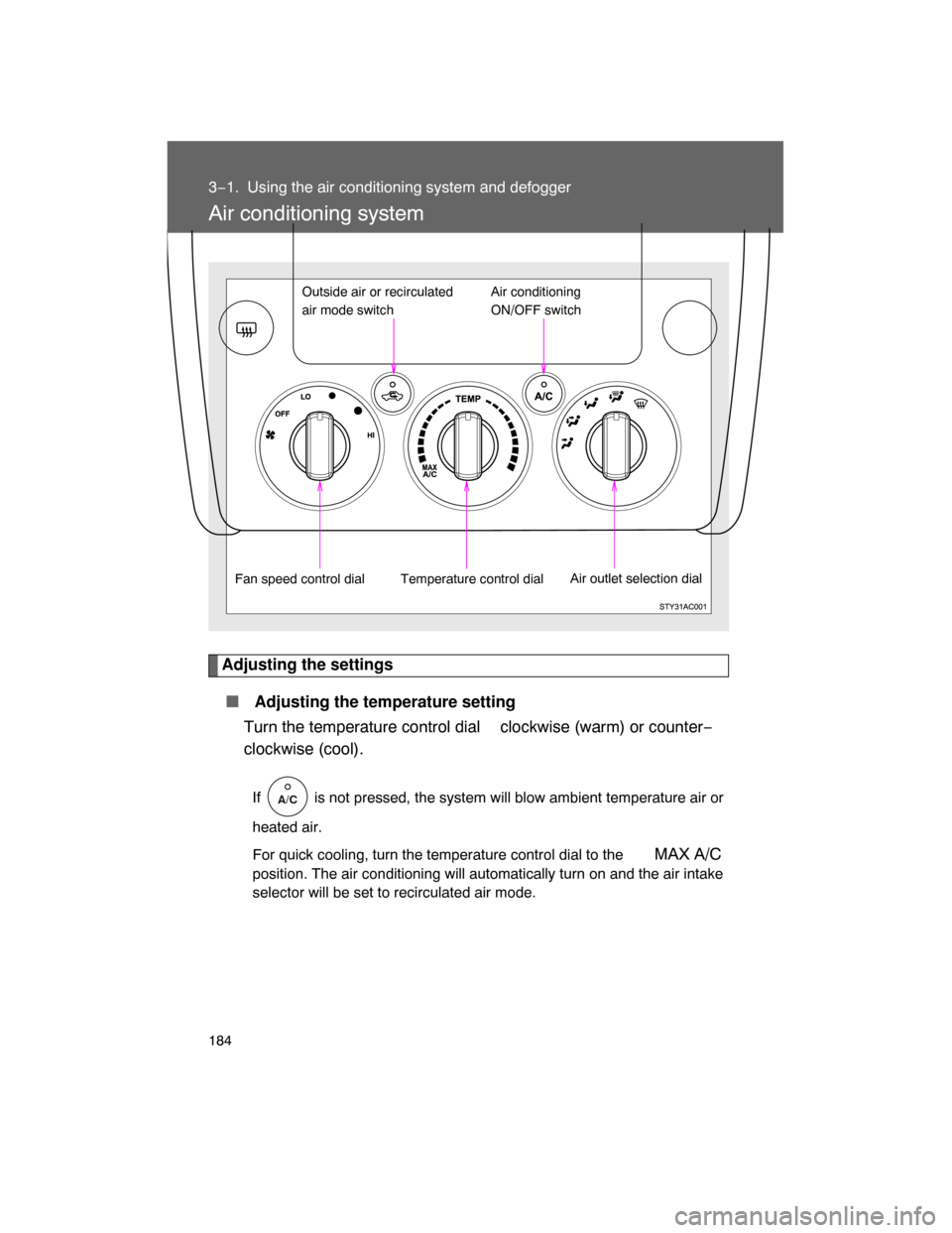
Adjusting the settings
� Adjusting the temperature setting
Turn the temperature control dial clockwise (warm) or counter−
clockwise (cool).
If is not pressed, the system will blow ambient temperature air or
heated air.
For quick cooling, turn the temperature control dial to the
MAX A/C
position. The air conditioning will automatically turn on and the air intake
selector will be set to recirculated air mode.
Outside air or recirculated
air mode switch
Air outlet selection dial Air conditioning
ON/OFF switch
Temperature control dialFan speed control dial
A/C
Page 238 of 400
241
3−5. Other interior features
3
Interior features
� The power outlet can be used when
The engine is started.
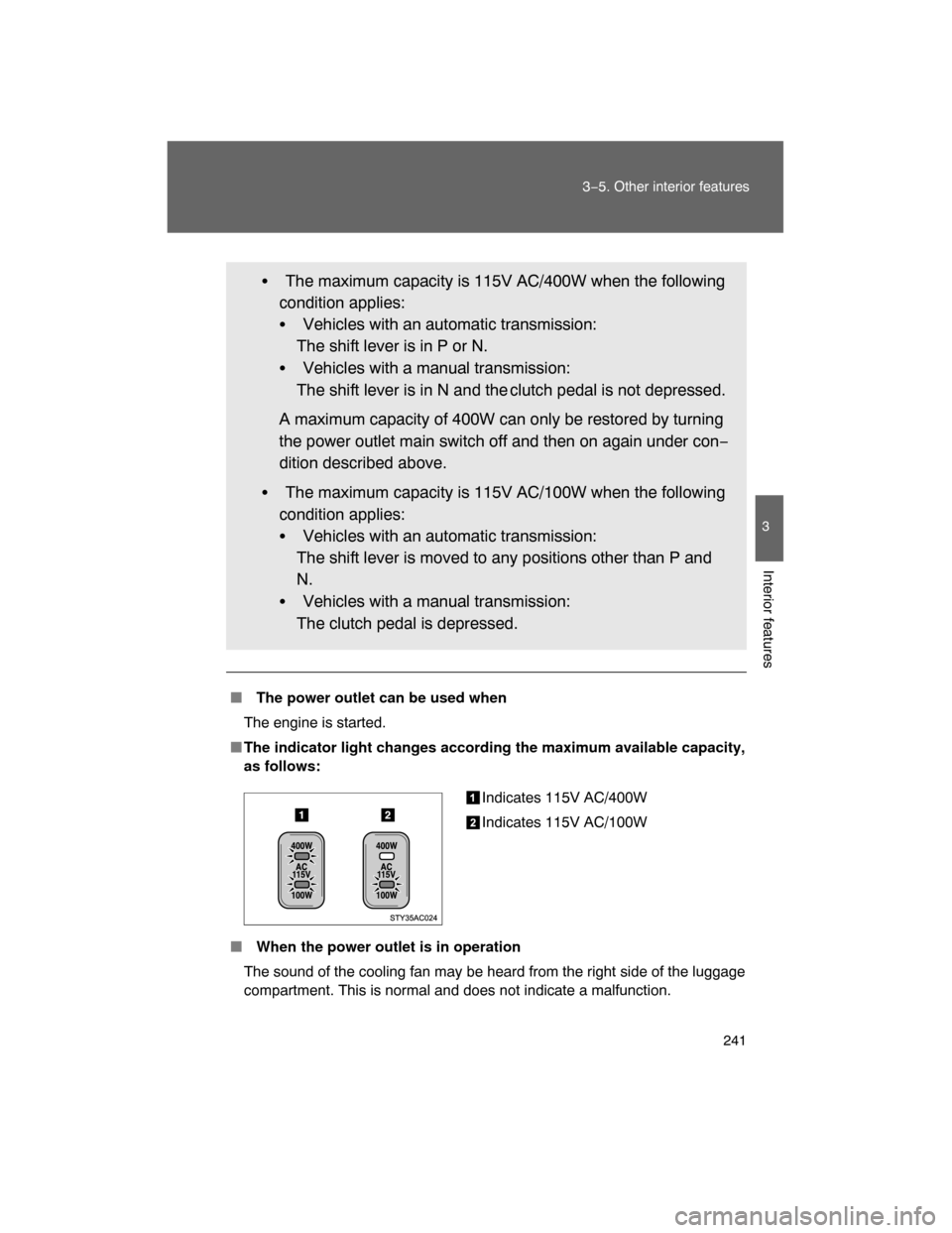
�The indicator light changes according the maximum available capacity,
as follows:
� When the power outlet is in operation
The sound of the cooling fan may be heard from the right side of the luggage
compartment. This is normal and does not indicate a malfunction.
�The maximum capacity is 115V AC/400W when the following
condition applies:
�Vehicles with an automatic transmission:
The shift lever is in P or N.
�Vehicles with a manual transmission:
The shift lever is in N and the clutch pedal is not depressed.
A maximum capacity of 400W can only be restored by turning
the power outlet main switch off and then on again under con−
dition described above.
�The maximum capacity is 115V AC/100W when the following
condition applies:
�Vehicles with an automatic transmission:
The shift lever is moved to any positions other than P and
N.
�Vehicles with a manual transmission:
The clutch pedal is depressed.
Indicates 115V AC/400W
Indicates 115V AC/100W
Page 267 of 400

271
4−3. Do−it−yourself maintenance
4
Maintenance and care
CAUTION
The engine compartment contains many mechanisms and fluids that may
move suddenly, become hot, or become electrically energized. To avoid death
or serious injury observe the following precautions.
� When working on the engine compartment
� Keep hands, clothing, and tools away from the moving fan and engine
drive belt.
�Be careful not to touch the engine, radiator, exhaust manifold, etc. right
after driving as they may be hot. Oil and other fluids may also be hot.
� Do not leave anything that may burn easily, such as paper or rags, in the
engine compartment.
�Do not smoke, cause sparks or expose an open flame to fuel or the bat−
tery. Fuel and battery fumes are flammable.
� Be extremely cautious when working on the battery. It contains poisonous
and corrosive sulfuric acid.
�Take care because brake fluid can harm your hands or eyes and damage
painted surfaces.
If fluid gets on your hands or in your eyes, flush the affected area with
clean water immediately.
If you still experience discomfort, see a doctor.
�When working near the cooling fan or radiator grille
Be sure the engine switch is off.
With the engine switch on, the cooling fan may automatically start to run if
the air conditioning is on and/or the coolant temperature is high.
� Safety glasses
Wear safety glasses to prevent flying or falling material, fluid spray, etc. from
getting in the eyes.
Page 275 of 400

279
4−3. Do−it−yourself maintenance
4
Maintenance and care
Engine coolant
The coolant level is satisfactory if it is between the F (Full) and L
(Low) lines on the reservoir when the engine is cold.
Reservoir cap
Full
Low
If the level is on or below the L
line, add coolant up to the F line.
1
2
3
� If the coolant level drops within a short time after replenishing
Visually check the radiator, hoses, reservoir cap, radiator cap, drain cock
and water pump.
If you cannot find a leak, have your Toyota dealer pressure test the cap and
check for leaks in the cooling system.
� Coolant selection
Only use “Toyota Super Long Life Coolant” or similar high quality ethylene
glycol based non−silicate, non−amine, non−nitrite and non−borate coolant with
long−life hybrid organic acid technology.
U.S.A.: “Toyota Super Long Life Coolant” is a mixture of 50% coolant and
50% deionized water. (Enabled: −31 F [−35 C])
Canada: “Toyota Super Long Life Coolant” is a mixture of 55% coolant and
45% deionized water. (Enabled: −44 F [−42 C])
For more details about engine coolant, contact your Toyota dealer.
CAUTION
� When the engine is hot
Do not remove the radiator cap.
The cooling system may be under pressure and may spray hot coolant if the
cap is removed, causing burns or other injuries.
Page 276 of 400
280 4−3. Do−it−yourself maintenance
Radiator and condenser
Check the radiator and condenser and clear any foreign objects.
If either of the above parts are ex
tremely dirty or you are not sure of
their condition, have your vehicle checked by your Toyota dealer.
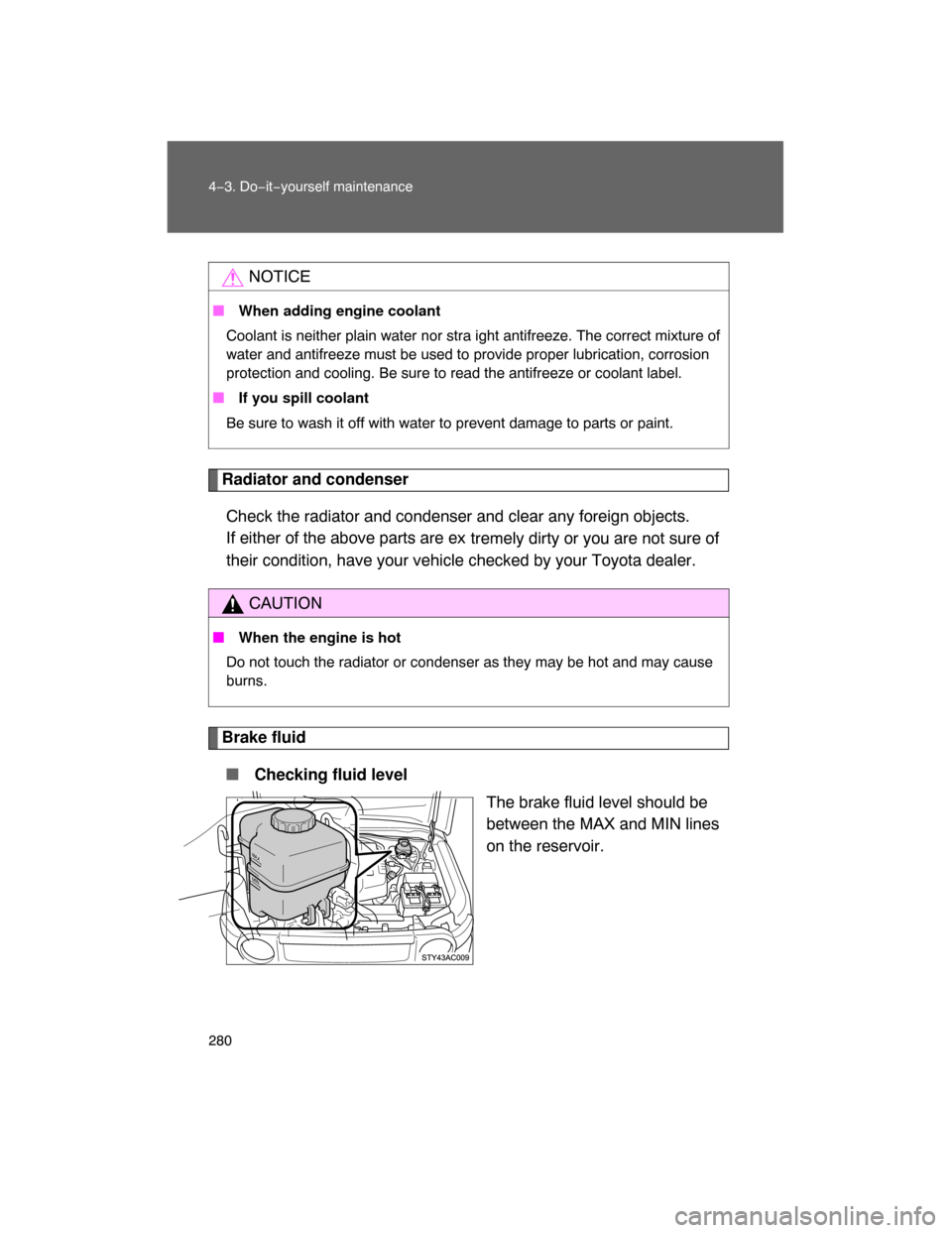
Brake fluid
� Checking fluid level
The brake fluid level should be
between the MAX and MIN lines
on the reservoir.
NOTICE
� When adding engine coolant
Coolant is neither plain water nor stra ight antifreeze. The correct mixture of
water and antifreeze must be used to provide proper lubrication, corrosion
protection and cooling. Be sure to read the antifreeze or coolant label.
� If you spill coolant
Be sure to wash it off with water to prevent damage to parts or paint.
CAUTION
� When the engine is hot
Do not touch the radiator or condenser as they may be hot and may cause
burns.
Page 350 of 400
5
When trouble arises
355 5−2. Steps to take in an emergency
CAUTION
� Battery precautions
The battery contains poisonous and corrosive acidic electrolyte, while
related parts contain lead and lead compounds. Observe the following pre−
cautions when handling the battery.
� When working with the battery, always wear safety glasses and take care
not to allow any battery fluids (acid) to come into contact with skin, clothing
or the vehicle body.
� Do not lean over the battery.
�In the event that battery fluid comes into contact with the skin or eyes,
immediately wash the affected area with water and seek medical attention.
Place a wet sponge or cloth over the affected area until medical attention
can be received.
� Always wash your hands after handling the battery support, terminals, and
other battery−related parts.
�
Do not allow children near the battery.
NOTICE
� To prevent damaging the vehicle
Do not pull− or push−start the vehicle, because the three−way catalytic con−
verter may overheat and become a fire hazard.
� When handling jumper cables
Be careful that the jumper cables do not become tangled in the cooling fan
or any of the belts when connecting or disconnecting them.
Page 351 of 400
356
5−2. Steps to take in an emergency
If your vehicle overheats
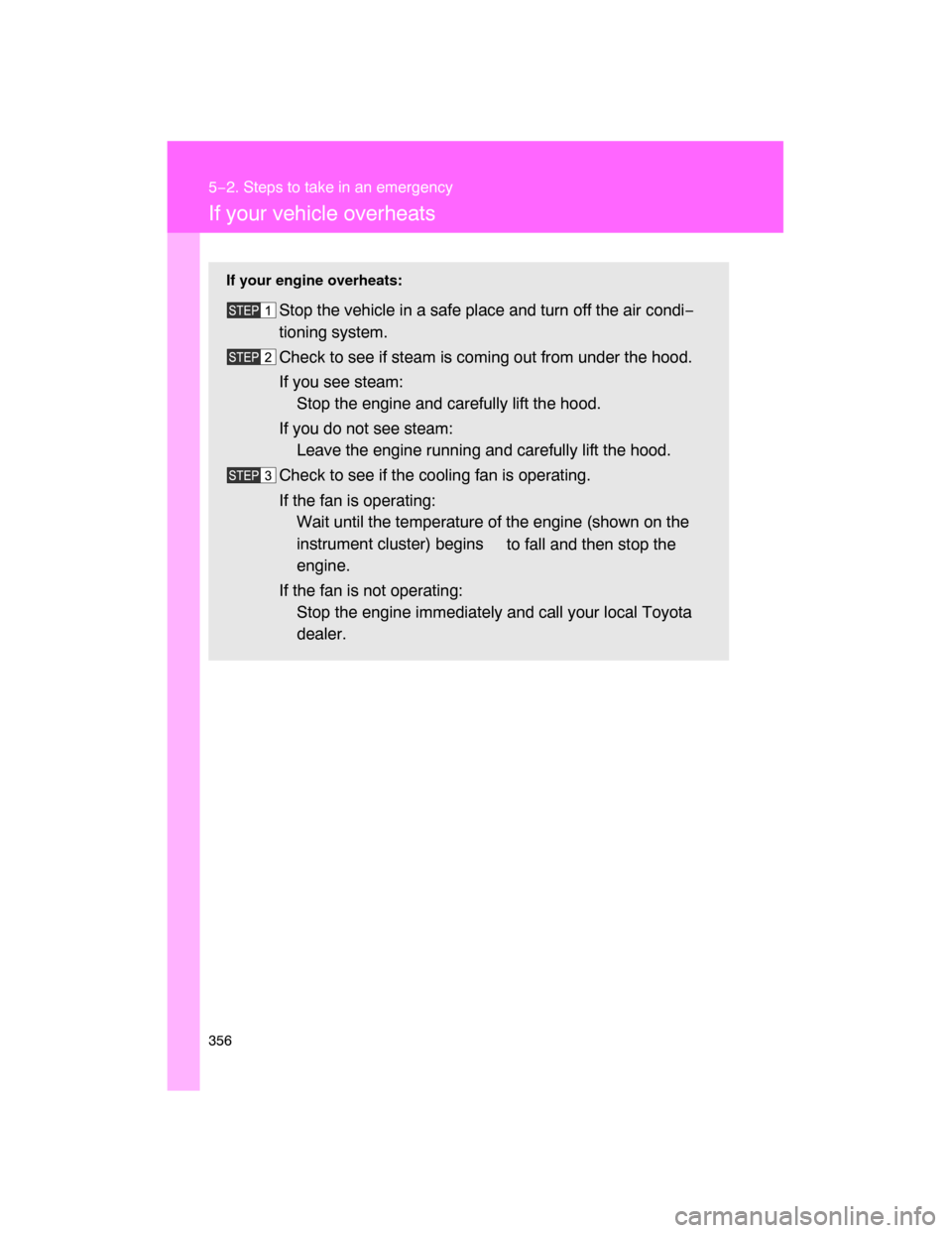
If your engine overheats:
Stop the vehicle in a safe place and turn off the air condi−
tioning system.
Check to see if steam is coming out from under the hood.
If you see steam:
Stop the engine and carefully lift the hood.
If you do not see steam:
Leave the engine running and carefully lift the hood.
Check to see if the cooling fan is operating.
If the fan is operating:
Wait until the temperature of the engine (shown on the
instrument cluster) begins
to fall and then stop the
engine.
If the fan is not operating:
Stop the engine immediately and call your local Toyota
dealer.
Page 360 of 400
366 6−1. Specifications
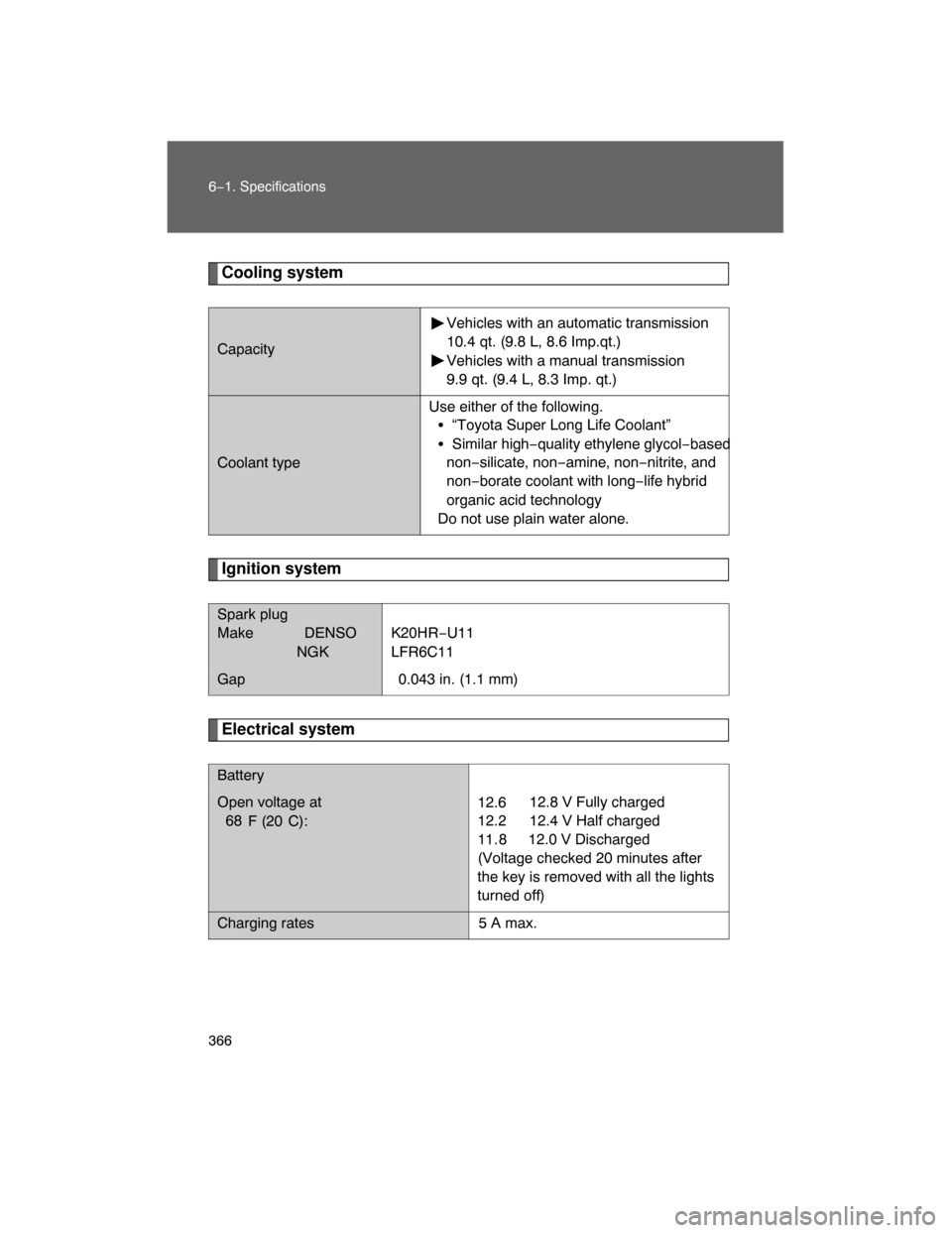
Cooling system
Ignition system
Electrical system
Capacity
Vehicles with an automatic transmission
10.4 qt. (9.8 L, 8.6 Imp.qt.)
Vehicles with a manual transmission
9.9 qt. (9.4 L, 8.3 Imp. qt.)
Coolant typeUse either of the following.
�“Toyota Super Long Life Coolant”
�Similar high−quality ethylene glycol−based
non−silicate, non−amine, non−nitrite, and
non−borate coolant with long−life hybrid
organic acid technology
Do not use plain water alone.
Spark plug
Make DENSO
NGK
K20HR−U11
LFR6C11
Gap 0.043 in. (1.1 mm)
Battery
Open voltage at
68
F (20 C):12.6 12.8 V Fully charged
12.2 12.4 V Half charged
11 . 8 12.0 V Discharged
(Voltage checked 20 minutes after
the key is removed with all the lights
turned off)
Charging rates 5 A max.