Page 410 of 496
398
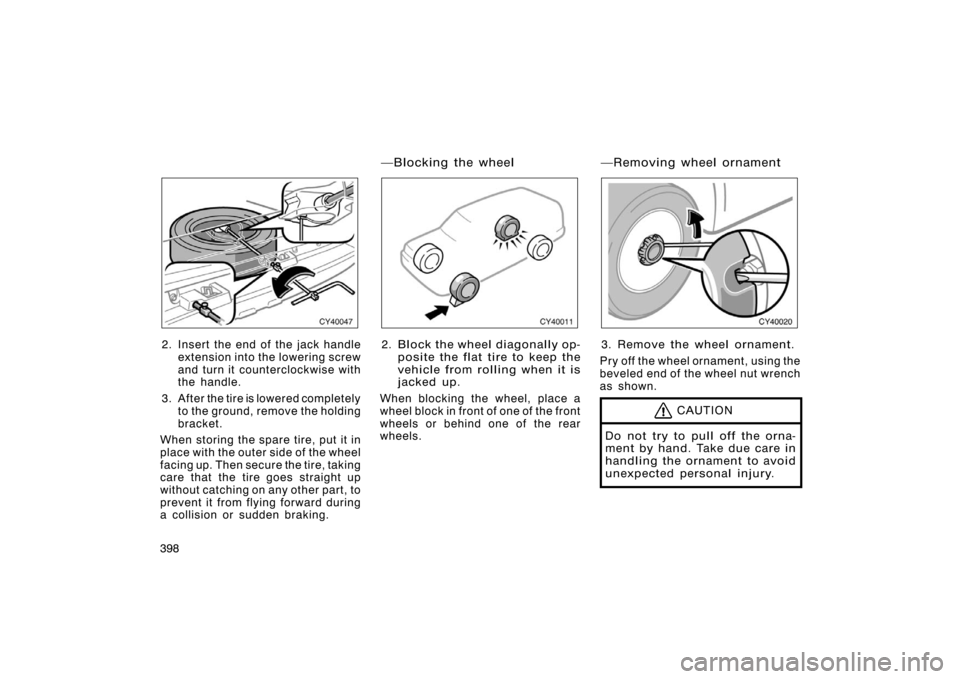
CY40047
2. Insert the end of the jack handleextension into the lowering screw
and turn it counterclockwise with
the handle.
3. After the tire is lowered completely to the ground, remove the holding
bracket.
When storing the spare tire, put it in
place with the outer side of the wheel
facing up. Then secure the tire, taking
care that the tire goes straight up
without catching on any other part, to
prevent it from flying forward during
a collision or sudden braking.
CY40011
2. Block the wheel diagonally op- posite the flat tire to keep the
vehicle from rolling when it is
jacked up.
When blocking the wheel, place a
wheel block in front of one of the front
wheels or behind one of the rear
wheels.
CY40020
3. Remove the wheel ornament.
Pry off the wheel ornament, using the
beveled end of the wheel nut wrench
as shown.
CAUTION
Do not try to pull off the orna-
ment by hand. Take due care in
handling the ornament to avoid
unexpected personal injury.
�Blocking the wheel �Removing wheel ornament
Page 413 of 496
401
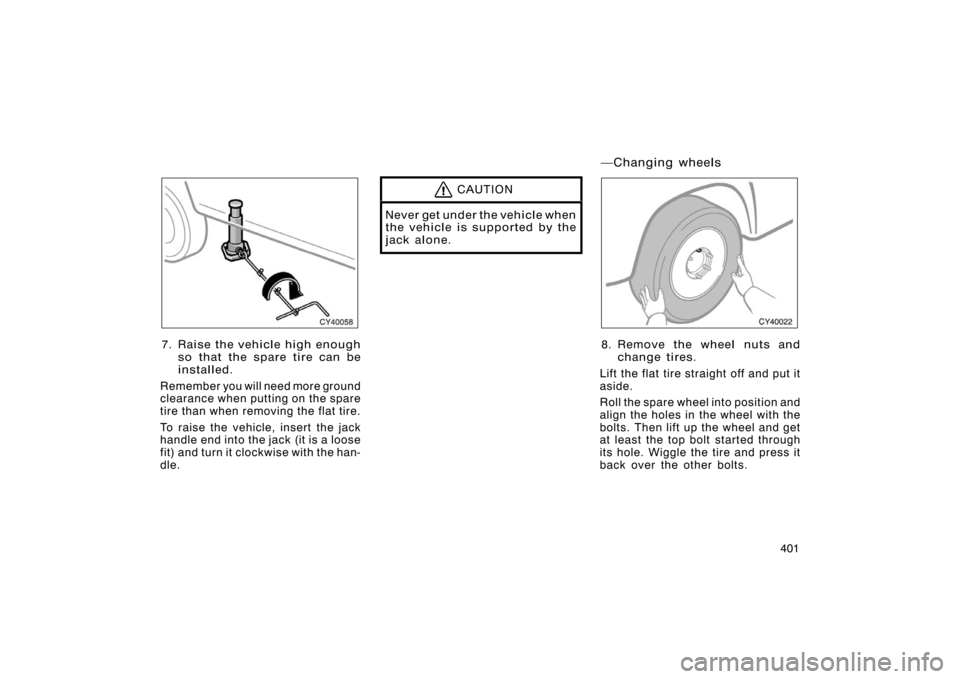
CY40058
7. Raise the vehicle high enoughso that the spare tire can be
installed.
Remember you will need more ground
clearance when putting on the spare
tire than when removing the flat tire.
To raise the vehicl e, insert the jack
handle end into the jack (it is a loose
fit) and turn it clockwise with the han-
dle.
CAUTION
Never get under the vehicle when
the vehicle is supported by the
jack alone.
CY40022
8. Remove the wheel nuts and
change tires.
Lift the flat tire straight off and put it
aside.
Roll the spare wheel into position and
align the holes in the wheel with the
bolts. Then lift up the wheel and get
at least the top bolt started through
its hole. Wiggle the tire and press it
back over the other bolts.
�Changing wheels
Page 416 of 496

404
CAUTION
�Take due care in handling the
ornament to avoid unexpected
personal injury.
� Do not attach a heavily dam-
aged plastic wheel ornament.
It may fly off the wheel and
cause accidents while the ve-
hicle is moving.
12.Check the air pressure of the re-
placed tire.
Adjust the air pressu re to the specifi-
cation designated on page 467 in
Section 8. If the pressure is lower,
drive slowly to the nearest service
station and fill to the correct pressure.
Do not forget to reinstall the tire infla-
tion valve cap as dirt and moisture
could get into the valve core and
possibly cause air leakage. If the cap
is missing, have a new one put on as
soon as possible.
13.Restow all the tools, jack and
flat tire securely.
As soon after changing wheels as
possible, tighten the wheel nuts to the
torque specified on page 467 in Sec-
tion 8 with a torque wrench. Have a
technician repair the flat tire.CAUTION
Before driving, make sure all the
tools, jack and flat tire are se-
curely in place in their storage
location to reduce the possibility
of personal injury during a colli-
sion or sudden braking.
�After changing wheels
Page 417 of 496
405
If your vehicle becomes stuck in snow,
mud, sand, etc., then you may attempt
to rock the vehicle free by moving it
forward and backward.
Turn off the traction control system to
become unstuck to allow the tires to
spin enough to remove the vehicle from
the obstruction. (For details, see
�Traction control system" on page 175
in Section 1−7.)
CAUTION
Do not attempt to rock the vehicle
free by moving it forward and back-
ward if people or objects are any-
where near the vehicle. During the
rocking operation the vehicle may
suddenly move forward or backward
as it becomes unstuck, causing injury
or damage to nearby people or ob-
jects.
NOTICE
If you rock your vehicle, observe the
following precautions to prevent dam-
age to the transmission and other
parts.
�Do not depress the accelerator ped-
al while shifting the selector lever
or before the transmission is com-
pletely shifted to forward or reverse
gear.
� Do not race the engine and avoid
spinning the wheels.
� If your vehicle remains stuck after
rocking the vehicle several times,
consider other ways such as tow-
ing.
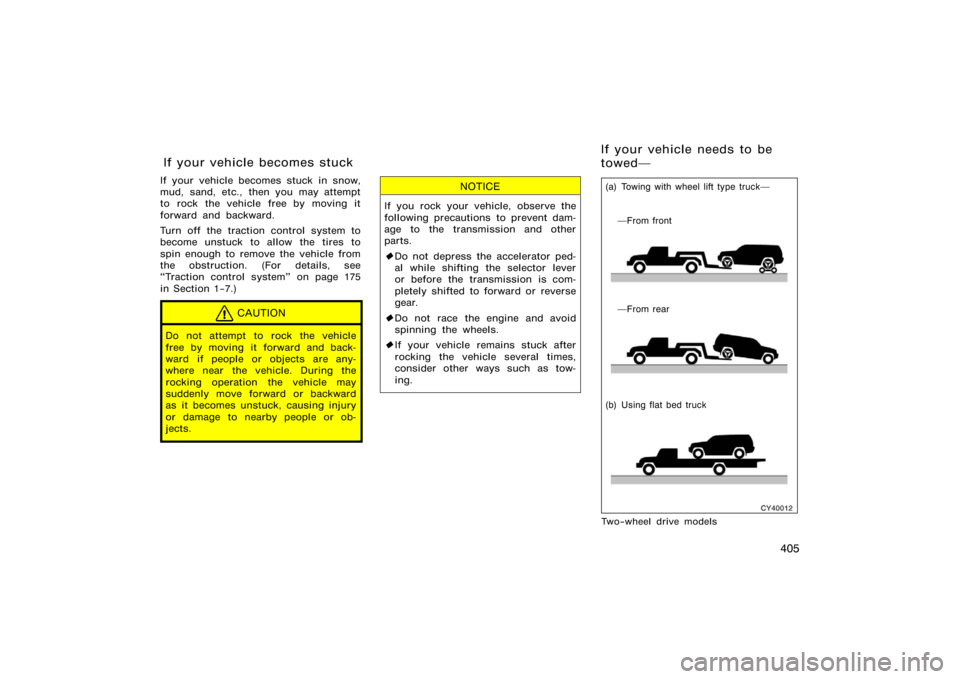
CY40012
(a) Towing with wheel lift type truck�
�From front
�From rear
(b) Using flat bed truck
Two−wheel drive models
If your vehicle becomes stuck If your vehicle needs to be
towed�
Page 422 of 496

410
The following methods are effective to
get out when your vehicle is struck in
mud, sand or other condition from
which the vehicle cannot be driven out
under its own power. Use extreme cau-
tion when towing vehicles. In addition,
keep away from the vehicles and towing
cable or chain when towing.
�Remove the soil and sand in the front
and the back of the tires.
�Place a stone or wood under the tires.
CY40015
If you cannot shift the selector lever
out of the �P" position to other posi-
tions even though the brake pedal is
depressed, use the shift lock override
button as follows:1. Turn the engine switch to the �LOCK" position. Make sure the
parking brake is set.
2. Pry up the cover with a flathead screwdriver or equivalent.
CY40016
3. Insert the screwdriver or equivalentinto the hole to push down the shift
lock override button. You can shift
out of the �P" position only while
pushing the button.
4. Shift into the �N" position.
5. Insert the cover.
6. Start the engine. For your safety, keep the brake pedal depressed.
Be sure to have the system checked by
your Toyota dealer as soon as possible.
�Tips for towing a stuck
vehicle If you cannot shift automatic
transmission selector lever
Page 437 of 496

425
Doors and engine hood
Check that all doors including back door
operate smoothly and all latches lock se-
curely. Make sure the engine hood sec-
ondary latch secures the hood from open-
ing when the primary latch is released.
Tire inflation pressure
Check the pressure with a gauge ev-
ery two weeks, or at least once a
month. See page 441 in Section 7−2
for additional information.
Tire surface and wheel nuts
Check the tires carefully for cuts,
damage or excessive wear. See page
443 in Section 7−2 for additional in-
formation. When checking the tires,
make sure no nuts are missing, and
check the nuts for looseness. Tighten
them if necessary.
Tire rotation
Rotate the tires according to the
maintenance schedule. (For
scheduled maintenance information,
please refer to the �Scheduled
Maintenance Guide" or �Owner ’s
Manual Supplement".) See page 445
in Section 7−2 for additional
information.
Be on the alert for changes in perfor-
mance, sounds, and visual tip−offs that
indicate service is needed. Some impor-
tant clues are as follows:
�Engine missing, stumbling, or pinging
�Appreciable loss of power
�Strange engine noises
�A leak under the vehicle (however, wa-
ter dripping from the air conditioning
after use is normal.)
�Change in exhaust sound (This may
indicate a dangerous carbon monoxide
leak. Drive with the windows open and
have the exhaust system checked im-
mediately.)
�Flat−looking tire; excessive tire squeal
when cornering; uneven tire wear
�Vehicle pulls to one side when driving
straight on a level road
�Strange noises related to suspension
movement
�Loss of brake effectiveness; spongy
feeling brake pedal; pedal almost
touches floor; vehicle pulls to one side
when braking
�Engine coolant temperature continually
higher than normal If you notice any of these clues, take your
vehicle to your Toyota dealer as soon as
possible. It probably needs adjustment or
repair.
CAUTION
Do not continue driving with the ve-
hicle unchecked. It could result in se-
rious vehicle damage and possibly
personal injury.
Does your vehicle need
repairing?
Page 447 of 496

435
DO−IT−YOURSELF MAINTENANCE
Engine and Chassis
Checking the engine oil level436
. . . . . . . . . . . . . . . . . . . . . . . . . . . . . . . . .
Checking the engine coolant level 438
. . . . . . . . . . . . . . . . . . . . . . . . . . . .
Checking the radiator and condenser 439
. . . . . . . . . . . . . . . . . . . . . . . . .
Checking brake fluid 439
. . . . . . . . . . . . . . . . . . . . . . . . . . . . . . . . . . . . \
. . . .
Checking power steering fluid 440
. . . . . . . . . . . . . . . . . . . . . . . . . . . . . . . .
Checking tire inflation pressure 441
. . . . . . . . . . . . . . . . . . . . . . . . . . . . . .
Checking and replacing tires 443
. . . . . . . . . . . . . . . . . . . . . . . . . . . . . . . . .
Rotating tires 445
. . . . . . . . . . . . . . . . . . . . . . . . . . . . . . . . . . . . \
. . . . . . . . . . .
Installing snow tires and chains 446
. . . . . . . . . . . . . . . . . . . . . . . . . . . . . .
Replacing wheels 447
. . . . . . . . . . . . . . . . . . . . . . . . . . . . . . . . . . . . \
. . . . . . .
Aluminum wheel precautions 448
. . . . . . . . . . . . . . . . . . . . . . . . . . . . . . . .
SECTION 7− 2
Page 453 of 496

441
Clean all dirt from the outside of the res-
ervoir tank and look at the fluid level. If
the fluid is cold, the level should be in the
�COLD" range. Similarly, if it is hot, the
fluid level should be in the �HOT" range.
If the level is at the low side of either
range, add automatic transmission fluid
DEXRON�II or� III to bring the level within
the range.
To remove the reservoir cap, turn it coun-
terclockwise and lift up. To reinstall it,
turn it clockwise. After replacing the reser-
voir cap, visually check the steering box
case, vane pump and hose connections
for leaks or damage.
CAUTION
The reservoir tank may be hot so be
careful not to burn yourself.
NOTICE
Avoid overfilling, or the power steer-
ing could be damaged.
CY72026
Keep your tire inflation pressures
at the proper level.
The recommended cold tire inflation
pressures, tire sizes and the com-
bined weight of occupants and cargo
(vehicle capacity weight) are de-
scribed on pages 462 and 467. They
are also on the tire and loading infor-
mation label.
You should check the tire inflation
pressure every two weeks, or at least
once a month. And do not forget the
spare!
The following instructions for
checking tire inflation pressure
should be observed:
� The pressure should be
checked only when the tires are
cold. If your vehicle has been
parked for at least 3 hours and has
not been driven for more than 1.5
km or 1 mile since, you will get
an accurate cold tire inflation pres-
sure reading.
Checking tire inflation
pressure