2008 TESLA ROADSTER ECU
[x] Cancel search: ECUPage 83 of 115

Fuse replacement
10-7
Roadside emergencies
Fuse replacementReplacing a fuse
WARNING: Use replacement fuses of
the same rating and type or fuses of
matching specification. Incorrect fuse ratings
can overload a system and cause a fire or
malfunction. Blown fuses should be replaced
and no attempt should be made to repair a
blown fuse.
S
Fuses protect the vehicle’s electrical systems
from damage. The failure of any fuse will
render the equipment it protects inoperative.
1. Before removing a fuse, turn off all electrical equipment and remove the key
from the starter switch.
2. Locate the fuse box. The fuse box is located behind the access panel on the
passenger side of the dashboard.
3. Open the panel to access the fuses. Remove the panel by using the
screwdriver supplied in the toolkit to rotate the fastener 90° counterclockwise,
then release the panel from the
dashboard.
4. Consult the fuse specification chart to determine which fuse is protecting the
non-functioning electrical system.
Note: A label is also affixed to the inside
of the panel.
5. Remove the appropriate fuse and replace with a fuse of the same amperage as the
original. If in doubt, check the fuse
specification chart on the following
pages.
6. Re-install the fuse panel by aligning the hinges at the bottom of the panel with
the slots on the surrounding dashboard
area. Secure the panel by rotating the
fastener 90° clockwise.
If a replacement fuse fails to solve an
electrical failure, or the replacement fuse fails
prematurely, contact Tesla Motors.TR0048
13579 2468
11 13 15 17
20 22 24 26
10 12 14 16 18 19 21 23 25 27
Fuse colors
Fuse color
Rating (amps)
Orange 5
Brown 7.5
Red 10
Blue 15
Yellow 20
Clear 25
Green 30
Roadster OHB.book Page 7 Th ursday, October 2, 2008 8:59 AM
Page 86 of 115
Bulb replacement10-10
Roadside emergencies
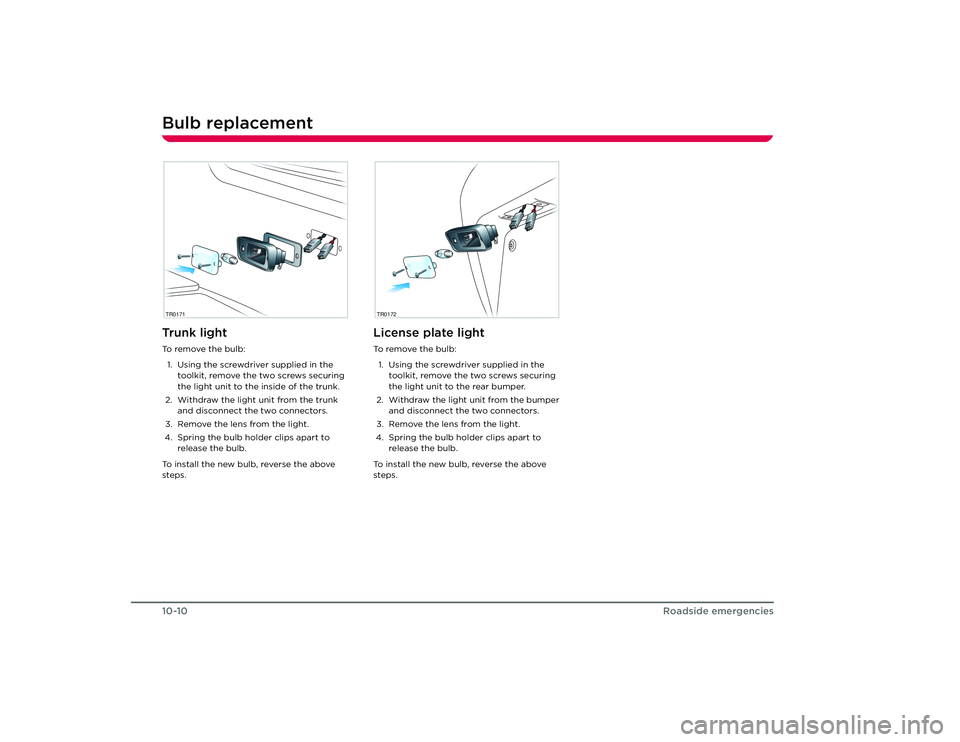
Tr u n k l i g h tTo r e m o v e t h e b u l b :1. Using the screwdriver supplied in the toolkit, remove the two screws securing
the light unit to the inside of the trunk.
2. Withdraw the light unit from the trunk and disconnect the two connectors.
3. Remove the lens from the light.
4. Spring the bulb holder clips apart to release the bulb.
To install the new bulb, reverse the above
steps.
License plate lightTo r e m o v e t h e b u l b : 1. Using the screwdriver supplied in the toolkit, remove the two screws securing
the light unit to the rear bumper.
2. Withdraw the light unit from the bumper and disconnect the two connectors.
3. Remove the lens from the light.
4. Spring the bulb holder clips apart to release the bulb.
To install the new bulb, reverse the above
steps.
TR0171
TR0172
Roadster OHB.book Page 10 Thursday, October 2, 2008 8:59 AM
Page 90 of 115

Vehicle recovery10-14
Roadside emergencies
4. Touch To w M o d e , then touch OK to
confirm. The Touch Screen displays the
following message to indicate that the
vehicle is in Tow Mode.
5. Release the hand brake, if appropriate.
Note: Although Tow Mode is activated, the
steering column lock will be engaged. To
disengage the steering column, turn the key
to the ACC position. If it is difficult to turn the
key, move the steering wheel slightly.
Caution: The car can roll freely when
Tow Mode is active. If the vehicle is not
on a flat surface, do not release the hand
brake until the vehicle is ready to be pulled. Note:
The vehicle can not be charged or
started until you exit Tow Mode.
Attaching the vehicle recovery eyeA vehicle recovery eye can be attached to the
front of the vehicle to allow the vehicle to be
pulled onto a transporter in situations when
the vehicle can roll freely.
WARNING: NEVER tow the vehicle
using the vehicle recovery eye. Doing
so can cause serious, even fatal injury to
other motorists and can also cause
significant damage to your vehicle.
S
1. Retrieve the recovery eye from the tool kit located in the trunk. See Tool kit
components, page 10-2.
2. Using the screwdriver (also supplied in the toolkit), remove the plug from the
recovery eye mounting point behind the
front grill. If a license plate has been
installed on the front of the vehicle, it
must be removed to access the recovery
eye.
3. Insert the recovery eye through the hole in the front grill and screw into the
mounting point. Ensure the recovery eye
is fully tightened.
After use, remove the recovery eye and return
it to the tool kit. Insert the plug back into the
mounting point to prevent dirt from entering.Transporter and trailer tie
down strapsWhen the vehicle is to be moved on a
transporter or trailer, it will be necessary to
use chocks and tie down straps to secure the
wheels. To avoid damage: • Ensure that metal parts on the tie down
straps do not contact the vehicle’s
painted surfaces or the face of any
wheels.
• Do not place tie down straps over or
through the vehicle’s body panels.
Caution: Attaching straps to the
chassis, suspension or other parts of
the body can damage the vehicle.
TR0162
Roadster OHB.book Page 14 Thursday, October 2, 2008 8:59 AM
Page 99 of 115
Wheels and tires
11-9
Technical specifications
pressure telltale illuminates, you should stop
and check your tires as soon as possible, and
inflate them to the proper pressure.
Driving on a significantly under-inflated tire
causes the tire to overheat and can lead to
tire failure. Under-inflation also reduces
Battery range and tire tread life, and may
affect the vehicle’s handling and stopping
ability.
The TPMS is not a substitute for proper tire
maintenance, and it is the driver’s
responsibility to maintain correct tire
pressure, even if under-inflation has not
reached a level to trigger illumination of the
TPMS tire pressure telltale.Checking tire pressures
WARNING: Tire pressures should be
checked using an accurate pressure
gauge when cold. Under-inflation is the most
common cause of tire failures and may result
in severe tire cracking, tread separation or
“blowout”, with unexpected loss of vehicle
control and increased risk of injury.
S
Check the pressures when the tires are cold.
Be aware that it only takes 1 mile (1.5 km) of
driving to warm up the tires sufficiently to
affect the tire pressures. If it is necessary to
check the tires when they are warm, you
should expect the pressures to have
increased. Do not let air out of warm tires in
an attempt to match the recommended cold
tire pressures.
Note: When adjusting tire pressures, you can
display tire pressure values on the Touch
Screen’s tire pressure screen. However, the values displayed by the Touch Screen will not
be updated until you place the car in drive
long enough for the tire pressure monitoring
sensors to take new readings. For details,
refer to the Touch Screen Users Manual
provided in your owners package.
Always inflate your tires to the Tesla Motors
recommended inflation pressure even if it is
different from the maximum inflation
pressure information found on the tire itself.
For the correct tire pressures, refer to
Specifications and tire pressures, page 11-4
.
The following procedure should be used to
check and adjust tire pressures: 1. Remove the cap from the valve, then firmly press the tire gauge onto the valve
and measure the pressure.
2. If required add air to reach the required pressure.
3. Check the pressure by removing the tire gauge and then re-attaching it.
Note: Failure to remove and re-attach the
gauge to the valve could cause the gauge
to show an incorrect reading.
4. If too much air is added, air can be released by pushing on the metal stem in
the center of the valve.
5. Recheck the pressure with the tire gauge and adjust if necessary.
6. Refit the valve cap.
Va l ve sFit the valve caps securely to prevent dirt
from entering the valve. Periodically check
the valve for damage and leaks.
Tire wear
WARNING: The tires should be
regularly checked for wear and to make
sure that there are no cuts, bulges or
exposure of the ply/cord structure. Do not
drive with tires which are worn or damaged.
The safety of the vehicle and occupants will
be adversely affected.p
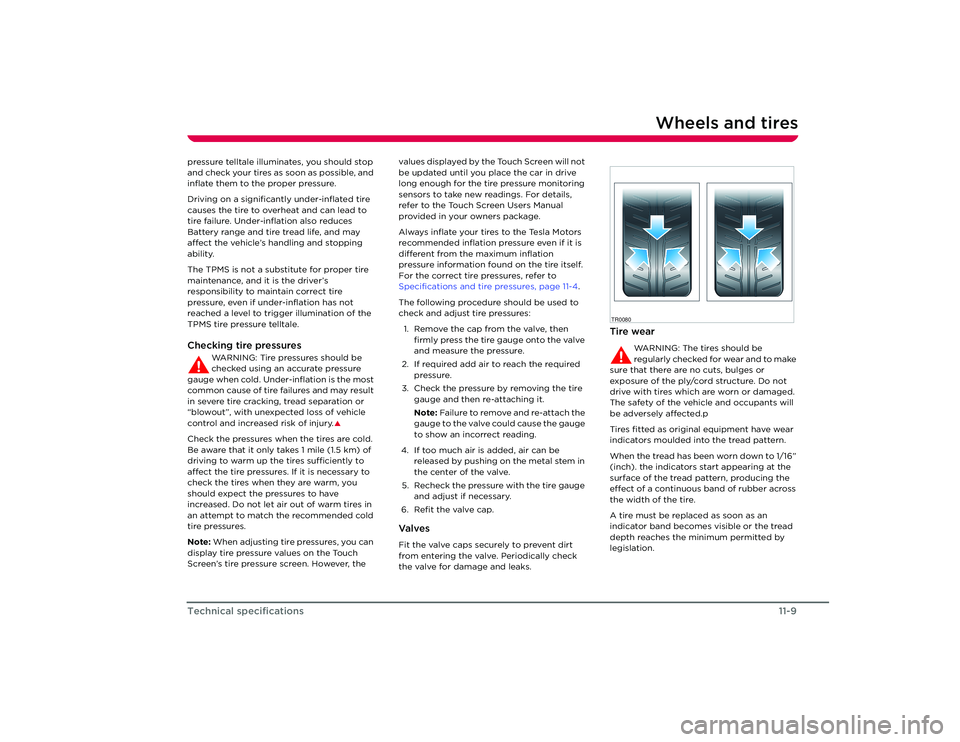
Tires fitted as original equipment have wear
indicators moulded into the tread pattern.
When the tread has been worn down to 1/16”
(inch). the indicators start appearing at the
surface of the tread pattern, producing the
effect of a continuous band of rubber across
the width of the tire.
A tire must be replaced as soon as an
indicator band becomes visible or the tread
depth reaches the minimum permitted by
legislation.
TR0080
Roadster OHB.book Page 9 Th ursday, October 2, 2008 8:59 AM
Page 112 of 115

Index
Locking your vehicle ........................................ 4-2
Low tire pressure indicator light ................ 6-12
Lumbar support...................................................3-2MMaintenanceBrake fluid ..................................................... 9-4
Cleaning the exterior ................................ 9-7
Cleaning the interior ................................. 9-8
Daily checks.................................................. 9-2
Fluids ............................................................... 9-4
Owner maintenance .................................. 9-2
Paint repair ................................................... 9-8
Removing tar ............................................... 9-7
Routine maintenance ................................ 9-2
Service internal indicator ........................ 9-2
Underbody .................................................... 9-7
Washer fluid ................................................. 9-5
Washer jets ................................................... 9-6
Weekly checks............................................. 9-2
Windshield wiper........................................ 9-6
Master door locking switch............................ 4-4
Mileage................................................................... 6-3
Mirrors .....................................................................7-3
Modifying your vehicle ......................................1-2
Motor specifications ........................................11-17NNavigation system.............................................. 8-1
NHTSA .................................................................... 1-4OOdometer display ............................................. 6-12
Opening the doors Inside the vehicle........................................ 4-4
Outside the vehicle .................................... 4-4
Ownership change ..............................................1-2
PPaint code ............................................................. 11-2
Paint damage....................................................... 9-8
Parking brake ...................................................... 6-5
Passenger airbag deactivation ..................... 3-7
Performance charge setting .......................... 5-4
PIN code ................................................................ 4-8
PIN lock ................................................................ 4-10
Polishing the bodywork................................... 9-8
Power socket ....................................................... 7-7
Power windows .................................................. 7-2
Pressure washers ............................................... 9-7
Programming the key fob .............................. 4-3
Proposition 65 ...................................................... 1-2RRaising the vehicle........................................... 10-11
Range charge setting ....................................... 5-4
Rear suspension specifications .................. 11-18
Rear view mirrors............................................... 7-3
Recovery eye ....................................................10-14
Regenerative braking ....................................... 6-5
Regenerative braking visual display ...........6-11
Removing the hard-top ..................................7-14
Replacement bulbs.......................................... 10-9
Reporting safety defects ................................. 1-4
Roof Hard-top........................................................ 7-13
Soft-top .......................................................... 7-11SSafety compliance certification label......... 11-3
Safety defects ...................................................... 1-4
Safety instructionsChild seats ............................................ 3-5, 3-7
Jacking the vehicle .................................. 10-11
Lifting the vehicle .................................... 10-12 Obstruction of airbags.............................. 3-7
Seat belts ....................................................... 3-3
Tire repair .................................................... 10-4
Wearing seat belts when pregnant ..... 3-4
Windows ........................................................ 7-2
Seat belts Care .................................................................. 3-4
Cleaning.......................................................... 9-8
General information ................................... 3-3
Pre-tensioners .............................................. 3-4
Reminder............................................. 3-4, 6-12
Safety instructions ..................................... 3-3
Testing ............................................................ 3-4
Wearing .......................................................... 3-3
Wearing when pregnant .......................... 3-4
Seat heater controls.......................................... 7-4
Seat heaters ......................................................... 7-6
Seats Adjustment.................................................... 3-2
Child seats and restraints ........................ 3-5
Lumbar support........................................... 3-2
Security .................................................................. 4-7
Security code .......................................................4-8
Service data recording...................................... 1-2
Soft top Installing ....................................................... 7-10
Removing .......................................................7-11
Specifications Antifreeze .................................................... 11-14
Battery .......................................................... 11-19
Brake fluid.................................................... 11-14
Brakes............................................................ 11-18
Coolant ......................................................... 11-14
Electrical....................................................... 11-19
Fluids ............................................................. 11-14
Front suspension ...................................... 11-18
Motor ............................................................. 11-17
Rear suspension ........................................ 11-18
Roadster OHB.book Page 3 Th ursday, October 2, 2008 8:59 AM