2008 SUBARU TRIBECA cooling
[x] Cancel search: coolingPage 289 of 409
ble.
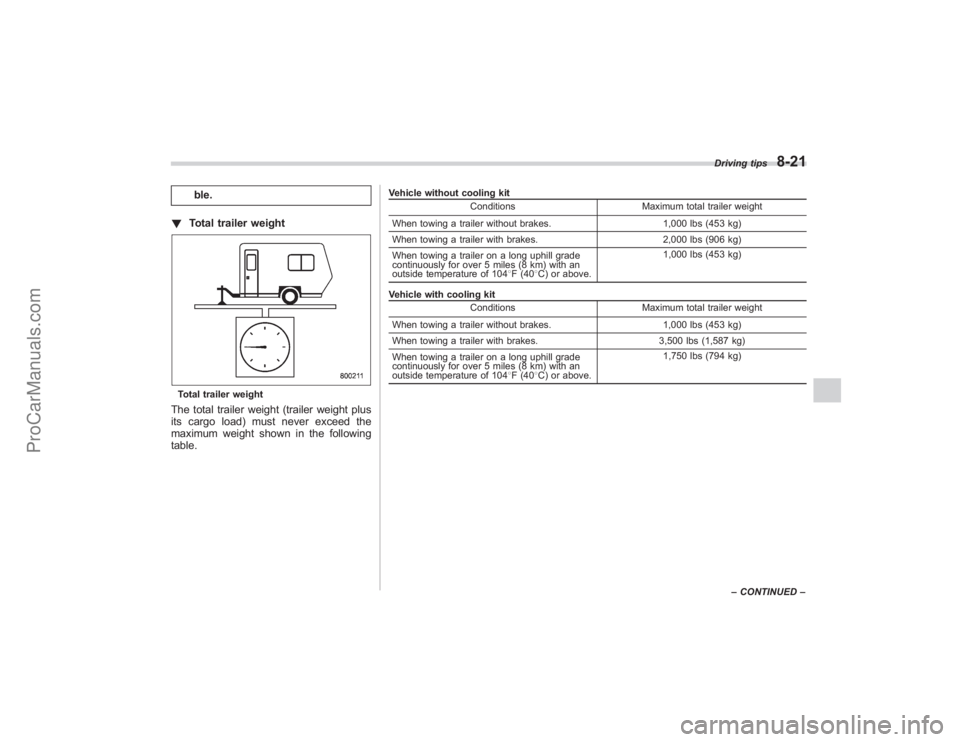
! Total trailer weight
Total trailer weightThe total trailer weight (trailer weight plus
its cargo load) must never exceed the
maximum weight shown in the following
table.
Vehicle without cooling kit
Conditions Maximum total trailer weight
When towing a trailer without brakes. 1,000 lbs (453 kg)
When towing a trailer with brakes. 2,000 lbs (906 kg)
When towing a trailer on a long uphill grade
continuously for over 5 miles (8 km) with an
outside temperature of 104 8F (40 8C) or above. 1,000 lbs (453 kg)
Vehicle with cooling kit Conditions Maximum total trailer weight
When towing a trailer without brakes. 1,000 lbs (453 kg)
When towing a trailer with brakes. 3,500 lbs (1,587 kg)
When towing a trailer on a long uphill grade
continuously for over 5 miles (8 km) with an
outside temperature of 104 8F (40 8C) or above. 1,750 lbs (794 kg)Driving tips
8-21
–
CONTINUED –
ProCarManuals.com
Page 291 of 409
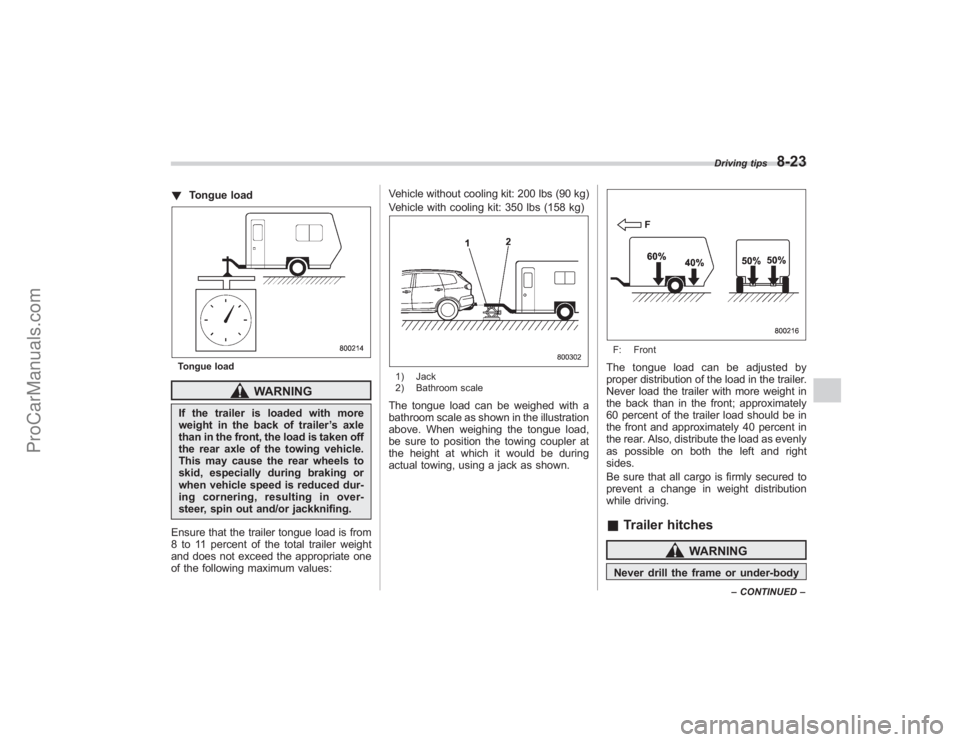
!Tongue loadTongue load
WARNING
If the trailer is loaded with more
weight in the back of trailer ’s axle
than in the front, the load is taken off
the rear axle of the towing vehicle.
This may cause the rear wheels to
skid, especially during braking or
when vehicle speed is reduced dur-
ing cornering, resulting in over-
steer, spin out and/or jackknifing.
Ensure that the trailer tongue load is from
8 to 11 percent of the total trailer weight
and does not exceed the appropriate one
of the following maximum values: Vehicle without cooling kit: 200 lbs (90 kg)
Vehicle with cooling kit: 350 lbs (158 kg)
1) Jack
2) Bathroom scaleThe tongue load can be weighed with a
bathroom scale as shown in the illustration
above. When weighing the tongue load,
be sure to position the towing coupler at
the height at which it would be during
actual towing, using a jack as shown.
F: FrontThe tongue load can be adjusted by
proper distribution of the load in the trailer.
Never load the trailer with more weight in
the back than in the front; approximately
60 percent of the trailer load should be in
the front and approximately 40 percent in
the rear. Also, distribute the load as evenly
as possible on both the left and right
sides.
Be sure that all cargo is firmly secured to
prevent a change in weight distribution
while driving.&
Trailer hitches
WARNING
Never drill the frame or under-body
Driving tips
8-23
–CONTINUED –
ProCarManuals.com
Page 308 of 409
9-12
In case of emergency
eye protectors, and remove metal
objects such as rings, bands or
other metal jewelry.
. Be sure the jumper cables and
clamps on them do not have
loose or missing insulation.
Do not jump start unless cables
in suitable condition are avail-
able.
. A running engine can be danger-
ous. Keep your fingers, hands,
clothing, hair and tools away
from the cooling fan, belts and
any other moving engine parts.
Removing rings, watches and
ties is advisable.
. Jump starting is dangerous if it is
done incorrectly. If you are un-
sure about the proper procedure
for jump starting, consult a com-
petent mechanic.
When your vehicle does not start due to a
run down (discharged) battery, the vehicle
may be jump started by connecting your
battery to another battery (called the
booster battery) with jumper cables.
& How to jump start1. Make sure the booster battery is 12
volts and the negative terminal is
grounded.
2. If the booster battery is in another
vehicle, do not let the two vehicles touch.
3. Turn off all unnecessary lights and
accessories.
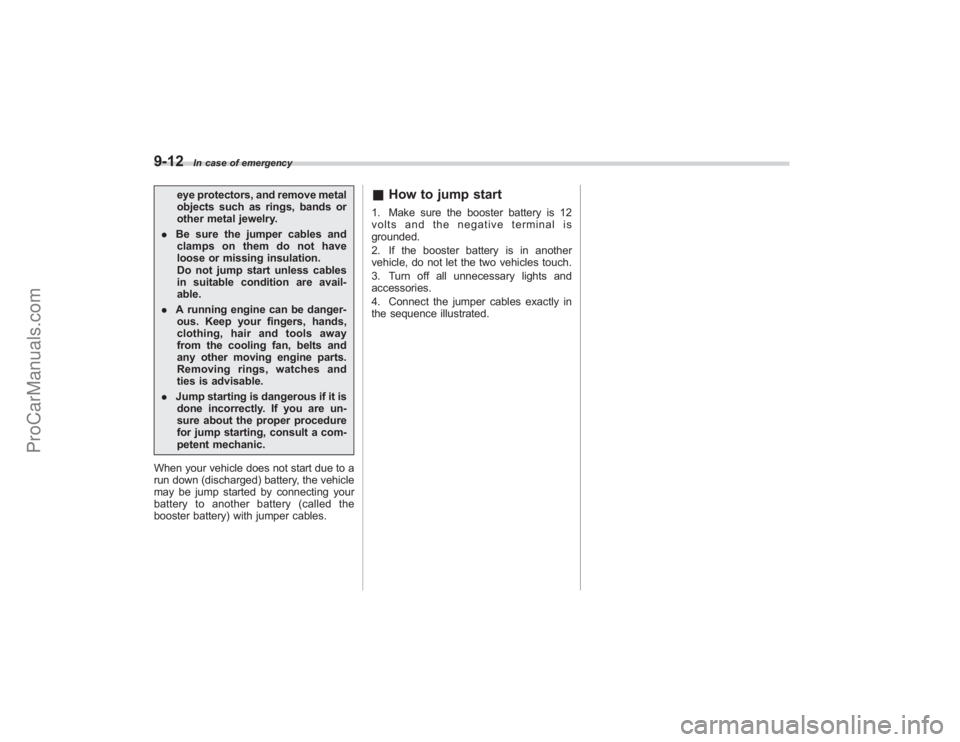
4. Connect the jumper cables exactly in
the sequence illustrated.
ProCarManuals.com
Page 310 of 409

9-14
In case of emergency
5. Start the engine of the vehicle with the
booster battery and run it at moderate
speed. Then start the engine of the vehicle
that has the discharged battery.
6. When finished, carefully disconnect
the cables in exactly the reverse order.
Engine overheating
WARNING
Never attempt to remove the radia-
tor cap until the engine has been
shut off and has fully cooled down.
When the engine is hot, the coolant
is under pressure. Removing the
cap while the engine is still hot
could release a spray of boiling hot
coolant, which could burn you very
seriously.
If the engine overheats, safely pull off the
road and stop the vehicle in a safe place.& If steam is coming from the
engine compartmentTurn off the engine and get everyone
away from the vehicle until it cools down.&If no steam is coming from
the engine compartment1. Keep the engine running at idling
speed.
2. Open the hood to ventilate the engine
compartment.
Confirm that the cooling fan is turning. If
the fan is not turning, immediately turn off the engine and contact your authorized
dealer for repair.
3. After the engine coolant temperature
has dropped, turn off the engine.
If the temperature gauge stays at the
overheated zone, turn off the engine.
4. After the engine has fully cooled down,
check the coolant level in the reserve
tank.
If the coolant level is below the
“LOW ”
mark, add coolant up to the “FULL”mark.
5. If there is no coolant in the reserve
tank, add coolant to the reserve tank.
Then remove the radiator cap and fill the
radiator with coolant.
If you remove the radiator cap from a hot
radiator, first wrap a thick cloth around the
radiator cap, then turn the cap counter-
clockwise slowly without pressing down
until it stops. Release the pressure from
the radiator. After the pressure has been
fully released, remove the cap by pressing
down and turning it.
ProCarManuals.com
Page 323 of 409

Maintenance schedule................................... 11-3
Maintenance precautions............................... 11-3
Before checking or servicing in the engine compartment ................................................. 11-4
When you do checking or servicing in the engine compartment while the engine is running ....... 11-4
Engine hood................................................... 11-4
Engine compartment overview ...................... 11-6
Engine oil ........................................................ 11-7
Checking the oil level ...................................... 11-7
Changing the oil and oil filter ........................... 11-8
Recommended grade and viscosity ................. 11-9
Recommended grade and viscosity under severe driving conditions ....................................... 11-10
Cooling system............................................ 11-11
Hose and connections ................................... 11-11
Engine coolant .............................................. 11-11
Air cleaner element ...................................... 11-14
Replacing the air cleaner element .................. 11-14
Spark plugs.................................................. 11-15
Recommended spark plugs ........................... 11-15
Drive belts.................................................... 11-15
Automatic transmission fluid ...................... 11-15
Checking the fluid level................................. 11-15
Recommended fluid ...................................... 11-16
Front differential gear oil ............................. 11-17
Checking the oil level.................................... 11-17
Recommended grade and viscosity ............... 11-17
Rear differential gear oil.............................. 11-18
Checking the gear oil level ............................ 11-18 Recommended grade and viscosity
............... 11-18
Power steering fluid..................................... 11-19
Checking the fluid level ................................. 11-19
Recommended fluid ...................................... 11-20
Brake fluid..................................................... 11-20
Checking the fluid level ................................. 11-20
Recommended brake fluid ............................ 11-21
Brake booster............................................... 11-21
Brake pedal ................................................... 11-21
Checking the brake pedal free play ............... 11-21
Checking the brake pedal reserve distance ..................................................... 11-22
Replacement of brake pad and lining ......... 11-22
Breaking-in of new brake pads and
linings ........................................................ 11-22
Parking brake stroke .................................... 11-23
Tires and wheels ........................................... 11-23
Types of tires................................................ 11-23
Tire pressure monitoring system (TPMS) ....... 11-24
Tire inspection .............................................. 11-25
Tire pressures and wear ............................... 11-25
Wheel balance .............................................. 11-27
Wear indicators ............................................ 11-28
Tire rotation direction mark ........................... 11-28
Tire rotation .................................................. 11-28
Tire replacement ........................................... 11-29
Wheel replacement ....................................... 11-29
Aluminum wheels......................................... 11-30
Chrome plated wheels (if equipped) ........... 11-31
Windshield washer fluid ............................... 11-32
Maintenance and service
11
ProCarManuals.com
Page 326 of 409

11-4
Maintenance and service
guard against getting oil or fluids
in your eyes. If something does
get in your eyes, thoroughly
wash them out with clean water.
. Do not tamper with the wiring of
the SRS airbag system or seat-
belt pretensioner system, or at-
tempt to take its connectors
apart, as that may activate the
system or it can render it inop-
erative. The wiring and connec-
tors of these systems are yellow
for easy identification. NEVER
use a circuit tester for these
wiring.
If your SRS airbag or seatbelt
pretensioner needs service, con-
sult your nearest SUBARU deal-
er.
& Before checking or servicing
in the engine compartment
WARNING
. Always stop the engine and set
the parking brake firmly to pre-
vent the vehicle from moving.
. Always let the engine cool down.
Engine parts become very hot
when the engine is running and remain hot for some time after
the engine is stopped.
. Do not spill engine oil, engine
coolant, brake fluid or any other
fluid on hot engine components.
This may cause a fire.
. Always remove the key from the
ignition switch. When the ignition
switch is in the “ON ”position,
thecoolingfanmayoperate
suddenly even when the engine
is stopped.
& When you do checking or
servicing in the engine com-
partment while the engine is
running
WARNING
A running engine can be dangerous.
Keep your fingers, hands, clothing,
hair and tools away from the cooling
fan, belts and any other moving
engine parts. Removing rings,
watches and ties is advisable.
Engine hoodTo open the hood:
1. If the wiper blades are lifted off the
windshield, return them to their original
positions.
2. Pull the hood release knob under the
instrument panel.
ProCarManuals.com
Page 333 of 409

Cooling system
WARNING
Never attempt to remove the radia-
tor cap until the engine has been
shut off and has cooled down
completely. Since the coolant is
under pressure, you may suffer
serious burns from a spray of boil-
ing hot coolant when the cap is
removed.
CAUTION
.The cooling system has been
filled at the factory with a high
quality, corrosion-inhibiting,
year-around coolant which pro-
vides protection against freezing
down to −33 8F( −36 8C).
Subaru engines use aluminum
components that require the
anti-corrosive and anti-freeze
properties of Subaru Genuine
Coolant, which is specifically
formulated for the Subaru cool-
ing system. Failure to use Subaru
Genuine Coolant along with
Subaru Cooling System Condi-
tioner at the recommended main- tenance intervals may result in
problems, including, but not lim-
ited to shortened life of engine
components and cooling system
clogging, coolant leaks and en-
gine damage from overheating.
Problems caused by the failure to
use Subaru Genuine Coolant and
Subaru Cooling System Condi-
tioner at recommended intervals
are not covered under the
Subaru Limited Warranty.
While there may be other generic
products that may provide the
required protection, they have
not been tested for compatibility
with Subaru engines and cooling
system components, and there-
fore not recommended.
. Do not splash the engine coolant
over painted parts. The alcohol
contained in the engine coolant
may damage the paint surface.
& Hose and connectionsYour vehicle employs an electric cooling
fan which is thermostatically controlled to
operate when the engine coolant reaches
a specific temperature.
If the radiator cooling fan does not operate even when the engine coolant tempera-
ture gauge exceeds the normal operating
range, the cooling fan circuit may be
defective. Check the fuse and replace it
if necessary. If the fuse is not blown, have
the cooling system checked by your
SUBARU dealer.
If frequent addition of coolant is neces-
sary, there may be a leak in the engine
cooling system. It is recommended that
the cooling system and connections be
checked for leaks, damage, or looseness.
&
Engine coolant! Checking the coolant levelCheck the coolant level at each fuel stop.
1. Check the coolant level on the outside
of the reservoir while the engine is cool.
Maintenance and service
11-11
–CONTINUED –
ProCarManuals.com
Page 334 of 409
11-12
Maintenance and service
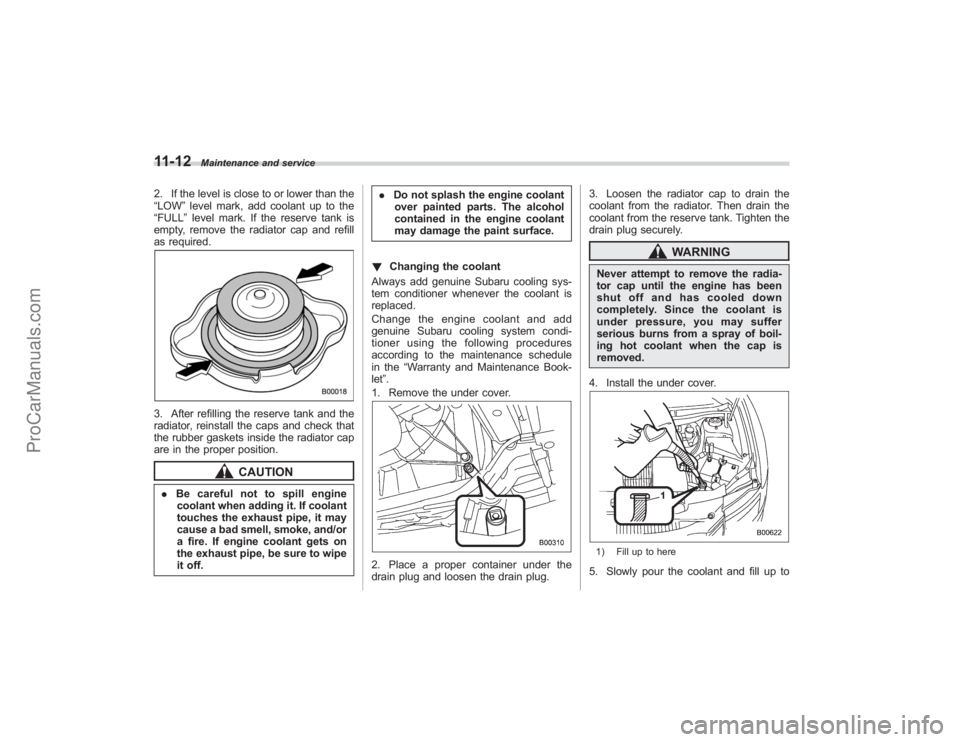
2. If the level is close to or lower than the
“LOW”level mark, add coolant up to the
“FULL ”level mark. If the reserve tank is
empty, remove the radiator cap and refill
as required.3. After refilling the reserve tank and the
radiator, reinstall the caps and check that
the rubber gaskets inside the radiator cap
are in the proper position.
CAUTION
. Be careful not to spill engine
coolant when adding it. If coolant
touches the exhaust pipe, it may
cause a bad smell, smoke, and/or
a fire. If engine coolant gets on
the exhaust pipe, be sure to wipe
it off. .
Do not splash the engine coolant
over painted parts. The alcohol
contained in the engine coolant
may damage the paint surface.
! Changing the coolant
Always add genuine Subaru cooling sys-
tem conditioner whenever the coolant is
replaced.
Change the engine coolant and add
genuine Subaru cooling system condi-
tioner using the following procedures
according to the maintenance schedule
in the “Warranty and Maintenance Book-
let ”.
1. Remove the under cover.
2. Place a proper container under the
drain plug and loosen the drain plug. 3. Loosen the radiator cap to drain the
coolant from the radiator. Then drain the
coolant from the reserve tank. Tighten the
drain plug securely.
WARNING
Never attempt to remove the radia-
tor cap until the engine has been
shut off and has cooled down
completely. Since the coolant is
under pressure, you may suffer
serious burns from a spray of boil-
ing hot coolant when the cap is
removed.
4. Install the under cover.1) Fill up to here5. Slowly pour the coolant and fill up to
ProCarManuals.com