2008 MERCEDES-BENZ CLS COUPE technical data
[x] Cancel search: technical dataPage 17 of 329
14 W
Warning and indicator lamp ABS (yellow)
. . . . . . . . . . . . . . . . . . 244
Warning signal
Audible . . . . . . . . . . . . . . . . . . . . . . 251
Warning triangle . . . . . . . . . . . . . . . . 216
Washer fluid Display message . . . . . . . . . . . . . . 240
Wearing seat belts . . . . . . . . . . . . . . . . 88
Wheel bolts
Tightening torque . . . . . . . . . . . . . . 286
Wheels
General notes . . . . . . . . . . . . . . . . . 198
Technical data . . . . . . . . . . . . . . . . 305
Windowbags . . . . . . . . . . . . . . . . . . . . . 48
Windows Cleaning . . . . . . . . . . . . . . . . . . . . . 212
Cleaning the windscreen . . . . . . . . 211
Side windows . . . . . . . . . . . . . . . . . . 98
Windscreen
Cleaning . . . . . . . . . . . . . . . . . . . . . 211
Windscreen washer fluid . . . . . . . . . 317
Topping up . . . . . . . . . . . . . . . . . . . 197
Windscreen washer fluid reservoir
. . . . . . . . . . . . . . . . . . . . . . . . . . 197, 317
Windscreen washer reservoir
Capacity . . . . . . . . . . . . . . . . . . . . . 317
Windscreen washer system . . . . . . . 317Windscreen wipers
. . . . . . . . . . . . . . . 97
Cleaning . . . . . . . . . . . . . . . . . . . . . 211
Malfunction . . . . . . . . . . . . . . . . . . 259
Replacing the wiper blades . . . . . . 275
Winter diesel . . . . . . . . . . . . . . . . . . . 193
Winter driving . . . . . . . . . . . . . . 204, 205
Winter tyres . . . . . . . . . . . . . . . . . . . . 204
Limiting the speed (on-board com-
puter) . . . . . . . . . . . . . . . . . . . . . . . 144 Index
219_AKB; 2; 4, en-GB
mkalafa,
2007-11-13T09:28:36+01:00 - Seite 14
Page 19 of 329
Operating safety
16 Operating safety
Safety notes
G
Risk of accident and injury
All work on the vehicle and, in particular,
work relevant to safety or on safety-related
systems must be carried out at a qualified
specialist workshop. The specialist work-
shop must have the necessary specialist
knowledge and tools to carry out the work
required. Mercedes-Benz recommends
that you use a Mercedes-Benz Service
Centre for this purpose. G
Risk of accident and injury
Some safety systems only function when
the
engine is running. You should therefore
never switch off the engine when driving.
Otherwise the safety systems of your vehi-
cle may no longer protect you and other
persons as intended. In addition, there is
the danger that you may lose control of your
vehicle and thus cause an accident. G
Risk of accident and injury
Work carried out incorrectly, or alterations
made
to the vehicle, e.g. rerouting of cables
under coverings, could cause the safety
systems of your vehicle to stop working properly. The safety systems would thus no
longer protect you and other persons as
intended. In addition, there is the danger
that you may lose control of your vehicle
and thus cause an accident.
All
work and alterations to the vehicle, e.g.
installations or modifications, should there-
fore be carried out at a qualified specialist
workshop. G
Risk of accident
A heavy impact to the underbody, tyres or
wheels,
for example when bottoming out on
rough terrain or driving over an obstacle at
high speed, could damage your vehicle. As
a result, you could cause an accident. This
also applies to vehicles which are equipped
with underbody protection.
For this reason, drive slowly over obstacles,
avoid bottoming out the vehicle in rough
terrain and, if necessary, have your vehicle
checked at a qualified specialist workshop. G
Risk of accident
If work on electronic equipment and its
software is carried out incorrectly, this
equipment could stop working. The elec-
tronic systems are networked via interfa-
ces. Tampering with these electronic sys- tems could cause malfunctions in systems
which have not been modified. Malfunc-
tions such as these can seriously jeopard-
ise the vehicle's operating safety and
therefore your own safety.
You should thus have all work and modifi-
cations to electronic components carried
out at a qualified specialist workshop.
Vehicle registration
Mercedes-Benz may ask its Service Centres
to carry out technical inspections on certain
vehicles to improve their quality or safety.
If you did not purchase your vehicle from an
authorised specialist dealer and your vehicle
has never been inspected at a Mercedes-
Benz Service Centre, it is possible that your
vehicle is not registered in your name with
Mercedes-Benz. Mercedes-Benz can only
inform
you about vehicle checks if it has your
registration data.
It is advisable to register your vehicle with a
Mercedes-Benz Service Centre.
Inform Mercedes-Benz as soon as possible
about any change in address or vehicle own-
ership. Introduction
219_AKB; 2; 4, en-GB
mkalafa,
2007-11-13T09:28:36+01:00 - Seite 16
Page 20 of 329
Operating safety
17Correct use
Observe the following information when using
your vehicle:
R The safety notes in this manual
R The “Technical data” section in this manual
R National road traffic regulations
R National road traffic licensing regulations G
Risk of injury
Various warning stickers are affixed to your
vehicle.
Their purpose is to draw your atten-
tion, and the attention of others, to various
dangers. Therefore, do not remove any
warning stickers unless the sticker clearly
states that you may do so.
If you remove the warning stickers, you or
others could be injured by failing to recog-
nise certain dangers. Introduction
219_AKB; 2; 4, en-GB
mkalafa,
2007-11-13T09:28:36+01:00 - Seite 17
Page 195 of 329
Refuelling
192
CLS 350 CGI !
Refuel using only unleaded premium
grade petrol with a minimum octane num-
ber of 95 RON/85 MON conforming to
European standard EN 228.
You could otherwise impair engine output
or damage the engine.
You
will find further information about pet-
rol under "Technical data" in the index.
i In some countries, only petrol of insuffi-
cient quality (high-sulphur fuel) may be
available. This fuel can temporarily produce
unpleasant odours, especially on short
journeys. Refuelling with petrol of sufficient
quality (sulphur-free fuel) will reduce such
odours.
AMG vehicles !
Refuel using only super unleaded petrol
with a minimum octane number of 98
RON/88 MON conforming to European
standard EN 228.
You could otherwise impair engine output
or damage the engine.
You
will find further information about pet-
rol under "Technical data" in the index. i
If the recommended fuel is not available
and
only as a temporary measure, you may
also use premium unleaded petrol,
95 RON/85 MON. This may reduce per-
formance and increase petrol consump-
tion. You must avoid driving at full throttle.
! In emergencies, only when the recom-
mended fuel is not available, you may also
use standard unleaded petrol, 91 RON/
82.5 MON. However, using this fuel results
in considerably higher petrol consumption
and significantly reduced performance.
Avoid driving at full throttle, and only drive
in drive program C.
If no fuel other than regular petrol fuel 91
RON/82.5 MON or a lower grade is per-
manently available, you should have the
vehicle adapted to run on this fuel by the
local after-sales service. Diesel (EN 590)
! Only use diesel that complies with the
EN 590 European standard.
You could otherwise impair engine output
or damage the engine.
You will find further information about die-
sel under "Fuel" in the index.
! When
refuelling vehicles with a diesel par-
ticle filter in countries outside the EU, only
low-sulphur Euro diesel with less than
0.005 percent sulphur content by weight
should be used. In countries in which diesel
with a higher sulphur content is available
(e.g. 0.035 percent by weight), the engine
oil should be renewed at more frequent
intervals. More information about intervals
for changing the engine oil can be obtained
from any Mercedes-Benz Service Centre.
! Using fuel that does not comply with EN
590 can increase wear and damage the
engine and the exhaust system. Do not use
the following:
R Marine diesel
R Heating oil
R Bio-diesel Operation
219_AKB; 2; 4, en-GB
mkalafa,
2007-11-13T09:28:36+01:00 - Seite 192
Page 198 of 329
Engine compartment
195Engine oil
Depending on how it is driven, the vehicle
consumes a maximum of 0.8 l oil per 1,000
km. The oil consumption may be higher than
this when the vehicle is new or if you fre-
quently drive at high engine speeds. You can
only estimate the oil consumption after you
have driven a considerable distance.
You will find further information about engine
oil in the "Technical data" section
(Y page 314).
Checking the engine oil level To do so:
R
the vehicle should be parked on level
ground
R the engine should be switched off for at
least five minutes if the engine was at nor-
mal operating temperature
R the engine should be switched off for at
least 30 minutes if the engine was not at
operating temperature (i.e. if you only star-
ted the engine briefly) Using the oil dipstick
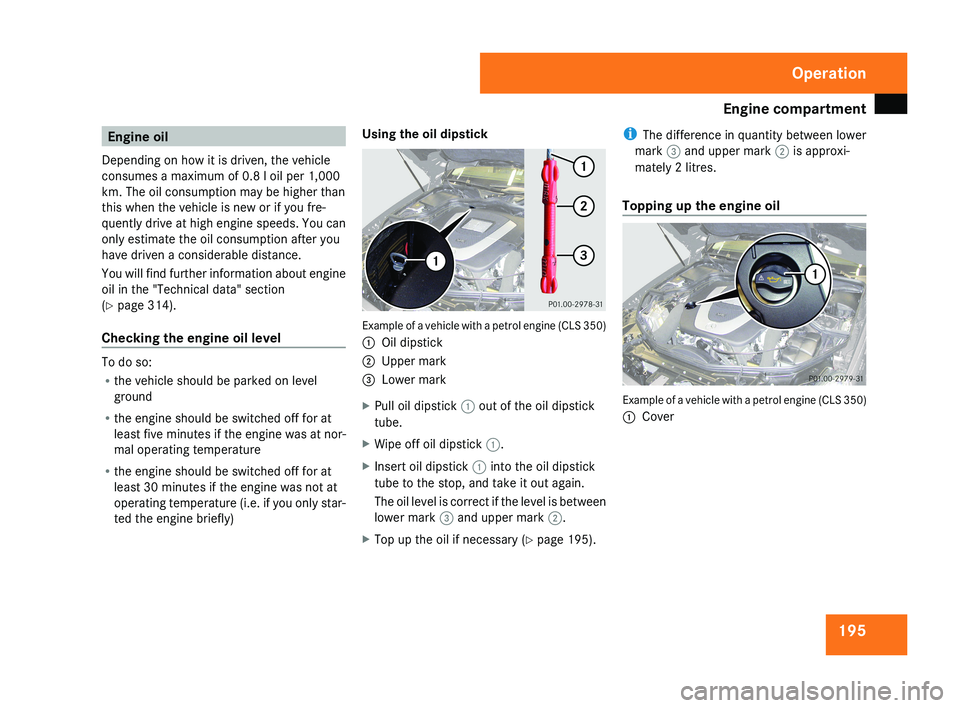
Example of a vehicle with a petrol engine (CLS 350)
1
Oil dipstick
2 Upper mark
3 Lower mark
X Pull oil dipstick 1 out of the oil dipstick
tube.
X Wipe off oil dipstick 1.
X Insert oil dipstick 1 into the oil dipstick
tube to the stop, and take it out again.
The oil level is correct if the level is between
lower mark 3 and upper mark 2.
X Top up the oil if necessary ( Y page 195).i
The difference in quantity between lower
mark 3 and upper mark 2 is approxi-
mately 2 litres.
Topping up the engine oil Example of a vehicle with a petrol engine (CLS 350)
1
Cover Operation
219_AKB; 2; 4, en-GB
mkalafa,
2007-11-13T09:28:36+01:00 - Seite 195
Page 200 of 329
Engine compartment
197
X
Top up the coolant if necessary.
X Replace cap 1 and tighten all the way to
the stop.
You will find further information about coolant
in the "Technical data" section
(Y page 316). Windscreen washer system/head-
lamp cleaning system*
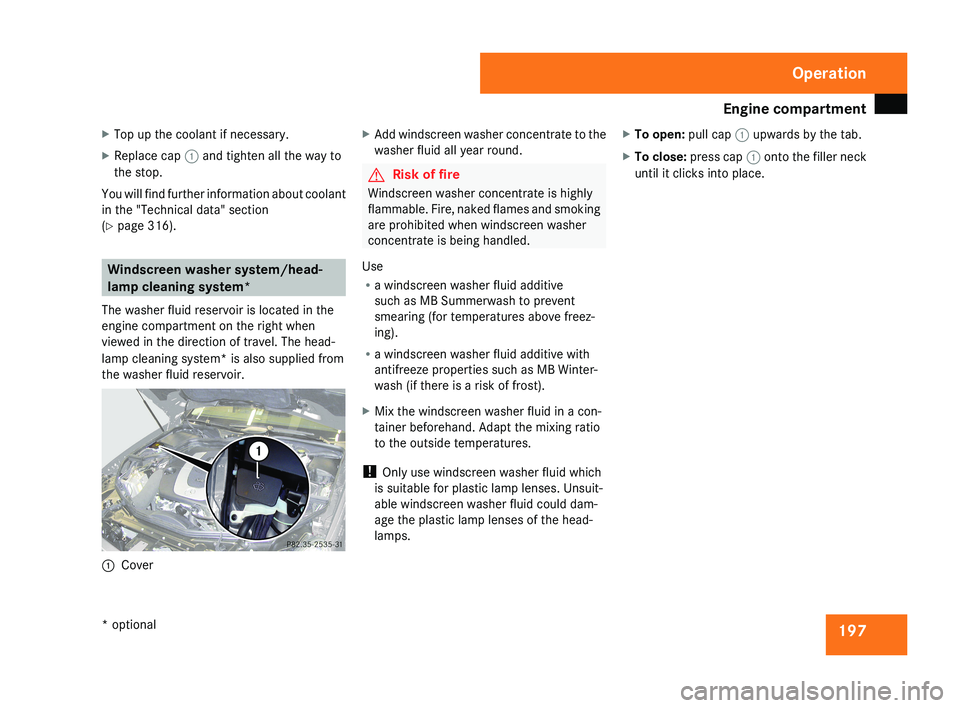
The washer fluid reservoir is located in the
engine compartment on the right when
viewed in the direction of travel. The head-
lamp cleaning system* is also supplied from
the washer fluid reservoir.1 Cover X
Add windscreen washer concentrate to the
washer fluid all year round.
G Risk of fire
Windscreen washer concentrate is highly
flammable. Fire, naked flames and smoking
are prohibited when windscreen washer
concentrate is being handled.
Use
R a windscreen washer fluid additive
such as MB Summerwash to prevent
smearing (for temperatures above freez-
ing).
R a windscreen washer fluid additive with
antifreeze properties such as MB Winter-
wash (if there is a risk of frost).
X Mix the windscreen washer fluid in a con-
tainer beforehand. Adapt the mixing ratio
to the outside temperatures.
! Only use windscreen washer fluid which
is suitable for plastic lamp lenses. Unsuit-
able windscreen washer fluid could dam-
age the plastic lamp lenses of the head-
lamps. X
To open: pull cap 1 upwards by the tab.
X To close: press cap 1 onto the filler neck
until it clicks into place.
Operation
* optional
219_AKB; 2; 4, en-GB
mkalafa,
2007-11-13T09:28:36+01:00 - Seite 197
Page 300 of 329
297
Introduction to technical data .........
298
Genuine Mercedes-Benz parts ......... 298
Vehicle electronics ...........................299
Vehicle identification plates ............300
Engine ................................................ 302
Performance ...................................... 303
Tyres and wheels .............................. 304
Vehicle dimensions ..........................309
Vehicle weights ................................. 310
Service products and capacities ..... 311
Frequencies for garage door open-
ers* .................................................... 319
Technical data
219_AKB; 2; 4, en-GB
mkalafa,
2007-11-13T09:28:36+01:00 - Seite 297
Page 301 of 329
Genuine Mercedes-Benz parts
298 Introduction to technical data
i The technical data was determined in
accordance with EU directives. All data
applies to the vehicle's standard equip-
ment. The data may therefore differ for
vehicles with optional equipment. You can
obtain further information from a
Mercedes-Benz Service Centre. Genuine Mercedes-Benz parts
Mercedes-Benz tests genuine parts and con-
version parts and accessories which have
been
specifically approved for your vehicle for
their reliability, safety and suitability. Despite
ongoing market research, Mercedes-Benz is
unable to evaluate other parts. Mercedes-
Benz therefore accepts no responsibility for
the use of such parts in Mercedes-Benz vehi-
cles, even if they have been independently or
officially approved.
In Germany and some other countries, certain
parts are only officially approved for installa-
tion or modification if they comply with legal
requirements. All genuine Mercedes-Benz
parts meet this requirement. The use of non-
approved parts may invalidate the vehicle's
general operating permit. This is the case if:
R they cause a change of the vehicle type
from that for which the vehicle's general
operating permit was granted
R other road users could be endangered
R the emission or noise levels are adversely
affected
The use of non-approved parts could affect
your vehicle's operating safety. Mercedes-
Benz therefore recommends genuine Mercedes-Benz parts and conversion parts
and
accessories that have been approved for
your vehicle. H
Environmental note
Daimler also supplies reconditioned
assemblies
and parts which are of the same
quality as new parts and to which the same
warranty applies.
Genuine Mercedes-Benz parts and approved
conversion parts and accessories are availa-
ble from Mercedes-Benz Service Centres.
There, you can also receive advice about tech-
nical modifications and have the parts pro-
fessionally fitted.
Always quote the vehicle identification num-
ber and the engine number when ordering
genuine parts. You will find these numbers on
the vehicle data card in the Service Booklet
or on your vehicle's identification plates
(Y page 300). Technical data
219_AKB; 2; 4, en-GB
mkalafa,
2007-11-13T09:28:36+01:00 - Seite 298