2008 MERCEDES-BENZ A-CLASS HATCHBACK door lock
[x] Cancel search: door lockPage 46 of 305
Occupant safety
43system could heat up and the child could
burn itself on them.
If a child opens a door, the child or other
persons could be injured as a result. The
child could get out and be injured in the
process or be injured by a passing vehicle.
G
Risk of injury
An unsecured or incorrectly positioned load
increases the risk of injury to the child in
the event of:
R an accident
R a braking manoeuvre
R a sudden change of direction
Do not carry heavy or hard objects inside
the vehicle unless they are secured. You
will find further information under "Loading
guidelines" in the index.
Child restraint systems Mercedes-Benz recommends that you only
use the child restraint systems listed on
(Y page 47). G
Risk of injury
To reduce the risk of serious or even fatal
injury to the child in the event of a sudden
change in direction, braking or an accident:
R children less than 1.50 m tall and under
twelve years of age must always be
secured in special child restraint systems
on a suitable vehicle seat. This is neces-
sary because the seat belts are not
designed for children of this size.
R Do not secure children less than 1.50 m
tall or under twelve years of age on the
front-passenger seat. Exception: the
child is secured in a vehicle with auto-
matic child seat recognition on the front-
passenger seat* and is secured in a child
restraint system with automatic child
seat recognition.
R If you secure a forward-facing child
restraint system to the front-passenger
seat, you must move the front-passenger
seat as far back as possible.
R children must never travel sitting on the
lap of another occupant. Due to the
forces occurring in the event of a sudden
change of direction, heavy braking or an
accident, it would not be possible to restrain the child. The child could be
thrown against parts of the vehicle inte-
rior and be seriously or even fatally
injured.
G
Risk of injury
The child restraint system cannot perform
its protective function if is not correctly fit-
ted to a suitable vehicle seat. The child can-
not be restrained in the event of a sudden
change of direction, heavy braking or an
accident. This may lead to serious or even
fatal injuries. For this reason, when fitting
a child restraint system, observe the man-
ufacturer's installation instructions and the
correct use of the child restraint system.
Child restraint systems should be fitted to
the rear seats. Children are generally better
protected there.
The entire base of the child restraint system
must always rest on the seat cushion.
Never place objects, e.g. a cushion, under
the child restraint system.
Only use child restraint systems with their
original covers. Only replace damaged cov-
ers with genuine Mercedes-Benz covers.
For safety reasons, you should only use
child restraint systems which have been Safety
* optional
169_AKB; 2; 4, en-GB
wdomann
,V ersion: 2.10.6
2008-07-16T08:52:06+02:00 - Seite 43 ZDateiname: 6515_0315_02_buchblock.pdf; preflight
Page 48 of 305

Occupant safety
45
Automatic child seat recognition on the
front-passenger seat*
If your vehicle does not have automatic child
seat recognition on the front-passenger seat,
this is indicated by a special sticker. The
sticker is affixed to the side of the dashboard
on the front-passenger side. It is visible when
you open the front-passenger door. 1
5 PASSENGER AIRBAG OFF warning
lamp
The front-passenger seat sensor system for
child restraint systems detects whether a
special Mercedes-Benz child seat with auto-
matic child seat recognition has been fitted.
In such cases, 5PASSENGER AIRBAG
OFF indicator lamp 1lights up. The front-
passenger airbag is deactivated. G
Risk of injury
If the 5 PASSENGER AIRBAG OFF warn-
ing lamp does not light up when the child
restraint system is fitted, the front-
passenger front airbag has not been disa-
bled. If the front-passenger front airbag is
deployed, the child could be seriously or
even fatally injured.
Proceed as follows:
R do not use a rearward-facing child
restraint system on the front-passenger
seat.
R fit a rearward-facing child restraint sys-
tem on a suitable rear seat.
or
R only use a forward-facing child restraint
system on the front-passenger seat and
move the front-passenger seat to its rear-
most position.
R have the automatic child seat recognition
checked at a qualified specialist work-
shop.
To ensure that the automatic child seat rec-
ognition on the front-passenger seat func-
tions correctly, never place objects (such
as a cushion) under the child restraint sys-
tem. The entire base of the child restraint system must always rest on the seat cush-
ion. An incorrectly fitted child restraint sys-
tem cannot perform its intended protective
function in the event of an accident, and
could lead to injuries.
i The windowbag*, th e head/thorax airbag
and the belt tensioner for the front-
passenger seat are still active even if the
front-passenger seat front airbag has been
disabled by the automatic child seat rec-
ognition. G
Risk of injury
Do not place items of electronic equipment
on the front-passenger seat, e.g.:
R laptops, when switched on
R mobile phones
R cards with transponders, e.g. ski passes
or access cards
Signals from electronic equipment can
cause interference in the automatic child
seat recognition sensor system. This could
lead to a system malfunction. This may
cause the 5PASSENGER AIRBAG OFF
warning lamp to light up without there
being a child seat with automatic child seat
recognition fitted. This means that the Safety
* optional
169_AKB; 2; 4, en-GB
wdomann,
Version: 2.10.6 2008-07-16T08:52:06+02:00 - Seite 45 ZDateiname: 6515_0315_02_buchblock.pdf; preflight
Page 56 of 305
Occupant safety
53
!
Make sure that the padded table is not
trapped or damaged, for example when
you:
R close the doors
R adjust the seat
R store the padded table or transport
heavy objects
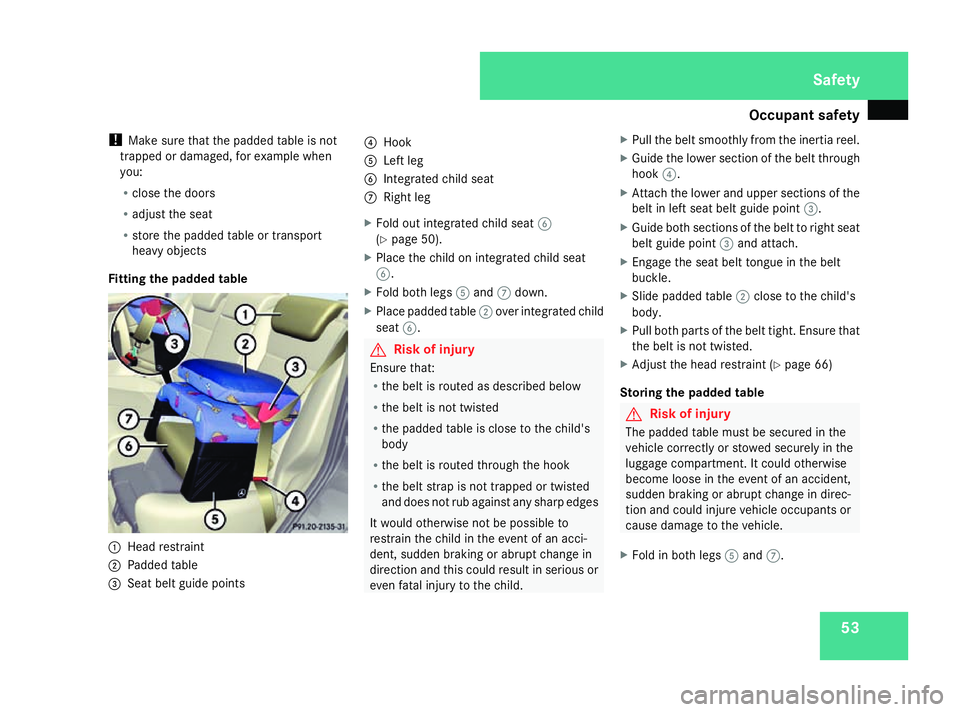
Fitting the padded table 1
Head restraint
2 Padded table
3 Seat belt guide points 4
Hook
5 Left leg
6 Integrated child seat
7 Right leg
X Fold out integrated child seat 6
(Y page 50).
X Place the child on integrated child seat
6.
X Fold both legs 5and 7down.
X Place padded table 2over integrated child
seat 6. G
Risk of injury
Ensure that:
R the belt is routed as described below
R the belt is not twisted
R the padded table is close to the child's
body
R the belt is routed through the hook
R the belt strap is not trapped or twisted
and does not rub against any sharp edges
It would otherwise not be possible to
restrain the child in the event of an acci-
dent, sudden braking or abrupt change in
direction and this could result in serious or
even fatal injury to the child. X
Pull the belt smoothly from the inertia reel.
X Guide the lower section of the belt through
hook 4.
X Attach the lower and upper sections of the
belt in left seat belt guide point 3.
X Guide both sections of the belt to right seat
belt guide point 3and attach.
X Engage the seat belt tongue in the belt
buckle.
X Slide padded table 2close to the child's
body.
X Pull both parts of the belt tight. Ensure that
the belt is not twisted.
X Adjust the head restraint (Y page 66)
Storing the padded table G
Risk of injury
The padded table must be secured in the
vehicle correctly or stowed securely in the
luggage compartment. It could otherwise
become loose in the event of an accident,
sudden braking or abrupt change in direc-
tion and could injure vehicle occupants or
cause damage to the vehicle.
X Fold in both legs 5and 7. Safety
169_AKB; 2; 4, en-GB
wdomann
,V ersion: 2.10.6
2008-07-16T08:52:06+02:00 - Seite 53 ZDateiname: 6515_0315_02_buchblock.pdf; preflight
Page 57 of 305
Occupant safety
54
Child-proof locks If children are travelling in the vehicle, you can
activate the child-proof locks for the rear
doors.
Child-proof locks on the rear doors (5-
door vehicles)
The child-proof locks on the rear doors enable
you to secure each door individually. A locked
door cannot be opened from the inside. The
door can be opened from the outside if the
vehicle is unlocked. G
Risk of accident and injury
Activate the child-proof locks for the rear
doors and the override switch for the rear
compartment side windows when children
are travelling in the vehicle. The children
could otherwise open doors or windows
while the vehicle is in motion and injure
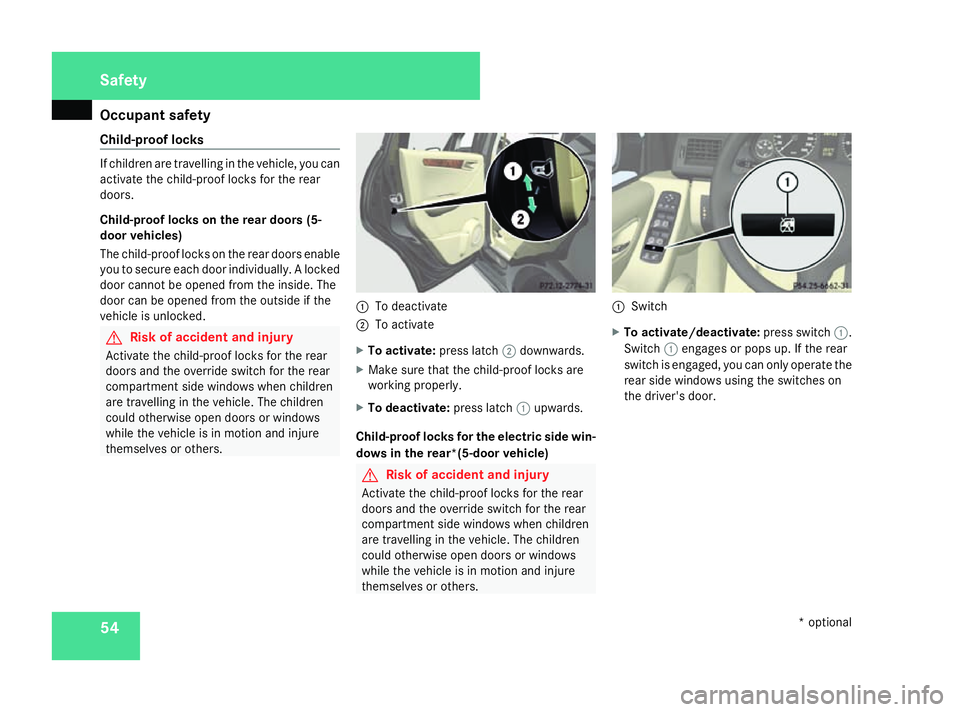
themselves or others. 1
To deactivate
2 To activate
X To activate: press latch2downwards.
X Make sure that the child-proof locks are
working properly.
X To deactivate: press latch1upwards.
Child-proof locks for the electric side win-
dows in the rear*(5-door vehicle) G
Risk of accident and injury
Activate the child-proof locks for the rear
doors and the override switch for the rear
compartment side windows when children
are travelling in the vehicle. The children
could otherwise open doors or windows
while the vehicle is in motion and injure
themselves or others. 1
Switch
X To activate/deactivat e:press switch 1.
Switch 1engages or pops up. If the rear
switch is engaged, you can only operate the
rear side windows using the switches on
the driver's door. Safety
* optional
169_AKB; 2; 4, en-GB
wdomann
,V ersion: 2.10.6
2008-07-16T08:52:06+02:00 - Seite 54 Dateiname: 6515_0315_02_buchblock.pdf; preflight
Page 60 of 305

Anti-theft syste
ms 57steering assistant STEER CONTROL. The
steering continues to function with power
assistance. Anti-theft systems
Immobiliser
The immobiliser prevents your vehicle from
being started without the correct key.
X To activate: remove the key from the igni-
tion lock.
X To deactivate: turn the key to position 2
in the ignition lock. ATA* (anti-theft alarm system)
A visual and audible alarm is triggered when
the alarm system is primed and you open:
R a door
R a door using the emergency key element
R the tailgate
R the bonnet
The alarm is not switched off even if you close
a door again. 1
Indicator lamp
X To prime: lock the vehicle using the key.
Indicator lamp 1flashes. The alarm sys-
tem is primed after approximately 15 sec-
onds.
X To deactivate: unlock the vehicle using the
key.
Deactivating the alarm X
Insert the key into the ignition lock.
The alarm is deactivated.
or
X Press the korj button on the key.
The alarm is deactivated. Safety
* optional
169_AKB; 2; 4, en-GB
wdomann,
Version: 2.10.6 2008-07-16T08:52:06+02:00 - Seite 57 ZDateiname: 6515_0315_02_buchblock.pdf; preflight
Page 63 of 305

Opening and closing
60 Opening and closing
Key
The key centrally locks/unlocks:
R the doors
R the tailgate
R the fuel filler flap G
Risk of accident
If children are left unsupervised in the vehi-
cle, they could:
R open a door from the inside at any time,
even if it has been locked
R start the vehicle using a key which has
been left in the vehicle
R release the parking brake
They could endanger themselves and oth-
ers. Never leave children unsupervised in
the vehicle. Always take the key with you
when leaving the vehicle, even if you are
only leaving it for a short time. 1
Battery check lamp
2 j To lock the vehicle
3 Emergency key element release catch
4 k To unlock the vehicle
When unlocking, the turn signals flash once.
When locking, they flash three times.
If you do not open either a door or the tailgate
after you have unlocked the vehicle, it will
automatically relock after approximately 40
seconds.
Individual settings You can change the setting of the locking
system in such a way that only the driver's
door and the fuel filler flap are unlocked. This
could be useful if you frequently travel on your
own.X
To change the setting: press thek
and j buttons simultaneously for
approximately six seconds until the battery
check lamp flashes twice.
The key now functions as follows:
X To unlock the driver's door: press the
k button once.
X To unlock centrally: press thekbut-
ton twice.
X To lock centrally: press thejbutton.
Restoring the factory settings X
Press the kandj buttons simulta-
neously for approximately six seconds until
the battery check lamp flashes twice.
Additional information R
Convenience closing (Y page 86)
R Convenience opening (Y page 86)
R Opening and closing in an emergency
(Y page 241) Controls
169_AKB; 2; 4, en-GB
wdomann,
Version: 2.10.6 2008-07-16T08:52:06+02:00 - Seite 60Dateiname: 6515_0315_02_buchblock.pdf; preflight
Page 64 of 305
Opening and closing
61Opening the doors from the inside
You can open a door from the inside at any
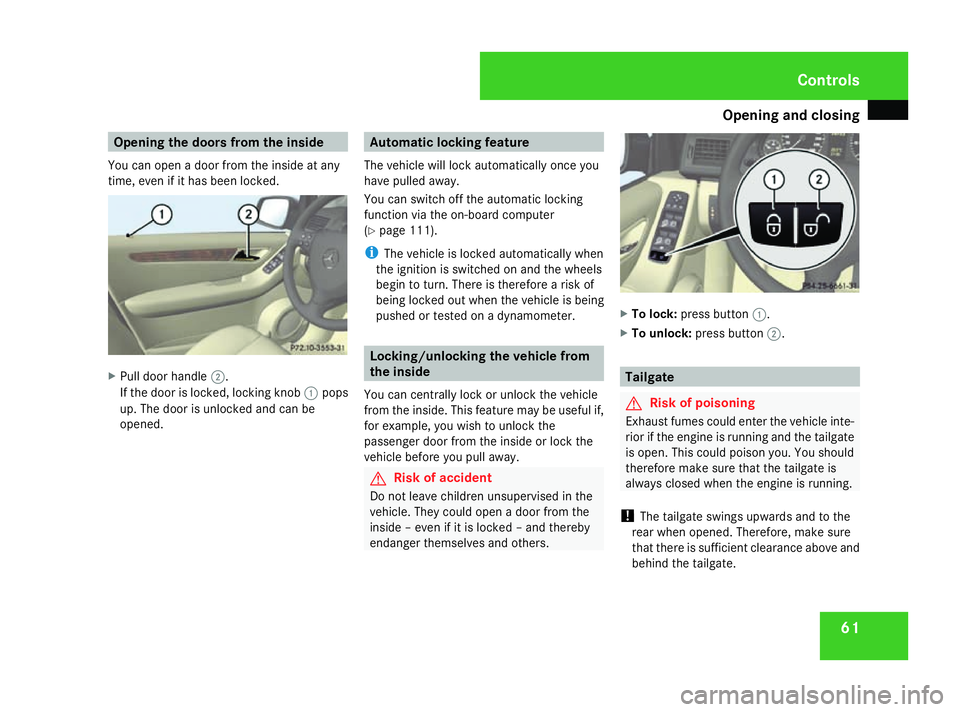
time, even if it has been locked. X
Pull door handle 2.
If the door is locked, locking knob 1pops
up. The door is unlocked and can be
opened. Automatic locking feature
The vehicle will lock automatically once you
have pulled away.
You can switch off the automatic locking
function via the on-board computer
(Y page 111).
i The vehicle is locked automatically when
the ignition is switched on and the wheels
begin to turn. There is therefore a risk of
being locked out when the vehicle is being
pushed or tested on a dynamometer. Locking/unlocking the vehicle from
the inside
You can centrally lock or unlock the vehicle
from the inside. This feature may be useful if,
for example, you wish to unlock the
passenger door from the inside or lock the
vehicle before you pull away. G
Risk of accident
Do not leave children unsupervised in the
vehicle. They could open a door from the
inside – even if it is locked – and thereby
endanger themselves and others. X
To lock: press button 1.
X To unlock: press button 2. Tailgate
G
Risk of poisoning
Exhaust fumes could enter the vehicle inte-
rior if the engine is running and the tailgate
is open. This could poison you. You should
therefore make sure that the tailgate is
always closed when the engine is running.
! The tailgate swings upwards and to the
rear when opened. Therefore, make sure
that there is sufficient clearance above and
behind the tailgate. Controls
169_AKB; 2; 4, en-GB
wdomann,
Version: 2.10.6
2008-07-16T08:52:06+02:00 - Seite 61 ZDateiname: 6515_0315_02_buchblock.pdf; preflight
Page 66 of 305

Seats
63Seats
Points to remember
You can find information about enlarging the
luggage compartment (folding forwards/
removing the rear seats) on (Y page 150).
Depending on the vehicle's equipment, the
seats can be adjusted either manually or elec-
trically. G
Risk of injury
The seats can be adjusted when the key is
removed and the door is open. For this rea-
son, children should never be left unsuper-
vised in the vehicle. They could become
trapped when adjusting a seat. G
Risk of accident
Only adjust the driver's seat when the vehi-
cle is stationary. You will otherwise be dis-
tracted from the road and traffic conditions
and you could lose control of the vehicle as
a result of the seat moving. This could
cause an accident. G
Risk of injury
Make sure that nobody can become trap-
ped when you adjust the seat. Observe the notes concerning the airbag
system.
Secure children as recommended; see
"Children in the vehicle" section.
! When you move the seats, make sure that
there are no objects in the footwell or
behind the seats. Otherwise, you could
damage the seats and the objects.
i The front seats are fitted with active head
restraints (Y page 42). For this reason, it is
not possible to remove the head restraints
from the front seats.
The rear-compartment head restraints can
be removed (Y page 66).
Please contact a Mercedes-Benz Service
Centre for more information. Adjusting the seat manually
1
Seat fore-and-aft adjustment
2 Seat cushion angle*
3 Seat height
4 Backrest angle
Seat fore-and-aft adjustment X
Lift handle 1and slide the seat forwards
or backwards.
X Release handle 1again.
Make sure that you hear the seat engage
into position. Controls
* optional
169_AKB; 2; 4, en-GB
wdomann,
Version: 2.10.6 2008-07-16T08:52:06+02:00 - Seite 63 ZDateiname: 6515_0315_02_buchblock.pdf; preflight