2008 KIA CERATO oil
[x] Cancel search: oilPage 289 of 327
Maintenance
26
7
1 23456789
LUBRICANTS AND FLUIDS
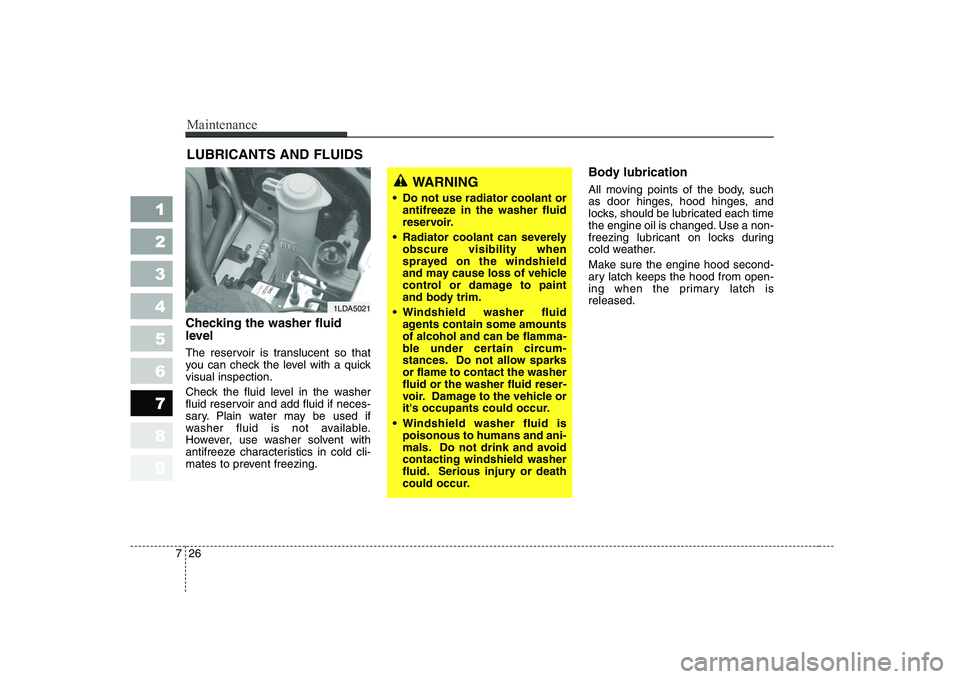
Checking the washer fluid
level
The reservoir is translucent so that
you can check the level with a quickvisual inspection.
Check the fluid level in the washer
fluid reservoir and add fluid if neces-
sary. Plain water may be used if
washer fluid is not available.
However, use washer solvent with
antifreeze characteristics in cold cli-
mates to prevent freezing. Body lubrication
All moving points of the body, such
as door hinges, hood hinges, and
locks, should be lubricated each time
the engine oil is changed. Use a non-
freezing lubricant on locks during
cold weather.
Make sure the engine hood second-
ary latch keeps the hood from open-
ing when the primary latch isreleased.
1LDA5021
WARNING
Do not use radiator coolant or antifreeze in the washer fluid
reservoir.
Radiator coolant can severely obscure visibility when
sprayed on the windshield
and may cause loss of vehicle
control or damage to paint
and body trim.
Windshield washer fluid agents contain some amountsof alcohol and can be flamma-
ble under certain circum-
stances. Do not allow sparksor flame to contact the washerfluid or the washer fluid reser-
voir. Damage to the vehicle or
it's occupants could occur.
Windshield washer fluid is poisonous to humans and ani-
mals. Do not drink and avoidcontacting windshield washer
fluid. Serious injury or death
could occur.
Page 308 of 327
745
Maintenance
1 23456789
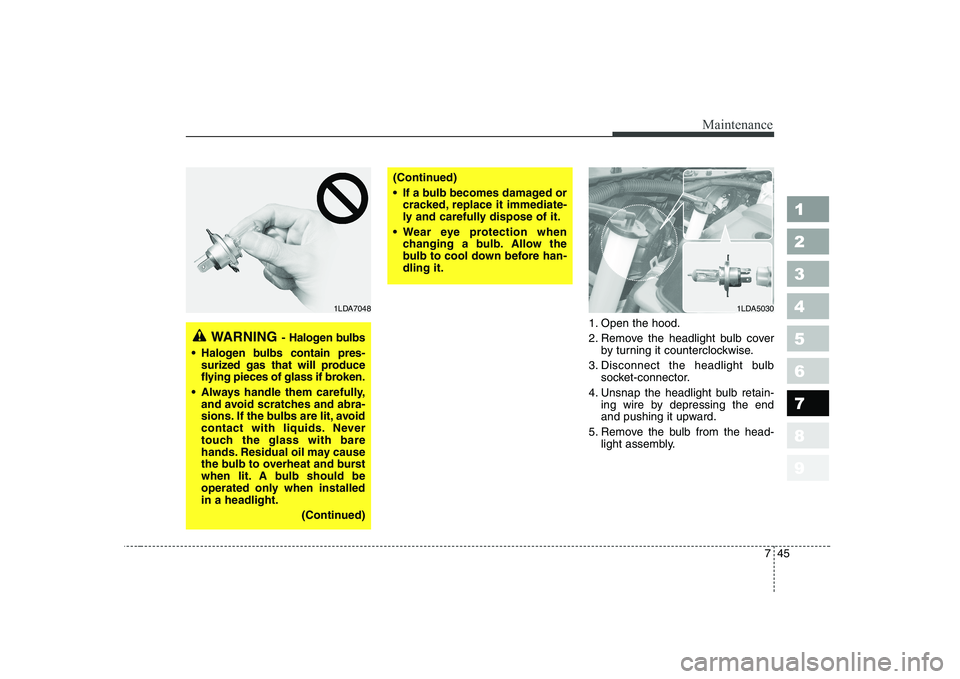
1. Open the hood.
2. Remove the headlight bulb coverby turning it counterclockwise.
3. Disconnect the headlight bulb socket-connector.
4. Unsnap the headlight bulb retain- ing wire by depressing the end
and pushing it upward.
5. Remove the bulb from the head- light assembly.
WARNING - Halogen bulbs
Halogen bulbs contain pres-
surized gas that will produce
flying pieces of glass if broken.
Always handle them carefully, and avoid scratches and abra-
sions. If the bulbs are lit, avoid
contact with liquids. Never
touch the glass with bare
hands. Residual oil may cause
the bulb to overheat and burst
when lit. A bulb should be
operated only when installedin a headlight.
(Continued)
(Continued)
If a bulb becomes damaged orcracked, replace it immediate-
ly and carefully dispose of it.
Wear eye protection when changing a bulb. Allow the
bulb to cool down before han-dling it.
1LDA50301LDA7048
Page 315 of 327
Maintenance
52
7
1 23456789
Waxing
Wax the vehicle when water will no longer bead on the paint.
Always wash and dry the vehicle
before waxing. Use a good quality
liquid or paste wax, and follow the
manufacturer’s instructions. Wax all
metal trim to protect it and to main-
tain its luster.
Removing oil, tar, and similar materi-
als with a spot remover will usually
strip the wax from the finish. Be sure
to re-wax these areas even if the rest
of the vehicle does not yet need wax-ing.
✽✽
NOTICE
Page 318 of 327
755
Maintenance
1 23456789
INTERIOR CARE
Interior general precautions
Prevent caustic solutions such as perfume and cosmetic oil from con-
tacting the dashboard because they
may cause damage or discoloration.
If they do contact the dashboard,
wipe them off immediately. See the
instructions that follow for the proper
way to clean vinyl.
Cleaning the upholstery and interior trim
Vinyl
Remove dust and loose dirt from
vinyl with a whisk broom or vacuum
cleaner. Clean vinyl surfaces with a
vinyl cleaner.
Fabric
Remove dust and loose dirt from fab-
ric with a whisk broom or vacuum
cleaner. Clean with a mild soap solu-
tion recommended for upholstery or
carpets. Remove fresh spots imme-
diately with a fabric spot cleaner. If
fresh spots do not receive immediate
attention, the fabric can be stained
and its color can be affected. Also, its
fire-resistant properties can be
reduced if the material is not proper-ly maintained. Cleaning the lap/shoulder belt webbing
Clean the belt webbing with any mild
soap solution recommended for
cleaning upholstery or carpet. Follow
the instructions provided with the
soap. Do not bleach or re-dye the
webbing because this may weakenit.
Cleaning the interior window glass
If the interior glass surfaces of the
vehicle become fogged (that is, cov-
ered with an oily, greasy or waxy
film), they should be cleaned with
glass cleaner. Follow the directions
on the glass cleaner container.
✽✽
NOTICE
Do not scrape or scratch the inside
of the rear window. This may result
in damage to the rear window
defroster grid.
CAUTION
Using anything but recommend- ed cleaners and procedures may affect the fabric’s appear-ance and fire-resistant proper-ties.
Page 322 of 327
Specifications
4
8
1
2
3
4
5
6
7
8
9
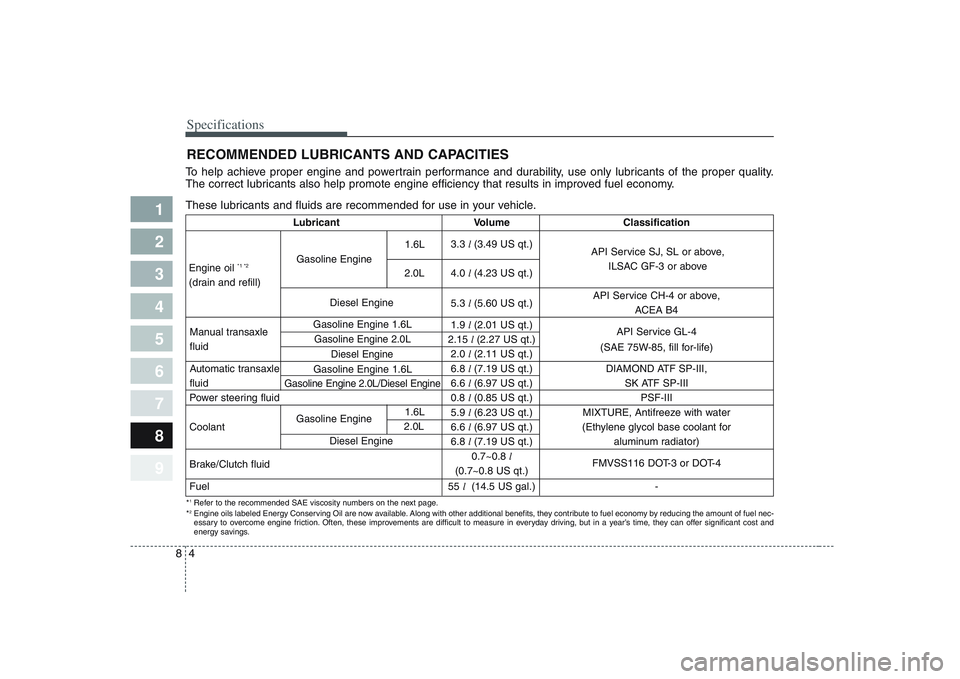
RECOMMENDED LUBRICANTS AND CAPACITIES
To help achieve proper engine and powertrain performance and durability, use only lubricants of the proper quality.
The correct lubricants also help promote engine efficiency that results in improved fuel economy.
These lubricants and fluids are recommended for use in your vehicle.
* 1
Refer to the recommended SAE viscosity numbers on the next page.
* 2
Engine oils labeled Energy Conserving Oil are now available. Along with other additional benefits, they contribute to fuel economy by reducing the amount of fuel nec-
essary to overcome engine friction. Often, these improvements are difficult to measure in everyday driving, but in a year’s time, they can offer significant cost and
energy savings.
Lubricant Volume Classification
3.3 l (3.49 US qt.)
4.0 l (4.23 US qt.)
API Service CH-4 or above,
5.3 l (5.60 US qt.)
ACEA B4
1.9 l (2.01 US qt.)
API Service GL-4
2.15 l (2.27 US qt.)
(SAE 75W-85, fill for-life)
2.0 l (2.11 US qt.)
6.8 l (7.19 US qt.) DIAMOND ATF SP-III,
6.6 l (6.97 US qt.) SK ATF SP-III
Power steering fluid 0.8 l (0.85 US qt.) PSF-III
5.9 l (6.23 US qt.) MIXTURE, Antifreeze with water
Coolant 6.6 l (6.97 US qt.) (Ethylene glycol base coolant for
6.8 l (7.19 US qt.) aluminum radiator)
Brake/Clutch fluid 0.7~0.8
l
FMVSS116 DOT-3 or DOT-4
(0.7~0.8 US qt.)
Fuel 55 l (14.5 US gal.) -
Engine oil *1 *2
(drain and refill)
Automatic transaxle fluidManual transaxlefluid Gasoline Engine
1.6L
2.0L
Gasoline Engine Diesel Engine
Diesel Engine API Service SJ, SL or above,
ILSAC GF-3 or above
1.6L
2.0L
Gasoline Engine 1.6L
Gasoline Engine 2.0L
Diesel Engine
Gasoline Engine 1.6L
Gasoline Engine 2.0L/Diesel Engine
Page 323 of 327
85
1
2
3
4
5
6
7
8
9
Specifications
Recommended SAE viscosity
number
✽✽NOTICE
Always be sure to clean the area
around any filler plug, drain plug,
or dipstick before checking or drain-
ing any lubricant. This is especially
important in dusty or sandy areasand when the vehicle is used on
unpaved roads. Cleaning the plug
and dipstick areas will prevent dirt
and grit from entering the engine
and other mechanisms that could bedamaged.
Temperature Range for SAE Viscosity Numbers
Temperature
Gasoline
Engine Oil *
1
°C
(°F)-30 -20 -10 0 10 20 30 40 50 -10 0 20 40 60 80 100 120
Diesel
Engine Oil10W-30
15W-40
0W-30 *2
5W-30
1. For better fuel economy, it is recommended to use the engine oil of a viscosity grade SAE 5W-
20,5W-30 (API SJ, SL / ILSAC GF-3). However, if the engine oil is not available in your coun-
try, select the proper engine oil using the engine oil viscosity chart.
2. It is only for extreme cold area and to be restricted by driving condition and area. (Especially, not recommended for sustained high loaded and high speed operation.)
20W-50
10W-30
15W-40
5W-20, 5W-30
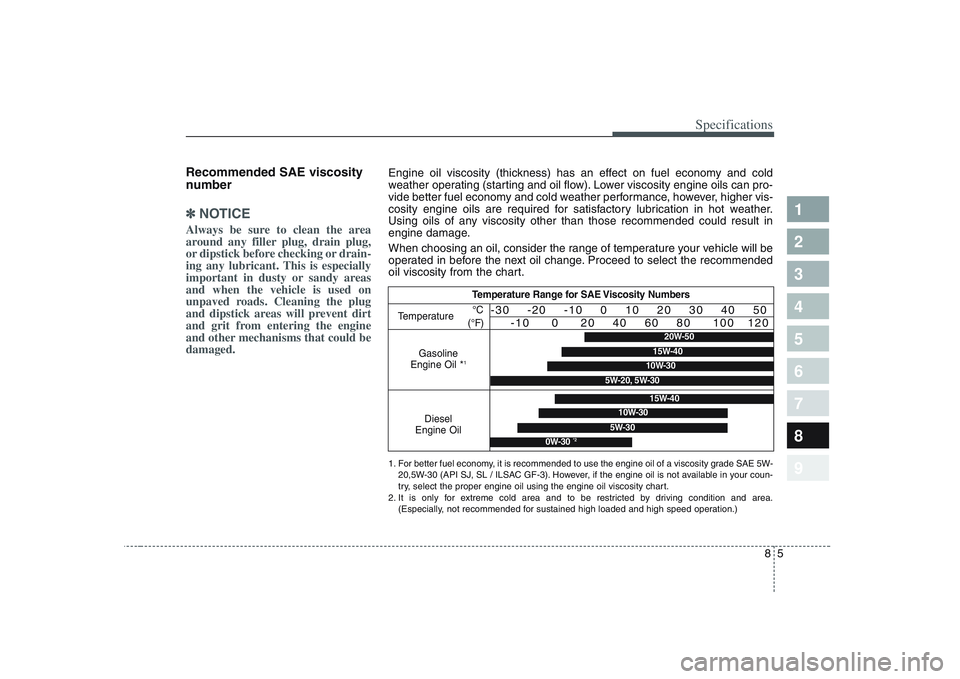
Engine oil viscosity (thickness) has an effect on fuel economy and cold
weather operating (starting and oil flow). Lower viscosity engine oils can pro-
vide better fuel economy and cold weather performance, however, higher vis-
cosity engine oils are required for satisfactory lubrication in hot weather.
Using oils of any viscosity other than those recommended could result in
engine damage.
When choosing an oil, consider the range of temperature your vehicle will be
operated in before the next oil change. Proceed to select the recommended
oil viscosity from the chart.
Page 325 of 327
Index
2
9
1
2
3
4
5
6
7
8
9
Air cleaner . . . . . . . . . . . . . . . . . . . . . . . . . . . . . . . . 7-28
Airbags-supplemental restraint system . . . . . . . . . . 3-54
Antenna . . . . . . . . . . . . . . . . . . . . . . . . . . . . . . . . . 3-100
Audio system . . . . . . . . . . . . . . . . . . . . . . . . . . . . . 3-102
Automatic climate control system . . . . . . . . . . . . . . 4-64
Automatic transaxle . . . . . . . . . . . . . . . . . . . . . 4-8, 7-24
Battery . . . . . . . . . . . . . . . . . . . . . . . . . . . . . . . . . . . 7-34
Before driving. . . . . . . . . . . . . . . . . . . . . . . . . . . . . . . 5-6
Brake system . . . . . . . . . . . . . . . . . . . . . . . . . . . . . . 4-14
Brakes and clutch. . . . . . . . . . . . . . . . . . . . . . . . . . . 7-21
Bulb replacement . . . . . . . . . . . . . . . . . . . . . . . . . . . 7-44
Climate control air filter . . . . . . . . . . . . . . . . . . . . . 7-30
Cruise control . . . . . . . . . . . . . . . . . . . . . . . . . . . . . . 4-23
Defroster . . . . . . . . . . . . . . . . . . . . . . . . . . . . . . . . . . 4-53
Door locks. . . . . . . . . . . . . . . . . . . . . . . . . . . . . . . . . . 3-7 Electrical circuit protection . . . . . . . . . . . . . . . . . . . . 6-7
Emergency commodity. . . . . . . . . . . . . . . . . . . . . . . 6-25
Emergency starting . . . . . . . . . . . . . . . . . . . . . . . . . . 6-4
Emission control system. . . . . . . . . . . . . . . . . . . . . . . 5-4
Engine compartment. . . . . . . . . . . . . . . . . . . . . 2-4, 7-14
Engine cooling system . . . . . . . . . . . . . . . . . . . . . . . 7-18
Engine oil and oil filter . . . . . . . . . . . . . . . . . . . . . . 7-17
Exterior care. . . . . . . . . . . . . . . . . . . . . . . . . . . . . . . 7-51
Fuel filler lid . . . . . . . . . . . . . . . . . . . . . . . . . . . . . . . 3-79
Fuel filter . . . . . . . . . . . . . . . . . . . . . . . . . . . . . . . . . 7-27
Fuel requirements . . . . . . . . . . . . . . . . . . . . . . . . . . . 5-2
Gauges . . . . . . . . . . . . . . . . . . . . . . . . . . . . . . . . . . . 4-31
Hazard warning flasher . . . . . . . . . . . . . . . . . . . . . . 4-54
Hood . . . . . . . . . . . . . . . . . . . . . . . . . . . . . . . . . . . . . 3-77
How to use this manual . . . . . . . . . . . . . . . . . . . . . . . 1-2
A
B
C
D
F
E
G
H