Page 224 of 327
Driving tips
10
5
1 23456789
Driving too fast through large pud-
dles can affect your brakes. If you
must go through puddles, try to
drive through them slowly.
If you believe you may have gotten your brakes wet, apply them lightly
while driving until normal braking
operation returns. Winter driving
We recommend that you carry
emergency equipment, including
tire chains, a window scraper,
windshield de-icer, a bag of sand
or salt, flares, a small shovel and
jumper cables.
Make sure you have sufficient eth- ylene-glycol coolant in the radiator.
Check the battery condition and cables. Cold temperatures reduce
the capacity of any battery, so it
must be in excellent condition to
provide enough winter starting
power.
Make sure the engine oil viscosity is suitable for cold weather.
Check the ignition system for loose connections and damage.
Use antifreeze-formulated wind- shield washer fluid. (Do not use
engine coolant antifreeze.)
Do not use the parking brake if it might freeze. When parking, shift
to 1 (First) or R (Reverse) with a
manual transaxle or P (Park) with
an automatic transaxle and block
the rear wheels.Snow tires
If you mount snow tires on your Kia,
make sure they are radial tires of the
same size and load range as the
original tires. Mount snow tires on all
four wheels to balance your vehicle’s
handling in all weather conditions.
Keep in mind that the traction provid-
ed by snow tires on dry roads may
not be as high as your vehicle's orig-
inal equipment tires. You should drive
cautiously even when the roads are
clear. Check with the tire dealer for
maximum speed recommendations.
Do not install studded tires without
first checking local, state and munic-ipal regulations for possible restric-tions against their use.
WARNING - Snow tire
size
Snow tires should be equivalent
in size and type to the vehicle's
standard tires. Otherwise, the
safety and handling of your
vehicle may be adversely affect-ed.
Page 235 of 327
521
Driving tips
1 23456789
Maintenance when trailer tow- ing
Your vehicle will need service more
often when you regularly pull a trail-
er. Important items to pay particularattention to include engine oil, auto-
matic transaxle fluid, axle lubricant
and cooling system fluid. Brake con-
dition is another important item to
frequently check. Each item is cov-
ered in this manual, and the Index
will help you find them quickly. If
you’re trailering, it’s a good idea to
review these sections before you
start your trip.
Don’t forget to also maintain your
trailer and hitch. Follow the mainte-nance schedule that accompanied
your trailer and check it periodically.
Preferably, conduct the check at the
start of each day’s driving. Most
importantly, all hitch nuts and boltsshould be tight.✽✽NOTICE
Page 240 of 327
63
In case of an emergency
OVERHEATING
If your temperature gauge indicates
overheating, if you experience a loss
of power, or if you hear a loud knock-
ing or pinging noise, the engine has
probably overheated. Should any of
these symptoms occur, use the fol-
lowing procedure:
1. Turn on the hazard warning flash- er, then drive to the nearest safe
location and stop your vehicle; set
the automatic transaxle in P
(Park), or shift the manual
transaxle to N (Neutral) and apply
the parking brake.
2. Make sure the air conditioner is off.
3. If coolant or steam is boiling out of the radiator, stop the engine and
call an Authorized Kia Dealer for
assistance. If coolant is not boiling out, allowthe engine to idle and open the
hood to permit the engine to cool
gradually.
If the temperature does not go
down with the engine idling, stop
the engine and allow sufficient
time for it to cool.
4. The coolant level should then be checked. If the level in the reser-
voir is low, look for leaks at the
radiator hoses and connections,
heater hoses and connections,
radiator, and water pump. If youfind a major leak or another prob-
lem that may have caused the
engine to overheat, do not operatethe engine until it has been cor-
rected. Call an Authorized Kia
Dealer for assistance. If you do not
find a leak or other problem, care-
fully add coolant to the reservoir.
If the engine frequently overheats,
have the cooling system checkedand repaired by an Authorized Kia Dealer.
1 23456789
WARNING - Removing
radiator cap
Do not remove the radiator cap when the engine and radiator
are hot. Scalding hot coolant
and steam may blow out under
pressure. This could cause seri-
ous injury.
Page 255 of 327
In case of an emergency
18
6
1 23456789
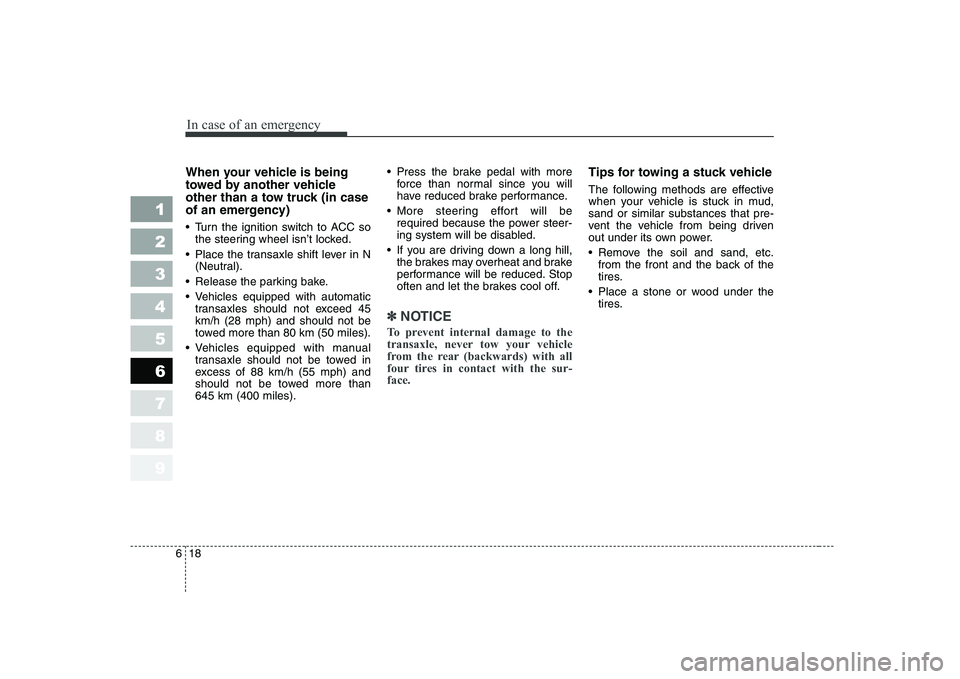
When your vehicle is being
towed by another vehicle
other than a tow truck (in case
of an emergency)
Turn the ignition switch to ACC so
the steering wheel isn’t locked.
Place the transaxle shift lever in N (Neutral).
Release the parking bake.
Vehicles equipped with automatic transaxles should not exceed 45 km/h (28 mph) and should not be
towed more than 80 km (50 miles).
Vehicles equipped with manual transaxle should not be towed in
excess of 88 km/h (55 mph) and
should not be towed more than645 km (400 miles). Press the brake pedal with more
force than normal since you will
have reduced brake performance.
More steering effort will be required because the power steer-
ing system will be disabled.
If you are driving down a long hill, the brakes may overheat and brake
performance will be reduced. Stop
often and let the brakes cool off.
✽✽ NOTICE
To prevent internal damage to the
transaxle, never tow your vehicle
from the rear (backwards) with all
four tires in contact with the sur-face.
Tips for towing a stuck vehicle
The following methods are effective
when your vehicle is stuck in mud,sand or similar substances that pre-
vent the vehicle from being driven
out under its own power.
Remove the soil and sand, etc. from the front and the back of the
tires.
Place a stone or wood under the tires.
Page 264 of 327
1 234567891 23456789
10
Maintenance services / 7-3 Normal maintenance schedule / 7-5
Maintenance under severe usage conditions / 7-9
Owner maintenance / 7-11Engine compartment / 7-14
Engine oil and oil filter / 7-17Engine cooling system / 7-18Brakes and clutch / 7-21Parking brake / 7-22
Power steering / 7-23Manual transaxle / 7-23Automatic transaxle / 7-24Lubricants and fluids / 7-26
Fuel filter / 7-27
Air cleaner / 7-28
Climate control air filter / 7-30
Wiper blades / 7-32Battery / 7-34
Tires and wheels / 7-36
Maintenance
Page 268 of 327

1 23456789
75
Maintenance
NORMAL MAINTENANCE SCHEDULE
I : Inspect and if necessary, adjust, correct, clean or replace.
R : Replace or change. *1: Adjust alternator and power steering (and water pump drive belt) and air conditioner drive belt (if equipped).
Inspect and if necessary correct or replace.
*2 : Check the engine oil level and leak every 500 km (350 miles) or before starting a long trip.
*3 : For your convenience, it can be replaced prior to it's interval when you do maintenance of other items.
MAINTENANCE
INTERVALS
MAINTENANCE ITEMNumber of months or driving distance, whichever comes first
Months 12 24 36 48 60 72 84 96
Miles×1,000 10 20 30 40 50 60 70 80
Km×1,000 15 30 45 60 75 90 105 120
Drive belts *1 Gasoline I I I I I I I I
Diesel I I I I
Engine oil and Gasoline R R R R R R R R
engine oil filter *2
Diesel For Europe R R R R R R R R
Except Europe
Gasoline (2.0L)Engine timing belt
Tensioner/idler Gasoline (2.0L)
Air cleaner filter
I I R I I R I I
Air cleaner filter For Middle East
Spark plugs (Gasoline)
Replace every 10,000 km (6,000 miles) or 12 months
Inspect every 90,000 km (60,000 miles) or 48 months
and replace every 140,000 km (90,000 miles) or 72 months*3
Replace every 40,000 km (25,000 miles) *3
Replace every 15,000 km (10,000 miles)
Inspect when timing belt is inspected or replaced
Page 269 of 327
1 23456789
Maintenance
6
7
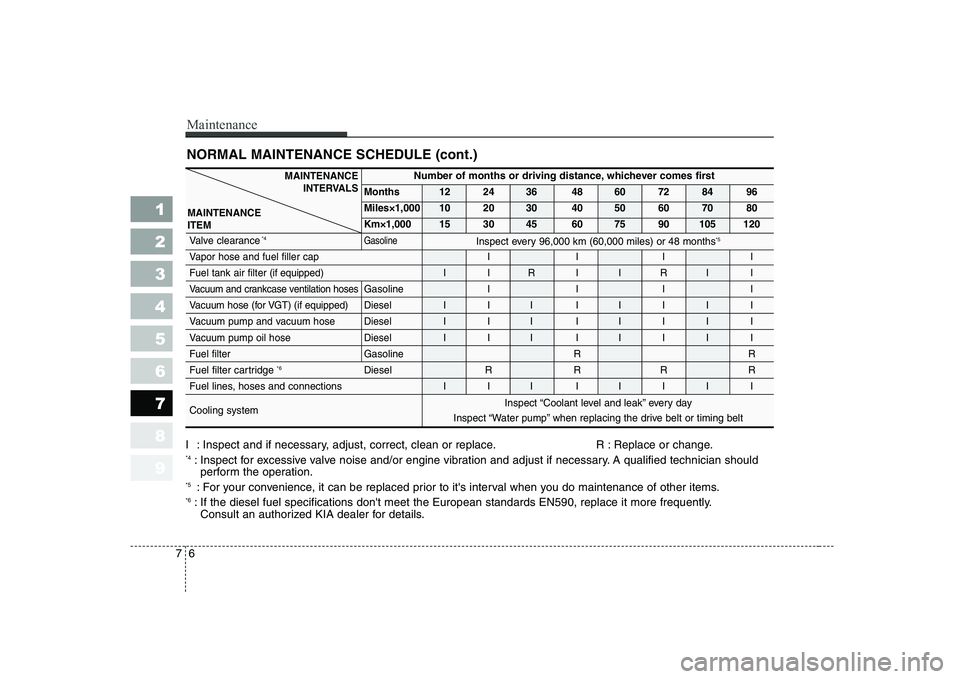
NORMAL MAINTENANCE SCHEDULE (cont.)
MAINTENANCE
INTERVALS
MAINTENANCE ITEMNumber of months or driving distance, whichever comes first
Months 12 24 36 48 60 72 84 96
Miles×1,000 10 20 30 40 50 60 70 80
Km×1,000 15 30 45 60 75 90 105 120
Valve clearance *4
Gasoline
Vapor hose and fuel filler cap
I I I I
Fuel tank air filter (if equipped) I I R I I R I I
Vacuum and crankcase ventilation hosesGasolineIIII
Vacuum hose (for VGT) (if equipped) Diesel
III IIIII
Vacuum pump and vacuum hose DieselIII IIIII
Vacuum pump oil hose DieselIII IIIII
Fuel filterGasoline RR
Fuel filter cartridge *6
Diesel R R R R
Fuel lines, hoses and connections I I I I I I I I Cooling system
Inspect every 96,000 km (60,000 miles) or 48 months *5
Inspect “Coolant level and leak” every day
Inspect “Water pump” when replacing the drive belt or timing belt
I : Inspect and if necessary, adjust, correct, clean or replace. R : Replace or change. *4 : Inspect for excessive valve noise and/or engine vibration and adjust if necessary. A qualified technician should
perform the operation.
*5 : For your convenience, it can be replaced prior to it's interval when you do maintenance of other items.
*6 : If the diesel fuel specifications don't meet the European standards EN590, replace it more frequently.
Consult an authorized KIA dealer for details.
Page 272 of 327

79
Maintenance
1 23456789
MAINTENANCE UNDER SEVERE USAGE CONDITIONS
The following items must be serviced more frequently on cars mainly used under severe driving conditions.
Refer to the chart below for the appropriate maintenance intervals.
R : Replace I : Inspect and if necessary, adjust, correct, clean or replaceEngine oil and G asoline R Every 7,500 km (5,000 miles) or 6 months
A, B, C, D, E, F, G, H, I, K
engine oil filterDiesel
For EuropeR Every 7,500 km (5,000 miles) or 6 months A, B, C, D, E, F,
Except EuropeR Every 5,000 km (3,000 miles) or 6 months G, H, I
Air cleaner filter R C, E
Spark plugs Gasoline R A, B, C, G, H, I, K
Engine timing belt, G asoline (2.0L) R Every 90,000 km (60,000 miles) or 48 months D, E, F, G
tensioner and idler
Manual transaxle fluid (if equipped)
REvery 100,000 km (62,000 miles)A, C, D, E, F, G, H, I, K
Automatic transaxle fluid For EuropeR Every 45,000 km (30,000 miles)A, C, D, E, F
(if equipped) Except Europe R
Every 40,000 km (25,000 miles)G, H, I, K
Steering gear rack, linkage and boots I
C, D, E, F, G
MAINTENANCE ITEMMaintenance
operation Maintenance intervals
Driving condition
Replace more frequently
depending on the condition
Inspect more frequently
depending on the condition Replace more frequently
depending on the condition