Page 268 of 438
WARNING!
Never attempt to climb a hill at an angle or turn
around on a steep grade. Driving across an incline
increases the risk of a rollover, which may result in
severe injury.
•Driving Down Hill– Before driving down a steep hill
you need to determine if it is too steep for a safe
descent. What is the surface traction? Is the grade too
steep to maintain a slow controlled descent? Are there
obstacles? Is it a straight descent? Is there plenty of
distance at the base of the hill to regain control if the
vehicle descends to fast? If you feel confident in your
ability to proceed then make sure you are in low (L
Off-Road) with the 4WD LOCK engaged and proceedwith caution. Allow engine and hill descent braking to
control the descent and apply your brakes if necessary,
but do not allow the tires to lock.
WARNING!
Do not descend a steep grade in NEUTRAL. Use
vehicle brakes in conjunction with engine braking.
Descending a grade too fast could cause you to lose
control and be seriously injured.
•Driving Across An Incline– If at all possible avoid
driving across an incline. If it is necessary, know your
vehicle’s abilities. Driving across an incline places
more weight on the down-hill wheels, which increases
the possibilities of a down-hill slide or rollover. Make
sure the surface has good traction with firm and stable
soils. If possible transverse the incline at an angle
heading slightly up or down.
266 STARTING AND OPERATING
Page 269 of 438
WARNING!
Driving across an incline increases the risk of a
rollover, which may result in severe injury.
•If You Stall Or Begin To Lose Headway– If you stall
or begin to lose headway while climbing a steep hill,
allow your vehicle to come to a stop and immediately
apply the brake. Restart the engine and shift to RE-
VERSE. Back slowly down the hill allowing engine
and hill descent braking to control the descent and
apply your brakes if necessary, but do not allow the
tires to lock.
WARNING!
If the engine stalls or you lose headway or cannot
make it to the top of a steep hill or grade, never
attempt to turn around. To do so may result in
tipping and rolling the vehicle, which may result in
severe injury. Always back carefully straight down a
hill in REVERSE gear. Never back down a hill in
NEUTRAL using only the vehicle brakes. Never
drive diagonally across a hill, always drive straight
up or down.
STARTING AND OPERATING 267
5
Page 270 of 438
Driving Through Water
Extreme care should be taken crossing any type of water.
Water crossings should be avoided if possible, and only
be attempted when necessary in a safe responsible man-
ner. You should only drive through areas which are
designated and approved. You should tread lightly and
avoid damage to the environment. You should know
your vehicles abilities and be able to recover it if some-
thing goes wrong. You should never stop or shut a
vehicle off when crossing deep water unless you ingested
water into the engine air intake. If the engine stalls, do
not attempt to restart it. Determine if it has ingested
water first. The key to any crossing is low and slow. You
want to use low (L Off-Road) with the 4WD LOCK
engaged and proceed very slowly with a constant slow
speed {3-5 mph (5–8 km/h) maximum} and light throttle.Keep the vehicle moving; do not try to accelerate through
the crossing. After crossing any water higher than the
bottom of the axle differentials, you should inspect all of
the vehicle fluids for signs of water ingestion.
CAUTION!
Water ingestion into the axles, transmission, transfer
case, engine or vehicle interior can occur if you drive
too fast or through too deep of water. Water can cause
permanent damage to engine, driveline or other
vehicle components and your brakes will be less
effective once wet and/or muddy.
268 STARTING AND OPERATING
Page 280 of 438
WARNING!
•Never leave children alone in a vehicle. Leaving
unattended children in a vehicle is dangerous for a
number of reasons. A child or others could be
seriously or fatally injured. Don’t leave the key in
the ignition. A child could operate power win-
dows, other controls, or move the vehicle.
•Be sure the parking brake is fully disengaged
before driving; failure to do so can lead to brake
failure and an accident.
BRAKE SYSTEM
Your vehicle is equipped with power assisted brakes as
standard equipment. In the event power assist is lost for
any reason (for example, repeated brake applications
with the engine off), the brakes will still function. How-
ever, the effort required to brake the vehicle will be much
greater than that required with the power system oper-
ating.
WARNING!
Riding the brakes can lead to brake failure and
possibly an accident. Driving with your foot resting
or riding on the brake pedal can result in abnormally
high brake temperatures, excessive lining wear, and
possible brake damage. You would not have your full
braking capacity in an emergency.
278 STARTING AND OPERATING
Page 297 of 438

Radial Ply Tires
WARNING!
Combining radial ply tires with other types of tires
on your vehicle will cause your vehicle to handle
poorly. The instability could cause an accident. Al-
ways use radial ply tires in sets of four (or six, in case
of trucks with dual rear wheels). Never combine
them with other types of tires.
Cuts and punctures in radial tires are repairable only in
the tread area because of sidewall flexing. Consult your
authorized tire dealer for radial tire repairs.
Compact Spare Tire — If Equipped
The compact spare is for temporary emergency use with
radial tires. It is engineered to be used on your stylevehicle only. Since this tire has limited tread life, the
original tire should be repaired (or replaced) and rein-
stalled at the first opportunity.
WARNING!
•Temporary use spare tires are for emergency use
only. With these tires, DO NOT drive more than 50
mph (80 km/h).
•Temporary-use spare tires have limited tread life.
When the tread is worn to the tread wear indica-
tors, the temporary use spare tire needs to be
replaced.
•Be sure to follow the warnings, which apply to
your spare. Failure to do so could result in spare
tire failure and loss of vehicle control.
STARTING AND OPERATING 295
5
Page 313 of 438
FUEL REQUIREMENTS
GASOLINE ENGINES
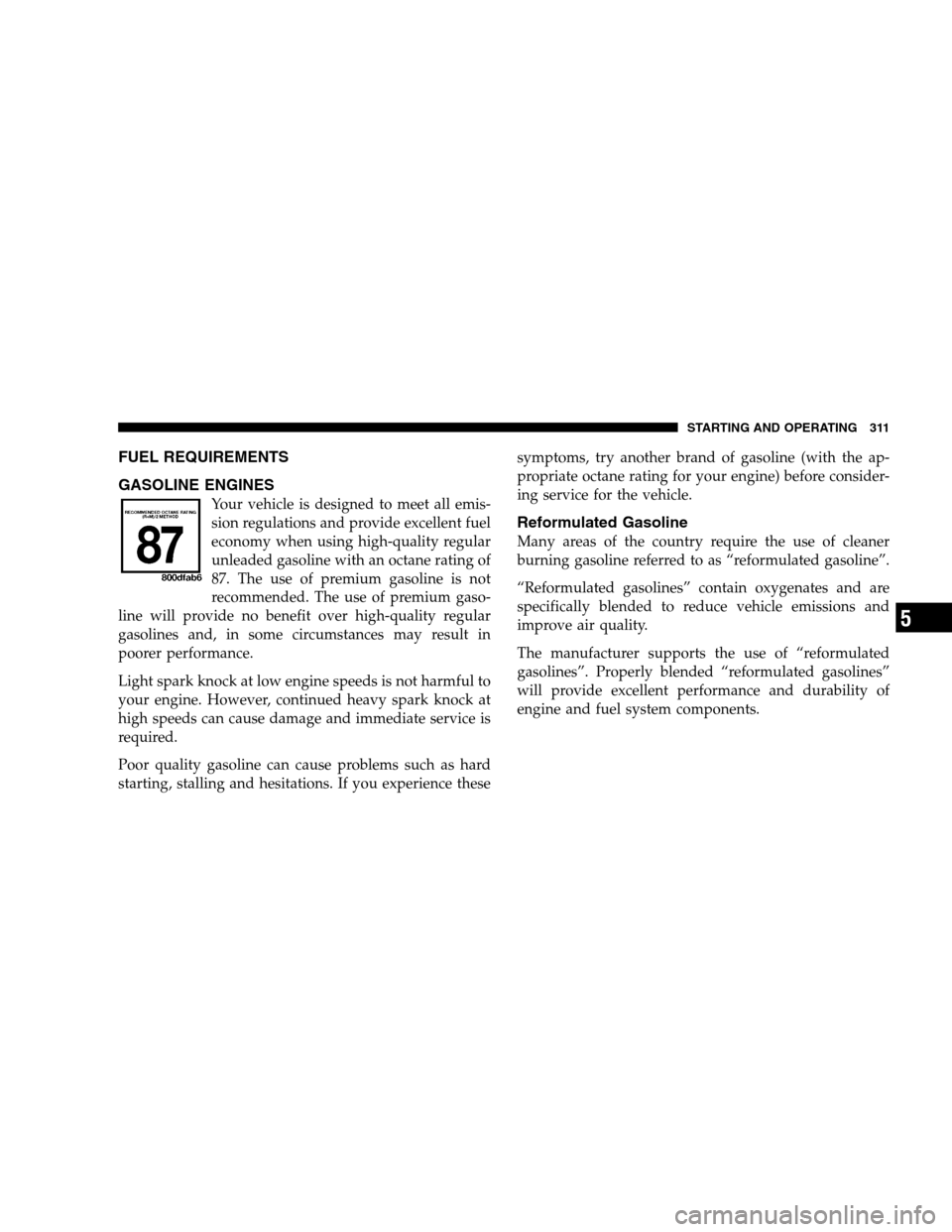
Your vehicle is designed to meet all emis-
sion regulations and provide excellent fuel
economy when using high-quality regular
unleaded gasoline with an octane rating of
87. The use of premium gasoline is not
recommended. The use of premium gaso-
line will provide no benefit over high-quality regular
gasolines and, in some circumstances may result in
poorer performance.
Light spark knock at low engine speeds is not harmful to
your engine. However, continued heavy spark knock at
high speeds can cause damage and immediate service is
required.
Poor quality gasoline can cause problems such as hard
starting, stalling and hesitations. If you experience thesesymptoms, try another brand of gasoline (with the ap-
propriate octane rating for your engine) before consider-
ing service for the vehicle.
Reformulated Gasoline
Many areas of the country require the use of cleaner
burning gasoline referred to as “reformulated gasoline”.
“Reformulated gasolines” contain oxygenates and are
specifically blended to reduce vehicle emissions and
improve air quality.
The manufacturer supports the use of “reformulated
gasolines”. Properly blended “reformulated gasolines”
will provide excellent performance and durability of
engine and fuel system components.
STARTING AND OPERATING 311
5
Page 315 of 438
Materials Added To Fuel
All gasoline sold in the United States is required to
contain effective detergent additives. Use of additional
detergents or other additives is not needed under normal
conditions and would result in additional cost. Therefore
you should not have to add anything to the fuel.
Fuel System Cautions
CAUTION!
Follow these guidelines to maintain your vehicle’s
performance:
•The use of leaded gas is prohibited by Federal law.
Using leaded gasoline can impair engine performance
and damage the emission control system.
•An out-of-tune engine, or certain fuel or ignition
malfunctions, can cause the catalytic converter tooverheat. If you notice a pungent burning odor or
some light smoke, your engine may be out of tune or
malfunctioning and may require immediate service.
Contact your authorized dealer for service assistance.
•The use of fuel additives, which are now being sold as
octane enhancers, is not recommended. Most of these
products contain high concentrations of Methanol.
Fuel system damage or vehicle performance problems
resulting from the use of such fuels or additives is not
the responsibility of the manufacturer.
NOTE:Intentional tampering with emissions control
systems can result in civil penalties being assessed
against you.
STARTING AND OPERATING 313
5
Page 316 of 438

Carbon Monoxide Warnings
WARNING!
Carbon monoxide (CO) in exhaust gases is deadly.
Follow the precautions below to prevent carbon
monoxide poisoning:
•Do not inhale exhaust gases. They contain carbon
monoxide, a colorless and odorless gas which can kill.
Never run the engine in a closed area, such as a
garage, and never sit in a parked vehicle with the
engine running for an extended period of time. If the
vehicle is stopped in an open area with the engine
running for more than a short period, adjust the
ventilation system to force fresh, outside air into the
vehicle.
•Guard against carbon monoxide with proper mainte-
nance. Have the exhaust system inspected every time
the vehicle is raised. Have any abnormal conditions
repaired promptly. Until repaired, drive with all side
windows fully open.
•Keep the liftgate closed when driving your vehicle to
prevent carbon monoxide and other poisonous ex-
haust gases from entering the vehicle.
ADDING FUEL
Fuel Filler Cap (Gas Cap)
The gas cap is behind the fuel filler door, on the left side
of the vehicle. If the gas cap is lost or damaged, be sure
the replacement cap is for use with this vehicle.
314 STARTING AND OPERATING
