Page 338 of 438
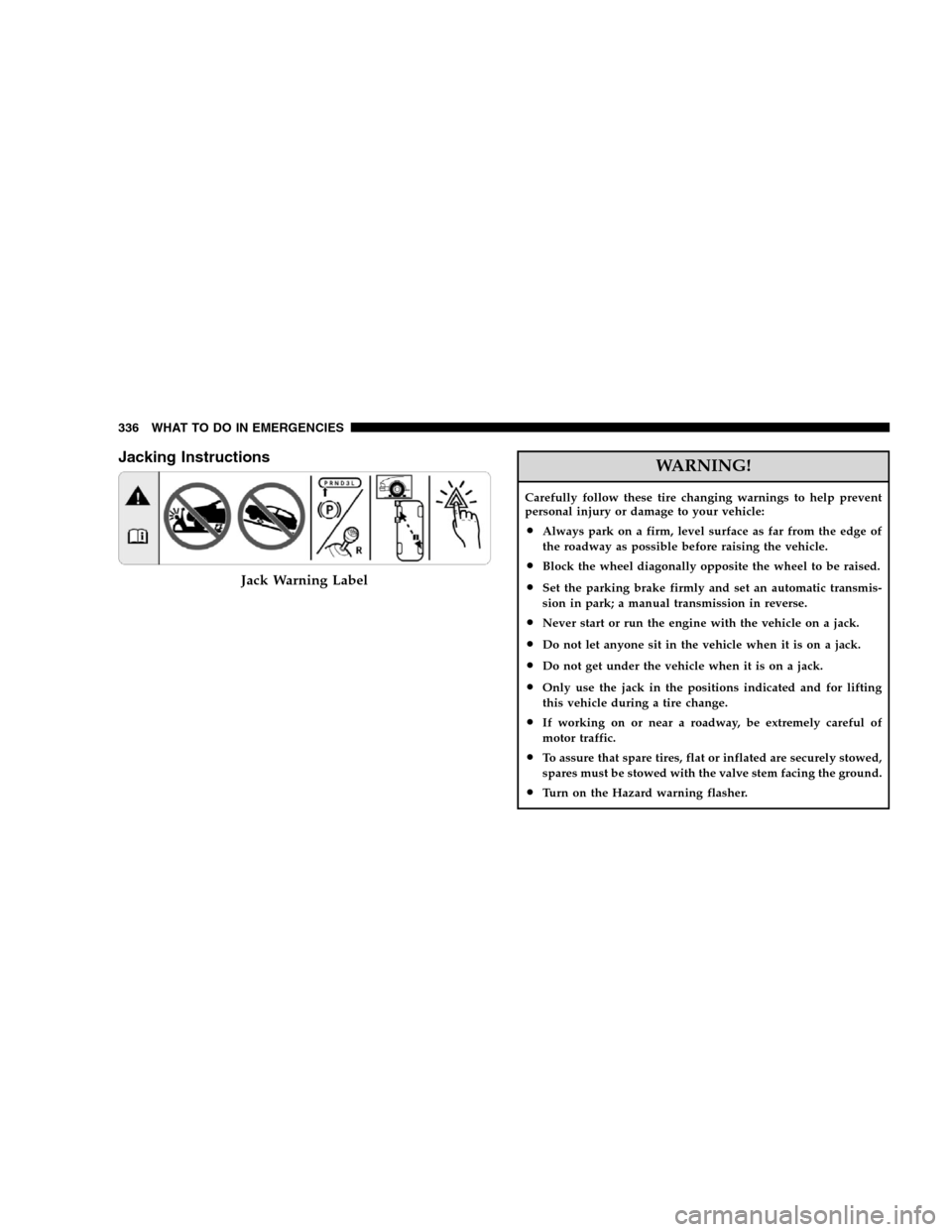
Jacking InstructionsWARNING!
Carefully follow these tire changing warnings to help prevent
personal injury or damage to your vehicle:
•Always park on a firm, level surface as far from the edge of
the roadway as possible before raising the vehicle.
•Block the wheel diagonally opposite the wheel to be raised.
•Set the parking brake firmly and set an automatic transmis-
sion in park; a manual transmission in reverse.
•Never start or run the engine with the vehicle on a jack.
•Do not let anyone sit in the vehicle when it is on a jack.
•Do not get under the vehicle when it is on a jack.
•Only use the jack in the positions indicated and for lifting
this vehicle during a tire change.
•If working on or near a roadway, be extremely careful of
motor traffic.
•To assure that spare tires, flat or inflated are securely stowed,
spares must be stowed with the valve stem facing the ground.
•Turn on the Hazard warning flasher.
Jack Warning Label
336 WHAT TO DO IN EMERGENCIES
Page 342 of 438
JUMP-STARTING PROCEDURES DUE TO A LOW
BATTERY
WARNING!
Take care to avoid the radiator cooling fan whenever
the hood is raised. It can start anytime the ignition
switch is on. You can be hurt by the fan.
WARNING!
Do not attempt to push or tow your vehicle to get it
started. Vehicles equipped with an automatic trans-
axle cannot be started this way and may be damaged.
Unburned fuel could enter the catalytic converter and
once the engine has started, ignite and damage the
converter and vehicle. If the vehicle has a discharged
battery, booster cables may be used to obtain a start
from another vehicle. This type of start can be
dangerous if done improperly, so follow this proce-
dure carefully.
340 WHAT TO DO IN EMERGENCIES
Page 344 of 438

WARNING!
Battery fluid is a corrosive acid solution; do not allow
battery fluid to contact eyes, skin or clothing. Don’t
lean over the battery when attaching the clamps or
allow the clamps to touch each other. If acid splashes
in your eyes or on your skin, flush the contaminated
area immediately with large quantities of water.
A battery generates hydrogen gas which is flam-
mable and explosive. Keep flame or spark away from
the vent holes. Do not use a booster battery or any
other booster source with an output that exceeds 12
volts.
5. Connect the other cable, first to the negative terminal
of the booster battery and then to the negative terminal of
the discharged battery. Make sure you have a good
contact.6. If the vehicle is equipped with a Sentry Key�Immo-
bilizer, turn the ignition switch to the ON position for
three seconds before moving the ignition switch to the
START position.
7. Start the engine in the vehicle that has the booster
battery, let the engine idle a few minutes, then start the
engine in the vehicle with the discharged battery.
8. When removing the jumper cables, reverse the se-
quence exactly. Be careful of the moving belts and fan.
FREEING A STUCK VEHICLE
NOTE:If your vehicle is equipped with Traction Con-
trol or ESP, turn the system OFF before attempting to
“rock” the vehicle.
If your vehicle becomes stuck in mud, sand or snow, it
can often be moved by a rocking motion. Turn your
steering wheel right and left to clear the area around the
342 WHAT TO DO IN EMERGENCIES
Page 345 of 438
front wheels. Then shift back and forth between RE-
VERSE and 1st gear. Usually the least accelerator pedal
pressure to maintain the rocking motion without spin-
ning the wheels is most effective.
WARNING!
Fast spinning tires can be dangerous. Forces gener-
ated by excessive wheel speeds may cause axle, tire
damage or failure. A tire could explode and injure
someone. Do not spin your vehicle’s wheels faster
than 30 mph (48 km/h) or for longer than 30 seconds
continuously without stopping when you are stuck.
And don’t let anyone near a spinning wheel, no
matter what the speed.
CAUTION!
Racing the engine or spinning the wheels too fast
may lead to transaxle overheating and failure. It can
also damage the tires. Do not spin the wheels above
30 mph (48 km/h). Do not spin the wheels continu-
ously for more than 30 seconds.
TOWING A DISABLED VEHICLE
With Ignition Key
Automatic And Manual Transaxle
Front wheel drive vehicles must have the front wheels
elevated; 4-wheel drive vehicles must be hauled on a
flatbed truck.
WHAT TO DO IN EMERGENCIES 343
6
Page 347 of 438
MAINTAINING YOUR VEHICLE
CONTENTS
�Engine Compartment — Gasoline...........348
�Onboard Diagnostic System — OBD II........349
▫Loose Fuel Filler Cap Message............349
�Emissions Inspection And Maintenance
Programs............................350
�Replacement Parts......................351
�Authorized Dealer Service................352
�Maintenance Procedures..................352
▫Engine Oil..........................352▫Drive Belt — Check Condition............356
▫Spark Plugs.........................356
▫Catalytic Converter....................356
▫Crankcase Emission Control System........358
▫Fuel Filter..........................358
▫Air Cleaner Element (Filter)..............358
▫Maintenance-Free Battery................359
▫Air Conditioner Maintenance.............361
▫Power Steering — Fluid Check............362
7
Page 349 of 438
▫Auxiliary Off-Road Light................393
�Fluids And Capacities...................395
�Fluids, Lubricants, And Genuine Parts........396▫Engine.............................396
▫Chassis............................397
MAINTAINING YOUR VEHICLE 347
7
Page 350 of 438
ENGINE COMPARTMENT — GASOLINE
348 MAINTAINING YOUR VEHICLE
Page 351 of 438
ONBOARD DIAGNOSTIC SYSTEM — OBD II
Your vehicle is equipped with a sophisticated Onboard
Diagnostic system called OBD II. This system monitors
the performance of the emissions, engine, and automatic
transaxle control systems. When these systems are oper-
ating properly, your vehicle will provide excellent per-
formance and fuel economy, as well as engine emissions
well within current government regulations.
If any of these systems require service, the OBD II system
will turn on the Malfunction Indicator Light (MIL). It will
also store diagnostic codes and other information to
assist your service technician in making repairs. Al-
though your vehicle will usually be drivable and not
need towing, see your authorized dealer for service as
soon as possible.CAUTION!
•Prolonged driving with the MIL on could cause
further damage to the emission control system. It
could also affect fuel economy and drivability. The
vehicle must be serviced before any emissions
tests can be performed.
•If the MIL is flashing while the engine is running,
severe catalytic converter damage and power loss
will soon occur. Immediate service is required.
Loose Fuel Filler Cap Message
After fuel is added, the vehicle diagnostic system can
determine if the fuel filler cap is possibly loose or
improperly installed. A “gASCAP” message will be dis-
played in the instrument cluster. Tighten the gas cap until
a�clicking�sound is heard. This is an indication that the
gas cap is properly tightened. Press the trip odometer
MAINTAINING YOUR VEHICLE 349
7