2008 JEEP PATRIOT light
[x] Cancel search: lightPage 272 of 438
•Crossing Ditches, Streams, Shallow Rivers Or Other
Flowing Water– Flowing water can be extremely
dangerous. Never attempt to cross a fast running
stream or river even in shallow water. Fast moving
water can easily push your vehicle downstream
sweeping it out of control. Even in very shallow water,
a high current can still wash the dirt out from around
your tires putting you and your vehicle in jeopardy.
There is still a high risk of personal injury and vehicle
damage with slower water currents in depths greater
than the vehicle’s running ground clearance. You
should never attempt to cross flowing water which is
deeper than the vehicle’s running ground clearance.
Even the slowest current can push the heaviest vehicle
downstream out of control if the water is deep enough
to push on the large surface area of the vehicle’s body.
Before you proceed determine the speed of the current,
the water’s depth, approach angle, bottom conditionand if there are any obstacles, then cross at an angle
heading slightly upstream using the low and slow
technique.
WARNING!
Never drive through fast moving deep water. It can
push your vehicle downstream, sweeping it out of
control. This could put you and your passengers at
risk of injury or drowning.
Airing Down For Off-Road Driving
Running lower tire pressure off-road can improve your
ride comfort and vehicle traction. Reducing the tire air
pressure allows the tire to bulge slightly, improving its
surface area for better flotation and ability to mold or
form to the ground contour. Different terrain, tires, and
vehicles require different tire pressure. Hard surfaces like
rock and heavier vehicles require higher pressures than
270 STARTING AND OPERATING
Page 273 of 438
softer surfaces such as sand and lighter vehicles. You will
need to experiment to determine what is right for your
situation. It is easier and faster to let air out than it is to
replace it so, start high and lower it as required. Remem-
ber you must return the tires to normal air pressure
before driving on-road or at highway conditions. Be sure
you have a way to return the tires to their normal on-road
air pressure.
CAUTION!
Reduced tire pressure increases the risk of tire dam-
age and may cause tire unseating with total loss of air
pressure. To reduce the risk of tire unseating, while at
a reduced tire pressure, drive at slower speeds and
avoid sharp turns or abrupt maneuvers.
Vehicle Recovery
If you drive off-road, you may encounter a situation
where you will need to recover your vehicle. Vehicle
recovery should always be given consideration before
attempting a questionable obstacle. You should never go
off-road driving without the ability to recover your
vehicle from a situation. Having another vehicle with
you usually works best for most situations. The first
thing to do is assess the situation. Why are you stuck?
Are you hung up on something? Would it be easier to go
forward or to go backward? Can you still move the
vehicle? Are you alone or do you have another vehicle to
help? Is there high risk of vehicle damage during the
recovery process? Answering these questions will help
you determine the best method of recovery. If you can
still move the vehicle slightly and the only issue is slick
ground, then rock cycling your vehicle would be the first
choice. If you have ample room, an additional vehicle
and there is low risk of vehicle impingement on the
STARTING AND OPERATING 271
5
Page 275 of 438

CAUTION!
Damage can occur when spinning your tires at an
excessive high speed. Do not spin your tires faster
than an indicated 30 mph (48 km/h). Do not spin the
wheels continuously for more than 30 seconds.
•Using The Tow Hooks With A Tow Strap–Tow straps
are a quick and easy way to recover your vehicle from
minor situations if you have a secondary vehicle which
is not stuck. The tow hooks on your vehicle are de-
signed to take the abusive force generated during
vehicle recovery. Do not use the bumper or any other
vehicle component as an attachment point. Using tow
straps requires coordination between the two drivers.
Good communication and line of sight are required for
a safe recovery. First connect the tow strap to the correct
attachment points on both vehicles. There should be aleast 20 to 30 ft (6 to 9 m) between the vehicles to allow
for a safe recovery. If necessary join two tow straps
together using a 1 1/2 in (4 cm) hard wood dowel. This
will keep the straps from becoming knotted and is safer
than using a clevis pin if the strap breaks. Next have the
tow vehicle backup, leaving 2 to 3 ft (61 to 91 cm) worth
of slack in the strap. Then the tow vehicle, using light
throttle, should accelerate tightening the strap provid-
ing the pulling force needed to free the vehicle. The
vehicle being recovered should assist in the recovery, at
the time of the snap, by slowly spinning the tires in the
same direction as the pulling vehicle. After the vehicle
becomes free, the driver of the previously stuck vehicle
should signal they are free and should hit their brakes
stopping both vehicles. The driver of the pulling vehicle
should let off the throttle without using the brakes, once
signaled by the other driver. This sequence is important
to avoid having the recovered vehicle hit the pulling
vehicle.
STARTING AND OPERATING 273
5
Page 278 of 438
TRACTION
When driving on wet or slushy roads, it is possible for a
wedge of water to build up between the tire and road
surface. This is hydroplaning and may cause partial or
complete loss of vehicle control and stopping ability. To
reduce this possibility, the following precautions should
be observed:
1. Slow down during rainstorms or when roads are
slushy.
2. Slow down if the road has standing water or puddles.
3. Replace the tires when tread wear indicators first
become visible.
4. Keep the tires properly inflated.
5. Maintain enough distance between your vehicle and
the vehicle in front of you to avoid a collision in a sudden
stop.
PARKING BRAKE
When the parking brake is applied with the
ignition ON, the Brake Light in the instrument
cluster will come on.
NOTE:This light only shows that the parking brake is
on. It does not show the degree of brake application.
If the parking brake is applied while the vehicle is
moving, a chime will sound to alert the driver. The chime
will sound up to 10 times or until the vehicle has
returned to a stop.
Before leaving the vehicle, make sure that the parking
brake is set. To set the parking brake, pull up firmly on
the lever. Also, place the shift lever in the PARK position
(automatic transmission) or REVERSE position (manual
transmission). To release the parking brake, apply the
276 STARTING AND OPERATING
Page 279 of 438
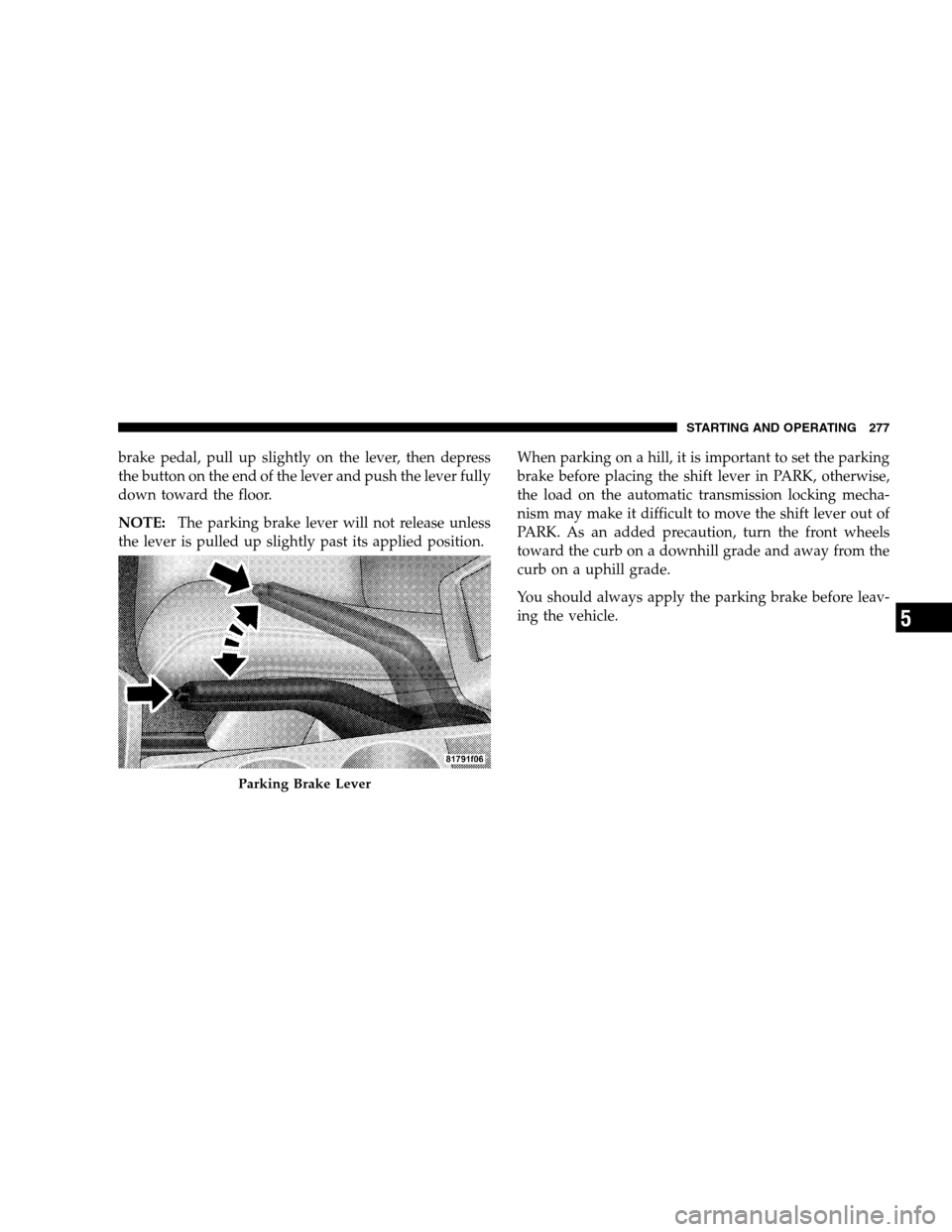
brake pedal, pull up slightly on the lever, then depress
the button on the end of the lever and push the lever fully
down toward the floor.
NOTE:The parking brake lever will not release unless
the lever is pulled up slightly past its applied position.When parking on a hill, it is important to set the parking
brake before placing the shift lever in PARK, otherwise,
the load on the automatic transmission locking mecha-
nism may make it difficult to move the shift lever out of
PARK. As an added precaution, turn the front wheels
toward the curb on a downhill grade and away from the
curb on a uphill grade.
You should always apply the parking brake before leav-
ing the vehicle.
Parking Brake Lever
STARTING AND OPERATING 277
5
Page 281 of 438
If either of the two hydraulic systems lose normal capa-
bility, the remaining system will still function with some
loss of overall braking effectiveness. This will be evident
by increased pedal travel during application and greater
pedal force required to slow or stop. In addition, if the
malfunction is caused by an internal leak, as the brake
fluid in the master cylinder drops, the brake warning
indicator will light.
WARNING!
Driving a vehicle with the brake light on is danger-
ous. A significant decrease in braking performance or
vehicle stability during braking may occur. It will
take you longer to stop the vehicle or will make your
vehicle harder to control. You could have an accident.
Have the vehicle checked immediately.
Anti-Lock Brake System (ABS) — If Equipped
The ABS provides increased vehicle stability and brake
performance under most braking conditions. The system
automatically “pumps” the brakes during severe braking
conditions to prevent wheel lock-up.
WARNING!
Pumping of the Anti-Lock Brakes will diminish their
effectiveness and may lead to an accident. Pumping
makes the stopping distance longer. Just press firmly
on your brake pedal when you need to slow down or
stop.
STARTING AND OPERATING 279
5
Page 282 of 438
WARNING!
•The ABS cannot prevent the natural laws of phys-
ics from acting on the vehicle, nor can it increase
braking or steering efficiency beyond that af-
forded by the condition of the vehicle brakes and
tires or the traction afforded.
•The ABS cannot prevent accidents, including
those resulting from excessive speed in turns,
following another vehicle too closely, or hydro-
planing. Only a safe, attentive, and skillful driver
can prevent accidents.
•The capabilities of an ABS-equipped vehicle must
never be exploited in a reckless or dangerous
manner which could jeopardize the user’s safety
or the safety of others.The ABS light monitors the ABS System. The
light will come on when the ignition switch is
turned to the ON position and may stay on for
as long as four seconds.
If the ABS light remains on or comes on while driving, it
indicates that the Anti-Lock portion of the brake system
is not functioning and that service is required. However,
the conventional brake system will continue to operate
normally if the BRAKE warning light is not on.
If the ABS light is on, the brake system should be serviced
as soon as possible to restore the benefits of Anti-Lock
brakes. If the ABS light does not come on when the
ignition switch is turned to the ON position, have the
bulb repaired as soon as possible.
If both the Brake Warning light and the ABS light remain
on, the ABS and Electronic Brake Force Distribution
(EBD) systems are not functioning. Immediate repair to
the ABS is required.
280 STARTING AND OPERATING
Page 283 of 438
When the vehicle is driven over 7 mph (11 km/h), you
may also hear a slight clicking sound as well as some
related motor noises. These noises are the system per-
forming its self-check cycle to ensure that the ABS
working properly. This self-check occurs each time the
vehicle is started and accelerated past 7 mph (11 km/h).
ABS is activated during braking under certain road or
stopping conditions. ABS-inducing conditions can in-
clude ice, snow, gravel, bumps, railroad tracks, loose
debris, or panic stops.
You may also experience the following when the brake
system goes into Anti-Lock mode:
•the ABS motor running (it may continue to run for a
short time after the stop)
•the clicking sound of solenoid valves
•brake pedal pulsations
•a slight drop or fall away of the brake pedal at the end
of the stop
These are all normal characteristics of ABS.
WARNING!
The Anti-Lock Brake System (ABS) contains sophis-
ticated electronic equipment that may be susceptible
to interference caused by improperly installed or
high output radio transmitting equipment. This in-
terference can cause possible loss of Anti-Lock brak-
ing capability. Installation of such equipment should
be performed by qualified professionals.
All vehicle wheels and tires must be the same size and
type and tires must be properly inflated to produce
accurate signals for the computer.
STARTING AND OPERATING 281
5