Page 12 of 438
▫Programming Additional Transmitters........22
▫General Information....................24
▫Transmitter Battery Replacement...........24
�Door Locks............................26
▫Manual Door Locks.....................26
▫Power Door Locks.....................27
▫Child-Protection Door Lock System
(Rear Doors) — If Equipped...............30
�Power Windows — If Equipped.............32
▫Power Window Switches.................32
▫Auto Down..........................32
▫Window Lockout Switch.................33
�Liftgate...............................33�Occupant Restraints......................35
▫Lap/Shoulder Belts.....................36
▫Adjustable Upper Shoulder Belt Anchorage....41
▫Second Row Center Lap/Shoulder Belt
Operating Instructions...................42
▫Seat Belt Pretensioners...................45
▫Enhanced Driver Seat Belt Reminder System
(BeltAlert�) ..........................46
▫Seat Belt Extender......................47
▫Seat Belts And Pregnant Women............48
▫Driver And Front Passenger Supplemental
Restraint System (SRS) - Airbag............48
▫Event Data Recorder (EDR)...............58
▫Child Restraint........................60
10 THINGS TO KNOW BEFORE STARTING YOUR VEHICLE
Page 16 of 438
NOTE:If you try to remove the key before you place the
shift lever in PARK, the key may become trapped tem-
porarily in the ignition cylinder. If this occurs, rotate the
key to the right slightly, then remove the key as de-
scribed. If a malfunction occurs, the system will trap the
key in the ignition cylinder to warn you that this safety
feature is inoperable. The engine can be started and
stopped but the key cannot be removed until you obtain
service.
WARNING!
Never leave children alone in a vehicle. Leaving
unattended children in a vehicle is dangerous for a
number of reasons. A child or others could be seri-
ously or fatally injured. Don’t leave the keys in the
ignition. A child could operate power windows,
other controls, or move the vehicle.
CAUTION!
An unlocked car is an invitation to thieves. Always
remove the key from the ignition and lock all the
doors when leaving the vehicle unattended.
Locking Doors With The Key
You can insert the key with either side up. To lock the
door, turn the key rearward. To unlock the door, turn the
key forward. Refer to “Body Lubrication” under “Main-
tenance Procedures” in Section 7.
Key-In-Ignition Reminder
Opening the driver’s door when the key is in the ignition
sounds a signal to remind you to remove the key.
NOTE:With the driver’s door open and the key in the
ignition, both the power door locks and Remote Keyless
Entry (RKE) will not function.
14 THINGS TO KNOW BEFORE STARTING YOUR VEHICLE
Page 28 of 438
DOOR LOCKS
Manual Door Locks
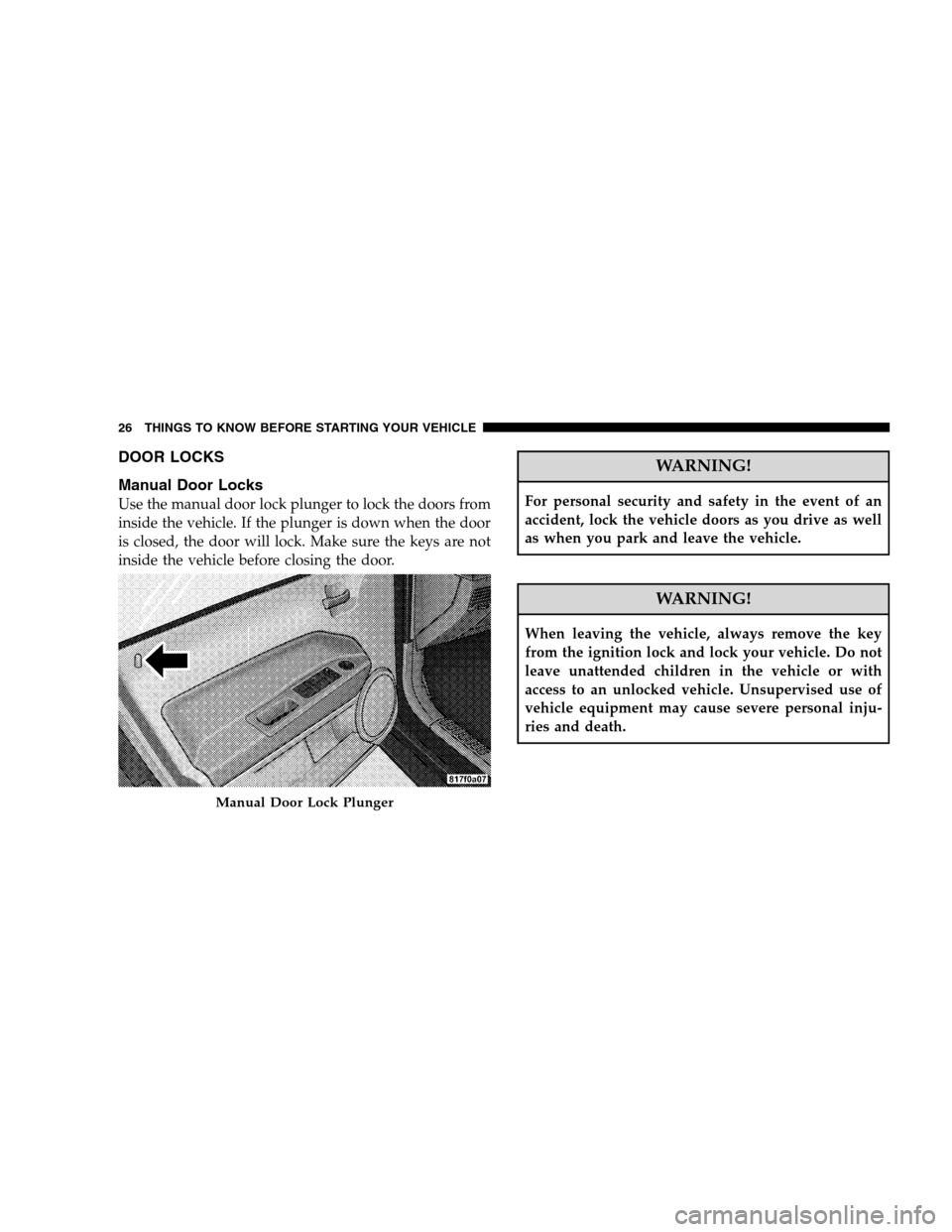
Use the manual door lock plunger to lock the doors from
inside the vehicle. If the plunger is down when the door
is closed, the door will lock. Make sure the keys are not
inside the vehicle before closing the door.
WARNING!
For personal security and safety in the event of an
accident, lock the vehicle doors as you drive as well
as when you park and leave the vehicle.
WARNING!
When leaving the vehicle, always remove the key
from the ignition lock and lock your vehicle. Do not
leave unattended children in the vehicle or with
access to an unlocked vehicle. Unsupervised use of
vehicle equipment may cause severe personal inju-
ries and death.
Manual Door Lock Plunger
26 THINGS TO KNOW BEFORE STARTING YOUR VEHICLE
Page 32 of 438
4. A single chime will indicate the completion of the
programming.
NOTE:Use the Auto Door Locks and Auto Unlock
features in accordance with local laws.
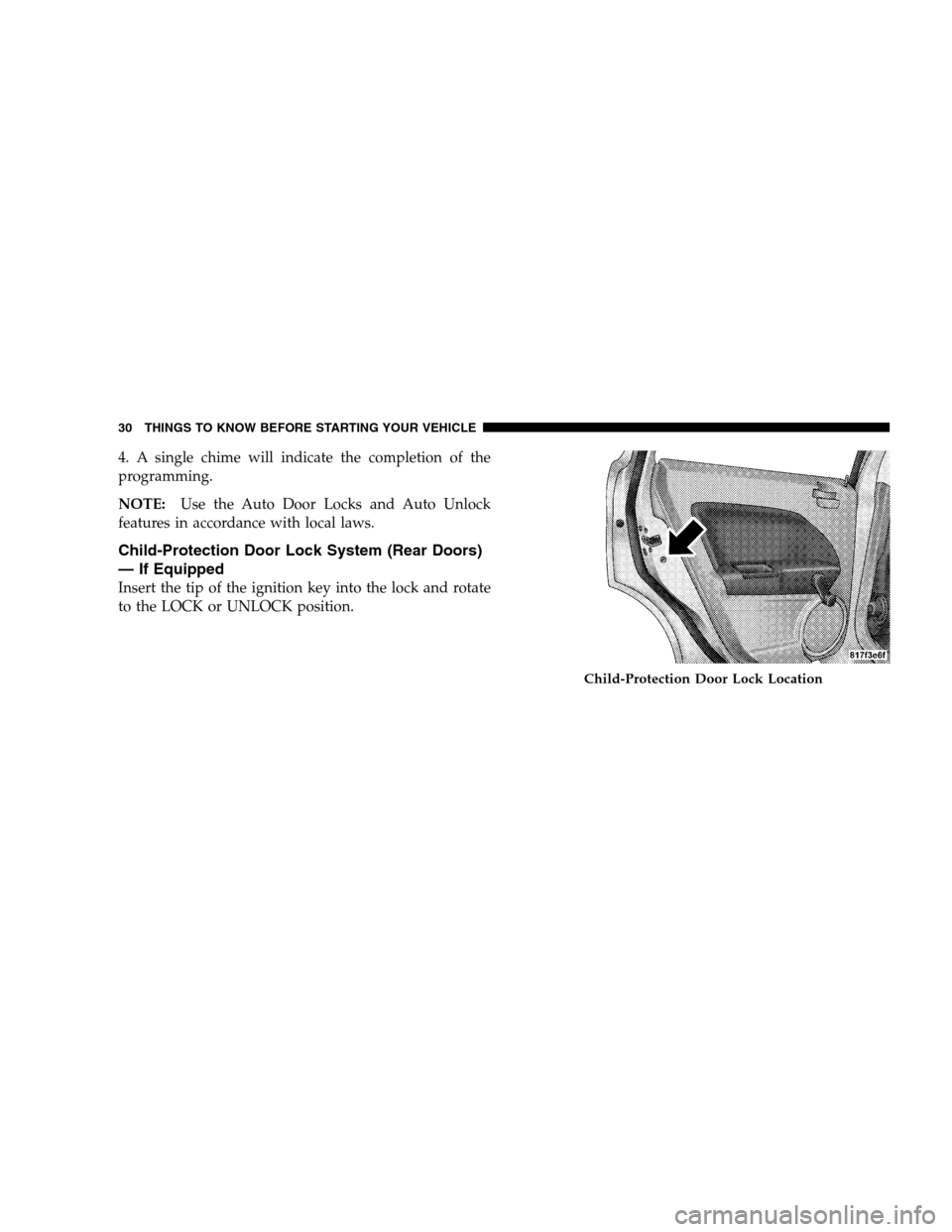
Child-Protection Door Lock System (Rear Doors)
— If Equipped
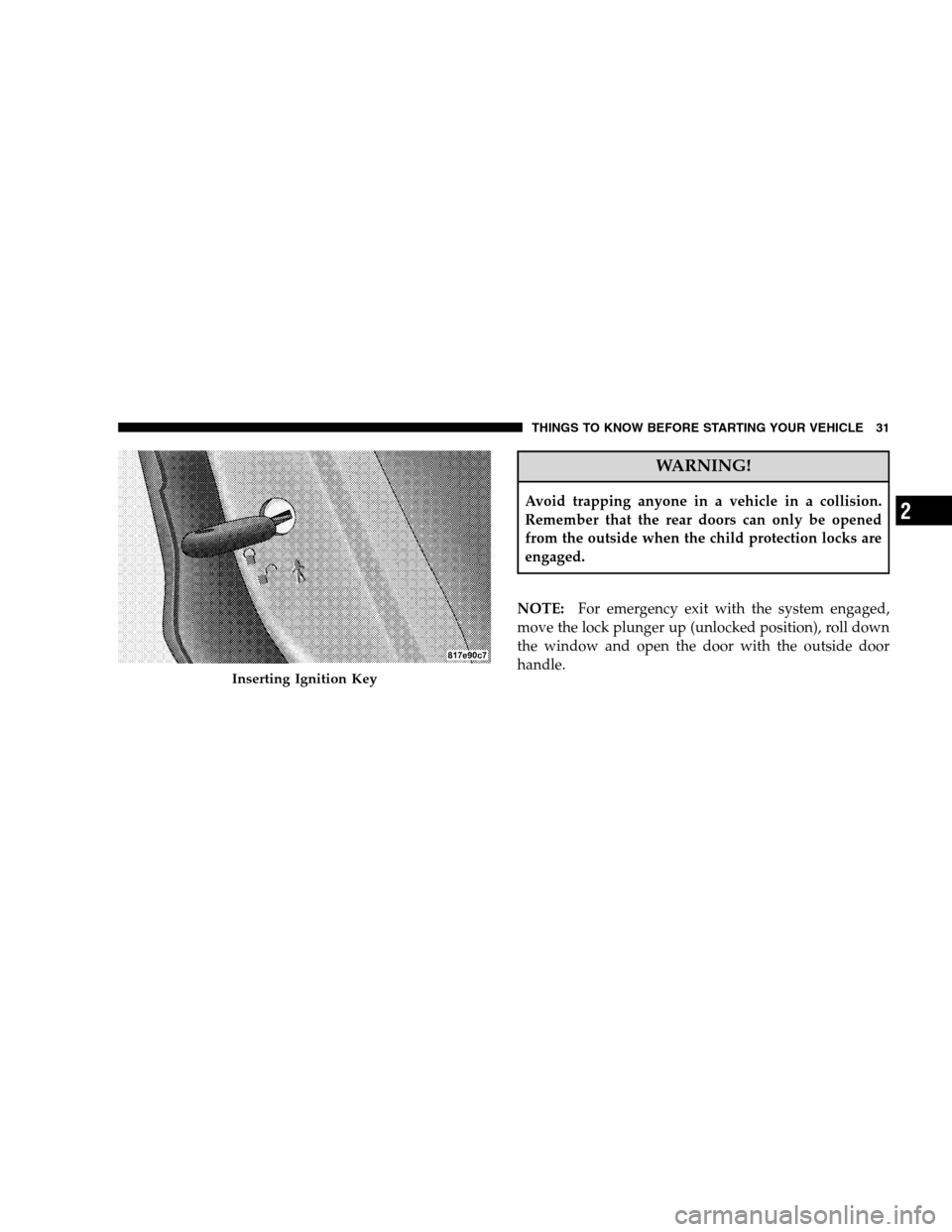
Insert the tip of the ignition key into the lock and rotate
to the LOCK or UNLOCK position.
Child-Protection Door Lock Location
30 THINGS TO KNOW BEFORE STARTING YOUR VEHICLE
Page 33 of 438
WARNING!
Avoid trapping anyone in a vehicle in a collision.
Remember that the rear doors can only be opened
from the outside when the child protection locks are
engaged.
NOTE:For emergency exit with the system engaged,
move the lock plunger up (unlocked position), roll down
the window and open the door with the outside door
handle.
Inserting Ignition Key
THINGS TO KNOW BEFORE STARTING YOUR VEHICLE 31
2
Page 65 of 438

Here are some tips on getting the most out of your child
restraint:
•Before buying any restraint system, make sure that it
has a label certifying that it meets all applicable Safety
Standards. We also recommend that you make sure
that you can install the child restraint in the vehicle
where you will use it, before you buy it.
•The restraint must be appropriate for your child’s
weight and height. Check the label on the restraint for
weight and height limits.
•Carefully follow the instructions that come with the
restraint. If you install the restraint improperly, it may
not work when you need it.
The passenger seat belts are equipped with either
cinching latch plates or seat belt retractors that can be
switched to an automatic locking mode, which are
designed to keep the lap portion tight around the childrestraint so that it is not necessary to use a locking clip.
If the seat belt has a cinching latch plate, pulling up on
the shoulder portion of the lap/shoulder belt will
tighten the belt. The cinching latch plate will keep the
belt tight, however, any seat belt system will loosen
with time, so check the belt occasionally and pull it
tight if necessary.
If the seat belt has a switchable retractor, it will have a
distinctive label. To operate the switchable retractor,
please refer to Automatic-Locking Retractor (ALR) in this
section.•In the rear seat, you may have trouble tightening the
lap/shoulder belt on the child restraint because the
buckle or latch plate is too close to the belt path
opening on the restraint. Disconnect the latch plate
from the buckle and twist the short buckle end of the
belt several times to shorten it. Insert the latch plate
into the buckle with the release button facing out.
THINGS TO KNOW BEFORE STARTING YOUR VEHICLE 63
2
Page 66 of 438

•If the belt still can’t be tightened, or if pulling and
pushing on the restraint loosens the belt, disconnect
the latch plate from the buckle, turn the latch plate
around, and insert the latch plate into the buckle
again. If you still can’t make the child restraint secure,
try a different seating position.
•Buckle the child into the seat according to the child
restraint manufacturer’s directions.
•When your child restraint is not in use, secure it in the
vehicle with the seat belt or remove it from the vehicle.
Don’t leave it loose in the vehicle. In a sudden stop or
collision, it could strike the occupants or seatbacks and
cause serious personal injury.
Automatic-Locking Retractor (ALR)
To operate the switchable retractor, pull the belt from the
retractor until there is enough allowance to pass it
through the child restraint and slide the latch plate into
the buckle. Then pull on the belt until it is all removedfrom the retractor. Allow the belt to return into the
retractor, pulling on the excess webbing to tighten the lap
portion about the child restraint. Follow the instructions
of the child restraint manufacture.
NOTE:To reset this feature you must let all of the belt
webbing return into the retractor. You will not be able to
pull out more webbing until all of the webbing has been
returned back into the retractor.
Lower Anchors and Tether for CHildren (LATCH)
Your vehicle is equipped with the child restraint anchor-
age system called LATCH, which stands for Lower
Anchors and Tether for CHildren. The LATCH system
provides for the installation of the child restraint without
using the vehicle seat belt. All three rear seating positions
have lower anchorages that are capable of accommodat-
ing LATCH-compatible child seats having flexible,
webbing-mounted lower attachments. Child seats with
64 THINGS TO KNOW BEFORE STARTING YOUR VEHICLE
Page 241 of 438
STARTING PROCEDURES
Before starting your vehicle, adjust your seat, adjust both
inside and outside mirrors, and fasten your seat belts.
WARNING!
Never leave children alone in a vehicle. Leaving
unattended children in a vehicle is dangerous for a
number of reasons. A child or others could be seri-
ously or fatally injured. Don’t leave the key in the
ignition. A child could operate power windows,
other controls, or move the vehicle.
Manual Transmission
Before starting the engine fully apply the parking brake,
press the clutch pedal to the floor, and place the shift
lever in NEUTRAL.NOTE:The engine will not start unless the clutch pedal
is pressed to the floor.
NOTE:If the key won’t turn and the steering wheel is
locked, rotate the wheel in either direction to relieve
pressure on the locking mechanism and then turn the
key.
Automatic Transmission
The shift lever must be in the PARK or NEUTRAL
position before you can start the engine. Apply the brakes
before shifting to any driving gear.
NOTE:You must press the brake pedal before shifting
out of PARK.
STARTING AND OPERATING 239
5