Page 322 of 438
WARNING!
An improperly adjusted weight-distributing hitch
system may reduce handling, stability, and braking
performance, and could result in an accident.
Weight-Distributing Systems may not be compatible
with Surge Brake Couplers. Consult with your hitch
and trailer manufacturer or a reputable Recreational
Vehicle dealer for additional information.
Trailer Hitch Classification
Your vehicle may be factory equipped for safe towing of
trailers weighing over 2,000 lbs (907 kg) with the optional
Trailer Tow Prep Package. See your authorized dealer for
package content.
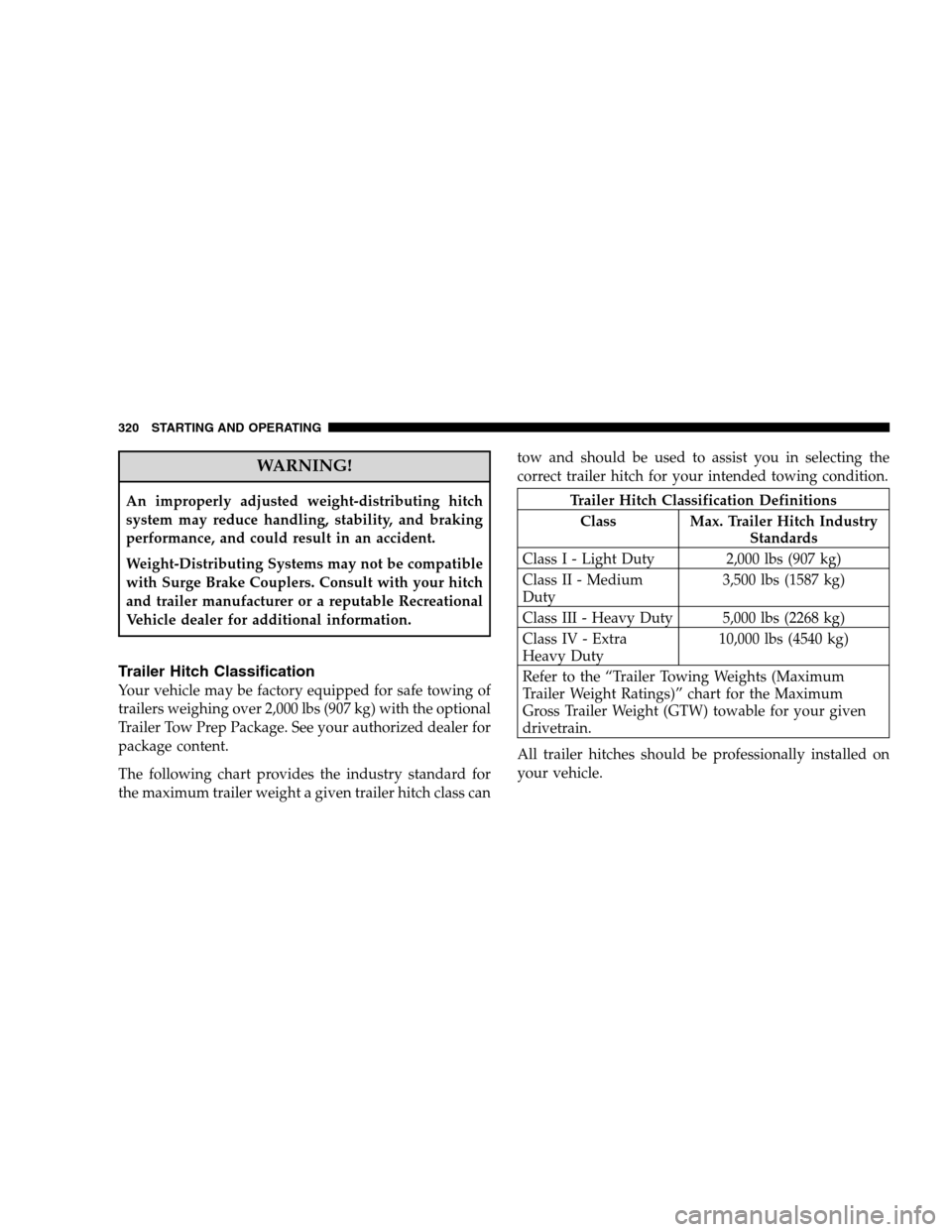
The following chart provides the industry standard for
the maximum trailer weight a given trailer hitch class cantow and should be used to assist you in selecting the
correct trailer hitch for your intended towing condition.
Trailer Hitch Classification Definitions
Class Max. Trailer Hitch Industry
Standards
ClassI-LightDuty 2,000lbs(907 kg)
Class II - Medium
Duty3,500 lbs (1587 kg)
Class III - Heavy Duty 5,000 lbs (2268 kg)
Class IV - Extra
Heavy Duty10,000 lbs (4540 kg)
Refer to the “Trailer Towing Weights (Maximum
Trailer Weight Ratings)” chart for the Maximum
Gross Trailer Weight (GTW) towable for your given
drivetrain.
All trailer hitches should be professionally installed on
your vehicle.
320 STARTING AND OPERATING
Page 328 of 438
CAUTION!
If the trailer weighs more than 1,000 lbs (454 kg)
loaded, it should have its own brakes and they
should be of adequate capacity. Failure to do this
could lead to accelerated brake lining wear, higher
brake pedal effort, and longer stopping distances.
WARNING!
Do not connect trailer brakes to your vehicle’s hy-
draulic brake lines. It can overload your brake sys-
tem and cause it to fail. You might not have brakes
when you need them and could have an accident.
Towing any trailer will increase your stopping dis-
tance. When towing you should allow for additional
space between your vehicle and the vehicle in front
of you. Failure to do so could result in an accident.
Towing Requirements — Trailer Lights and Wiring
Whenever you pull a trailer, regardless of the trailer size,
stop lights and turn signals on the trailer are required for
motoring safety.
The Trailer Tow Package may include a 4- and 7-pin
wiring harness. Use a factory approved trailer harness
and connector.
326 STARTING AND OPERATING
Page 330 of 438
Towing Tips — Automatic Transmission
The automatic transmission fluid and filter should be
changed if you REGULARLY tow a trailer for more than
45 minutes of continuous operation. Refer to the “Main-
tenance Schedule” in Section 8 for transmission fluid
change intervals.
NOTE:Check the automatic transmission fluid level
before towing.
Towing Tips — Electronic Speed Control (If
Equipped)
Don’t use in hilly terrain or with heavy loads.
When using the speed control, if you experience speed
drops greater than 10 mph (16 km/h), disengage until
you can get back to cruising speed.
Use speed control in flat terrain and with light loads to
maximize fuel efficiency.
Towing Tips — Cooling System
To reduce the potential for engine and transmission
overheating, take the following actions:
City Driving
When stopped for short periods of time, put transmission
in NEUTRAL but do not increase engine idle speed.
Highway Driving
Reduce speed.
Air Conditioning
Turn off temporarily.
refer to Cooling System Operating information in the
Maintenance section of this manual for more informa-
tion.
328 STARTING AND OPERATING
Page 335 of 438
the engine cooling system and turning off the A/C
removes this heat. You can also turn the Temperature
control to maximum heat, the Mode control to floor, and
the fan control to HIGH. This allows the heater core to act
as a supplement to the radiator and aids in removing heat
from the engine cooling system.
CAUTION!
Driving with a hot cooling system could damage
your vehicle. If the temperature gauge reads “H”,
pull over when safe and stop the vehicle with the
engine at idle. Turn the air conditioner OFF and wait
until the pointer drops back into the normal range.
After appropriate action has been taken, if the
pointer remains on the “H”, turn the engine OFF
immediately and call for service.
WARNING!
A hot engine cooling system is dangerous. You or
others could be badly burned by steam or boiling
coolant. You may want to call a service center if your
vehicle overheats. If you decide to look under the
hood yourself, refer to “Maintenance”, Section 7 of
this manual. Follow the warnings under the Cooling
System Pressure Cap paragraph.
AUTOMATIC TRANSAXLE OVERHEATING
During sustained high speed driving or trailer towing up
long grades on hot days, the automatic transaxle oil may
become too hot.
If this happens, the transmission overheat indi-
cator light will come on, and the vehicle will
slow slightly until the automatic transaxle cools
down enough to allow a return to the requested speed. If
the high speed is maintained, the overheating will reoccur,
as before, in a cyclic fashion.
WHAT TO DO IN EMERGENCIES 333
6
Page 340 of 438
3. There are two front jacking locations and two rear
jacking locations on each side of the body. The front
locations are outlined by two triangular cutouts, the rear
ones by two rectangular cutouts. For vehicles equipped
with plastic trim, the plastic has been cut away to expose
the jacking locations in the body.
Do not raise the vehicle until you are sure the jack is
securely engaged.
4. Turn the jack screw to the left until the jack can be
placed under the jacking location. Once the jack is
positioned, turn the jack screw to the right until the jack
head is properly engaged with the lift area closest to the
wheel to be changed. Do not raise the vehicle until you
are sure the jack is securely engaged.WARNING!
Raising the vehicle higher than necessary can make
the vehicle less stable. It could slip off the jack and
hurt someone near it. Raise the vehicle only enough
to remove the tire.
5. Raise the vehicle by turning the jack screw to the right,
using the swivel wrench. Raise the vehicle only until the
tire just clears the surface and enough clearance is
obtained to install the spare tire. Minimum tire lift
provides maximum stability.
6. Remove the wheel nuts and pull the wheel (and
bolt-on center cap if equipped) off the hub. Install the
spare wheel and wheel nuts with the cone shaped end of
the nuts toward the wheel. Lightly tighten the nuts. To
avoid the risk of forcing the vehicle off the jack, do not
tighten the nuts fully until the vehicle has been lowered.
338 WHAT TO DO IN EMERGENCIES
Page 343 of 438
WARNING!
Wear eye protection and remove any metal jewelry
such as watch bands or bracelets that might make an
inadvertent electrical contact. You could be seriously
injured.
NOTE: Disconnecting the battery with the ignition in
the ON position will cause vehicles with an automatic
transaxle (CVT2) to go into “default mode” and turn on
the Malfunction Indicator Light (MIL). See your autho-
rized dealer to correct this condition.
1. When boosting from a battery in another vehicle, park
that vehicle within booster cable reach but without
letting the vehicles touch. Set the parking brake, place the
automatic transmission in PARK (the manual transmis-
sion in NEUTRAL) and turn the ignition to OFF for both
vehicles.2. Turn off the heater, radio and all unnecessary electrical
loads.
3. Using the two finger screws on the cover, remove the
air intake duct covering the battery.
4. Connect one end of a jumper cable to the positive
terminal of the booster battery. Connect the other end of
the jumper cable to the positive terminal of the dis-
charged battery.
WHAT TO DO IN EMERGENCIES 341
6
Page 348 of 438
▫Front Suspension Ball Joints..............362
▫Body Lubrication.....................363
▫Windshield Wiper Blades................363
▫Windshield Washer Fluid Reservoir........364
▫Exhaust System......................364
▫Cooling System.......................365
▫Hoses And Vacuum/Vapor Harnesses.......370
▫Fuel System Connections................370
▫Brake System........................371
▫Automatic Transaxle (CVT)..............373
▫Manual Transaxle.....................374
▫Rear Drive Assembly (RDA) – AWD/4WD
Models Only........................375▫Power Transfer Unit (PTU) – AWD/4WD
Models Only........................375
▫Appearance Care And Protection
From Corrosion......................376
�Fuses/Integrated Power Module (IPM).......382
�Vehicle Storage........................385
�Replacement Bulbs......................385
�Bulb Replacement......................386
▫Headlamps..........................386
▫Fog Lights..........................389
▫Tail Lights, Rear Turn Signals And Backup
Lights — Replacement..................389
▫License Lights........................391
▫Center High-Mounted Stoplight...........392
346 MAINTAINING YOUR VEHICLE
Page 349 of 438
▫Auxiliary Off-Road Light................393
�Fluids And Capacities...................395
�Fluids, Lubricants, And Genuine Parts........396▫Engine.............................396
▫Chassis............................397
MAINTAINING YOUR VEHICLE 347
7