2008 INFINITI FX35 engine control system
[x] Cancel search: engine control systemPage 108 of 3924
A/T CONTROL SYSTEMAT-35
< SERVICE INFORMATION >
DE
F
G H
I
J
K L
M A
B
AT
N
O P
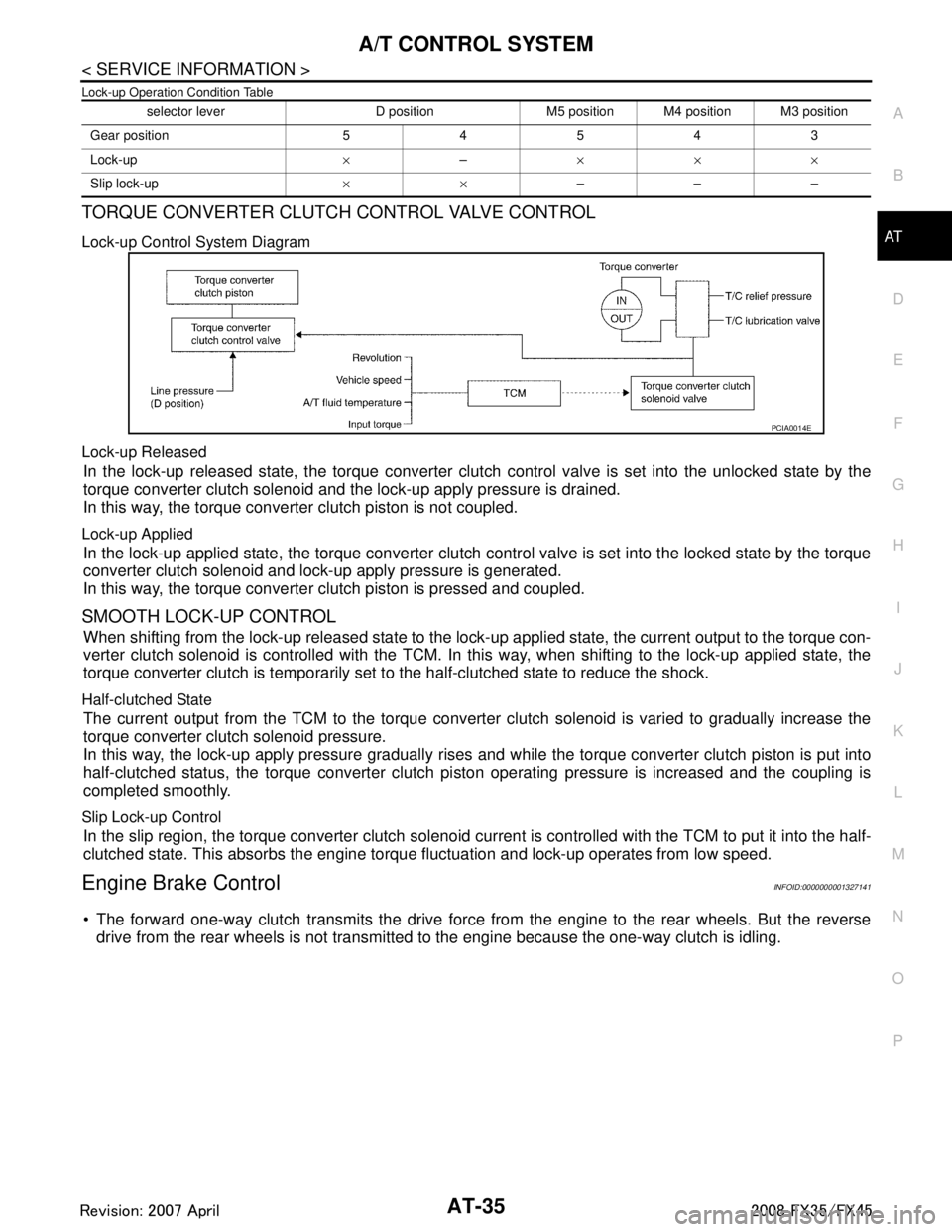
Lock-up Operation Condition Table
TORQUE CONVERTER CLUTCH CONTROL VALVE CONTROL
Lock-up Control System Diagram
Lock-up Released
In the lock-up released state, the torque converter clutch control valve is set into the unlocked state by the
torque converter clutch solenoid and the lock-up apply pressure is drained.
In this way, the torque converter clutch piston is not coupled.
Lock-up Applied
In the lock-up applied state, the torque converter clutch control valve is set into the locked state by the torque
converter clutch solenoid and lock-up apply pressure is generated.
In this way, the torque converter clutch piston is pressed and coupled.
SMOOTH LOCK-UP CONTROL
When shifting from the lock-up released state to the lock- up applied state, the current output to the torque con-
verter clutch solenoid is controlled with the TCM. In this way, when shifting to the lock-up applied state, the
torque converter clutch is temporarily set to the half-clutched state to reduce the shock.
Half-clutched State
The current output from the TCM to the torque converte r clutch solenoid is varied to gradually increase the
torque converter clutch solenoid pressure.
In this way, the lock-up apply pressure gradually rises and while the torque converter clutch piston is put into
half-clutched status, the torque converter clutch pi ston operating pressure is increased and the coupling is
completed smoothly.
Slip Lock-up Control
In the slip region, the torque converter clutch solenoid cu rrent is controlled with the TCM to put it into the half-
clutched state. This absorbs the engine torque fluctuation and lock-up operates from low speed.
Engine Brake ControlINFOID:0000000001327141
The forward one-way clutch transmits the drive force from the engine to the rear wheels. But the reverse
drive from the rear wheels is not transmitted to the engine because the one-way clutch is idling.
selector lever D position M5 position M4 position M3 position
Gear position 54543
Lock-up ×– ×××
Slip lock-up ××–––
PCIA0014E
3AA93ABC3ACD3AC03ACA3AC03AC63AC53A913A773A893A873A873A8E3A773A983AC73AC93AC03AC3
3A893A873A873A8F3A773A9D3AAF3A8A3A8C3A863A9D3AAF3A8B3A8C
Page 109 of 3924
AT-36
< SERVICE INFORMATION >
A/T CONTROL SYSTEM
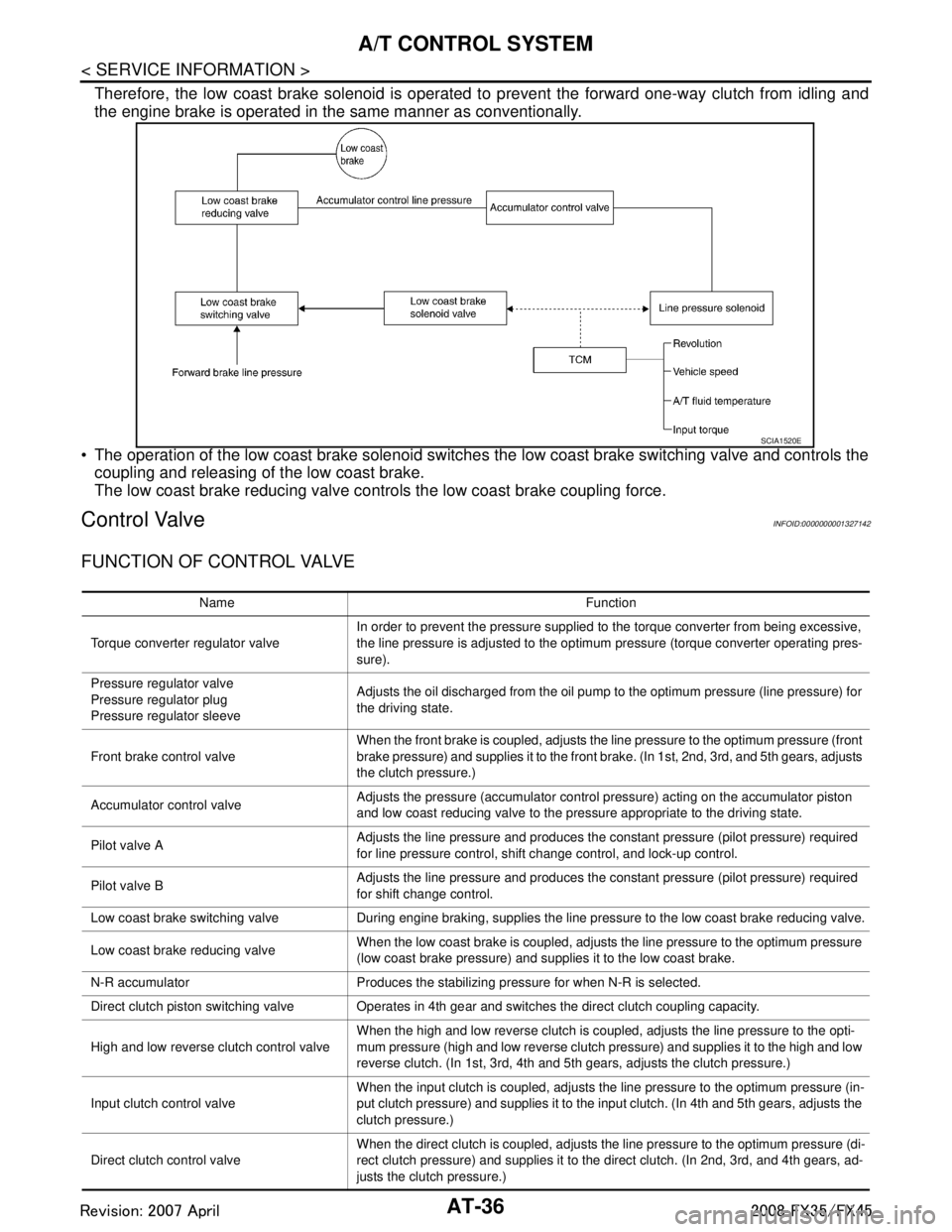
Therefore, the low coast brake solenoid is operated to prevent the forward one-way clutch from idling and
the engine brake is operated in the same manner as conventionally.
The operation of the low coast brake solenoid switches the low coast brake switching valve and controls the
coupling and releasing of the low coast brake.
The low coast brake reducing valve contro ls the low coast brake coupling force.
Control ValveINFOID:0000000001327142
FUNCTION OF CONTROL VALVE
SCIA1520E
Name Function
Torque converter regulator valve In order to prevent the pressure supplied to the torque converter from being excessive,
the line pressure is adjusted to the optimum pressure (torque converter operating pres-
sure).
Pressure regu lator valve
Pressure regulator plug
Pressure regu lator sleeve Adjusts the oil discharged from the oil pump to the optimum pressure (line pressure) for
the driving state.
Front brake control valve When the front brake is coupled, adjusts the line pressure to the optimum pressure (front
brake pressure) and supplies it to the front brake. (In 1st, 2nd, 3rd, and 5th gears, adjusts
the clutch pressure.)
Accumulator control valve Adjusts the pressure (accumulator control pressure) acting on the accumulator piston
and low coast reducing valve to the pressure appropriate to the driving state.
Pilot valve A Adjusts the line pressure and produces the constant pressure (pilot pressure) required
for line pressure control, shift change control, and lock-up control.
Pilot valve B Adjusts the line pressure and produces the constant pressure (pilot pressure) required
for shift change control.
Low coast brake switching valve During engine braking, supplies the line pressure to the low coast brake reducing valve.
Low coast brake reducing valve When the low coast brake is coupled, adjusts the line pressure to the optimum pressure
(low coast brake pressure) and supplies it to the low coast brake.
N-R accumulator Produces the stabilizing pressure for when N-R is selected.
Direct clutch piston switching valve Operates in 4th ge ar and switches the direct clutch coupling capacity.
High and low reverse clutch control valve When the high and low reverse clutch is coupled, adjusts the line pressure to the opti-
mum pressure (high and low reverse clutch pressure) and supplies it to the high and low
reverse clutch. (In 1st, 3rd, 4th and 5th gears, adjusts the clutch pressure.)
Input clutch control valve When the input clutch is coupled, adjusts the line pressure to the optimum pressure (in-
put clutch pressure) and supplies it to the input clutch. (In 4th and 5th gears, adjusts the
clutch pressure.)
Direct clutch control valve When the direct clutch is coupled, adjusts the line pressure to the optimum pressure (di-
rect clutch pressure) and supplies it to the direct clutch. (In 2nd, 3rd, and 4th gears, ad-
justs the clutch pressure.)
3AA93ABC3ACD3AC03ACA3AC03AC63AC53A913A773A893A873A873A8E3A773A983AC73AC93AC03AC3
3A893A873A873A8F3A773A9D3AAF3A8A3A8C3A863A9D3AAF3A8B3A8C
Page 114 of 3924

TROUBLE DIAGNOSISAT-41
< SERVICE INFORMATION >
DE
F
G H
I
J
K L
M A
B
AT
N
O P
TROUBLE DIAGNOSIS
DTC Inspection Priority ChartINFOID:0000000001327148
If some DTCs are displayed at the same time, per form inspections one by one based on the following priority
chart.
NOTE:
If “DTC U1000” is displayed with other DTCs, fi rst perform the trouble diagnosis for “DTC U1000 CAN
COMMUNICATION”. Refer to AT- 9 4
.
Fail-SafeINFOID:0000000001327149
The TCM has an electrical fail-safe mode. This mode make s it possible to operate even if there is an error in a
main electronic control input/output signal circuit.
In fail-safe mode, even if the selector lever is “D” or “M” mode, the transmission is fixed in 2nd, 4th or 5th
(depending on the breakdown position), so the customer should feel “slipping” or “poor acceleration”.
Even when the electronic circuits are normal, under s pecial conditions (for example, when slamming on the
brake with the wheels spinning drastically and stopping the ti re rotation), the transmission can go into fail-safe
mode. If this happens, switch OFF the ignition switch for 10 seconds, then switch it ON again to return to the
normal shift pattern. Therefore, t he customer's vehicle has returned to normal, so handle according to the
“WORK FLOW” (Refer to AT- 4 2
).
FAIL-SAFE FUNCTION
If any malfunction occurs in a sensor or solenoid, th is function controls the A/T to mark driving possible.
Vehicle Speed Sensor
Signals are input from two systems - from vehicle speed sensor A/T (revolution sensor) installed on the trans-
mission and from combination meter so normal driving is possible even if there is a malfunction in one of the
systems. And if vehicle speed sens or A/T (revolution sensor) has unus ual cases, 5th gear and manual mode
are prohibited.
Accelerator Pedal Position Sensor
If there is a malfunction in one of the systems, the accelerator opening angle is controlled by ECM according
to a pre-determined accelerator angle to make driving po ssible. And if there are malfunctions in tow systems,
the engine speed is fixed by ECM to a pre-determined engine speed to make driving possible.
Throttle Position Sensor
If there is a malfunction in one of the systems, the accelerator opening angle is controlled by ECM according
to a pre-determined accelerator angle to make driving po ssible. And if there are malfunctions in tow systems,
the accelerator opening angle is controlled by the idle signal sent from the ECM which is based on input indi-
cating either idle condition or off-idle condition (pre- determined accelerator opening) in order to make driving
possible.
PNP Switch
In the unlikely event that a malfunction signal enters t he TCM, the position indicator is switched OFF, the
starter relay is switched OFF (starter starting is di sabled), the back-up lamp relay switched OFF (back-up lamp
is OFF) and the position is fixed to the “D” position to make driving possible.
Starter Relay
The starter relay is switched OFF. (Starter starting is disabled.)
A/T Interlock
If there is an A/T interlock judgment malfunction, t he A/T is fixed in 2nd gear to make driving possible.
NOTE:
When the vehicle is driven fixed in 2nd gear, a turbine revolution sensor malfunction is displayed,
but this is not a turbine r evolution sensor malfunction.
When the coupling pattern below is detected, the fail- safe action corresponding to the pattern is performed.
A/T 1st Engine Braking
Priority Detected items (DTC)
1 U1000 CAN communication line
2 Except above
3AA93ABC3ACD3AC03ACA3AC03AC63AC53A913A773A893A873A873A8E3A773A983AC73AC93AC03AC3
3A893A873A873A8F3A773A9D3AAF3A8A3A8C3A863A9D3AAF3A8B3A8C
Page 115 of 3924

AT-42
< SERVICE INFORMATION >
TROUBLE DIAGNOSIS
When there is an A/T first gear engine brake judgment malfunction, the low coast brake solenoid is switched
OFF to avoid the engine brake operation.
Line Pressure Solenoid
The solenoid is switched OFF and the line pressure is set to the maximum hydraulic pressure to make driving
possible.
Torque Converter Clutch Solenoid
The solenoid is switched OFF to release the lock-up.
Low Coast Brake Solenoid
When a malfunction (electrical or functional) occurs, in or der to make driving possible, if the solenoid is ON,
the transmission is held in 2nd gear; if the solenoid is OFF, the A/T is held in 4th gear. (Engine brake is not
applied in 1st and 2nd gear.)
Input Clutch Solenoid
If a malfunction (electrical or functi onal) occurs with the solenoid either ON or OFF, the A/T is held in 4th gear
to make driving possible.
Direct Clutch Solenoid
If a malfunction (electrical or functi onal) occurs with the solenoid either ON or OFF, the A/T is held in 4th gear
to make driving possible.
Front Brake Solenoid
If a malfunction (electrical or functi onal) occurs with the solenoid ON, in order to make driving possible, the A/
T is held in 5th gear; if the solenoid is OFF, 4th gear.
High and Low Reverse Clutch Solenoid
If a malfunction (electrical or functi onal) occurs with the solenoid either ON or OFF, the A/T is held in 4th gear
to make driving possible.
Turbine Revolution Sensor 1 or 2
The control is the same as if there were no turbi ne revolution sensors, 5th gear and manual mode are prohib-
ited.
How to Perform Trouble Diagnosis for Quick and Accurate RepairINFOID:0000000001327150
INTRODUCTION
The TCM receives a signal from the vehicle speed sensor , accelerator pedal position sensor (throttle position
sensor) or PNP switch and provides shift cont rol or lock-up control via A/T solenoid valves.
The TCM also communicates with the ECM by means of a signal
sent from sensing elements used with the OBD-related parts of the
A/T system for malfunction-diagnos tic purposes. The TCM is capa-
ble of diagnosing malfunctioning parts while the ECM can store mal-
functions in its memory.
Input and output signals must always be correct and stable in the
operation of the A/T system. The A/T system must be in good oper-
ating condition and be free of valve seizure, solenoid valve malfunc-
tion, etc.
It is much more difficult to diagnose a error that occurs intermittently
rather than continuously. Most inte rmittent errors are caused by poor
electric connections or improper wiring. In this case, careful check-
ing of suspected circuits may help prevent the replacement of good
parts.
A visual check only may not find the cause of the errors. A road test
with CONSULT-III (or GST) or a circuit tester connected should be
performed. Follow the "WORK FLOW".
SAT631IB
SAT632I
3AA93ABC3ACD3AC03ACA3AC03AC63AC53A913A773A893A873A873A8E3A773A983AC73AC93AC03AC3
3A893A873A873A8F3A773A9D3AAF3A8A3A8C3A863A9D3AAF3A8B3A8C
Page 140 of 3924

TROUBLE DIAGNOSISAT-67
< SERVICE INFORMATION >
DE
F
G H
I
J
K L
M A
B
AT
N
O P
23
Slips/Will
Not En-
gage Vehicle cannot be
started from D
1.
Refer to AT- 1 8 0 , "
Ve-
hicle Cannot Be Start-
ed from D1". ON vehicle
1. A/T fluid level and state
AT- 4 9
2. Accelerator pedal position sensorAT- 1 3 0
3. Line pressure test AT- 4 9
4. CAN communication lineAT- 9 4
5. Control valve with TCMAT- 2 1 5
OFF vehicle6. Torque converter
AT- 2 6 7
7. Oil pump assemblyAT- 2 8 5
8. 3rd one-way clutchAT- 2 8 7
9. 1st one-way clutch AT- 2 9 5
10. Gear systemAT- 2 4 9
11. Reverse brakeAT- 2 6 7
12. Forward one-way clutch (Parts behind drum support is im-
possible to perform inspection by disassembly. Refer to AT-
16, "Cross-Sectional View (2WD Models)", AT- 1 7 , "Cross-
Sectional View (VQ35DE Models for AWD)" or AT- 1 8 , "Cross-
Sectional View (VK45DE Models for AWD)") AT- 2 6 7
13. Forward brake (Parts behind drum support is impossible
to perform inspection by disassembly. Refer to
AT- 1 6 , "
Cross-
Sectional View (2WD Models)", AT- 1 7 , "Cross-Sectional View
(VQ35DE Models for AWD)" or AT- 1 8 , "Cross-Sectional View
(VK45DE Models for AWD)") AT- 2 6 7
24
Does not lock-up.
Refer to
AT- 1 9 0 , "A/T
Does Not Lock-up".ON vehicle 1. A/T fluid level and state
AT- 4 9
2. Line pressure testAT- 4 9
3. Engine speed signalAT- 11 2
4. Turbine revolution sensorAT- 1 0 6
5. Torque converter clutch solenoid valveAT- 1 2 4
6. CAN communication line AT- 9 4
7. Control valve with TCMAT- 2 1 5
OFF vehicle8. Torque converter
AT- 2 6 79. Oil pump assemblyAT- 2 8 5
25Does not hold lock-up
condition.
Refer to
AT- 1 9 2 , "A/T
Does Not Hold Lock-
up Condition". ON vehicle 1. A/T fluid level and state
AT- 4 9
2. Line pressure testAT- 4 9
3. Engine speed signalAT- 11 2
4. Turbine revolution sensorAT- 1 0 6
5. Torque converter clutch solenoid valveAT- 1 2 4
6. CAN communication line AT- 9 4
7. Control valve with TCMAT- 2 1 5
OFF vehicle8. Torque converter
AT- 2 6 79. Oil pump assemblyAT- 2 8 5
No. Items Symptom Condition Diagnostic Item Reference
page
3AA93ABC3ACD3AC03ACA3AC03AC63AC53A913A773A893A873A873A8E3A773A983AC73AC93AC03AC3
3A893A873A873A8F3A773A9D3AAF3A8A3A8C3A863A9D3AAF3A8B3A8C
Page 141 of 3924

AT-68
< SERVICE INFORMATION >
TROUBLE DIAGNOSIS
26Slips/Will
Not En-
gage Lock-up is not re-
leased.
Refer to
AT- 1 9 4 ,
"Lock-up Is Not Re-
leased". ON vehicle1. A/T fluid level and state
AT- 4 9
2. Line pressure testAT- 4 9
3. Engine speed signalAT- 11 2
4. Turbine revolution sensorAT- 1 0 6
5. Torque converter clutch solenoid valveAT- 1 2 4
6. CAN communication line AT- 9 4
7. Control valve with TCMAT- 2 1 5
OFF vehicle8. Torque converter
AT- 2 6 79. Oil pump assemblyAT- 2 8 5
27No shock at all or the
clutch slips when vehi-
cle changes speed D1
→ D
2 or M1 → M2. ON vehicle
1. A/T fluid level and state
AT- 4 9
2. Vehicle speed sensor A/T and vehicle speed sensor MTRAT- 1 0 8,
AT- 1 3 7
3. Direct clutch solenoid valve AT- 1 4 7
4. CAN communication line AT- 9 4
5. Line pressure testAT- 4 9
6. Control valve with TCMAT- 2 1 5
OFF vehicle7. Torque converter
AT- 2 6 7
8. Oil pump assemblyAT- 2 8 5
9. 3rd one-way clutchAT- 2 8 7
10. Gear systemAT- 2 4 9
11. Direct clutchAT- 3 0 3
12. Forward brake (Parts behind drum support is impossible
to perform inspection by disassembly. Refer to AT- 1 6 , "
Cross-
Sectional View (2WD Models)", AT- 1 7 , "Cross-Sectional View
(VQ35DE Models for AWD)" or AT- 1 8 , "Cross-Sectional View
(VK45DE Models for AWD)") AT- 2 6 7
No. Items Symptom Condition Diagnostic Item
Reference
page
3AA93ABC3ACD3AC03ACA3AC03AC63AC53A913A773A893A873A873A8E3A773A983AC73AC93AC03AC3
3A893A873A873A8F3A773A9D3AAF3A8A3A8C3A863A9D3AAF3A8B3A8C
Page 143 of 3924

AT-70
< SERVICE INFORMATION >
TROUBLE DIAGNOSIS
30Slips/Will
Not En-
gage No shock at all or the
clutch slips when vehi-
cle changes speed D4
→ D
5 or M4 → M5. ON vehicle
1. A/T fluid level and state
AT- 4 9
2. Vehicle speed sensor A/T and vehicle speed sensor MTRAT- 1 0 8,
AT- 1 3 7
3. Front brake solenoid valve AT- 1 4 5
4. Direct clutch solenoid valveAT- 1 4 7
5. CAN communication line AT- 9 4
6. Line pressure testAT- 4 9
7. Control valve with TCMAT- 2 1 5
OFF vehicle8. Torque converter
AT- 2 6 7
9. Oil pump assemblyAT- 2 8 5
10. Front brake (brake band)AT- 2 6 7
11. Input clutchAT- 2 8 9
12. Gear systemAT- 2 4 9
13. High and low reverse clutchAT- 3 0 1
31When you press the
accelerator pedal and
shift speed D5
→ D4 or
M5 → M4 the engine
idles or the A/T slips. ON vehicle
1. A/T fluid level and state
AT- 4 9
2. Vehicle speed sensor A/T and vehicle speed sensor MTRAT- 1 0 8,
AT- 1 3 7
3. Front brake solenoid valve AT- 1 4 5
4. Direct clutch solenoid valveAT- 1 4 7
5. CAN communication line AT- 9 4
6. Line pressure testAT- 4 9
7. Control valve with TCMAT- 2 1 5
OFF vehicle8. Torque converter
AT- 2 6 7
9. Oil pump assemblyAT- 2 8 5
10. Input clutchAT- 2 8 9
11. Gear systemAT- 2 4 9
12. High and low reverse clutchAT- 3 0 1
13. Direct clutchAT- 3 0 3
No. Items Symptom Condition Diagnostic Item Reference
page
3AA93ABC3ACD3AC03ACA3AC03AC63AC53A913A773A893A873A873A8E3A773A983AC73AC93AC03AC3
3A893A873A873A8F3A773A9D3AAF3A8A3A8C3A863A9D3AAF3A8B3A8C
Page 145 of 3924

AT-72
< SERVICE INFORMATION >
TROUBLE DIAGNOSIS
34Slips/Will
Not En-
gage When pressing the ac-
celerator pedal and
shifting speed D2
→
D
1 or M2 → M1 the
engine idles or the A/T
slips. ON vehicle
1. A/T fluid level and state
AT- 4 9
2. Vehicle speed sensor A/T and vehicle speed sensor MTRAT- 1 0 8,
AT- 1 3 7
3. Direct clutch solenoid valve AT- 1 4 7
4. CAN communication line AT- 9 4
5. Line pressure testAT- 4 9
6. Control valve with TCMAT- 2 1 5
OFF vehicle7. Torque converter
AT- 2 6 7
8. Oil pump assemblyAT- 2 8 5
9. 3rd one-way clutchAT- 2 8 7
10. 1st one-way clutchAT- 2 9 5
11. Gear systemAT- 2 4 9
12. Reverse brakeAT- 2 6 7
13. Forward one-way clutch (Parts behind drum support is im-
possible to perform inspection by disassembly. Refer to AT-
16, "Cross-Sectional View (2WD Models)", AT- 1 7 , "Cross-
Sectional View (VQ35DE Models for AWD)" or AT- 1 8 , "Cross-
Sectional View (VK45DE Models for AWD)") AT- 2 6 7
14. Forward brake (Parts behind drum support is impossible
to perform inspection by disassembly. Refer to
AT- 1 6 , "
Cross-
Sectional View (2WD Models)", AT- 1 7 , "Cross-Sectional View
(VQ35DE Models for AWD)" or AT- 1 8 , "Cross-Sectional View
(VK45DE Models for AWD)") AT- 2 6 7
35
With selector lever in
“D” position, accelera-
tion is extremely poor. ON vehicle
1. A/T fluid level and state
AT- 4 9
2. Line pressure testAT- 4 9
3. Accelerator pedal position sensorAT- 1 3 0
4. CAN communication line AT- 9 4
5. PNP switchAT- 1 0 2
6. A/T positionAT- 2 0 7
7. Control valve with TCMAT- 2 1 5
OFF vehicle8. Torque converter
AT- 2 6 7
9. Oil pump assemblyAT- 2 8 5
10. 1st one-way clutchAT- 2 9 5
11. Gear systemAT- 2 4 9
12. Reverse brakeAT- 2 6 7
13. Forward one-way clutch (Parts behind drum support is im-
possible to perform inspection by disassembly. Refer to AT-
16, "Cross-Sectional View (2WD Models)", AT- 1 7 , "Cross-
Sectional View (VQ35DE Models for AWD)" or AT- 1 8 , "Cross-
Sectional View (VK45DE Models for AWD)") AT- 2 6 7
14. Forward brake (Parts behind drum support is impossible
to perform inspection by disassembly. Refer to
AT- 1 6 , "
Cross-
Sectional View (2WD Models)", AT- 1 7 , "Cross-Sectional View
(VQ35DE Models for AWD)" or AT- 1 8 , "Cross-Sectional View
(VK45DE Models for AWD)") AT- 2 6 7
No. Items Symptom Condition Diagnostic Item
Reference
page
3AA93ABC3ACD3AC03ACA3AC03AC63AC53A913A773A893A873A873A8E3A773A983AC73AC93AC03AC3
3A893A873A873A8F3A773A9D3AAF3A8A3A8C3A863A9D3AAF3A8B3A8C