Page 270 of 329
Replace your tires with radial tires of
the same size, load range, speed
rating, and maximum cold tire
pressure rating (as shown on the
tire’s side wall).
Mixing radial and bias-ply tires on
your vehicle can reduce braking
ability, traction, and steering
accuracy. Using tires of a dif f erent
size or construction can cause the
anti-lock brake and the vehicle
stability assist systems to work
inconsistently.
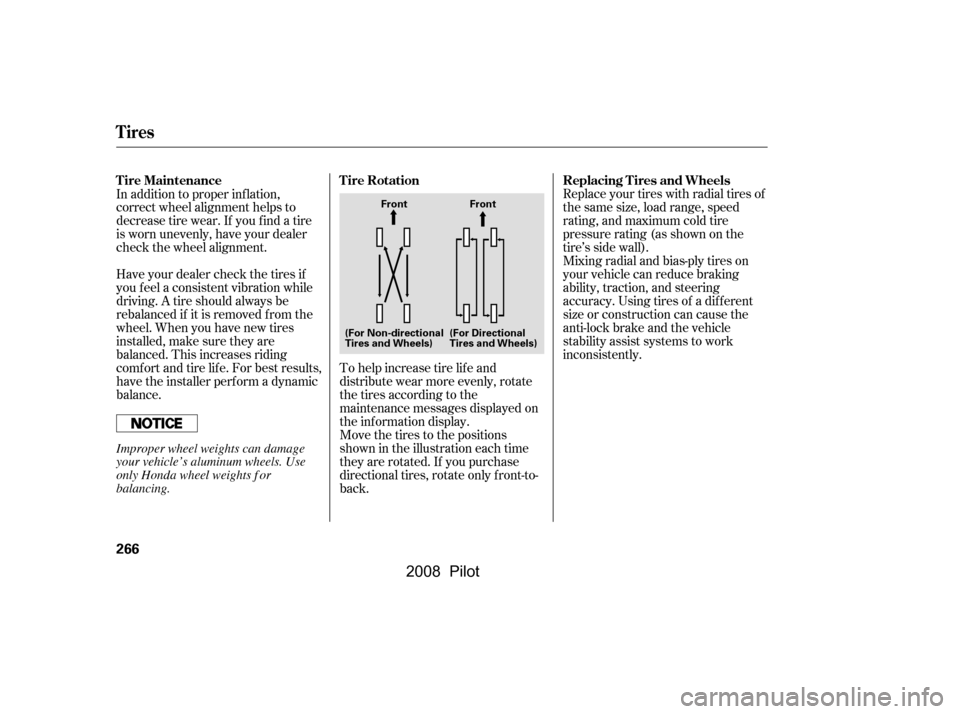
To help increase tire lif e and
distribute wear more evenly, rotate
the tires according to the
maintenance messages displayed on
the information display.
Move the tires to the positions
shown in the illustration each time
they are rotated. If you purchase
directional tires, rotate only f ront-to-
back.
In addition to proper inf lation,
correct wheel alignment helps to
decrease tire wear. If you f ind a tire
is worn unevenly, have your dealer
check the wheel alignment.
Have your dealer check the tires if
you f eel a consistent vibration while
driving. A tire should always be
rebalanced if it is removed f rom the
wheel. When you have new tires
installed, make sure they are
balanced. This increases riding
comf ort and tire lif e. For best results,
have the installer perform a dynamic
balance.
Tires
Replacing T ires and Wheels
Tire Rotation
T ire Maintenance
266
(For Non-directional
Tires and Wheels) (For Directional
Tires and Wheels)
Front Front
Improper wheel weights can damage
your vehicle’s aluminum wheels. Use
only Honda wheel weights f or
balancing.
�\f���—�\f���—�\f���y�
�
�����������y���
�(���+�����\f�y�\f�����
�y
2008 Pilot
Page 287 of 329

To check if they are set, turn the
ignition switch to the ON (II)
position without starting the engine.
The malf unction indicator lamp will
come on f or 20 seconds. If it then
goes of f , the readiness codes are set.
If it blinks 5 times, the readiness
codes are not set. If possible, do not
take your vehicle for a state
emissions test until the readiness
codes are set. Ref er tof or more inf ormation (see
page ).
If this indicator comes on
while driving, it means one
of the engine’s emission control
systems may have a problem. Even
though you may f eel no dif f erence in
your vehicle’s perf ormance,
continued operation may cause
serious damage.
If the malf unction indicator lamp
comes on along with the ‘‘D’’
indicator, there is a problem in the
automatic transmission control
system.
Your vehicle has certain ‘‘readiness
codes’’ that are part of the on-board
diagnostics f or the emissions
systems. In some states, part of the
emissions testing is to make sure
these codes are set. If they are not
set, the test cannot be completed.
If you have recently ref ueled your
vehicle, the indicator coming on
could be due to a loose or missing
f uel f ill cap. You will also see a
‘‘CHECK FUEL CAP’’ message on
the inf ormation display. Tighten the
cap until it clicks at least once.
Tightening the cap will not turn the
indicator of f immediately; it can take
several days of normal driving.
If the indicator comes on repeatedly,
even though it may turn of f as you
continue driving, have your vehicle
checked by your dealer as soon as
possible. If the battery in your vehicle has
been disconnected or gone dead,
thesecodesmaybeerased.Ittakes
several days of driving under various
conditions to set the codes again.
305 Emissions
Testing
Readiness Codes
Malf unction Indicator L amp
T aking Care of t he Unexpect ed
283
If you keep driving with the
malf unction indicator lamp on, you can
damage your vehicle’s emissions
controls and the engine. Those repairs
may not be covered by your vehicle’s
warranties.
�\f���—�\f���—�\f���y�
�
����
������y���
�(���+�����\f�y�\f�������y
2008 Pilot
Page 292 of 329

If you cannot drive the vehicle
without f ixing the problem, and you
do not have a spare fuse, take a fuse
of the same rating or a lower rating
f rom one of the other circuits. Make
sureyoucandowithoutthatcircuit
temporarily (such as the accessory
power socket or radio).
If you replace the blown f use with a
spare f use that has a lower rating, it
might blow out again. This does not
indicate anything wrong. Replace the
f use with one of the correct rating as
soon as you can.If the replacement fuse of the
same rating blows in a short time,
there is probably a serious
electrical problem with your
vehicle. Leave the blown fuse in
that circuit, and have your vehicle
checked by a qualif ied technician.
If a trailer light is burned out, check
if these f uses are blown when you
replace the light bulbs:
If thosefusesareOK,butthetrailer
lights still do not work, there are two
blown 7.5 amp f uses in the trailer
hitch wiring. To access the 7.5 amp
f uses:
Open the tailgate and remove the
cargo f loor lid.
Pull out the bottom of the tailgate
rubber seal.
Remove rear trim panel by pulling
up on the inside edge of the rear
trim panel, and unhooking the f our
clips and tabs.
Af ter replacing f uses, and reinstall
the rear trim panel in the reverse
order of removal.
Primary under-hood f use box
fuses5,7,and24
Interior driver’s side f use box: 10
Interior passenger’s side f use box:
10
If the radio f use is removed, the
audio system will disable itself . The
nexttimeyouturnontheradioyou
will see ‘‘ENTER CODE’’ in the
f requency display. Use the preset
buttons to enter the digit code (see
page ).
If the driver’s power window f use is
removed, the AUTO function of the
driver’s window may be disabled.
You should reset the AUTO f eature,
(see page ).
6.
1.
2.
3.
4.
95
141
Except f or LX models
Trailer Fuses
Fuses
288
Replacing a f use with one that has a
higher rating greatly increases the
chances of damaging the electrical
system. If you do not have a
replacement f use with the proper rating
f or the circuit, install one with a lower
rating.
�\f���—�\f���—�\f���y�
�
���������
�y���
�(���+�����\f�y�\f�������y
2008 Pilot
Page 305 of 329
�µ
Always check the TPMS malf unction
telltale af ter replacing one or more
tires or wheels on your vehicle to
ensure that the replacement or
alternate tires and wheels allow the
TPMS to continue to f unction
properly.
Your vehicle has also been equipped
with a TPMS malf unction indicator
to indicate when the system is not
operating properly. The TPMS
malf unction indicator is provided by
a separate telltale, which displays the
symbol ‘‘TPMS’’ when illuminated.
When the malf unction indicator is
illuminated,
the system may not be able to detect
or signal low tire pressure as
intended.
TPMS malf unctions may occur f or a
variety of reasons, including the
installation of replacement or
alternate tires or wheels on the
vehicle that prevent the TPMS f rom
f unctioning properly.
Tire Pressure Monitoring System (TPMS) Required Federal Explanation
Technical Inf ormation
301
�\f���—�\f���—�\f���y�
�
�����������y���
�(���+�����\f�y�\f���\f���y
2008 Pilot