2008 GREAT WALL FLORID ect
[x] Cancel search: ectPage 90 of 281

Downloaded from www.Manualslib.com manuals search engine 83Suspension System
(d) On the press, use SST (Special Service Tools) to press
the new lower swing arm's small shaft sleeve into the
correct position.
F
SST
SST
Page 91 of 281

Downloaded from www.Manualslib.com manuals search engine GWFLORID Maintenance Manual84
Drive Shaft
Components
Drive shaft removal
1. First use a M32 sleeve, ratchet wrench, and extension
bar, to remove front drive shaft nut LH. Then, according
t o t h e w h e e l a n d f r o n t s u s p e n s i o n d i s a s s e m b l y
specifications, remove the Front suspension system
LH and wheel.
2. Then use a pry bar to forcefully pry the connection
between the differential and the drive shaft until the
drive shaft obviously moves towards the outside. Do
not damage the drive shaft's dust cover.
Front shock absorber with coil spring assembly LH
Front drive shaft nut LH
Wheel assembly
Front drive shaft assembly LHTransmission assembly
F
F
Page 92 of 281

Downloaded from www.Manualslib.com manuals search engine 85Suspension System
Drive shaft installation
1. Insert the drive shaft.
First, align the inner end of the drive shaft and differential
spline. Keep the drive shaft axes and the differential axes
bases uniform, then hammer towards the direction of the
differential drive shaft's outer end until a clear and sharp
clicking sound is heard. Here, the drive shaft and the
transmission should have a clearance of about 1 mm.
2. According to the front suspension and wheel assembly
installation specifications, properly install the front
shock absorber with coil spring assembly LH and
wheel.
3. Use an M32 sleeve, ratchet wrench, and extension bar
to tighten front drive shaft nut LH.
Tightening torque: 225±20 N·m
F
F
Page 94 of 281

Downloaded from www.Manualslib.com manuals search engine 87Suspension System
Inspection, installation, and removal of the
trailing arm spindle sleeve assembly
1. Trailing arm spindle sleeve inspection.
(a) Inspect the trailing arm spindle sleeve for deformities,
shifting, partial or serious cracks, or loosening.
(b) If any existing damage of the trailing arm spindle
sleeve is not clearly seen, take the following steps:
Wash the trailing arm spindle sleeve's rubber areas with
clean water. Rub it clean with cotton meanwhile (shown
on the left). Check and make sure the rubber surface has
none of the previously mentioned flaws. If it does, re-
place with a new trailing arm spindle sleeve assembly.
2. Trailing arm spindle sleeve removal.
(a) Use a white paint pen to mark, and remember the trail-
ing arm spindle sleeve assembly direction.
(b) T h e t r a i l i n g a r m s p i n d l e s l e e v e i s d i s p o s a b l e . I f
damaged, first use a pry bar to lift up the edge of the
trailing arm spindle sleeve's outer tube in order to
install the SST (Special Service Tools).
Rear twist beam assembly removal
1. Hold up the rear twist beam assembly with a lift, and
remove the rear shock absorber and rear coil spring.
For detailed steps, refer to the rear shock absorber and
coil spring removal.
2. Remove the hexagon bolt for flange face
Q151B12110TF2 + Q402 (d2=35 t=5) FD, and slowly
set down the twist beam (as shown on the left).
Tightening torque: 77-87 N·m
When removing bolts, check and ensure that the rear
twist beam is reliably supported, to avoid injury from it
falling.
4. Remove the rear shock absorber.
Screw down the hexagon nut for flange face Q32012T13F2
(M12×1.25) FD linking the rear shock absorber and rear
twist beam, and remove the rear shock absorber. Make sure
the rear twist beam is firmly supported meanwhile.
Tightening torque: 44-54 N·m
5. Remove the coil spring.
Slowly release the firmly supported rear twist beam, at
the same time support the coil spring, until the coil spring
loosens, then take it down.
Rear shock absorber
Large washer
Hexagon nut for flange face
Page 95 of 281
Downloaded from www.Manualslib.com manuals search engine GWFLORID Maintenance Manual88
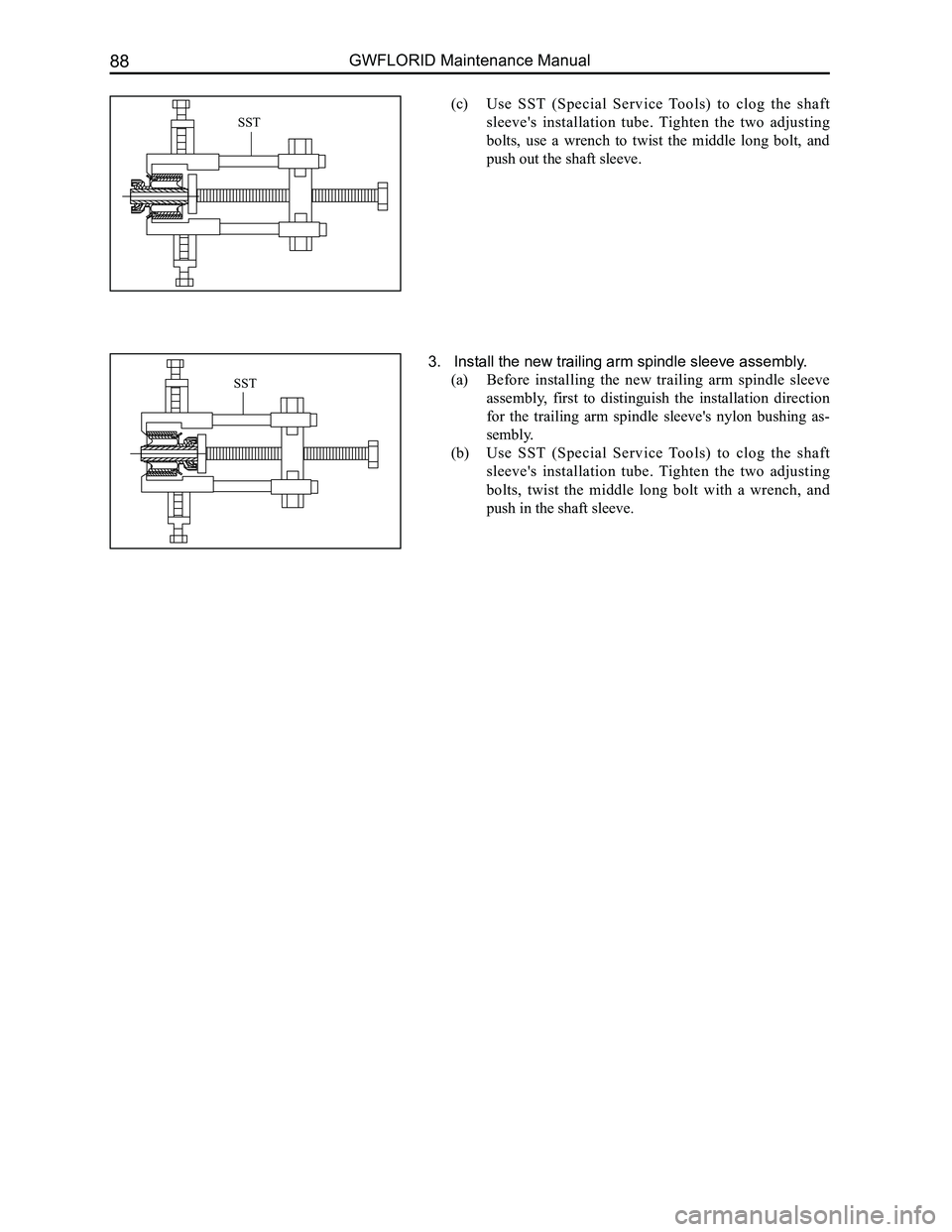
(c) Use SST (Special Service Tools) to clog the shaft
sleeve's installation tube. Tighten the two adjusting
bolts, use a wrench to twist the middle long bolt, and
push out the shaft sleeve.
SST
3. Install the new trailing arm spindle sleeve assembly.
(a) Before installing the new trailing arm spindle sleeve
assembly, first to distinguish the installation direction
for the trailing arm spindle sleeve's nylon bushing as-
sembly.
(b) Use SST (Special Service Tools) to clog the shaft
sleeve's installation tube. Tighten the two adjusting
bolts, twist the middle long bolt with a wrench, and
push in the shaft sleeve.
SST
Page 96 of 281

Downloaded from www.Manualslib.com manuals search engine 89Suspension System
Wheel and Tire
Tire
Remark
This vehicle's tire is of the tubeless type. The optimal design condition is met when the inflation pressure is at
the recommended value, and the tire is under full load. Maintaining suitable tire pressure and proper driving
habits greatly influence the tire's use life. For the vehicle, it improves riding comfort, stability, and handling. For
the tire, it reduces tread wear, damage to the tire and extends tire life. Overloading, speeding, and unnecessary
emergency braking will all add to the tire's wear and tear.
Tire pressure measurements should be taken under normal temperature. If the tire pressure rises due to motion
generated heat when driving, cooling it will return to the normal temperature. Therefore, do not deflate the tire
when the air pressure has risen to this point. The tire's air pressure will naturally and slowly decrease when used
under normal conditions. Hence please inspect the air pressure regularly (suggested once a month). The spare
tire should be kept in a useable condition at all times.
Inspect the tire pressure when it is cool monthly or before a long drive. Adjust the tire pressure to the recom-
mended level. The air pressure will normally rise because the tire warms up due to movement. Therefore, after
driving, you absolutely must not deflate or reduce the tire's air pressure, as deflating could reduce the cool tire's
air pressure.
Tire inflation
During a new tire's initial stage of use, warning due to bending motions will cause the tire to swell, and thus
reduce the corresponding air pressure. After 24 hours or 2000-3000 km worth of drive, charge the air pressure.
After inflating, check if the air nozzle core is leaking air with soapy \
water, then lock on the cap.
Possible problems caused by tire pressure
Exceeding the recommended air
pressure
Below the recommended air pressureSame vehicle axle, different
air pressure
Possible problems it
can create
1. Bumpy ride
2. The tear or rupturing of the tire
3. Rapid wear of the tire tread's center
1. Noisy turns
2. Uneasy turns
3. Tread edge wear is accelerated and uneven
4. The tire's rim is damaged or ruptured
5. The tire cord ruptures
6. High tire temperature
7. Steering failure
8. Large oil consumption
1. Uneven braking
2. Over steering
3. Steering failure
4. Deviation while accelerating
Tire and wheel (steel wheel) installation instructions
When installing the tire and wheel, the tire's radial hardware components, also called "high spot", should be at
the same level of the wheel's minimum radius or so called "low spot".
The "high spot" of the tire is initially marked by the paint spot on the side of the tire's surface. This paint will
eventually be washed away.
The "low spot" of the wheel is initially marked by a paint spot on the wheel flange. Whenever the tire is
removed from the wheel, the tire and wheel need re-balancing to make sure the vehicle runs smoothly. If no
paint spot is found on the tire, draw a line on the tire and the wheel before they are removed, in order to make
sure that the tire and the wheel will be re-assembled at the same place.\
Tire replacement
When a tire needs to be replaced, make sure to use a tire with the same specification as the original one. A new
tire used for replacement must be of the same dimension, load area, and structure as the original one. Using tires
that are different in dimension or type will influence the vehicle's riding comfort, handling, speedometer and
odometer calibration, vehicle ground clearance, and the clearance between the tire or the tire's snow chain and
the vehicle body or chassis.
It is suggested to use a new pair of tires on the same axle. If only one tire is needed to be replaced, make sure to
use a tire with a tread most similar to the original, so as to keep brak\
e power and traction balanced.
Warning: Do not mix radial tires, bias tires, bias belted tires, etc., which are of different structure on the
same vehicle unless it is an emergency. Mixing different tires would seriously influence the vehicle's
handling and stability, and even possibly lead to losing control of the vehicle.
Page 97 of 281

Downloaded from www.Manualslib.com manuals search engine GWFLORID Maintenance Manual90
Vehicle road test methods
1. Drive the vehicle and find out if the swaying is coming from the front tires or the back tires. Then replace the
identified problem tire with a good tire (one that has been tested on t\
he same model of vehicle).
2. If unable to determine the problem tire, replace the rear wheels. Continue with the road test. If the driving
condition obviously changes, replace the original tires, and only switch one at a time until the problem tire is
identified.
3. If no obvious improvement, replace all four tires with good tires, and then replace the original tires one by
one following the steps mentioned above.
Tire's abnormal wear and tear
Tire's abnormal wear and tear includes uneven and excessive
w e a r o f t h e t i r e . T h e r e a r e m a n y c a u s e s f o r t h i s . F o r
example, improper tire pressure, tire rotation has not been
timely maintained, bad driving habits, abnormal front wheel
location, etc.
Change the tires when the below situations happen:
1. When the extents of wear and tear of the front and rear
tires are different.
2. When any of the tire's tread has uneven wear and tear.
3. When the extents of the wear and tear of the left and right
front tires are different.
4. When the extents of wear and tear of the left and right rear
wheels are different.
5. When the groove of the tire tread wear appears abnormal
and the tire's contact area starts to flatten.
Inspect the front wheel alignment when the following
situations occur:
1. When the extents of the wear and tear of the left and right
front tires are different.
2. When any of the tire's tread has uneven wear and tear.
3. When the tread pattern strip or pattern block of a front
tire's single side is badly worn.
[A]
[B]
[A]: Steering problems, air pressure not sufficient, or tire rotation has not been timely maintained. [B]: Abnormal front wheel alignment, tire or wheel structure is not the same.
Radial tire sway
Here the sway means the vehicle's front or rear part shakes
from side to side, together or individually. Tire sway is
caused by the steel wire belt inside the tire not being straight.
The sway is the most obvious when the vehicle runs at the
speed of 8-48 km/h.
Road tests can help finding malfunctioning tires. If the
malfunction is with the rear tires, then left and right shaking
or "swaying" would take place at the back of the vehicle.
Here the driver of the vehicle would feel as if someone were
pushing from one side of the vehicle.
If the malfunction is with the front tires, swaying would be
even more obvious. The metal plate in the front may seem
moving back and forth, and the driver feels as if he/she were
at the vehicle's center of rotation.
Wear marks
There are several tread wear marks (refer to location A in the
diagram shown on the left) inside of the tire's pattern groove.
These marks indicate that the tire has been worn to the point
of replacing.
Before the tire's usage limit, indicated by the remaining
pattern's depth, reaches 1.6 mm (and its main pattern groove
bottom protrudes to the same level), for your safety, please
replace the tire.
When serious eccentric wear leads to the partial protrusion
of the cord fabric level, or outside objects damage the tire to
a depth that reaches the cord fabric level or steel band level,
stop using the tire.
A
Page 98 of 281

Downloaded from www.Manualslib.com manuals search engine 91Suspension System
Deviation judging methods
"Deviation" means that, when no one is in control of the steering, the vehicle does not move in a straight line
while driving on a straight and leveled surface.
Deviation causes:
• Incorrect tire and front wheel alignment,
• Braking force is not even,
• Tire structure problems.
Tire production and manufacturing methods can also lead to vehicle deviation. For example, the arrangement of
the tires inner steel wire belt. A steel wire belt which is inside the radial tire deviating from the tires centerline
can create lateral force when the tires are rolling in a straight line. If one of the tire's diameter is larger than the
other, the tire will tend to roll to that side, this also creates lateral force (a tapering effect) leading to vehicle
deviation. When the front wheel alignment is found to be correct and in proper order, the above process is also
applicable in judging tire deviation. Rear tires cannot cause deviation.\
After solving, if working,
switch the tires again
Return the tires to their
initial positions and inspect
the front wheel alignment
After solving,
switch the tires again
Tire rotation
For equal wear or tear for the tires, please rotate the tire
positions timely. Swapping principle shown on the left.
Radial tires should be regularly switched, and add pressure
according to the regulations.
Caution:
Due to structural reasons, radial tires usually quickly
receive most of its wear on the shoulders, especially
the front tires. Do a tire rotation per 8000-12000 km,
and the tire life can increase by 20%. This makes
regular tire rotation especially useful.
Test by driving back and forth
on a straight and leveled road
Tends to lean
in the same
direction
If the problem is not yet
solved, it means the "good
tire" is in fact not good
If the problem is not
yet solved, replace the
other side's front tire
with a "good tire"
Replace one of the
front side tires with
a "good tire"
Tends to
lean in the
other direction
FrontRear
Adjust the tire pressure to
the recommended level
After swapping the right and left front
tires, perform the above test again
After solving,
switch the tires again