Page 124 of 281
Downloaded from www.Manualslib.com manuals search engine 117Brake System
9. Examine the front brake disc plate surface runout.
When measuring, tighten the two wheel nut's symmetrical
locations. The front brake disc's brake linings runout on the
two sides should be less than 0.11 mm.
10. Install the brake caliper assembly.
Install the brake caliper on the steering knuckle, and tighten
the bolt according to the set torque.
Tightening torque: 100±10 N·m
Page 126 of 281

Downloaded from www.Manualslib.com manuals search engine 119Brake System
3. Remove the caliper assembly.
(a) Remove the hexagon bolt for flange face connecting
the caliper and caliper frame's lower end.
(b) Lift the caliper assembly and use a rope to hang it up to
protect the brake pipeline.
Remark: Do not unscrew the brake pipeline and bleed screw.
4. Remove the following parts.
(a) The group of inner and outer shims B.
(b) The group of inner and outer shims A.
(c) The group of inner and outer brake discs.
(d) One pair of yoke springs.
5. Measure the brake disc thickness.
(See steering knuckle and hub brake assembly examination and
disassembly step 4).
6. Measure the brake disc radial runout.
(See steering knuckle and hub brake assembly examination and
disassembly step 3).
7. Install the yoke spring.
Install the brake block yoke spring plate to the caliper frame.
Outer shim B
Outer shim AInner brake disc
Warning device
Inner shim B
Inner shim A
Outer brake disc
Yoke spring
Page 140 of 281

Downloaded from www.Manualslib.com manuals search engine 133Brake System
2. Remove the trailing arm spindle sleeve.
(a) M a r k w i t h a w h i t e p a i n t p e n , a n d r e m e m b e r t h e
direction of the trailing arm spindle sleeve assembly .
(b) The trailing arm spindle sleeve is a disposable part. If
it is damaged, first use a pry bar to lift up the edge of
the trailing arm spindle sleeve's outer tube in order to
install SST.
(c) Use SST (Special Service Tools) to clog the spindle
sleeve's installation tube. Tighten the two bolts, twist
them with a wrench and push out the spindle sleeve.
Caution: When performing the pressing out process,
be certain to ensure the trailing arm spindle sleeve is
vertically forced out.
3. Install the new trailing arm spindle sleeve with nylon
bushing assembly.
(a) Before installing the new trailing arm spindle sleeve
with nylon bushing assembly, first distinguish the
installation direction for the trailing arm spindle
sleeve's nylon bushing assembly, whereas the direction
of the nylon lining's four holes face one end of the
trailing arm.
Caution: Do not install the trailing arm spindle sleeve
with nylon bushing assembly in the opposite direction.
(b) Use SST to position the trailing arm spindle sleeve with
nylon bushing assembly, and slowly press it in.
Caution: When performing the pressing process, be
certain to ensure the trailing arm spindle sleeve is
vertically forced in.
SST
Steering alignment
SST
Page 141 of 281
Downloaded from www.Manualslib.com manuals search engine GWFLORID Maintenance Manual134
Steering System
Troubleshooting ..................................................................135
Steering System Maintenance............................................137
Power Steering Fluid Instructions .......................................141
Technical Requirements .....................................................141
Page 142 of 281
Downloaded from www.Manualslib.com manuals search engine 135Steering System
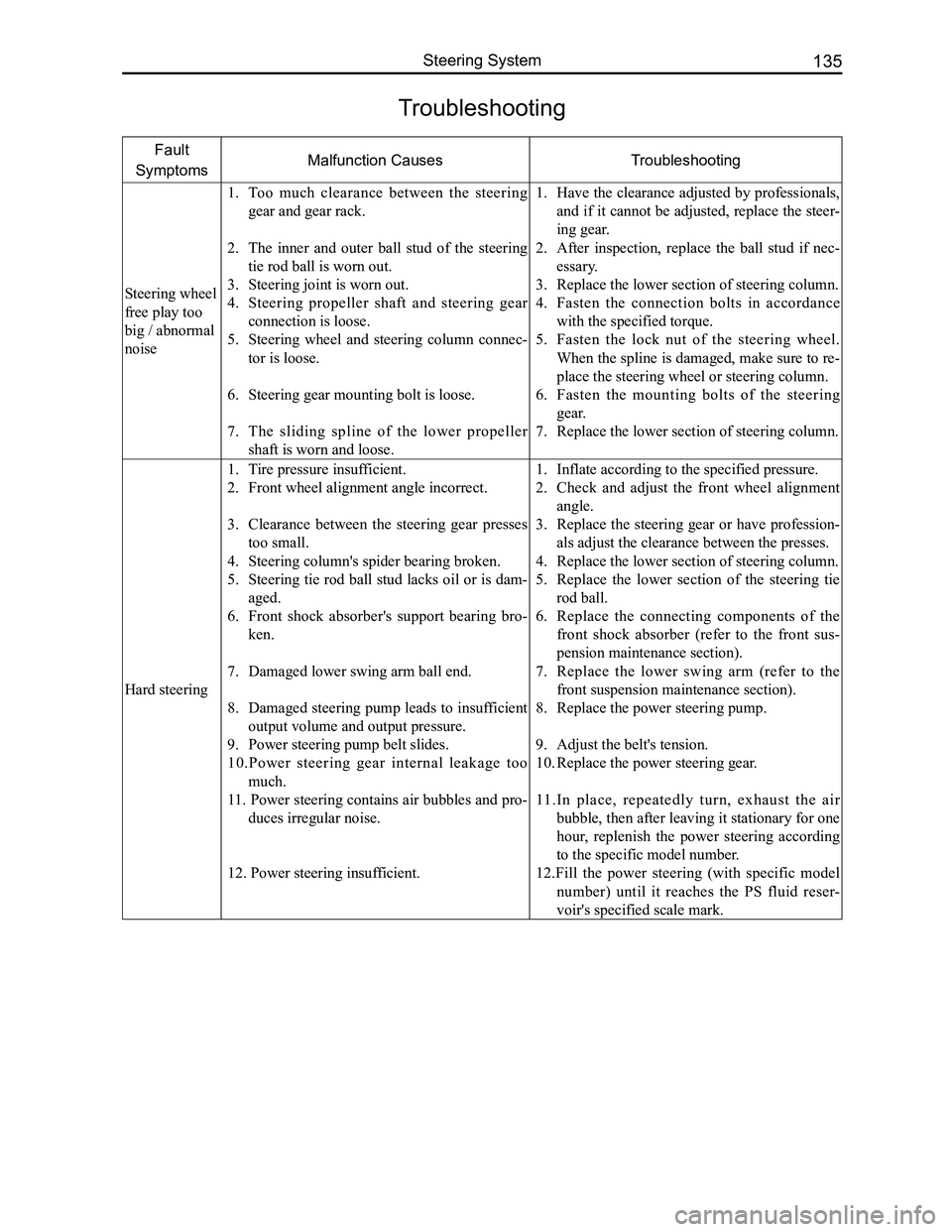
Troubleshooting
Fault
SymptomsMalfunction CausesTroubleshooting
Steering wheel
free play too
big / abnormal
noise
1. Too much clearance between the steering
gear and gear rack.
2. The inner and outer ball stud of the steering
tie rod ball is worn out.
3. Steering joint is worn out.
4. Steering propeller shaft and steering gear
connection is loose.
5. Steering wheel and steering column connec-
tor is loose.
6. Steering gear mounting bolt is loose.
7. The sliding spline of the lower propeller
shaft is worn and loose.
1. Have the clearance adjusted by professionals,
and if it cannot be adjusted, replace the steer-
ing gear.
2. After inspection, replace the ball stud if nec-
essary.
3. Replace the lower section of steering column.
4. Fasten the connection bolts in accordance
with the specified torque.
5. Fasten the lock nut of the steering wheel.
When the spline is damaged, make sure to re-
place the steering wheel or steering column.
6. Fasten the mounting bolts of the steering
gear.
7. Replace the lower section of steering column.
Hard steering
1. Tire pressure insufficient.
2. Front wheel alignment angle incorrect.
3. Clearance between the steering gear presses
too small.
4. Steering column's spider bearing broken.
5. Steering tie rod ball stud lacks oil or is dam-
aged.
6. Front shock absorber's support bearing bro-
ken.
7. Damaged lower swing arm ball end.
8. Damaged steering pump leads to insufficient
output volume and output pressure.
9. Power steering pump belt slides.
10.Power steering gear internal leakage too
much.
11. Power steering contains air bubbles and pro-
duces irregular noise.
12. Power steering insufficient.
1. Inflate according to the specified pressure.
2. Check and adjust the front wheel alignment
angle.
3. Replace the steering gear or have profession-
als adjust the clearance between the presses.
4. Replace the lower section of steering column.
5. Replace the lower section of the steering tie
rod ball.
6. Replace the connecting components of the
front shock absorber (refer to the front sus-
pension maintenance section).
7. Replace the lower swing arm (refer to the
front suspension maintenance section).
8. Replace the power steering pump.
9. Adjust the belt's tension.
10. Replace the power steering gear.
11.In place, repeatedly turn, exhaust the air
bubble, then after leaving it stationary for one
hour, replenish the power steering according
to the specific model number.
12.Fill the power steering (with specific model
number) until it reaches the PS fluid reser-
voir's specified scale mark.
Page 143 of 281

Downloaded from www.Manualslib.com manuals search engine GWFLORID Maintenance Manual136
Fault
SymptomsMalfunction CausesTroubleshooting
Poor steering
return
Straight
movement
stability poor
1. Tire pressure insufficient.
2. Wheel counterweight falls off or other fac-
tors cause extremely poor wheel balance.
3. Lower swing arm's rubber bushing is too old,
big difference between the left and right's
rigidity.
4. The front shock absorber's support bearing
and lower swing arm ball lacks sufficient lu-
brications.
5. The four wheels' positional parameters incor-
rect.
6. Steering gear's gear rack meshing condition
worsens and causes intense reverse resis-
tance.
7. Steering column bearing and spider bearing
damaged.
8. Power steering pump's oil supply insuffi-
cient.
9. Inner portion of the steering gear's control
valve performance degradation.
1. Inflate according to the specified pressure.
2. Recalibrate the wheel's dynamic balance.
3. Replace the lower swing arm.
4. Fill with grease of the specified model num-
ber.
5. Re-measure and adjust the four wheels' posi-
tional parameters.
6. Replace the steering gear.
7. Replace the steering column assembly.
8. Replace the power steering pump.
9. Replace the power steering gear.
Page 144 of 281

Downloaded from www.Manualslib.com manuals search engine 137Steering System
Steering System Maintenance
Structure Introduction
The steering wheel has an airbag module which should only be inspected and repaired by a professional. The
steering column's upper section adopts a steel deformation and energy absorbing crumple structure which
ensures collision protection for the driver. The lower section uses a high precision sliding spline structure,
which can effectively eliminate structural interference caused by body deformation. The steering column angle
is adjustable, which can more easily adapt to the driver, and at the same time possesses reasonable reverse
efficiency to ensure the driver has a good feel for the road. Steering sys\
tem is as shown below:
Steering column assembly removal and
installation
1. Remove the airbag.
(a) Disconnect the battery's negative cable, and wait for
one minute before canceling the airbags function in
order to avoid unnecessary injury.
(b) To ensure steering column's proper installation, during
the entire removal process, the front tires must keep
straight.
(c) Remove the two hexagon screws and the airbag module.
Hexagon screw
Steering wheel
Steering column
Steering propeller shaft
PS fluid reservoir
Power steering pumpBelt
Power steering gearSteering combination pipe
Steering propeller shaft connector jacket assembly
Steering dust cover
Steering protection plate
Page 145 of 281
Downloaded from www.Manualslib.com manuals search engine GWFLORID Maintenance Manual138
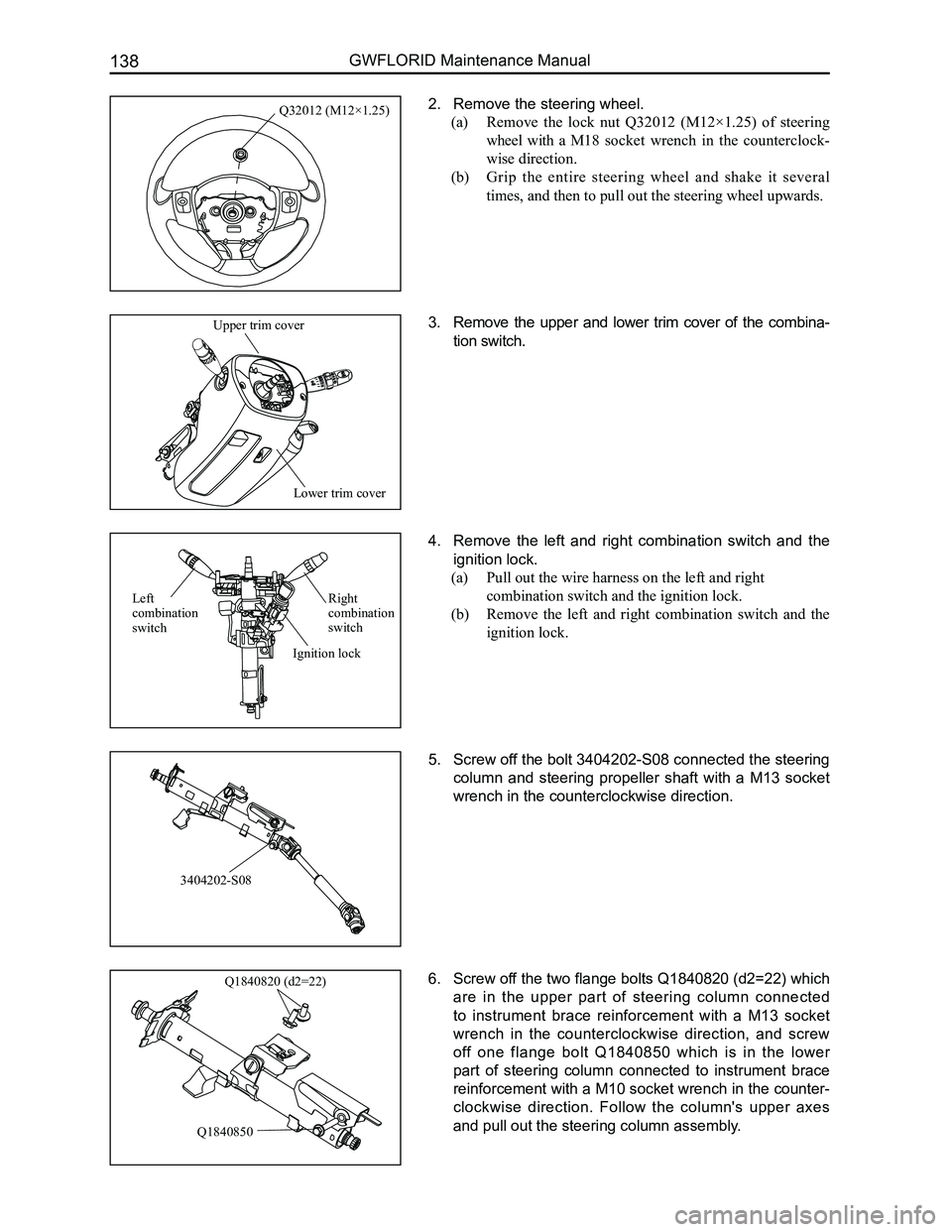
2. Remove the steering wheel.
(a) Remove the lock nut Q32012 (M12×1.25) of steering
wheel with a M18 socket wrench in the counterclock-
wise direction.
(b) Grip the entire steering wheel and shake it several
times, and then to pull out the steering wheel upwards.
3. Remove the upper and lower trim cover of the combina-
tion switch.
4. Remove the left and right combination switch and the
ignition lock.
(a) Pull out the wire harness on the left and right
combination switch and the ignition lock.
(b) Remove the left and right combination switch and the
ignition lock.
5. Screw off the bolt 3404202-S08 connected the steering
column and steering propeller shaft with a M13 socket
wrench in the counterclockwise direction.
6. Screw off the two flange bolts Q1840820 (d2=22) which
are in the upper part of steering column connected
to instrument brace reinforcement with a M13 socket
wrench in the counterclockwise direction, and screw
off one flange bolt Q1840850 which is in the lower
part of steering column connected to instrument brace
reinforcement with a M10 socket wrench in the counter-
clockwise direction. Follow the column's upper axes
and pull out the steering column assembly.
Q32012 (M12×1.25)
Lower trim cover
Upper trim cover
3404202-S08
Q1840820 (d2=22)
Q1840850
Right combination switch
Left combination switch
Ignition lock

