2008 GREAT WALL FLORID motor
[x] Cancel search: motorPage 2 of 281

Downloaded from www.Manualslib.com manuals search engine PREFACE
GWFLORID will build 1.3L (GW413EF, GW4G13) or 1.5L (GW4G15) gasoline engines, in which the
GW4G13 and GW4G15 engines will both incorporate the newest VVT technology which meets the Euro IV
emission standards. GWFLORID features McPherson technology on its chassis system. With an ultra light
body made from structural steel and high-intensity front and rear fender impact beams as well as a collision
impact absorption system, it is able to maintain the cab's integrity and safety to greater extent. We wrote this
maintenance manual in order to meet the demand of Great Wall after-sales service technicians. This manual
mainly introduces the areas of importance in regard to maintenance and care, and removal and installation of
each system's assembly and maintenance technical parameters.
To reduce the possibility of injury or property damage, read and follow t\
he instructions carefully:
This manual is provided by the Great Wall Motor Co., Ltd, and is written for the technician use. Any
maintenance or repair without proper prior training and tools or devices may result in personal injury of the
person performing the maintenance or others in the vicinity. It is also possible that damage to the vehicle will
occur or will lead to mechanical failure during normal operation.
Correct vehicle maintenance and repair is essential for the safety of the person performing regular
maintenance as well as the vehicle itself. If there is any component that needs to be replaced, use a
component with the same serial number or a serial number specified by the Great Wall Motor Co., Ltd. Never
use any part that has not been authorized by the Great Wall Motor Co., Ltd.
Any maintenance procedure introduced in this manual is effective for maintenance and repair. Some of
these procedures need specially designed tools.
Therefore, before using any vehicle part following any maintenance procedure or working with a tool
that has not been authorized by the Great Wall Motor Co., Ltd, check to make sure that none of the above
will endanger the safety of the person performing the work or the correc\
t operation of the vehicle.
This manual includes multiple "Warnings" and "Cautions," which should be strictly followed, so as to
reduce the possibility of injury during maintenance or repair. Improper maintenance or repair of the vehicle
may cause potential safety hazards. These "Warnings" and "Cautions" are not exhaustive. It is impossible for
the Great Wall Motor Co., Ltd, to warn against all the potential dangers caused by not properly following the
instructions.
Please read carefully the "Areas of Importance" before carrying out any maintenance or repair on the
airbag system's components or its surrounding electrical components. Action contrary to any of the "Areas of
Importance" may lead to the deployment of the airbag, resulting in injur\
y or unnecessary repair of the airbag.
To avoid accidental deployment of the airbag and its resulting injury, we suggest repairing the airbag
system before other vehicle systems if the airbag and the other vehicle \
systems both need repairing.
We have received generous support and help from many professional technicians during the preparation
of this manual. We would like to express our heartfelt gratitude to all of them.
Although we have tried our best to write this manual well, we do not guarantee that the entire content
in this manual is absolutely correct. Users may not make any legal claim against the Great Wall Motor Co.,
Ltd. in regards to this manual. Any loss caused by using this manual is not our responsibility. Because of
the writer's limited experience, there are likely mistakes in this manual, therefore we welcome any user
comments, suggestions, and corrections.
Great Wall Motor Co., Ltd. reserves the final right of explanation.
\
Editor
May 2008
Page 10 of 281

Downloaded from www.Manualslib.com manuals search engine 3Overview
Correct vehicle maintenance and repair is very important
to the safety of the maintenance person and the vehicle. If
any vehicle part change is necessary, please use a part with
the same part number or part number specified by the Great
Wall Motor Co., Ltd. Never use a part that has not been au-
thorized by the Great Wall Motor Co., Ltd.
4. Inspect the front brake disc thickness.
Standard thickness: 22.0 mm
Minimum thickness: 20.0 mm
The brake disc must be changed when its thickness falls be-
low the minimum level.
The maintenance procedures are explained step by step:
• The schematics and diagrams illustrate how and where to
operate.
• The titles convey the maintenance content.
• Detailed instruction explains how to perform the maintenance,
as well as introduces other related matters, such as specifications,
warnings, and so on.
For example:
Illustration: How and where to operate.
Work Subject: What to do
Detailed Instruction: How to do it
Specifications
Engine Manufacturing Number
The engine manufacturing number is engraved on the left
side of the engine cylinder block.
Vehicle Nameplate
Every vehicle has a vehicle nameplate, and this vehicle's
nameplate is located at the bottom of the right B-pillar.
Identifying Number Location
Vehicle Identification Number (VIN)
A Vehicle Identification Number is a unique serial number
consisting of 17 characters and used to identify individual
motor vehicles. This number is marked at three different
places: at the nameplate, at the upper-left side of the dash-
board, and at the cross member located under the front pas-
senger seat.
VIN
Vehicle Nameplate
Page 19 of 281

Downloaded from www.Manualslib.com manuals search engine GWFLORID Maintenance Manual12
Ride
Performance
Outter acceleration noise dB (A)≤74≤75
60 km/h constant velocity interior noise dB (A)≤65≤65
Driver operating noise dB (A)≤90≤90
Emission
CO emission (g/km)≤2.30≤1.00≤0.64
HC emission (g/km)≤0.20≤0.10/
NOx emission (g/km)≤0.15≤0.08≤0.5
Particle emission (g/km)//≤0.05
Smoke density//≤4.0
Engine Technical Parameters
ItemUnitSpecifications and Parameters
Model numberGW413EFGW4G15YC4W75-31
Model
Inline four cylinder, 4-stroke, water cooling, dual
overhead camshaft, petrol engine
Inline four cylinder,
4-stroke, water cooled,
dual overhead camshaft,
diesel engine
Fuel supply typeElectronic controlled, multi-points ordinal injection
High pressure electronic
controlled common-rail
fuel injection
Cylinder bore ×
strokemm × mm78.7 × 69.075 × 84.771.0 × 77.0
DisplacementL1.3421.4971.219
Compression ratio9.3:110.5: 118.5:1
Number of valves/
cylinder16/4
Lowest rate of fuel
consumption g/(kW·h)<260≤260215
Maximum power/
rotation speed kW/(r/m)65/600077/600050/4200
Max. torque/
rotation
speed
N·m/(r/m)115/4400-5200138/4200153/2000-2400
Total net weightkg11596142±2
Idle speedr/min800±50800750±50
Fuel type and
gradeRON/MONUnleaded gasoline, #93Euro diesel fuel
Cooling style and
performance
parameters
Forced water circulation
cooling, the opening
temperature of the
thermostat is 82±2oC, the
water temperature under
normal working condition
is 90-100oC, the opening
pressure of the coolant
compensation box's
pressure limiting valve is
108±14.7 kpa
Forced water circulation
cooling, the opening
temperature of the
thermostat is 82±2oC, the
water temperature under
normal working condition
is 80-90oC, the opening
pressure of the coolant
compensation box’s
pressure limiting valve is
108±15 kpa
Forced water circulation
cooling, the thermostat
starts to open at 75oC and
is fully open at 85oC, the
opening pressure of the
coolant compensation
box's pressure limiting
valve is 108±14.7 kpa
Starting style and
performance
Motor starting, starting performance complies with GB18297
requirements 8.1.2 and 8.1.3
Lubricating
methodPressure and splash combination
Page 22 of 281

Downloaded from www.Manualslib.com manuals search engine 15Overall Parameters
Vehicle Structure Type and Parameters
ItemStructural parameters & performance descriptions
Body
Body typeAll-metal closed hard surface bearing body.
Body in whitePressed and welded, all-metal enclosed structure.
Door assemblyFramed door with four-door impact beam, hinged sliding open door, trunk door
opens upwards, front/rear doors are installed with auto window regulator\
.
Engine hoodOpens up/downwards using a single arm hinge.
Closure part
parameters
Front door opening
angle35°/60°Engine hood
opening angle74.5°
Rear door opening
angle36°/64°Trunk door max.
opening angle96°
Vehicle
interior/
exterior and
accessories
Interior Satisfies ergonomic and comfort requirements. Fire resistance complies to regulatory
requirements.
Dashboard
Uses an injected molding structure with brace reinforcement, built in multifunctional
combination meter, knob plus button-press air conditioning controller, CD player
(DVD and GPS LCD are optional), and auxiliary facia console which adopts a gear
shift control mechanism.
A, B, C, and D
pillars and door's
inner decoration
board
Uses injected molding and front door guard plates equipped with package tray, four-
door guard plates are all installed with window regulator switches.
Automobile
glass
Windshield is laminated glass, front and rear door glass is tempered glass, trunk door
glass is heating & defrosting tempered glass with resistance wire.
Outer rearview
mirror
Elite type: electrically actuated convertible body and electronically controlled mirror
with defroster.
Luxury type: manually folded body and electronically controlled mirror without
defroster.
Comfort type: manually folded body and manually adjusted mirror without \
defroster.
Inner rearview
mirrorFlexible with anti-glare function
Seats
Driver & front passenger seats, independent seats. For front and rear seats, backrest
angle and seat headrest are both manually adjustable. Second row seats use a three-
seat arrangement. The seats' front and back positions and backrest angles are
nonadjustable. Seat headrests are both manually adjustable, back of the seat can be
folded forward, and the middle seat includes a child seat belt.
Seat belt
The front seat has two kinds of seat belts, complex equipment type being an
electronic preload three-point seat belt, and simple equipment type a non-preload
three-point seat belt. Advanced configuration uses the electronic preload three-point
seat belt, while simple configuration uses the non-preloaded three-point seat belt.
The rear seat belt uses a normal three-point seat belt.
Sun visor
Left and right sun visors both have cosmetic mirrors, and the sun visors can be
rotated up and down and from side to side, the up and down rotation can be held at
any position.
Front and rear
bumperBumper assembly can withstand collision speeds of 8 km/h.
Washer
Equipped with front and rear wiper, one 5th gear thrust washer reservoir, two motors,
two sets of pipelines in the front and rear, two washing nozzles with one in the front,
and the other in the back.
Page 23 of 281

Downloaded from www.Manualslib.com manuals search engine GWFLORID Maintenance Manual16
Air Conditioning System Structure and Parameters
ItemStructure and parameters
Structure typeVapor compression refrigeration, water warmer, and water heater
Performance parametersAir conditioner refrigerating capacity is 5 kW. Blower's air volume is 450 m3/h. Air
conditioner heating capacity is 4.5 kW.
Controls
Control panel knob, button, manual shift lever control, position gate and temperature
threshold cable drive, new damper micro-motor drive, able to select and adjust air
outlet position, heating/cooling mode, air inner/outer circulation mode and wind speed,
temperature, and more advanced selections and adjustables.
RefrigerantR134a, 510±10g
CompressorModel number: JSS-96TV4-4
CondenserAdvective and subcooling structure with flat tube thickness of 16 mm and dry reservoir
Φ34 mm × L280 mm.
Heating, Ventilating
and Air Conditioning
(HVAC)
Heating, Ventilating and Air Conditioning (HVAC): Of a three-box type consisting of
a layered evaporator, advective heater, H-shaped expansion valve, centrifugal blower,
and air outlet distributing box. Contains cooling, heating, defrosting and air freshening
functions, and operated by a link mechanism driving air valve.
Refrigeration line &
water heating tube
Refrigeration line: a compound structure using a rubber cooling pipe and an aluminum
pipe. Water heating pipe: molded rubber pipe.
SensorsEvaporator temperature sensor
Pressure switchHigh/Mid/Low three position pressure switch
Electrical System Structure and Parameters
ItemStructure and parameters
Power, start
up, and
electronic
charging
system
CircuitSingle wire system, voltage of DC12 V, negative ground
Battery12 V/60 Ah, maintenance-free battery
Starter1.2 kW
Alternator14 V/90 A
Lighting and
signaling
system
Headlight2 white (high beam 55 W, low beam 60 W) H4, height is electrically
adjustable.
Parking lamp2 front parking lamp: white, 5 W. 2 rear parking lamp: red, 5W
Turn signal lampAmber colored. 21W, 2 in the front and 21W, 2 in the back. Turn signal
lamps: 0.3W, 4 LED.
Fog lamp2 front fog lamps: 55W. 2 rear fog lamps: 7.5 W
Brake lamp2 red 21 W. high mounted brake lamps 3 W
License plate lamp2 white 5 W
Reverse lamp2 white 21 W
Hazard warning signal
lampAll turn signal lamps and switch controls
Rear reflectorsRed and non-triangular, inside the rear combination lamps.
Front reading lamp &
interior dome lamp
Front reading lamp: one white 10 W or one white 10 W, two 5 W (with
sunroof).
Interior dome lamp: White, 10 W.
Cigarette lighter
lightingBlue, 3 W, one
Page 51 of 281

Downloaded from www.Manualslib.com manuals search engine GWFLORID Maintenance Manual44
Transmission's Proper Use and Care
1. Transmission's proper operation
1.1 Shift the gear gently, not excessively.
1.2 Do not start with high speed.
1.3 To avoid premature abrasion of the gear shift fork, do not rest your hand on the \
gear lever while driving.
2. Model number of the lubricant to be used:
GL-4 80W-90 (For China domestic model)
GL-4 75W-90 (For alpine region model)
GL-5 140 (For high-temperature region model)
Caution: Please only use the lubricant with model numbers specified by t\
he Great Wall Motor Co., Ltd.
Do not mix lubricants with different model numbers. Only fill with clean lubricant.
3. Areas of importance for new vehicle usage:
3.1 Before using a new vehicle, be sure to check the transmission and all exposed connectors and fastening
pieces, so as to avoid failure due to faulty installation or loose conne\
ctions.
3.2 Since the new vehicle is still in the run-in period, the transmission's lubricant should be replaced after 5000 km
distance.
4. Transmission three-level maintenance:
4.1 Transmission level-one maintenance: During the first level of maintenance, the liquid level of the lubricant
should be checked to ensure that it is up to the oil-filling mouth. Add more if insufficient. Excessive low
oil level can lead to ineffective lubrication, as well as burning of the bearings and gears. Excessive high oil
level, however, can overheat the transmission or cause oil to leak. In addition, during the first level of main-
tenance, the breather plug should be checked and cleaned. If the breather plug is clogged, internal pressure
will build up and oil will leak from the transmission.
4.2 Transmission level-two maintenance: The transmission's lubricant should be replaced the first time that the
vehicle undergoes the second level of maintenance. Clean the transmission with kerosene. The quality of the
lubricant should be inspected during the future second level of maintenance practises. The lubricant should
be replaced if diluted, gummy, or dirty.
4.3 Transmission level-three maintenance: During the third level of maintenance, it should be removed for in-
spection, cleaning, and oil changing.
Technical Specifications for Transmission Installation and Adjustment
Inspect the axial play (δ) between the synchronizer ring and the gear shaft
Gear (δ1) (δ2) (δ3) (δ4) (δ5)
Standard axial play (mm)0.7-1.70.7-1.70.7-1.70.7-1.70.7-1.7
Gear (δ1) (δ2) (δ3) (δ4) (δ5)
Standard axial play (mm)0.1-0.40.1-0.60.1-0.40.1-0.60.1-0.55
Check the axial play (δ) between each gear
Page 116 of 281
Downloaded from www.Manualslib.com manuals search engine 109Brake System
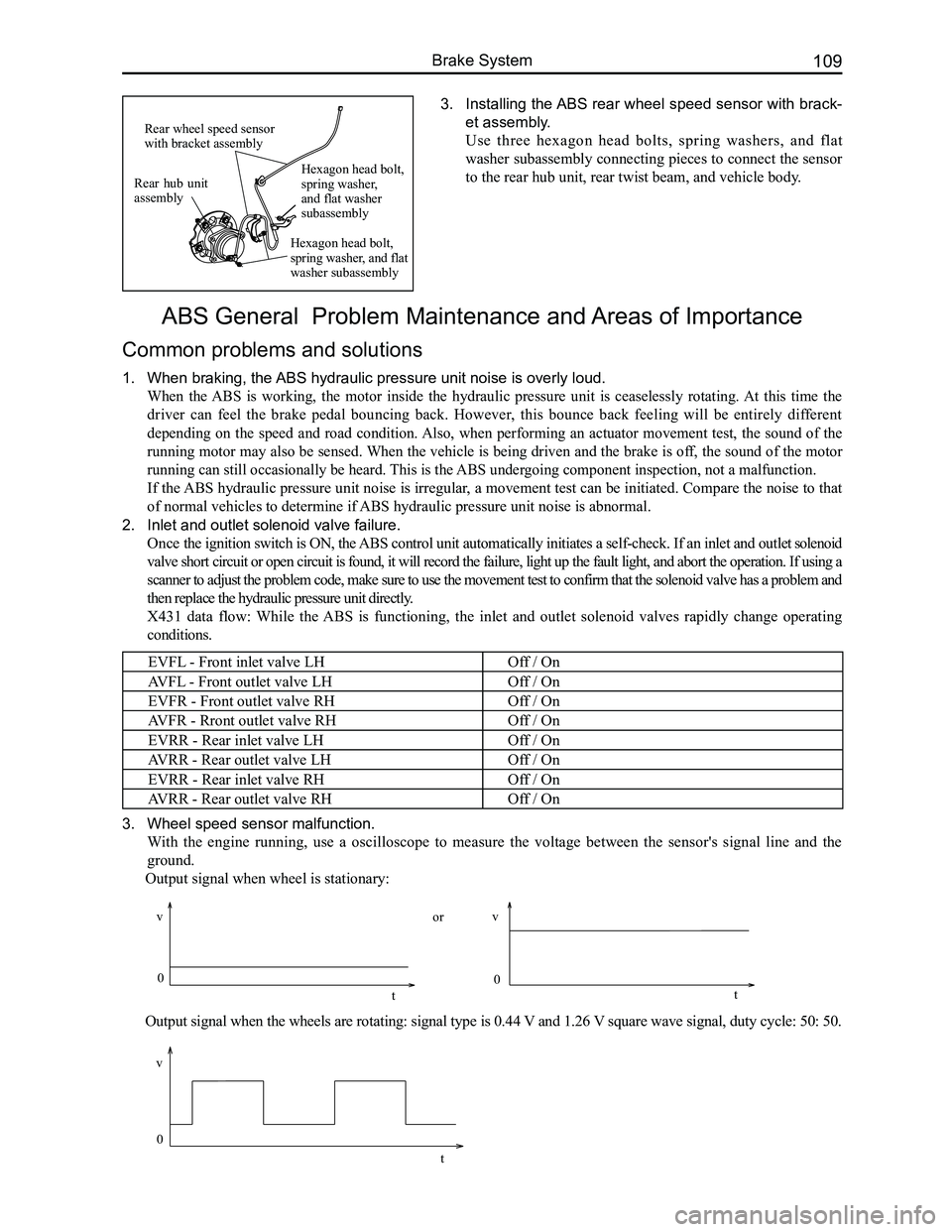
3. Installing the ABS rear wheel speed sensor with brack-
et assembly.
Use three hexagon head bolts, spring washers, and flat
washer subassembly connecting pieces to connect the sensor
to the rear hub unit, rear twist beam, and vehicle body.
ABS General Problem Maintenance and Areas of Importance
Common problems and solutions
1. When braking, the ABS hydraulic pressure unit noise is overly loud.
When the ABS is working, the motor inside the hydraulic pressure unit is ceaselessly rotating. At this time the
driver can feel the brake pedal bouncing back. However, this bounce back feeling will be entirely different
depending on the speed and road condition. Also, when performing an actuator movement test, the sound of the
running motor may also be sensed. When the vehicle is being driven and the brake is off, the sound of the motor
running can still occasionally be heard. This is the ABS undergoing component inspection, not a malfunction.
If the ABS hydraulic pressure unit noise is irregular, a movement test can be initiated. Compare the noise to that
of normal vehicles to determine if ABS hydraulic pressure unit noise is abnormal.
2. Inlet and outlet solenoid valve failure.
Once the ignition switch is ON, the ABS control unit automatically initiates a self-check. If an inlet and outlet solenoid
valve short circuit or open circuit is found, it will record the failure, light up the fault light, and abort the operation. If using a
scanner to adjust the problem code, make sure to use the movement test t\
o confirm that the solenoid valve has a problem and
then replace the hydraulic pressure unit directly.
X431 data flow: While the ABS is functioning, the inlet and outlet solenoid valves rapidly change operating
conditions.
EVFL - Front inlet valve LHOff / On
AVFL - Front outlet valve LHOff / On
EVFR - Front outlet valve RHOff / On
AVFR - Rront outlet valve RHOff / On
EVRR - Rear inlet valve LHOff / On
AVRR - Rear outlet valve LHOff / On
EVRR - Rear inlet valve RHOff / On
AVRR - Rear outlet valve RHOff / On
3. Wheel speed sensor malfunction.
With the engine running, use a oscilloscope to measure the voltage between the sensor's signal line and the
ground.
Output signal when wheel is stationary:
Output signal when the wheels are rotating: signal type is 0.44 V and 1.26 V square wave signal, duty cycle: 50: 50.
Rear hub unit assembly
Rear wheel speed sensor with bracket assembly
Hexagon head bolt, spring washer, and flat washer subassembly
Hexagon head bolt, spring washer, and flat washer subassembly
0
v
t
vv
0 0
tt
or
Page 118 of 281
Downloaded from www.Manualslib.com manuals search engine 111Brake System
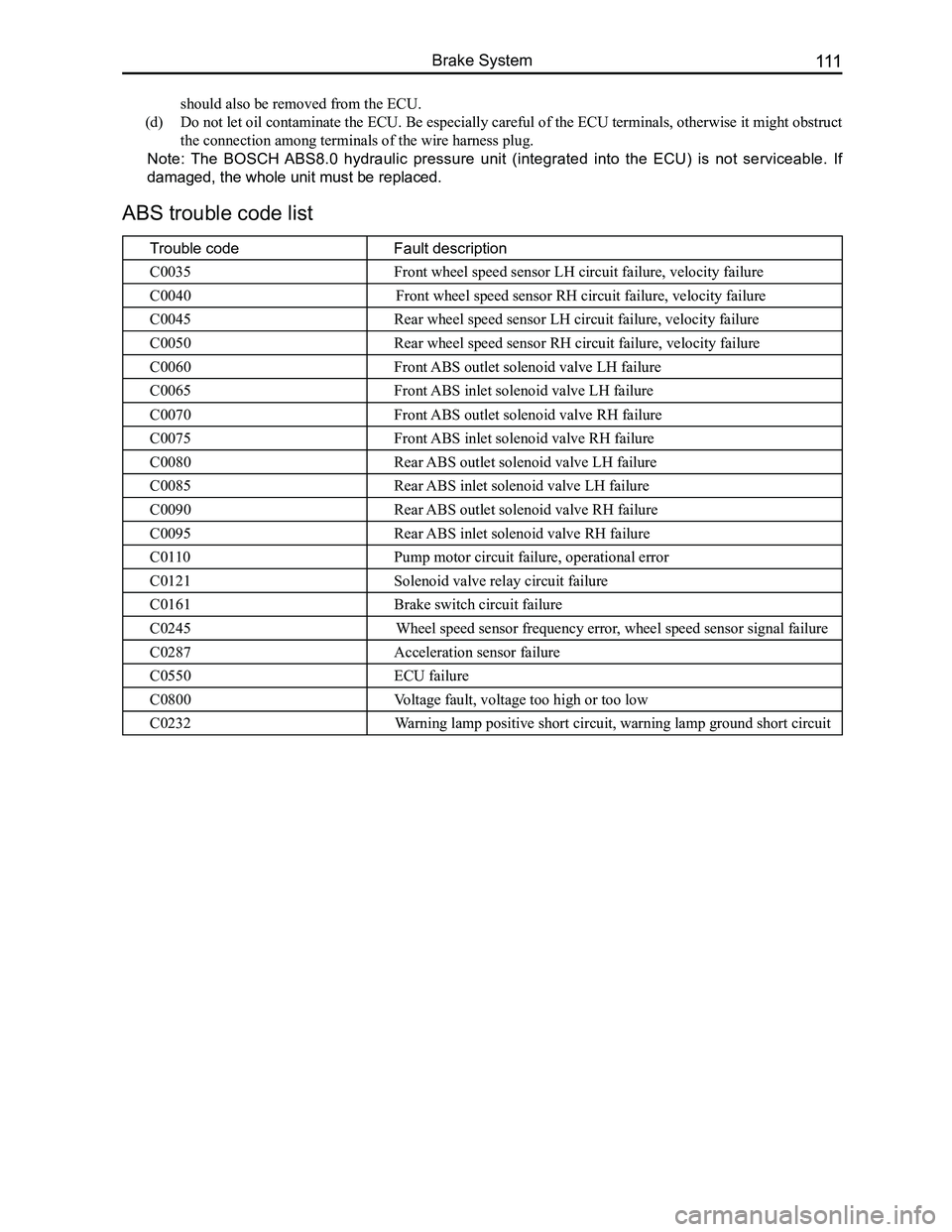
ABS trouble code list
Trouble codeFault description
C0035Front wheel speed sensor LH circuit failure, velocity failure
C0040Front wheel speed sensor RH circuit failure, velocity failure
C0045Rear wheel speed sensor LH circuit failure, velocity failure
C0050Rear wheel speed sensor RH circuit failure, velocity failure
C0060Front ABS outlet solenoid valve LH failure
C0065Front ABS inlet solenoid valve LH failure
C0070Front ABS outlet solenoid valve RH failure
C0075Front ABS inlet solenoid valve RH failure
C0080Rear ABS outlet solenoid valve LH failure
C0085Rear ABS inlet solenoid valve LH failure
C0090Rear ABS outlet solenoid valve RH failure
C0095Rear ABS inlet solenoid valve RH failure
C0110Pump motor circuit failure, operational error
C0121Solenoid valve relay circuit failure
C0161Brake switch circuit failure
C0245Wheel speed sensor frequency error, wheel speed sensor signal failure
C0287Acceleration sensor failure
C0550ECU failure
C0800Voltage fault, voltage too high or too low
C0232Warning lamp positive short circuit, warning lamp ground short circuit
should also be removed from the ECU.
(d) Do not let oil contaminate the ECU. Be especially careful of the ECU terminals, otherwise it might obstruct
the connection among terminals of the wire harness plug.
Note: The BOSCH ABS8.0 hydraulic pressure unit (integrated into the ECU) is not serviceable. If
damaged, the whole unit must be replaced.