2008 GREAT WALL FLORID ect
[x] Cancel search: ectPage 219 of 281
Downloaded from www.Manualslib.com manuals search engine GWFLORID Maintenance Manual212
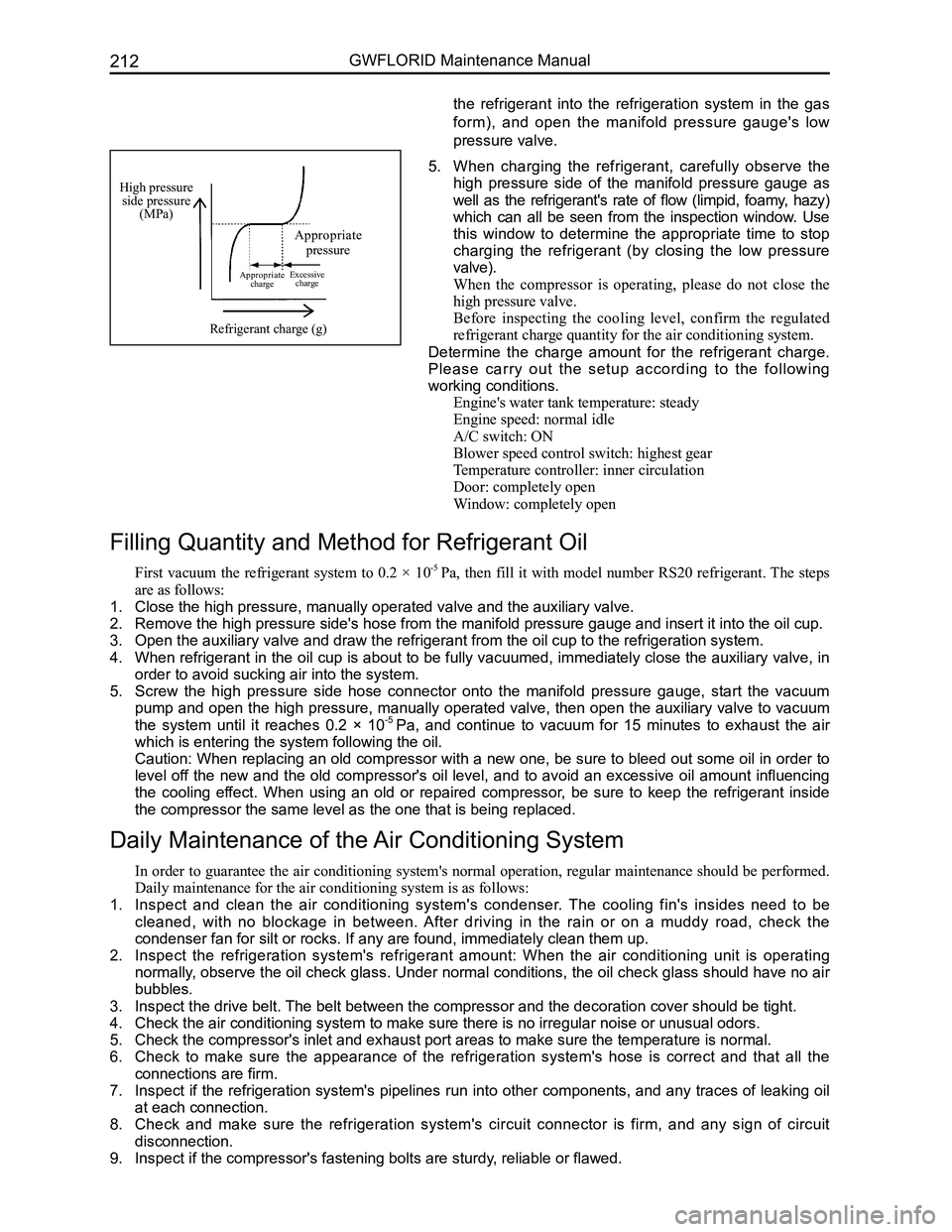
High pressure side pressure(MPa)
Appropriate pressure
Appropriate chargeExcessive charge
Refrigerant charge (g)
5. When charging the refrigerant, carefully observe the
high pressure side of the manifold pressure gauge as
well as the refrigerant's rate of flow (limpid, foamy, hazy)
which can all be seen from the inspection window. Use
this window to determine the appropriate time to stop
charging the refrigerant (by closing the low pressure
valve).
When the compressor is operating, please do not close the
high pressure valve.
Before inspecting the cooling level, confirm the regulated
refrigerant charge quantity for the air conditioning system.
Determine the charge amount for the refrigerant charge.
Please carry out the setup according to the following
working conditions.
Engine's water tank temperature: steady
Engine speed: normal idle
A/C switch: ON
Blower speed control switch: highest gear
Temperature controller: inner circulation
Door: completely open
Window: completely open
Filling Quantity and Method for Refrigerant Oil
First vacuum the refrigerant system to 0.2 × 10⁻⁵ Pa, then fill it with model number RS20 refrigerant. The steps
are as follows:
1. Close the high pressure, manually operated valve and the auxiliary valve\
.
2. Remove the high pressure side's hose from the manifold pressure gauge an\
d insert it into the oil cup.
3. Open the auxiliary valve and draw the refrigerant from the oil cup to th\
e refrigeration system.
4. When refrigerant in the oil cup is about to be fully vacuumed, immediately close the auxiliary valve, in
order to avoid sucking air into the system.
5. Screw the high pressure side hose connector onto the manifold pressure gauge, start the vacuum
pump and open the high pressure, manually operated valve, then open the auxiliary valve to vacuum
the system until it reaches 0.2 × 10⁻⁵ Pa, and continue to vacuum for 15 minutes to exhaust the air
which is entering the system following the oil.
Caution: When replacing an old compressor with a new one, be sure to bleed out some oil in order to
level off the new and the old compressor's oil level, and to avoid an excessive oil amount influencing
the cooling effect. When using an old or repaired compressor, be sure to keep the refrigerant inside
the compressor the same level as the one that is being replaced.
Daily Maintenance of the Air Conditioning System
In order to guarantee the air conditioning system's normal operation, regular maintenance should be performed.
Daily maintenance for the air conditioning system is as follows:
1. Inspect and clean the air conditioning system's condenser. The cooling fin's insides need to be
cleaned, with no blockage in between. After driving in the rain or on a muddy road, check the
condenser fan for silt or rocks. If any are found, immediately clean the\
m up.
2. Inspect the refrigeration system's refrigerant amount: When the air conditioning unit is operating
normally, observe the oil check glass. Under normal conditions, the oil check glass should have no air
bubbles.
3. Inspect the drive belt. The belt between the compressor and the decoration cover should be tight\
.
4. Check the air conditioning system to make sure there is no irregular noi\
se or unusual odors.
5. Check the compressor's inlet and exhaust port areas to make sure the tem\
perature is normal.
6. Check to make sure the appearance of the refrigeration system's hose is correct and that all the
connections are firm.
7. Inspect if the refrigeration system's pipelines run into other components, and any traces of leaking oil
at each connection.
8. Check and make sure the refrigeration system's circuit connector is firm, and any sign of circuit
disconnection.
9. Inspect if the compressor's fastening bolts are sturdy, reliable or flawed.
the refrigerant into the refrigeration system in the gas
form), and open the manifold pressure gauge's low
pressure valve.
Page 220 of 281

Downloaded from www.Manualslib.com manuals search engine 213Airbags
Airbags
Airbag Electronic Control Unit ..........................................214
Diagnostic Scanner ..........................................................215
Troubleshooting ................................................................216
Vehicle Collision Diagnostics ............................................226
Removal Method for Individual Components....................227
Driver Side Airbag Module (DAB), Front Passenger Side
Airbag Module (PAB), Clock Spring, and Steering Wheel ....228
Airbag Module Disposal....................................................230
Airbag’s Diagnostic Methods Without a
Diagnostic Scanner ..........................................................232
Page 221 of 281
Downloaded from www.Manualslib.com manuals search engine GWFLORID Maintenance Manual214
Areas of Importance
1. While performing maintenance on the SRS airbag, make sure to work in accordance with this
chapter's steps and notes.
2. Be sure to use the specified test apparatus and SST (Special Service Tools) which are mentioned in this
chapter.
3. While performing maintenance on the following mentioned components, if there is any problem with a
component, be sure to replace it with a new one.
• Airbag ECU assembly.
• Clock spring assembly.
• Driver side airbag assembly.
• Front passenger side airbag module.
• Driver side preload seat belt.
• Front passenger side preload seat belt.
• Airbag wire harness.
4. While performing maintenance, please disconnect the battery's negative terminal connector, and then
after waiting for 60 s, commence operation. Furthermore, wrap up the removed negative terminal with
insulating tape.
After the battery power is cut off, the capacitor in the airbag ECU will still maintain a set amount of electrical
energy. If used without waiting a sufficient amount of time, it may lead to serious injury and accidents due to
the airbag's faulty deployment.
5. When painting the vehicle, excessive heat may influence the components, in which case the SRS-ECU,
airbag module, clock spring, etc., should first be removed and set aside\
.
Use a diagnostic scanner to clear the trouble code after the SRS airbag is repaired, as to ensure the warning
lamp will continue to work normaly.
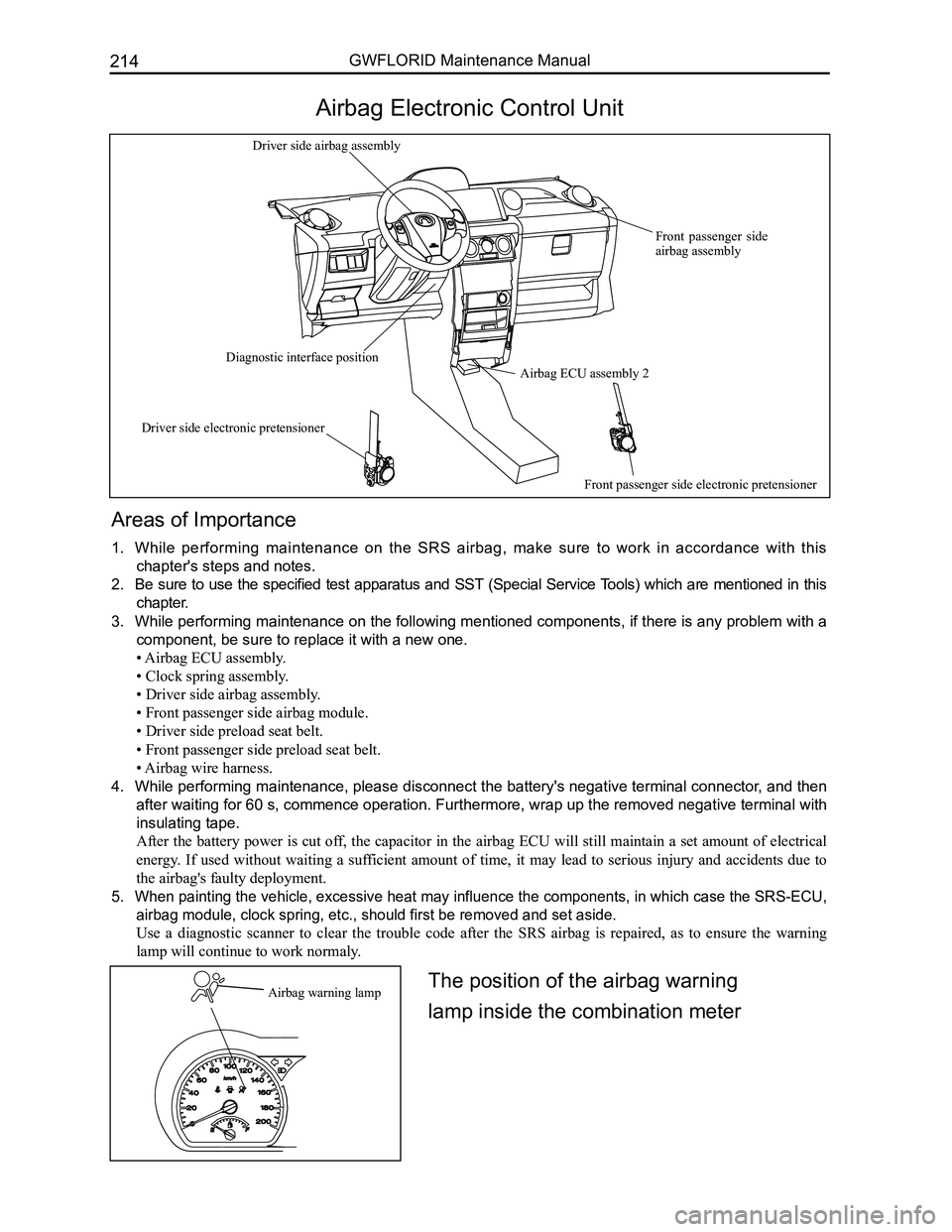
Airbag Electronic Control Unit
Airbag warning lamp
Airbag ECU assembly 2
Front passenger side airbag assembly
Driver side airbag assembly
Diagnostic interface position
Driver side electronic pretensioner
Front passenger side electronic pretensioner
The position of the airbag warning
lamp inside the combination meter
Page 222 of 281

Downloaded from www.Manualslib.com manuals search engine 215Airbags
Airbag electronic control interface and interface-pin definition
No. NameDescription
1DRV A/B + Driver side airbag assembly, high end
2DRV A/B -Driver side airbag assembly, low end
3PSG A/B +Front passenger side airbag assembly, high end
4PSG A/B -Front passenger side airbag assembly, low end
7PSG PRETENSIONER -Front passenger seat belt pretensioner, low end
8DRV PRETENSIONER +Driver seat belt pretensioner, high end
9DRV PRETENSIONER -Driver seat belt pretensioner, low end
10WARNING LAMPWarning lamp
11GNDGround cable
25BPT Hi ON power supply
30PSG PRETENSIONER -Front passenger seat belt pretensioner, high end
46K-LINESerial data I/O (K wire) diagnosis
Diagnostic Scanner
InstrumentNameApplication
X-431 diagnostic scannerCheck the system malfunction
of the SRS airbag system and
clear the ECU trouble code.
Page 223 of 281
Downloaded from www.Manualslib.com manuals search engine GWFLORID Maintenance Manual216
SRS airbag warning lamp inspection
1. When the ignition switch is set to the ON position, check if the SRS warning lamp remains on for 6-7 s.
2. If the SRS warning lamp shuts off after 6-7 s, this is normal.
3. Except for the items listed above, diagnostic inspection is still needed\
.
System diagnosis
Airbag ECU will initiate a series of diagnostic test cycles to check if the airbag system functions are ready for
use. This diagnostic test can guard against the restraint system's faulty execution and at the same time guarantee
prompt execution in a collision. If a malfunction appears, airbag ECU will store the appropriate trouble code and
light up the warning lamp to point out the malfunction, as to make maint\
enance more convenient.
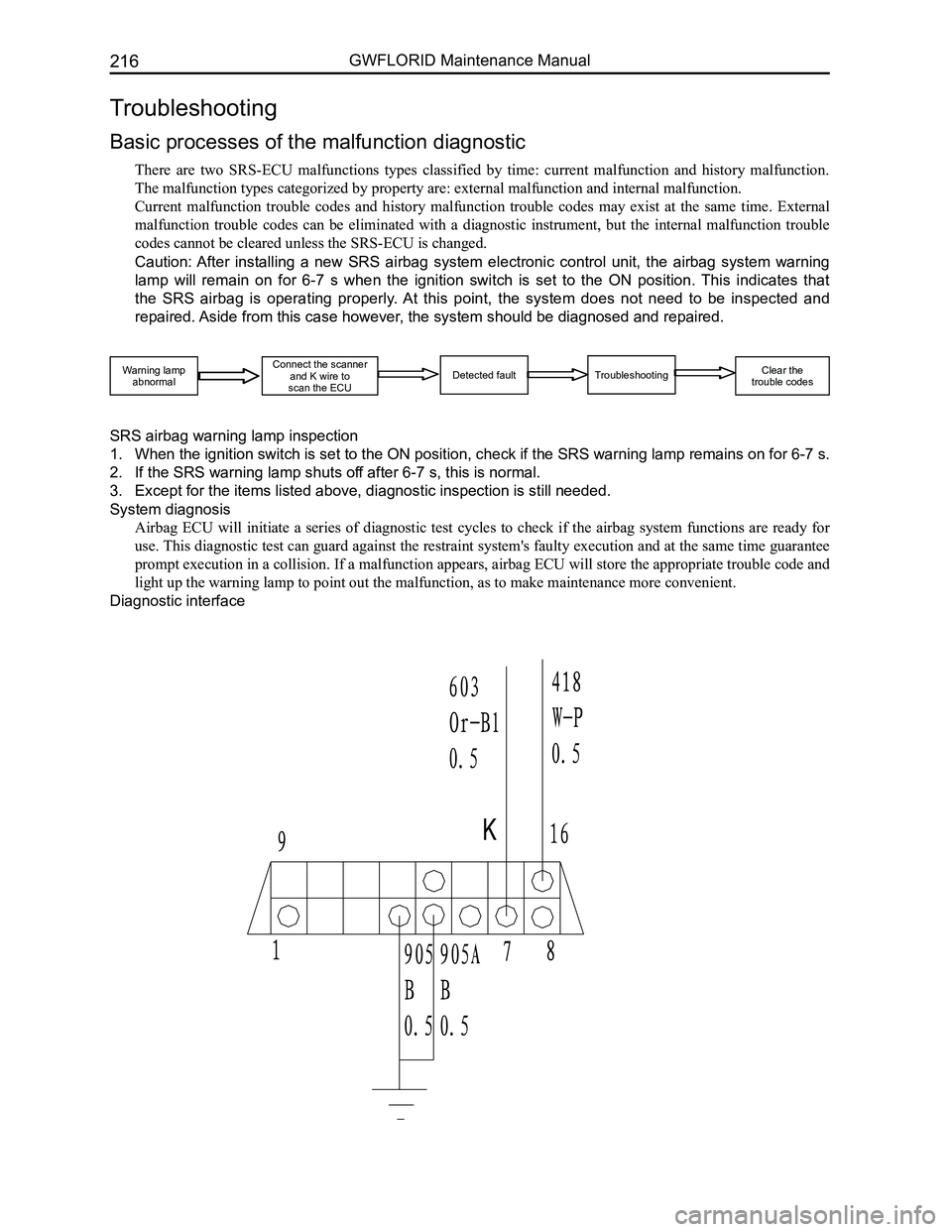
Diagnostic interface
Troubleshooting
Basic processes of the malfunction diagnostic
There are two SRS-ECU malfunctions types classified by time: current malfunction and history malfunction.
The malfunction types categorized by property are: external malfunction \
and internal malfunction.
Current malfunction trouble codes and history malfunction trouble codes may exist at the same time. External
malfunction trouble codes can be eliminated with a diagnostic instrument, but the internal malfunction trouble
codes cannot be cleared unless the SRS-ECU is changed.
Caution: After installing a new SRS airbag system electronic control unit, the airbag system warning
lamp will remain on for 6-7 s when the ignition switch is set to the ON position. This indicates that
the SRS airbag is operating properly. At this point, the system does not need to be inspected and
repaired. Aside from this case however, the system should be diagnosed and repaired.
Warning lampabnormal
Connect the scannerand K wire to scan the ECUDetected faultTroubleshooting Clear the trouble codes
Page 224 of 281
Downloaded from www.Manualslib.com manuals search engine 217Airbags
Malfunction judgment
1. Malfunction record (trouble code storage)
After the ECU performs the diagnostic test cycle in order to verify a malfunction, the SRS-ECU will store the
relevant code, the initial detection time, the final detection time, and the number of times it occurred in the
EEPROM.
The SRS-ECU can store 16 codes at most.
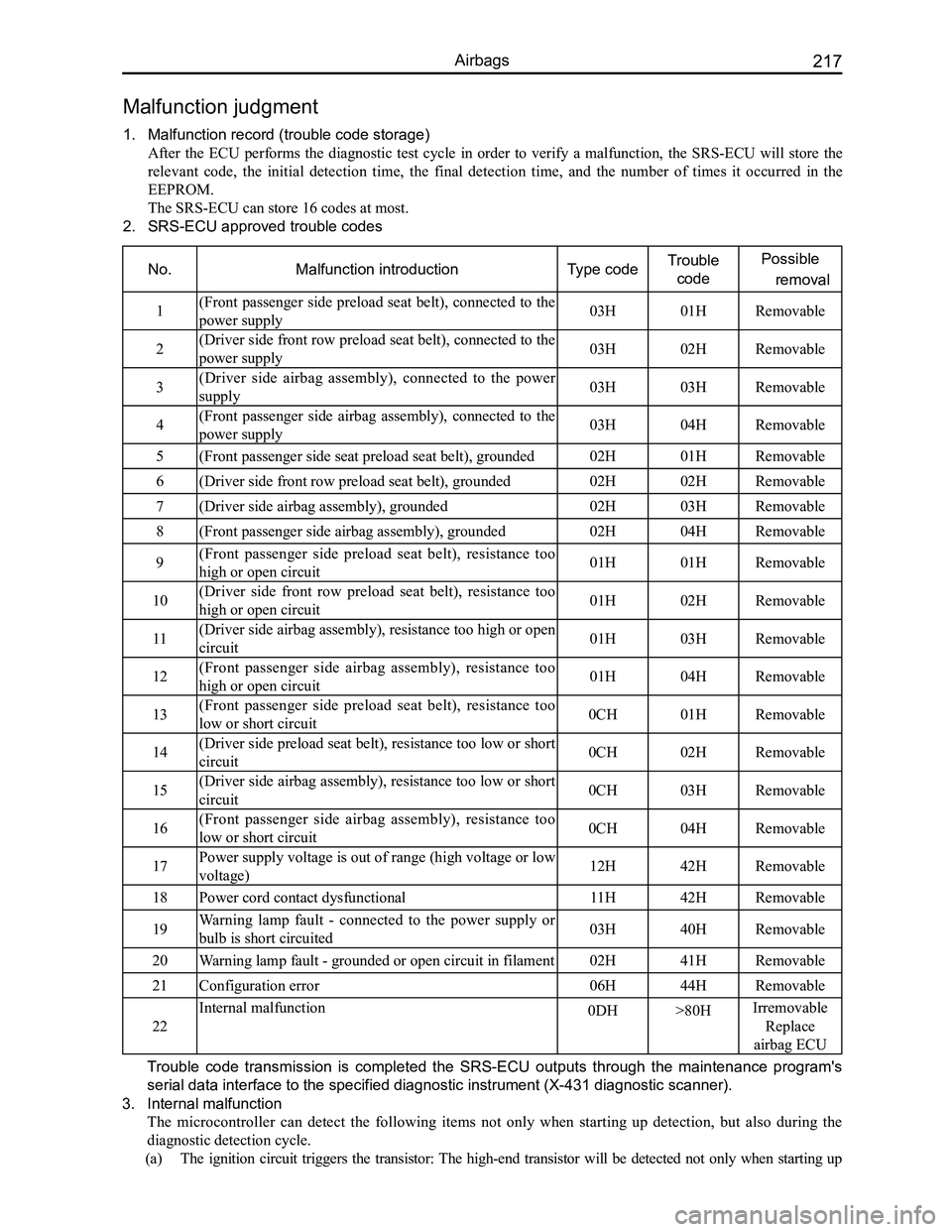
2. SRS-ECU approved trouble codes
No.Malfunction introductionType codeTrouble
code
Possible
removal
1(Front passenger side preload seat belt), connected to the
power supply03H01HRemovable
2(Driver side front row preload seat belt), connected to the
power supply03H02HRemovable
3(Driver side airbag assembly), connected to the power
supply03H03HRemovable
4(Front passenger side airbag assembly), connected to the
power supply03H04HRemovable
5(Front passenger side seat preload seat belt), grounded02H01HRemovable
6(Driver side front row preload seat belt), grounded02H02HRemovable
7(Driver side airbag assembly), grounded02H03HRemovable
8(Front passenger side airbag assembly), grounded02H04HRemovable
9(Front passenger side preload seat belt), resistance too
high or open circuit01H01HRemovable
10(Driver side front row preload seat belt), resistance too
high or open circuit01H02HRemovable
11(Driver side airbag assembly), resistance too high or open
circuit01H03HRemovable
12(Front passenger side airbag assembly), resistance too
high or open circuit01H04HRemovable
13(Front passenger side preload seat belt), resistance too
low or short circuit0CH01HRemovable
14(Driver side preload seat belt), resistance too low or short
circuit0CH02HRemovable
15(Driver side airbag assembly), resistance too low or short
circuit0CH03HRemovable
16(Front passenger side airbag assembly), resistance too
low or short circuit0CH04HRemovable
17Power supply voltage is out of range (high voltage or low
voltage)12H42HRemovable
18Power cord contact dysfunctional11H42HRemovable
19Warning lamp fault - connected to the power supply or
bulb is short circuited03H40HRemovable
20Warning lamp fault - grounded or open circuit in filament02H41HRemovable
21Configuration error06H44HRemovable
22
Internal malfunction0DH>80HIrremovable
Replace
airbag ECU
Trouble code transmission is completed the SRS-ECU outputs through the maintenance program's
serial data interface to the specified diagnostic instrument (X-431 dia\
gnostic scanner).
3. Internal malfunction
The microcontroller can detect the following items not only when starting up detection, but also during the
diagnostic detection cycle.
(a) The ignition circuit triggers the transistor: The high-end transistor will be detected not only when starting up
Page 225 of 281
Downloaded from www.Manualslib.com manuals search engine GWFLORID Maintenance Manual218
detection but also during the diagnostic detection cycle. However, if a short circuit on the power supply causes
a malfunction, and the low-end transistor is opened while malfunctioned, the low-end transistor can only be
detected when starting up detection, as to avoid faulty execution.
(b) Ignition voltage is provided by a pressure increase converter.
(c) Acceleration sensor performs self-detection when starting up detection.
(d) Allowed offset range of the acceleration sensor during a diagnostic cycle.
(e) Microcontroller includes AD converter, ROM, RAM, etc.
(f) Security sensor status.
Caution: There is a short-circuiting bar inside the squib circuit connector. When the connector is not
connected, the short circuit happens between the squib circuit's terminal (+) and terminal (-), as to
avoid faulty deployment caused by static electricity. When the connector is bad and the short-circuiting
bar is connected, the fault symptom may not be eliminated.
4. Clear the trouble code
When the X-431 diagnostic instrument receives the "Clear the trouble code" order sent through the serial inter-
face, the trouble code inside the ECU will be cleared. However, if an internal trouble code is recorded or has a
collision record, it will not carry out this order.
(a) Malfunction status display.
When the working voltage is supplied to the SRS-ECU through a battery, the SRS-ECU will light the warning
lamp to inspect the light bulbs. During the initialization stage, the warning lamp will remain on for 6-7 s, and
in order to inform the driver that the system has a malfunction, the warning lamp will continue to remain on
after the working voltage is supplied. If the history trouble code’s quantity is less than 16, the warning lamp
will remain lit for 6-7 s after turning the ignition on and then turn off automatically. If the history trouble code’s
quantity is 16 and the current malfunction appears, it will be recorded and the first history malfunction record
will be automatically removed.
(b) Malfunction indicator.
When the system has malfunctioned, the warning lamp will be always on.
A displayed or history malfunction can only be reset by service personnel. A SRS-ECU internal malfunction or
malfunction’s "collision record" cannot be reset. In this situation, the SRS-ECU mus\
t be replaced.
(c) Microcontroller - independent warning lamp is lit.
The controller has a self-diagnosis function. If the inner controller malfunctions, the warning lamp will always
be on.
(d) If the airbag warning lamp is always on, please inspect it according to the following steps.
The first step of inspecting any of the malfunctions is to detect the malfunction’s position with a scanner. Then
carry out the inspection using the corresponding part’s inspection method. If the scanning result is an internal
malfunction or having to do with airbag execution, the SRS-ECU can be di\
rectly replaced.
Page 226 of 281

Downloaded from www.Manualslib.com manuals search engine 219Airbags
NO.Troubleshooting listExplanation
1Airbag system warning lamp not litAirbag system warns of circuit malfunction
2Airbag system warning lamp is always onAirbag system warns of circuit
malfunction or external malfunction
2. Airbag system warning lamp does not lit
Inspection
statusAirbag system warning lamp does not lit.
Possible
causes
• Voltage disappears (fuse open circuit)
• Combination meter malfunction
• Wire harness malfunction between the instrument cluster and ECU unit
Diagnostic procedures
While performing the first malfunction detection, it is suggested to wiggle the wire harness and plugs to check for
intermittent or poor contact. If there is, please check whether the plugs, terminals, and the wire harness are connected
properly and undamaged. If the above mentioned problems do not exist, pl\
ease take the following steps.
StepsInspectionOperation
1
Detect other wire harness and instrument cluster indicator
lamps
• Set the ignition switch to the ON position
• Are other warning and indicator lamps on?
Yes
Set the ignition switch to the LOCK
position, and then proceed to the
next step
No
Detect the instrument cluster's
power supply system and the
grounded system (fuse)
2
Inspect the light bulbs
Warning:
Incorrect airbag system component operation will cause the
airbag and preload seat belt to opened accidentally, which
may cause serious injuries. Please read the airbag system
services warning before working on the airbag components
• Set the ignition switch to the LOCK position
• Disconnect the battery's negative cable and maintain for at
least 60 s
• Remove the combination meter
• Check whether the two corresponding pins of the airbag
warning lamp are conducting
Yes
Go to the next step
No
Replace the combination meter
3
Detect the wire harness connection between the ECU unit and
the instrument cluster
• Set the ignition switch to the LOCK position
• Disconnect the battery's negative cable
• Disconnect the instrument cluster plugs
• Check whether the warning lamp's corresponding circuits
are conducting
YesGo to the next step
No
Replace the wire harness
Malfunction diagnosis and troubleshooting
1. Warning lamp is not on or always on