Page 468 of 578

Dual Tire Operation
When the vehicle is new, or whenever a wheel,
wheel bolt or wheel nut is replaced, check the wheel
nut torque after 100, 1,000 and 6,000 miles
(160, 1 600 and 10 000 km) of driving. For proper
torque and wheel nut tightening information, see
Removing the Spare Tire and Tools on page 5-93.
The outer tire on a dual wheel setup generally wears
faster than the inner tire. Your tires will wear more
evenly and last longer if you rotate the tires periodically,
seeTire Inspection and Rotation on page 5-81. Also see
Scheduled Maintenance (Gasoline Engine) on page 6-4.
{CAUTION:
If you operate your vehicle with a tire that is
badly underinated, the tire can overheat. An
overheated tire can lose air suddenly or catch
re. You or others could be injured. Be sure all
tires (including the spare) are properly inated.
SeeInflation - Tire Pressure on page 5-74, for
information on proper tire ination.
Tire Pressure Monitor System
The Tire Pressure Monitor System (TPMS) uses radio
and sensor technology to check tire pressure levels. The
TPMS sensors monitor the air pressure in your vehicle’s
tires and transmit tire pressure readings to a receiver
located in the vehicle.
Each tire, including the spare (if provided), should be
checked monthly when cold and inated to the ination
pressure recommended by the vehicle manufacturer
on the vehicle placard or tire ination pressure label.
(If your vehicle has tires of a different size than the size
indicated on the vehicle placard or tire ination pressure
label, you should determine the proper tire ination
pressure for those tires.)
As an added safety feature, your vehicle has been
equipped with a tire pressure monitoring system (TPMS)
that illuminates a low tire pressure telltale when one or
more of your tires is signicantly under-inated.
Accordingly, when the low tire pressure telltale
illuminates, you should stop and check your tires as
soon as possible, and inate them to the proper
pressure. Driving on a signicantly under-inated tire
causes the tire to overheat and can lead to tire failure.
Under-ination also reduces fuel efficiency and tire
tread life, and may affect the vehicle’s handling and
stopping ability.
5-76
Page 511 of 578
Tires
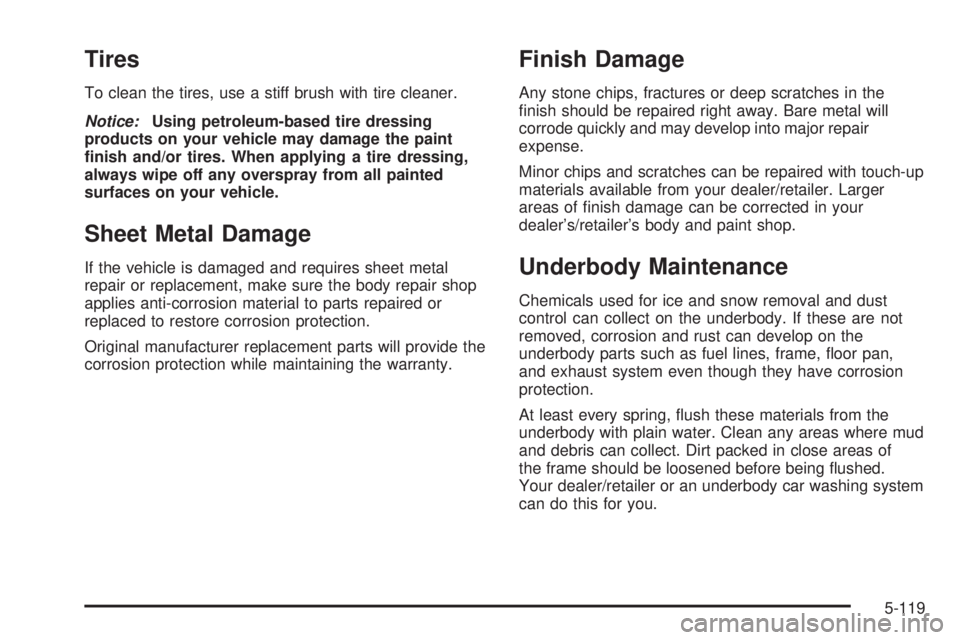
To clean the tires, use a stiff brush with tire cleaner.
Notice:Using petroleum-based tire dressing
products on your vehicle may damage the paint
nish and/or tires. When applying a tire dressing,
always wipe off any overspray from all painted
surfaces on your vehicle.
Sheet Metal Damage
If the vehicle is damaged and requires sheet metal
repair or replacement, make sure the body repair shop
applies anti-corrosion material to parts repaired or
replaced to restore corrosion protection.
Original manufacturer replacement parts will provide the
corrosion protection while maintaining the warranty.
Finish Damage
Any stone chips, fractures or deep scratches in the
nish should be repaired right away. Bare metal will
corrode quickly and may develop into major repair
expense.
Minor chips and scratches can be repaired with touch-up
materials available from your dealer/retailer. Larger
areas of nish damage can be corrected in your
dealer’s/retailer’s body and paint shop.
Underbody Maintenance
Chemicals used for ice and snow removal and dust
control can collect on the underbody. If these are not
removed, corrosion and rust can develop on the
underbody parts such as fuel lines, frame, oor pan,
and exhaust system even though they have corrosion
protection.
At least every spring, ush these materials from the
underbody with plain water. Clean any areas where mud
and debris can collect. Dirt packed in close areas of
the frame should be loosened before being ushed.
Your dealer/retailer or an underbody car washing system
can do this for you.
5-119
Page 519 of 578
Fuses Usage
1 Right Trailer Stop/Turn Lamp
2Electronic Suspension Control,
Automatic Level Control Exhaust
3 Left Trailer Stop/Turn Lamp
4 Engine Controls
5Engine Control Module, Throttle
Control
6 Trailer Brake Controller
Fuses Usage
7 Front Washer
8 Oxygen Sensor
9 Antilock Brakes System 2
10 Trailer Back-up Lamps
11 Driver Side Low-Beam Headlamp
12 Engine Control Module (Battery)
13Fuel Injectors, Ignition Coils
(Right Side)
14Transmission Control Module
(Battery)
15 Vehicle Back-up Lamps
16Passenger Side Low-Beam
Headlamp
17 Air Conditioning Compressor
18 Oxygen Sensors
19 Transmission Controls (Ignition)
20 Fuel Pump
21 Fuel System Control Module
22 Not Used
23 Not Used
24Fuel Injectors, Ignition Coils
(Left Side)
25 Trailer Park Lamps
26 Driver Side Park Lamps
5-127
Page 520 of 578
Fuses Usage
27 Passenger Side Park Lamps
28 Fog Lamps
29 Horn
30Passenger Side High-Beam
Headlamp
31 Daytime Running Lamps
32 Driver Side High-Beam Headlamp
33 Daytime Running Lights 2
34 Sunroof
35Key Ignition System, Theft Deterrent
System
36 Windshield Wiper
37 SEO B2 Uptter Usage (Battery)
38 Electric Adjustable Pedals
39 Climate Controls (Battery)
40 Airbag System (Ignition)
41 Amplier
42 Audio System
43Miscellaneous (Ignition), Cruise
ControlFuses Usage
44 Not Used
45 Airbag System (Battery)
46 Instrument Panel Cluster
47 Power Take-Off
48Auxiliary Climate Control (Ignition),
Compass-Temperature Mirror
49Center High-Mounted Stoplamp
(CHMSL)
50 Rear Defogger
51 Heated Mirrors
52 SEO B1 Uptter Usage (Battery)
53Cigarette Lighter, Auxiliary Power
Outlet
54Automatic Level Control Compressor
Relay, SEO Uptter Usage
55 Climate Controls (Ignition)
56Engine Control Module, Secondary
Fuel Pump (Ignition)
5-128
Page 521 of 578
J-Case Fuses Usage
57 Cooling Fan 1
58 Not Used
59 Heavy Duty Antilock Brake System
60 Cooling Fan 2
61 Antilock Brake System 1
62 Starter
63 Stud 2 (Trailer Brakes)
64 Left Bussed Electrical Center 1
65 Not Used
66 Heated Windshield Washer System
67 Four-Wheel Drive System
68Stud 1
(Trailer Connector Battery Power)
(Optional - 40A Fuse Required)
69 Mid-Bussed Electrical Center 1
70 Climate Control Blower
72 Not Used
73 Left Bussed Electrical Center 2Relays Usage
FAN HI Cooling Fan High Speed
FAN LO Cooling Fan Low Speed
ENG EXH VLV Not Used
FAN CNTRL Cooling Fan Control
HDLP LO/HID Low-Beam Headlamp
FOG LAMP Front Fog Lamps
A/C CMPRSR Air Conditioning Compressor
STRTR Starter
PWR/TRN Powertrain
FUEL PMP Fuel Pump
PRK LAMP Parking Lamps
REAR DEFOG Rear Defogger
RUN/CRANK Switched Power
5-129
Page 522 of 578
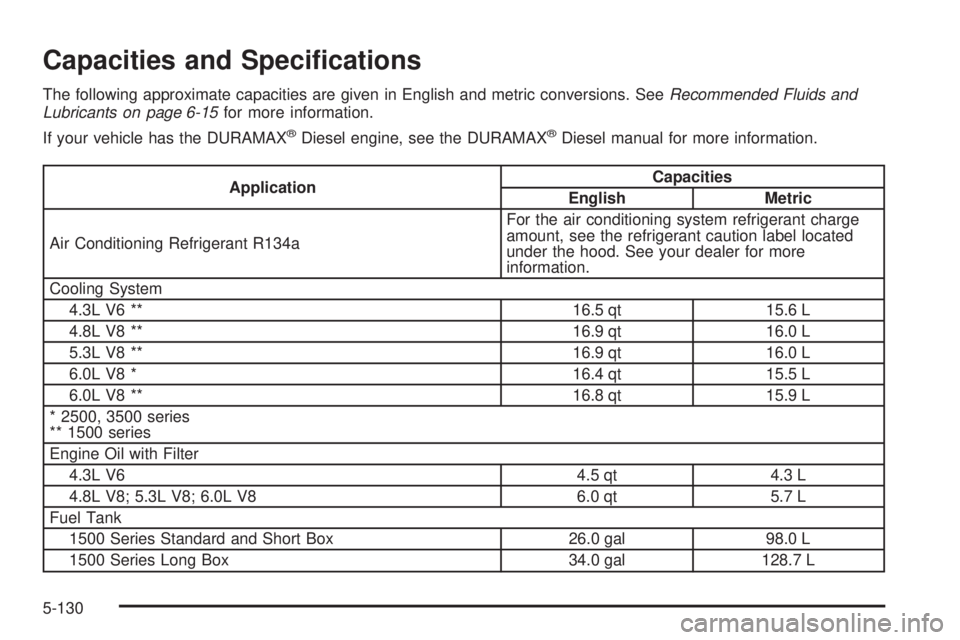
Capacities and Specications
The following approximate capacities are given in English and metric conversions. SeeRecommended Fluids and
Lubricants on page 6-15for more information.
If your vehicle has the DURAMAX
®Diesel engine, see the DURAMAX®Diesel manual for more information.
ApplicationCapacities
English Metric
Air Conditioning Refrigerant R134aFor the air conditioning system refrigerant charge
amount, see the refrigerant caution label located
under the hood. See your dealer for more
information.
Cooling System
4.3L V6 ** 16.5 qt 15.6 L
4.8L V8 ** 16.9 qt 16.0 L
5.3L V8 ** 16.9 qt 16.0 L
6.0L V8 * 16.4 qt 15.5 L
6.0L V8 ** 16.8 qt 15.9 L
* 2500, 3500 series
** 1500 series
Engine Oil with Filter
4.3L V6 4.5 qt 4.3 L
4.8L V8; 5.3L V8; 6.0L V8 6.0 qt 5.7 L
Fuel Tank
1500 Series Standard and Short Box 26.0 gal 98.0 L
1500 Series Long Box 34.0 gal 128.7 L
5-130
Page 524 of 578
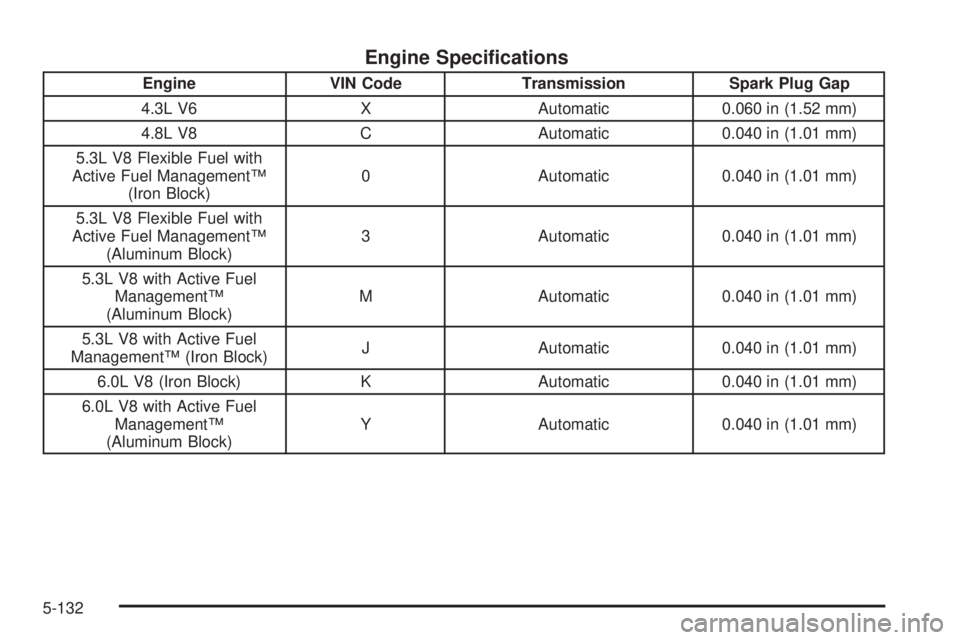
Engine Specications
Engine VIN Code Transmission Spark Plug Gap
4.3L V6 X Automatic 0.060 in (1.52 mm)
4.8L V8 C Automatic 0.040 in (1.01 mm)
5.3L V8 Flexible Fuel with
Active Fuel Management™
(Iron Block)0 Automatic 0.040 in (1.01 mm)
5.3L V8 Flexible Fuel with
Active Fuel Management™
(Aluminum Block)3 Automatic 0.040 in (1.01 mm)
5.3L V8 with Active Fuel
Management™
(Aluminum Block)M Automatic 0.040 in (1.01 mm)
5.3L V8 with Active Fuel
Management™ (Iron Block)J Automatic 0.040 in (1.01 mm)
6.0L V8 (Iron Block) K Automatic 0.040 in (1.01 mm)
6.0L V8 with Active Fuel
Management™
(Aluminum Block)Y Automatic 0.040 in (1.01 mm)
5-132
Page 525 of 578

Maintenance Schedule......................................6-2
Introduction...................................................6-2
Maintenance Requirements..............................6-2
Your Vehicle and the Environment....................6-2
Using the Maintenance Schedule......................6-3
Scheduled Maintenance (Gasoline Engine).........6-4
Additional Required Services
(Gasoline Engine).......................................6-7
Maintenance Footnotes (Gasoline Engine)..........6-9
Owner Checks and Services..........................6-11At the First 100, 1,000 and 6,000 Miles
(160, 1 600 and 10 000 km).......................6-11
At Each Fuel Fill..........................................6-11
At Least Once a Month.................................6-12
At Least Once a Year...................................6-13
Recommended Fluids and Lubricants...............6-15
Maintenance Replacement Parts.....................6-17
Engine Drive Belt Routing..............................6-18
Maintenance Record.....................................6-19
Section 6 Maintenance Schedule
6-1