2008 GMC SIERRA fuel
[x] Cancel search: fuelPage 527 of 578

Using the Maintenance Schedule
We want to help you keep your vehicle in good working
condition. But we do not know exactly how you will
drive it. You might drive very short distances only a few
times a week. Or you might drive long distances all
the time in very hot, dusty weather. You might use your
vehicle in making deliveries. Or you might drive it to
work, to do errands, or in many other ways.
Because of all the different ways people use their
vehicles, maintenance needs vary. You might need more
frequent checks and replacements. So please read
the following and note how you drive. If you have any
questions on how to keep your vehicle in good condition,
see your dealer/retailer.
This schedule is for vehicles that:
carry passengers and cargo within recommended
limits. You will nd these limits on the Tire and
Loading Information label. SeeLoading Your
Vehicle on page 4-36.
are driven on reasonable road surfaces within
legal driving limits.
are driven off-road in the recommended manner.
SeeOff-Road Driving on page 4-12.
use the recommended fuel. SeeGasoline
Octane on page 5-6.The services inScheduled Maintenance (Gasoline
Engine) on page 6-4should be performed when
indicated. SeeAdditional Required Services (Gasoline
Engine) on page 6-7andMaintenance Footnotes
(Gasoline Engine) on page 6-9for further information.
{CAUTION:
Performing maintenance work on a vehicle can
be dangerous. In trying to do some jobs, you
can be seriously injured. Do your own
maintenance work only if you have the
required know-how and the proper tools and
equipment for the job. If you have any doubt,
see your dealer/retailer to have a qualied
technician do the work. SeeDoing Your Own
Service Work on page 5-5.
Some maintenance services can be complex. So,
unless you are technically qualied and have the
necessary equipment, you should have your
dealer/retailer do these jobs.
When you go to your dealer/retailer for your service
needs, you will know that trained and supported service
technicians will perform the work using genuine parts.
6-3
Page 531 of 578
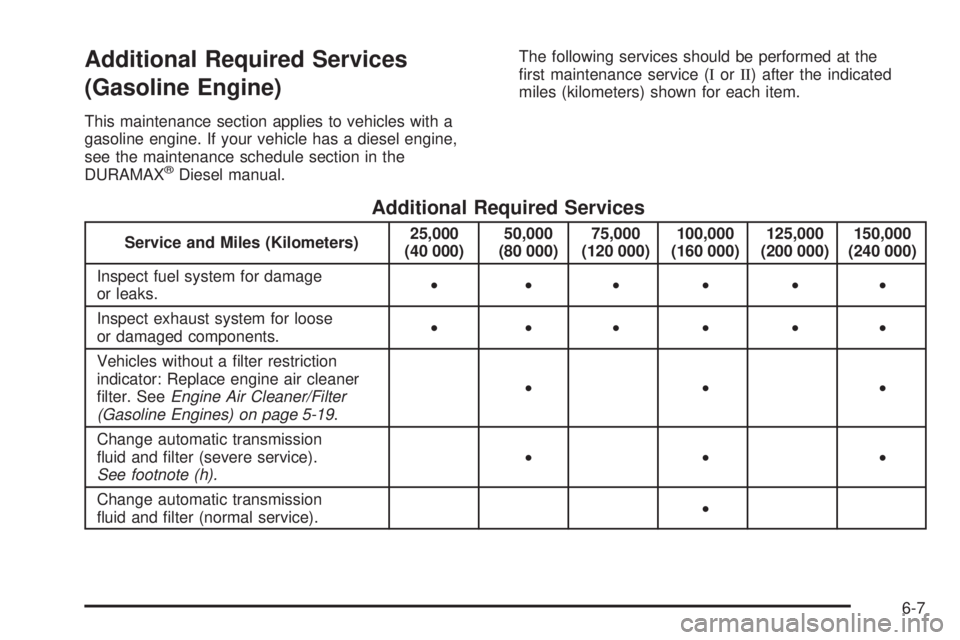
Additional Required Services
(Gasoline Engine)
This maintenance section applies to vehicles with a
gasoline engine. If your vehicle has a diesel engine,
see the maintenance schedule section in the
DURAMAX
®Diesel manual.The following services should be performed at the
rst maintenance service (IorII) after the indicated
miles (kilometers) shown for each item.
Additional Required Services
Service and Miles (Kilometers)25,000
(40 000)50,000
(80 000)75,000
(120 000)100,000
(160 000)125,000
(200 000)150,000
(240 000)
Inspect fuel system for damage
or leaks.• •••••
Inspect exhaust system for loose
or damaged components.• •••••
Vehicles without a lter restriction
indicator: Replace engine air cleaner
lter. SeeEngine Air Cleaner/Filter
(Gasoline Engines) on page 5-19.•••
Change automatic transmission
uid and lter (severe service).
See footnote (h).•••
Change automatic transmission
uid and lter (normal service).•
6-7
Page 534 of 578
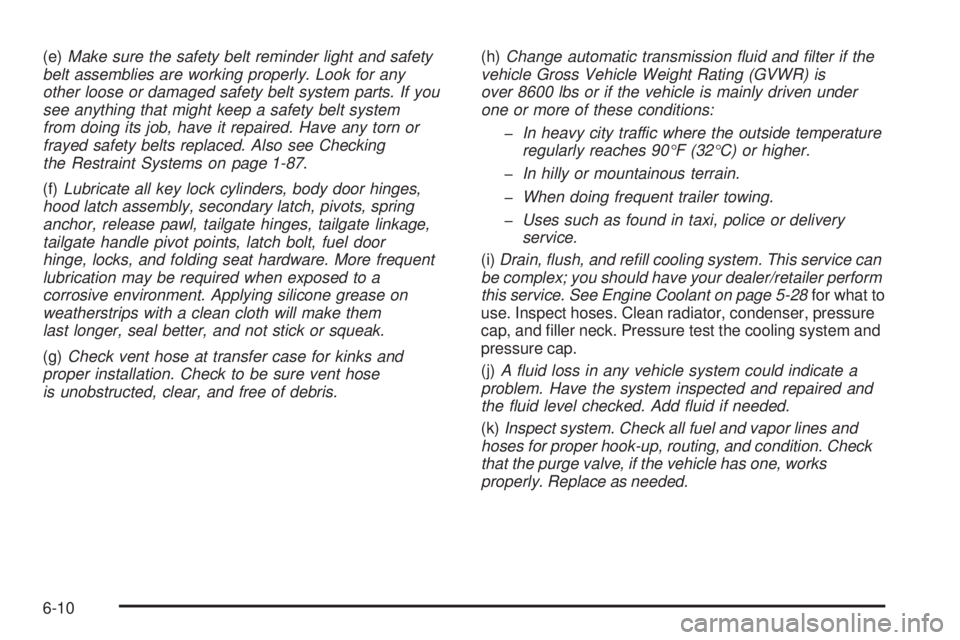
(e)Make sure the safety belt reminder light and safety
belt assemblies are working properly. Look for any
other loose or damaged safety belt system parts. If you
see anything that might keep a safety belt system
from doing its job, have it repaired. Have any torn or
frayed safety belts replaced. Also see Checking
the Restraint Systems on page 1-87.
(f)Lubricate all key lock cylinders, body door hinges,
hood latch assembly, secondary latch, pivots, spring
anchor, release pawl, tailgate hinges, tailgate linkage,
tailgate handle pivot points, latch bolt, fuel door
hinge, locks, and folding seat hardware. More frequent
lubrication may be required when exposed to a
corrosive environment. Applying silicone grease on
weatherstrips with a clean cloth will make them
last longer, seal better, and not stick or squeak.
(g)Check vent hose at transfer case for kinks and
proper installation. Check to be sure vent hose
is unobstructed, clear, and free of debris.(h)Change automatic transmission fluid and filter if the
vehicle Gross Vehicle Weight Rating (GVWR) is
over 8600 lbs or if the vehicle is mainly driven under
one or more of these conditions:
In heavy city traffic where the outside temperature
regularly reaches 90°F (32°C) or higher.
In hilly or mountainous terrain.
When doing frequent trailer towing.
Uses such as found in taxi, police or delivery
service.
(i)Drain, flush, and refill cooling system. This service can
be complex; you should have your dealer/retailer perform
this service. See Engine Coolant on page 5-28for what to
use. Inspect hoses. Clean radiator, condenser, pressure
cap, and ller neck. Pressure test the cooling system and
pressure cap.
(j)A fluid loss in any vehicle system could indicate a
problem. Have the system inspected and repaired and
the fluid level checked. Add fluid if needed.
(k)Inspect system. Check all fuel and vapor lines and
hoses for proper hook-up, routing, and condition. Check
that the purge valve, if the vehicle has one, works
properly. Replace as needed.
6-10
Page 535 of 578

(l)Extreme Duty Service: Change transfer case fluid if
the vehicle is mainly driven off-road in four-wheel
drive, or is used for heavy trailer towing. Farming,
mining, forestry, and Department of Natural Resources
(DNR) vehicles meet this definition.
(m)During any maintenance, if a power washer is used
to clean mud and dirt from the underbody, care should be
taken to not directly spray the transfer case output seals.
High pressure water can overcome the seals and
contaminate the transfer case fluid. Contaminated fluid
will decrease the life of the transfer case and should be
replaced.
(n)Vehicles with diesel engine or with GVWR above
10,000 lbs (4 536 kg) only: Inspect shields for damage or
looseness. Adjust or replace as required. This is a
Noise Emission Control Service. Applicable to vehicles
sold in the United States and recommended for
vehicles sold in Canada.
(p)If you drive regularly under dusty conditions, inspect
the filter or change indicator (if equipped) at each
engine oil change.
(q)Visually inspect belt for fraying, excessive cracks, or
obvious damage. Replace belt if necessary.Owner Checks and Services
These owner checks and services should be performed
at the intervals specied to help ensure the safety,
dependability, and emission control performance of your
vehicle. Your dealer/retailer can assist you with these
checks and services.
Be sure any necessary repairs are completed at once.
Whenever any uids or lubricants are added to your
vehicle, make sure they are the proper ones, as shown
inRecommended Fluids and Lubricants on page 6-15.
At the First 100, 1,000 and 6,000
Miles (160, 1 600 and 10 000 km)
For vehicles with dual wheels, check dual wheel
nut torque. For proper torque, seeCapacities and
Specifications on page 5-130.
At Each Fuel Fill
It is important to perform these underhood checks at
each fuel fill.
6-11
Page 540 of 578

Usage Fluid/Lubricant
Rear AxleSAE 75W-90 Synthetic Axle
Lubricant (GM Part No. U.S.
89021677, in Canada 89021678)
meeting GM Specication 9986115.
Transfer Case
(Four-Wheel
Drive)DEXRON
®-VI Automatic
Transmission Fluid.
Front Axle
Propshaft
Spline or
One-Piece
Propshaft
Spline
(Two-Wheel
Drive with
4-Speed Auto.
Trans.)Spline Lubricant, Special Lubricant
(GM Part No. U.S. 12345879, in
Canada 10953511) or lubricant
meeting requirements of GM
9985830.
Rear Driveline
Center SplineChassis Lubricant (GM Part No.
U.S. 12377985, in Canada
88901242) or lubricant meeting
requirements of NLGI #2, Category
LB or GC-LB.
Hood HingesMulti-Purpose Lubricant, Superlube
(GM Part No. U.S. 12346241, in
Canada 10953474).
Usage Fluid/Lubricant
Body Door
Hinge Pins,
Tailgate Hinge
and Linkage,
Folding Seats,
and Fuel Door
HingeMulti-Purpose Lubricant, Superlube
(GM Part No. U.S. 12346241, in
Canada 10953474).
Tailgate Handle
Pivot Points,
Hinges, Latch
Bolt, and
LinkageMulti-Purpose Lubricant, Superlube
(GM Part No. U.S. 12346241, in
Canada 10953474).
Weatherstrip
ConditioningWeatherstrip Lubricant (GM Part No.
U.S. 3634770, in Canada 10953518)
or Dielectric Silicone Grease (GM
Part No. U.S. 12345579, in Canada
992887).
Weatherstrip
SqueaksSynthetic Grease with Teon,
Superlube (GM Part No. U.S.
12371287, in Canada 10953437).
6-16
Page 553 of 578
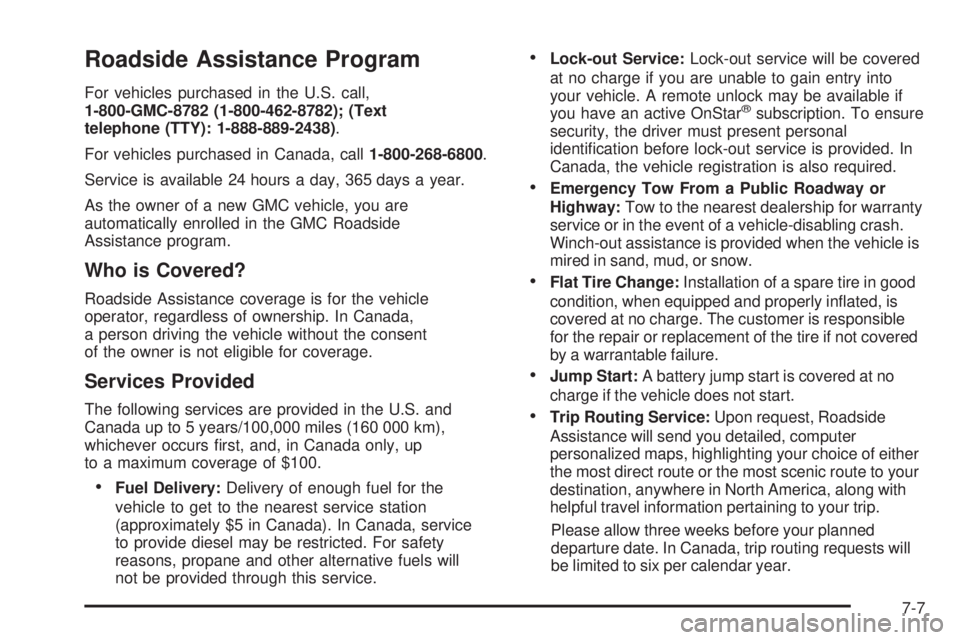
Roadside Assistance Program
For vehicles purchased in the U.S. call,
1-800-GMC-8782 (1-800-462-8782); (Text
telephone (TTY): 1-888-889-2438).
For vehicles purchased in Canada, call1-800-268-6800.
Service is available 24 hours a day, 365 days a year.
As the owner of a new GMC vehicle, you are
automatically enrolled in the GMC Roadside
Assistance program.
Who is Covered?
Roadside Assistance coverage is for the vehicle
operator, regardless of ownership. In Canada,
a person driving the vehicle without the consent
of the owner is not eligible for coverage.
Services Provided
The following services are provided in the U.S. and
Canada up to 5 years/100,000 miles (160 000 km),
whichever occurs rst, and, in Canada only, up
to a maximum coverage of $100.
Fuel Delivery:Delivery of enough fuel for the
vehicle to get to the nearest service station
(approximately $5 in Canada). In Canada, service
to provide diesel may be restricted. For safety
reasons, propane and other alternative fuels will
not be provided through this service.
Lock-out Service:Lock-out service will be covered
at no charge if you are unable to gain entry into
your vehicle. A remote unlock may be available if
you have an active OnStar
®subscription. To ensure
security, the driver must present personal
identication before lock-out service is provided. In
Canada, the vehicle registration is also required.
Emergency Tow From a Public Roadway or
Highway:Tow to the nearest dealership for warranty
service or in the event of a vehicle-disabling crash.
Winch-out assistance is provided when the vehicle is
mired in sand, mud, or snow.
Flat Tire Change:Installation of a spare tire in good
condition, when equipped and properly inated, is
covered at no charge. The customer is responsible
for the repair or replacement of the tire if not covered
by a warrantable failure.
Jump Start:A battery jump start is covered at no
charge if the vehicle does not start.
Trip Routing Service:Upon request, Roadside
Assistance will send you detailed, computer
personalized maps, highlighting your choice of either
the most direct route or the most scenic route to your
destination, anywhere in North America, along with
helpful travel information pertaining to your trip.
Please allow three weeks before your planned
departure date. In Canada, trip routing requests will
be limited to six per calendar year.
7-7
Page 556 of 578
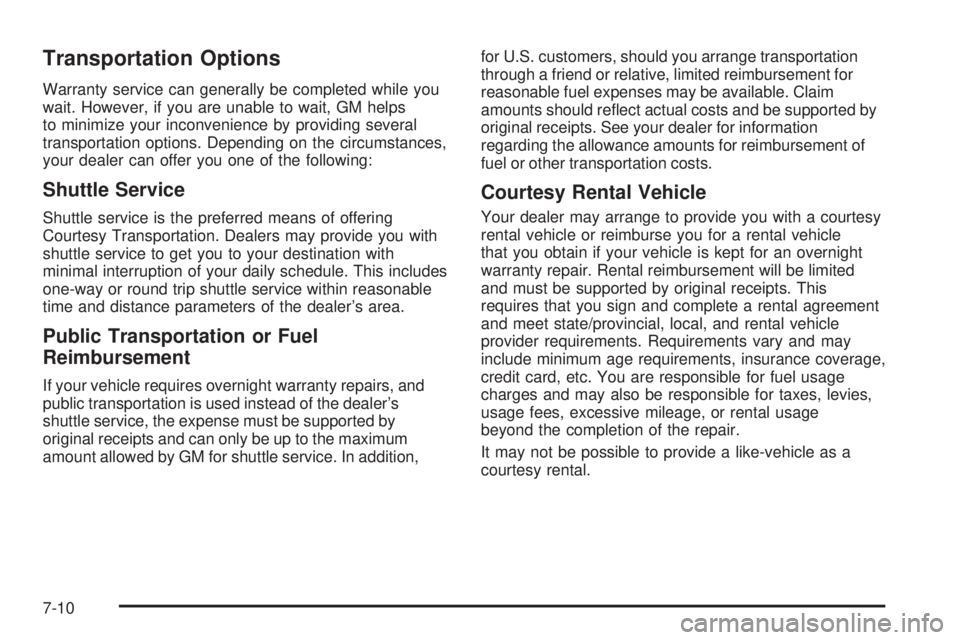
Transportation Options
Warranty service can generally be completed while you
wait. However, if you are unable to wait, GM helps
to minimize your inconvenience by providing several
transportation options. Depending on the circumstances,
your dealer can offer you one of the following:
Shuttle Service
Shuttle service is the preferred means of offering
Courtesy Transportation. Dealers may provide you with
shuttle service to get you to your destination with
minimal interruption of your daily schedule. This includes
one-way or round trip shuttle service within reasonable
time and distance parameters of the dealer’s area.
Public Transportation or Fuel
Reimbursement
If your vehicle requires overnight warranty repairs, and
public transportation is used instead of the dealer’s
shuttle service, the expense must be supported by
original receipts and can only be up to the maximum
amount allowed by GM for shuttle service. In addition,for U.S. customers, should you arrange transportation
through a friend or relative, limited reimbursement for
reasonable fuel expenses may be available. Claim
amounts should reect actual costs and be supported by
original receipts. See your dealer for information
regarding the allowance amounts for reimbursement of
fuel or other transportation costs.
Courtesy Rental Vehicle
Your dealer may arrange to provide you with a courtesy
rental vehicle or reimburse you for a rental vehicle
that you obtain if your vehicle is kept for an overnight
warranty repair. Rental reimbursement will be limited
and must be supported by original receipts. This
requires that you sign and complete a rental agreement
and meet state/provincial, local, and rental vehicle
provider requirements. Requirements vary and may
include minimum age requirements, insurance coverage,
credit card, etc. You are responsible for fuel usage
charges and may also be responsible for taxes, levies,
usage fees, excessive mileage, or rental usage
beyond the completion of the repair.
It may not be possible to provide a like-vehicle as a
courtesy rental.
7-10
Page 562 of 578

Current and Past Model Order Forms
Technical Service Bulletins and Manuals are available
for current and past model GM vehicles. To request
an order form, specify year and model name of
the vehicle.
ORDER TOLL FREE: 1-800-551-4123
Monday-Friday 8:00 AM - 6:00 PM
Eastern Time
For Credit Card Orders Only
(VISA-MasterCard-Discover), visit Helm, Inc.
on the World Wide Web at: www.helminc.com
Or you can write to:
Helm, Incorporated
P.O. Box 07130
Detroit, MI 48207
Prices are subject to change without notice and without
incurring obligation. Allow ample time for delivery.
Note to Canadian Customers: All listed prices are
quoted in U.S. funds. Canadian residents are to make
checks payable in U.S. funds.
Vehicle Data Recording and
Privacy
Your GM vehicle has a number of sophisticated
computers that record information about the vehicle’s
performance and how it is driven. For example,
your vehicle uses computer modules to monitor and
control engine and transmission performance, to monitor
the conditions for airbag deployment and deploy
airbags in a crash and, if so equipped, to provide
antilock braking to help the driver control the vehicle.
These modules may store data to help your
dealer/retailer technician service your vehicle. Some
modules may also store data about how you operate the
vehicle, such as rate of fuel consumption or average
speed. These modules may also retain the owner’s
personal preferences, such as radio pre-sets, seat
positions, and temperature settings.
7-16