Page 280 of 457

Automatic Transmission Ignition Interlock System
This system prevents the key from being removed unless
the shift lever is in PARK. It also prevents shifting out of
PARK unless the key is in the ACCESSORY or ON
position.
NOTE:If a malfunction occurs, the system will trap the
key in the ignition cylinder to warn you that this safety
feature is inoperable. The engine can be started and
stopped but the key cannot be removed until you obtain
service.
Reset Mode - Electronic Transmission
For electrical system malfunctions there is an override for
the interlock system. In order to override this system the
key must be in the ignition with the switch in the ACC or
ON positions. Pull up and rearward on the shifter bezel
ring.
The override can be activated by pressing the pink-
colored tab, which can be accessed through the lowerright corner of the shifter bezel ring. While the override is
pressed, the shifter can be moved out of the park position
without pressing the brake. After operation return the
shifter bezel ring to its original position.
NOTE:Even if the transmission can be reset, it is
recommended that you visit a dealer at your earliest
Brake Interlock Override
280 STARTING AND OPERATING
Page 281 of 457

possible convenience. Your dealer has diagnostic equip-
ment to determine if the problem could recur.
Gear Ranges
DO NOT race the engine when shifting from PARK or
NEUTRAL positions into another gear range.
ªPº Park
Supplements the parking brake by locking the transmis-
sion. The engine can be started in this range. Never
attempt to use PARK while vehicle is in motion.
Apply parking brake when leaving vehicle in this range.
WARNING!
Never use Park position on an automatic transmission
as a substitute for the parking brake. Always apply
parking brake fully when parked to guard against
vehicle movement and possible injury or damage.
ªRº Reverse
Shift into this range only after the vehicle has come to a
complete stop.
ªNº Neutral
Engine may be started in this range.
ªDº Overdrive
To be used for most city and highway driving, it provides
smoothest upshifts and downshifts and best fuel
economy. When frequent transmission shifting occurs
while using the ªDº Overdrive position, such as when
operating the vehicle under heavy loading conditions,
(i.e. in hilly terrain, traveling into strong head winds or
while towing heavy trailers), use the AutoStick mode and
select the ª3º range.
NOTE:Using the ª3º range in the AutoStick mode
while operating the vehicle under heavy operating con-
ditions will improve performance and extend transmis-
sion life by reducing excessive shifting and heat build up.
STARTING AND OPERATING 281
5
Page 282 of 457

AUTOSTICK
AutoStick is a driver-interactive transmission that offers
manual gear shifting capability to provide you with more
control. AutoStick allows you to maximize engine brak-
ing, eliminate undesirable upshifts and downshifts, and
improve overall vehicle performance. This system can
also provide you with more control during passing, city
driving, cold slippery conditions, mountain driving,
trailer towing, and many other situations.
AutoStickTOperation
By placing the selector lever one shift-level below the9D9
position, it can be moved from side to side. This allows
the driver to select a higher or lower range of gears.
Moving the selector lever to the Left (-) triggers a
downshift and to the Right (+) an upshift. The gear
position will display in the instrument cluster on the
transaxle range indicator.NOTE:In Autosticktmode, the transaxle will only shift
up or down when the driver moves the selector lever to
the Right (+) for shifting up or to the Left (-) when
shifting down.
AutoStickTGeneral Information
²
You can start out in first or second gear. The system
will ignore attempts to upshift at too low of a vehicle
speed.
²If a ratio other than 1st is selected, and the vehicle is
brought to a stop, the transaxle control logic will
automatically select the 1st gear ratio.
²Starting out in second gear is helpful in snowy or icy
conditions.
²Avoid using speed control when Autosticktis engaged.
²The transaxle will automatically shift up when maxi-
mum engine speed is reached while Autosticktis
engaged.
282 STARTING AND OPERATING
Page 283 of 457

²Transaxle shifting will be more noticeable when Auto-
sticktis engaged.
²If a low range is selected and the engine accelerates to
the rev limit, the transaxle will automatically select the
next higher ratio.
²If a downshift would cause the engine to over-speed,
that shift will not occur until it is safe for the engine.
Mostly the transaxle will stay in the manually selected
ratio, however.
²If the system detects powertrain overheating, the
transaxle will revert to the automatic shift mode and
remain in that mode until the powertrain cools off.
²If the system detects a problem, it will disable the
AutoSticktmode and the transaxle will return to the
automatic mode until the problem is corrected.
CAUTION!
Damage to the transmission may occur if the follow-
ing precautions are not observed:
²Shift into PARK only after the vehicle has come to
a complete stop.
²Shift into or out of REVERSE only after the
vehicle has come to a complete stop and the engine
is at idle speed.
²Do not shift from REVERSE, PARK, or NEUTRAL
into any forward gear when the engine is above
idle speed.
²Before shifting into any gear, make sure your foot
is firmly on the brake pedal.
STARTING AND OPERATING 283
5
Page 286 of 457
added precaution, turn the front wheels toward the curb
on a downhill grade and away from the curb on a uphill
grade.
The parking brake should always be applied when the
driver is not in the vehicle.WARNING!
²Always fully apply the parking brake when leav-
ing your vehicle, or it may roll and cause damage
or injury. Also be certain to leave an automatic
transmission in Park, a manual transmission in
Reverse or first gear. Failure to do so may allow the
vehicle to roll and cause damage or injury.
²NEVER leave children alone in a vehicle. Leaving
children in a vehicle unattended is dangerous for a
number of reasons. A child or others could be
seriously or fatally injured. Don't leave the keys in
the ignition. A child could operate power win-
dows, other controls, or move the vehicle
²Be sure the parking brake is fully disengaged
before driving, failure to do so can lead to brake
problems due to excessive heating of the rear
brakes.
286 STARTING AND OPERATING
Page 339 of 457
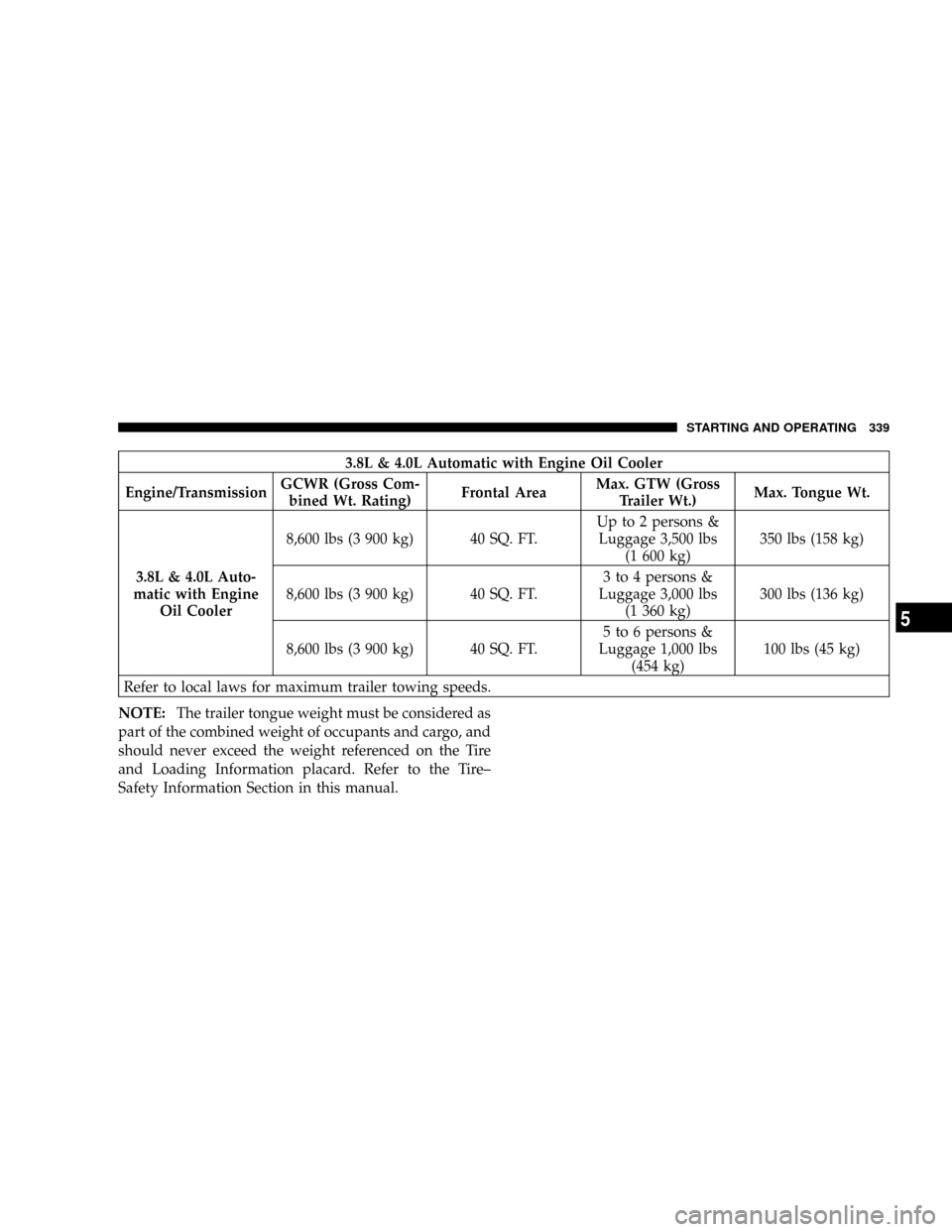
3.8L & 4.0L Automatic with Engine Oil Cooler
Engine/TransmissionGCWR (Gross Com-
bined Wt. Rating)Frontal AreaMax. GTW (Gross
Trailer Wt.)Max. Tongue Wt.
3.8L & 4.0L Auto-
matic with Engine
Oil Cooler8,600 lbs (3 900 kg) 40 SQ. FT.Up to 2 persons &
Luggage 3,500 lbs
(1 600 kg)350 lbs (158 kg)
8,600 lbs (3 900 kg) 40 SQ. FT.3 to 4 persons &
Luggage 3,000 lbs
(1 360 kg)300 lbs (136 kg)
8,600 lbs (3 900 kg) 40 SQ. FT.5 to 6 persons &
Luggage 1,000 lbs
(454 kg)100 lbs (45 kg)
Refer to local laws for maximum trailer towing speeds.
NOTE:The trailer tongue weight must be considered as
part of the combined weight of occupants and cargo, and
should never exceed the weight referenced on the Tire
and Loading Information placard. Refer to the Tire±
Safety Information Section in this manual.
STARTING AND OPERATING 339
5
Page 340 of 457
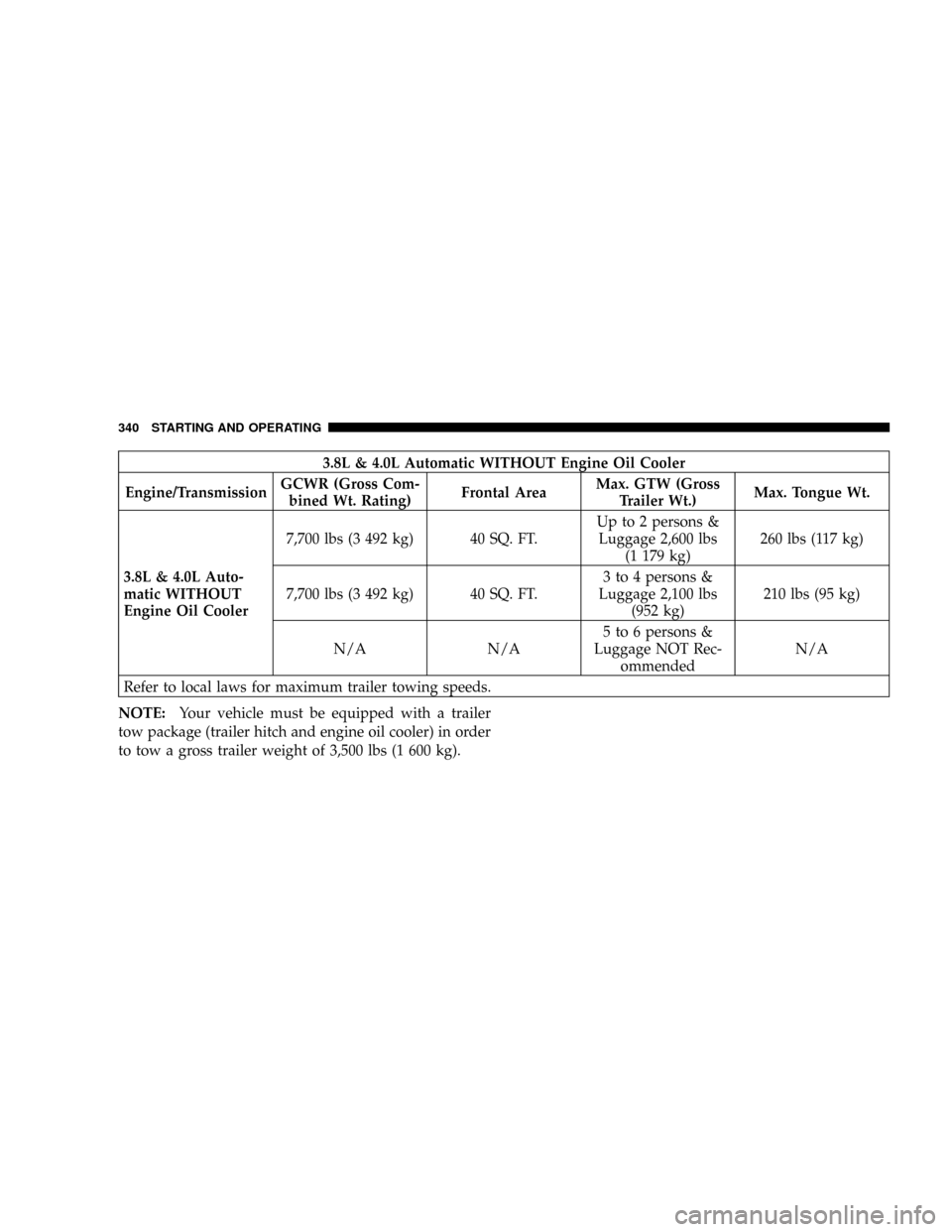
3.8L & 4.0L Automatic WITHOUT Engine Oil Cooler
Engine/TransmissionGCWR (Gross Com-
bined Wt. Rating)Frontal AreaMax. GTW (Gross
Trailer Wt.)Max. Tongue Wt.
3.8L & 4.0L Auto-
matic WITHOUT
Engine Oil Cooler7,700 lbs (3 492 kg) 40 SQ. FT.Up to 2 persons &
Luggage 2,600 lbs
(1 179 kg)260 lbs (117 kg)
7,700 lbs (3 492 kg) 40 SQ. FT.3 to 4 persons &
Luggage 2,100 lbs
(952 kg)210 lbs (95 kg)
N/A N/A5 to 6 persons &
Luggage NOT Rec-
ommendedN/A
Refer to local laws for maximum trailer towing speeds.
NOTE:Your vehicle must be equipped with a trailer
tow package (trailer hitch and engine oil cooler) in order
to tow a gross trailer weight of 3,500 lbs (1 600 kg).
340 STARTING AND OPERATING
Page 343 of 457

WARNING!
Improper towing can lead to an injury accident.
Follow these guidelines to make your trailer towing
as safe as possible:
Make certain that the load is secured in the trailer
and will not shift during travel. When trailering
cargo that is not fully secured, dynamic load shifts
can occur that may be difficult for the driver to
control. You could lose control of your vehicle and
have an accident.
²When hauling cargo or towing a trailer, do not over-
load your vehicle or trailer. Overloading can cause a
loss of control, poor performance or damage to brakes,
axle, engine, transmission, steering, suspension, chas-
sis structure or tires.
²Safety chains must always be used between your
vehicle and trailer. Always connect the chains to the
frame or hook retainers of the vehicle hitch. Cross the
chains under the trailer tongue and allow enough
slack for turning corners.
²Vehicles with trailers should not be parked on a grade.
When parking, apply the parking brake on the tow
vehicle. Put the tow vehicle automatic transmission in
P for Park. Always, block or9chock9the trailer wheels.
²GCWR must not be exceeded.
²Total weight must be distributed between the tow
vehicle and the trailer such that the following four
ratings are not exceeded:
1. GVWR
2. GTW
3. GAWR
STARTING AND OPERATING 343
5