Page 219 of 358
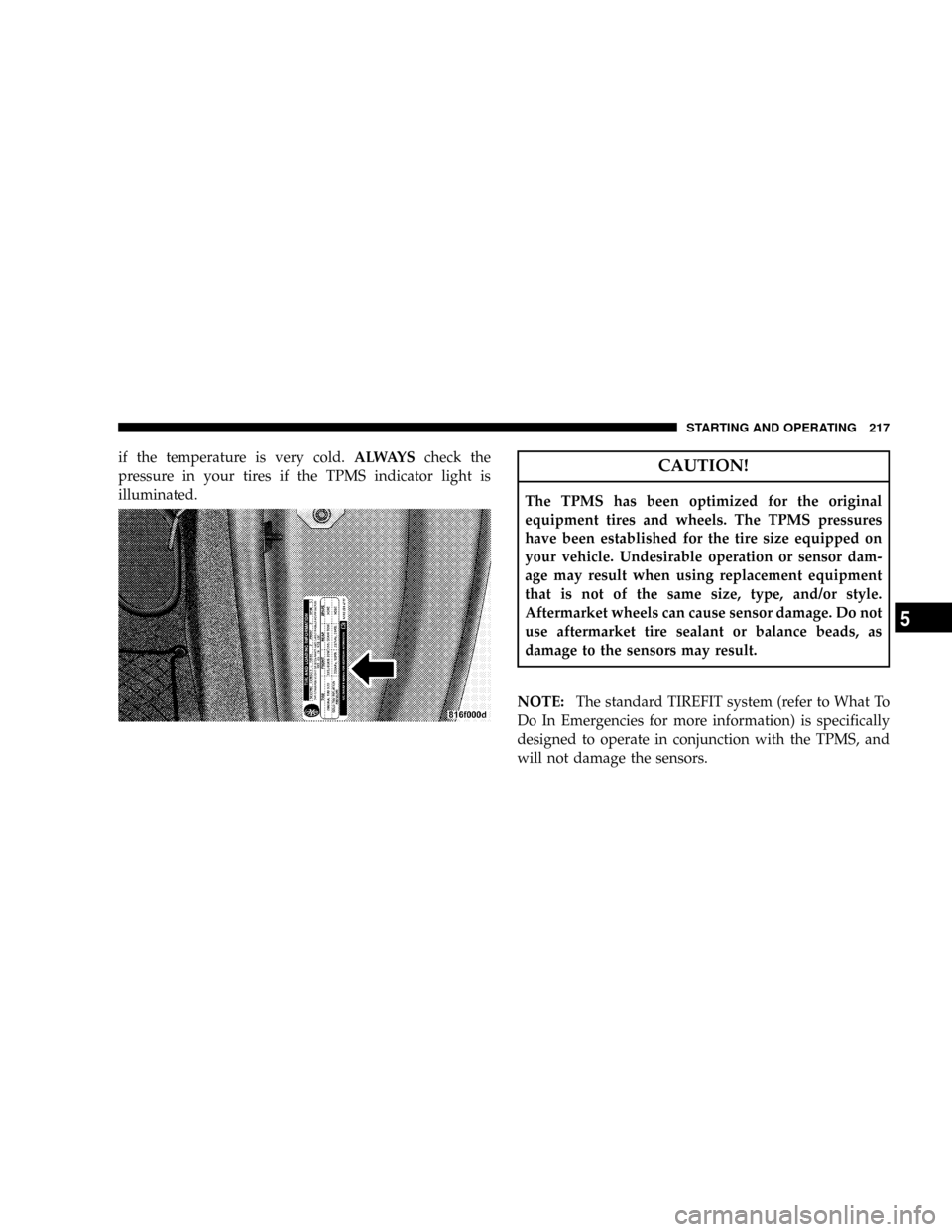
if the temperature is very cold.ALWAYScheck the
pressure in your tires if the TPMS indicator light is
illuminated.CAUTION!
The TPMS has been optimized for the original
equipment tires and wheels. The TPMS pressures
have been established for the tire size equipped on
your vehicle. Undesirable operation or sensor dam-
age may result when using replacement equipment
that is not of the same size, type, and/or style.
Aftermarket wheels can cause sensor damage. Do not
use aftermarket tire sealant or balance beads, as
damage to the sensors may result.
NOTE:The standard TIREFIT system (refer to What To
Do In Emergencies for more information) is specifically
designed to operate in conjunction with the TPMS, and
will not damage the sensors.
STARTING AND OPERATING 217
5
Page 220 of 358
If your tire pressure is low, you should correct your tire
inflation pressure as soon as possible and inspect all of
your tires. Low tire pressure will cause the tire pressure
light to illuminate. They will remain on for the rest of the
driving cycle, or until the tire pressure is corrected. If the
TPMS indicator light remains illuminated after the tire
pressure has been corrected, see your authorized dealer.
Your vehicle has also been equipped with a TPMS
malfunction indicator to indicate when the system is not
operating properly. The TPMS malfunction indicator is
combined with the low tire pressure indicator light.
When the system detects a malfunction, the indicator
light will flash for approximately one minute and then
remain continuously illuminated. This sequence will
continue upon subsequent vehicle start-ups as long as the
malfunction exists. When the malfunction indicator is
illuminated, the system may not be able to detect or
signal low tire pressure as intended. TPMS malfunctionsmay occur for a variety of reasons, including the instal-
lation of replacement or alternate tires or wheels on the
vehicle that prevent the TPMS from functioning properly.
Always check the TPMS malfunction indicator light after
replacing one or more tires or wheels on your vehicle to
ensure that the replacement or alternate tires and wheels
allow the TPMS to continue to function properly.
NOTE:Changes and modifications not expressly ap-
proved by the party responsible for compliance could
void the user's authority to operate the equipment.
General Information
This device complies with Part 15 of the FCC rules and
RSS 210 of Industry Canada. Operation is subject to the
following conditions:
²This device may not cause harmful interference.
218 STARTING AND OPERATING
Page 222 of 358
ORIGINAL EQUIPMENT TIRES
Your vehicle is equipped with either sport performance
tires or all-season performance tires. The sport perfor-
mance tires offer the maximum road handling capability
in dry and wet weather conditions. The all-season per-
formance tires, while offering slightly less road handling
capability, are able to provide traction capability in snow
and ice conditions. Both types of tires are rated for high
speed operation. It is important that you know what type
of tires your vehicle is equipped with so that you
understand their traction and handling characteristics for
various road conditions. Replacement tires should be of
the same size and speed rating to continue to provide the
same level of performance you are accustomed to.
SNOW TIRES
Some countries or regions require the use of snow tires
during winter. See the recommended snow type winter
tire applications in this section.
WARNING!
Your vehicle may be equipped with sport perfor-
mance tires that are optimized for driving in dry and
wet weather conditions. However, these tires have
reduced traction capability in snow and ice. When
driving your vehicle in these conditions with these
tires, you must take special care to maintain control
and avoid accidents. We recommend that you equip
your vehicle with ªSNOWº or ªALL SEASONº tires
on all four wheels for driving in snowy and icy
conditions.
220 STARTING AND OPERATING
Page 224 of 358
FUEL REQUIREMENTS
Your engine is designed to meet all emis-
sions regulations and provide satisfactory
fuel economy and optimum performance
when using high quality unleaded gaso-
line having an octane rating of 91 or
higher. DaimlerChrysler Corporation re-
quires the use of 91 octane or higher premium fuel to
minimize the potential for engine damage.
Light spark knock at low engine speeds is not harmful to
your engine. However, continued heavy spark knock at
high speeds can cause damage and should be reported to
your authorized dealer immediately. Engine damage
resulting from operating with a heavy spark knock may
not be covered by the new vehicle warranty.
222 STARTING AND OPERATING
Page 227 of 358
states adopting California emission standards, your ve-
hicle will operate satisfactorily on fuels meeting Federal
specifications, but emission control system performance
may be adversely affected.
Gasoline sold outside of California is permitted to have
higher sulfur levels, which may affect the performance of
the vehicle's catalytic converter. This may cause the
CHECK ENGINE light to illuminate. DaimlerChrysler
Corporation recommends that you try a different brand
of unleaded gasoline having lower sulfur to determine if
the problem is fuel-related prior to returning your vehicle
to an authorized dealer for service.CAUTION!
If the CHECK ENGINE Light is flashing, immediate
service is required. See the Onboard Diagnostic
System (OBDII) paragraph in the Maintaining Your
Vehicle section of this manual.
ADDING FUEL
Fuel Filler Cap (Gas Cap)
The gas cap is located under the fuel filler door, on the
passenger's side of the vehicle. To open the door, be sure
it is unlocked, then gently press the rear edge of the door
until a click can be heard, then release. The door rear
edge will spring open enough to grasp and pull it
completely open. If the central locking system does not
release the fuel filler door, see your authorized dealer for
STARTING AND OPERATING 225
5
Page 228 of 358

service. If the gas cap is lost or damaged, be sure the
replacement cap has been designed for use with this
vehicle.
CAUTION!
Damage to the fuel system or emission control sys-
tem could result from using an improper gas cap. A
poorly fitting cap could let impurities into the fuel
system. The CHECK ENGINE light will come on if
the gas cap is not properly secured.
NOTE:The fuel tank filler tube has a restricting door
about 2 in (50 mm) down from the opening. If fuel is
poured from a portable container, the container should
have a flexible nozzle long enough to force open the
restricting door.
CAUTION!
To avoid fuel spillage and overfilling, do not ªtop
offº the fuel tank after filling.
With the key in the ignition switch turned to the ON/
RUN position, the fuel reserve warning light comes on. It
should go out immediately when the engine is running.
If the warning light does not go out after starting the
engine, or if it comes on while driving, it indicates that
the fuel level is down to the reserve quantity of approxi-
mately 2 gal (7.5 L).
Leaving the engine running and the fuel cap open can
cause the CHECK ENGINE light to illuminate.
NOTE:
²When the fuel nozzle ªclicksº or shuts off, the fuel
tank is full.
226 STARTING AND OPERATING
Page 229 of 358

²Tighten the gas cap until you hear a single click. This
is an indication that the gas cap is properly tightened.
The CHECK ENGINE light will come on if the gas cap
is not properly secured. Make sure that the gas cap is
tightened each time the vehicle is refueled.
WARNING!
²Never have any smoking materials lit in or near
the vehicle when the gas cap is removed or the
tank is filled.
²Never add fuel to the vehicle when the engine is
running.
²A fire may result if gasoline is pumped into a
portable container that is inside of a vehicle. You
could be burned. Always place gas containers on
the ground outside the vehicle while filling.
VEHICLE LOADING
The load carrying capacity of your vehicle is in the
following chart and on the tire pressure label attached to
the driver door pillar.
Vehicle Loading Capacities
Front Seat Occupants....................... 2
Cargo Capacity (with two persons).... 115lbs(52kg)
Rated Vehicle Capacity............ 415lbs(188 kg)
STARTING AND OPERATING 227
5
Page 250 of 358
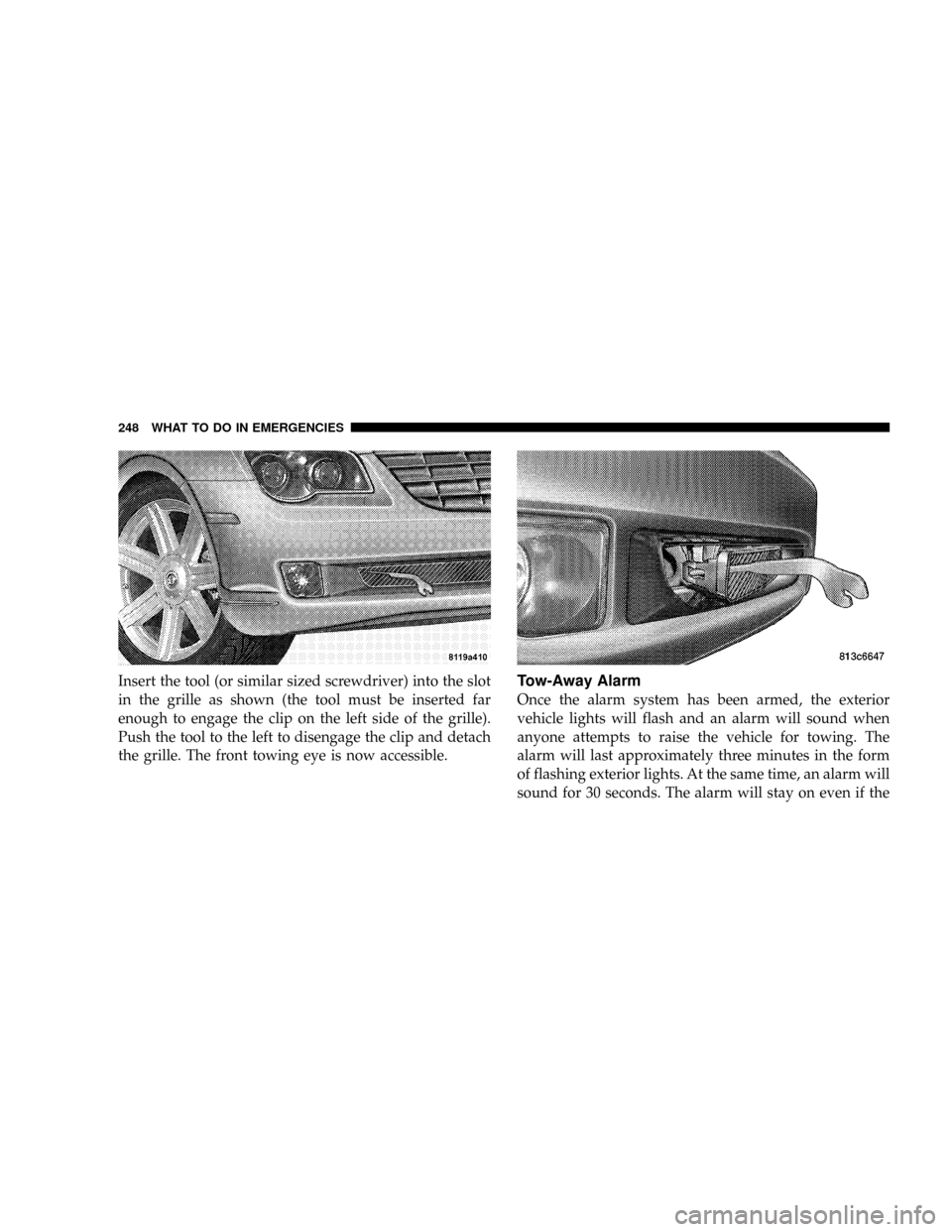
Insert the tool (or similar sized screwdriver) into the slot
in the grille as shown (the tool must be inserted far
enough to engage the clip on the left side of the grille).
Push the tool to the left to disengage the clip and detach
the grille. The front towing eye is now accessible.Tow-Away Alarm
Once the alarm system has been armed, the exterior
vehicle lights will flash and an alarm will sound when
anyone attempts to raise the vehicle for towing. The
alarm will last approximately three minutes in the form
of flashing exterior lights. At the same time, an alarm will
sound for 30 seconds. The alarm will stay on even if the
248 WHAT TO DO IN EMERGENCIES