Page 212 of 358
Tire Pressures For High Speed Operation
The manufacturer advocates driving at safe speeds
within posted speed limits. Where speed limits or condi-
tions are such that the vehicle can be driven at high
speeds, maintaining correct tire inflation pressure is very
important. Increased tire pressure and reduced vehicle
loading may be required for high-speed vehicle opera-
tion. Refer to original equipment or an authorized tire
dealer for recommended safe operating speeds, loading
and cold tire inflation pressures.
WARNING!
High speed driving with your vehicle at or above
maximum load is dangerous. The added strain on
your tires could cause them to fail. You could have a
serious accident. Don't drive a vehicle loaded to the
maximum capacity at continuous speeds above 75
mph (120 km/h).
Radial-Ply Tires
WARNING!
Combining radial ply tires with other types of tires
on your vehicle will cause your vehicle to handle
poorly. The instability could cause an accident. Al-
ways use radial tires in sets of four. Never combine
them with other types of tires.
Cuts and punctures in radial tires are repairable only in
the tread area because of sidewall flexing. Consult your
authorized dealer for radial tire repairs.
210 STARTING AND OPERATING
Page 213 of 358
Tire Spinning
When stuck in mud, sand, snow, or ice conditions, do not
spin your vehicle's wheels above 35 mph (55 km/h).
WARNING!
Fast spinning tires can be dangerous. Forces gener-
ated by excessive wheel speeds may cause tire dam-
age or failure. A tire could explode and injure some-
one. Do not spin your vehicle's wheels faster than 35
mph (55 km/h) when you are stuck, and do not let
anyone near a spinning wheel no matter what the
speed.
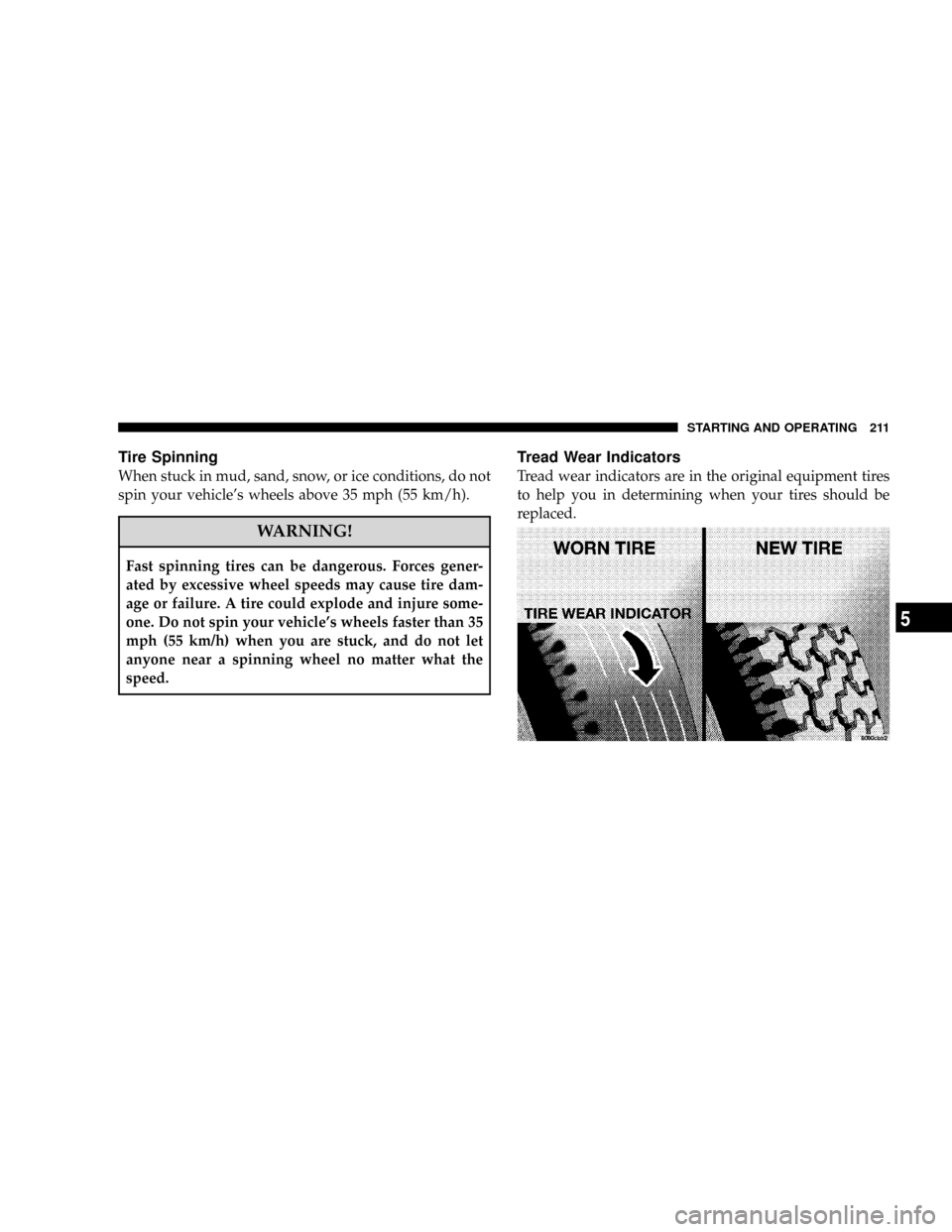
Tread Wear Indicators
Tread wear indicators are in the original equipment tires
to help you in determining when your tires should be
replaced.
STARTING AND OPERATING 211
5
Page 214 of 358
These indicators are molded into the bottom of the tread
grooves. They will appear as bands when the tread depth
becomes 1/16 in (2 mm). When the indicators appear in
two or more adjacent grooves, the tire should be re-
placed.
Many states have laws requiring tire replacement at this
point.
Life Of Tire
The service life of a tire is dependent upon various
factors including but not limited to:
²Driving style
²Tire pressure
²Distance driven
WARNING!
Tires and the spare tire should be replaced after six
years, regardless of the remaining tread. Failure to
follow this warning can result in sudden tire failure.
You could lose control and have an accident resulting
in serious injury or death.
Keep dismounted tires in a cool, dry place with as little
exposure to light as possible. Protect tires from contact
with oil, grease, and gasoline.
212 STARTING AND OPERATING
Page 215 of 358

Replacement Tires
The tires on your new vehicle provide a balance of many
characteristics. They should be inspected regularly for
wear and correct cold tire inflation pressure. The manu-
facturer strongly recommends that you use tires equiva-
lent to the originals in size, quality and performance
when replacement is needed. (Refer to the paragraph on
ªTread Wear Indicatorsº). Refer to the ªTire and Loading
Informationº placard for the size designation of your
tires. The service description and load identification will
be found on the original equipment tire. Failure to use
equivalent replacement tires may adversely affect the
safety, handling, and ride of your vehicle. We recommend
that you contact your original equipment or an autho-
rized tire dealer with any questions you may have on tire
specifications or capability.WARNING!
²Do not use a tire, wheel size or rating other than that
specified for your vehicle. Some combinations of
unapproved tires and wheels may change suspension
dimensions and performance characteristics, result-
ing in changes to steering, handling, and braking of
your vehicle. This can cause unpredictable handling
and stress to steering and suspension components.
You could lose control and have an accident resulting
in serious injury or death. Use only the tire and wheel
sizes with load ratings approved for your vehicle.
²Never use a tire with a smaller load index or capacity
than what was originally equipped on your vehicle.
Using a tire with a smaller load index could result in
tire overloading and failure. You could lose control
and have an accident.
²Failure to equip your vehicle with tires having ad-
equate speed capability can result in sudden tire
failure and loss of vehicle control.
STARTING AND OPERATING 213
5
Page 222 of 358
ORIGINAL EQUIPMENT TIRES
Your vehicle is equipped with either sport performance
tires or all-season performance tires. The sport perfor-
mance tires offer the maximum road handling capability
in dry and wet weather conditions. The all-season per-
formance tires, while offering slightly less road handling
capability, are able to provide traction capability in snow
and ice conditions. Both types of tires are rated for high
speed operation. It is important that you know what type
of tires your vehicle is equipped with so that you
understand their traction and handling characteristics for
various road conditions. Replacement tires should be of
the same size and speed rating to continue to provide the
same level of performance you are accustomed to.
SNOW TIRES
Some countries or regions require the use of snow tires
during winter. See the recommended snow type winter
tire applications in this section.
WARNING!
Your vehicle may be equipped with sport perfor-
mance tires that are optimized for driving in dry and
wet weather conditions. However, these tires have
reduced traction capability in snow and ice. When
driving your vehicle in these conditions with these
tires, you must take special care to maintain control
and avoid accidents. We recommend that you equip
your vehicle with ªSNOWº or ªALL SEASONº tires
on all four wheels for driving in snowy and icy
conditions.
220 STARTING AND OPERATING
Page 228 of 358

service. If the gas cap is lost or damaged, be sure the
replacement cap has been designed for use with this
vehicle.
CAUTION!
Damage to the fuel system or emission control sys-
tem could result from using an improper gas cap. A
poorly fitting cap could let impurities into the fuel
system. The CHECK ENGINE light will come on if
the gas cap is not properly secured.
NOTE:The fuel tank filler tube has a restricting door
about 2 in (50 mm) down from the opening. If fuel is
poured from a portable container, the container should
have a flexible nozzle long enough to force open the
restricting door.
CAUTION!
To avoid fuel spillage and overfilling, do not ªtop
offº the fuel tank after filling.
With the key in the ignition switch turned to the ON/
RUN position, the fuel reserve warning light comes on. It
should go out immediately when the engine is running.
If the warning light does not go out after starting the
engine, or if it comes on while driving, it indicates that
the fuel level is down to the reserve quantity of approxi-
mately 2 gal (7.5 L).
Leaving the engine running and the fuel cap open can
cause the CHECK ENGINE light to illuminate.
NOTE:
²When the fuel nozzle ªclicksº or shuts off, the fuel
tank is full.
226 STARTING AND OPERATING
Page 229 of 358

²Tighten the gas cap until you hear a single click. This
is an indication that the gas cap is properly tightened.
The CHECK ENGINE light will come on if the gas cap
is not properly secured. Make sure that the gas cap is
tightened each time the vehicle is refueled.
WARNING!
²Never have any smoking materials lit in or near
the vehicle when the gas cap is removed or the
tank is filled.
²Never add fuel to the vehicle when the engine is
running.
²A fire may result if gasoline is pumped into a
portable container that is inside of a vehicle. You
could be burned. Always place gas containers on
the ground outside the vehicle while filling.
VEHICLE LOADING
The load carrying capacity of your vehicle is in the
following chart and on the tire pressure label attached to
the driver door pillar.
Vehicle Loading Capacities
Front Seat Occupants....................... 2
Cargo Capacity (with two persons).... 115lbs(52kg)
Rated Vehicle Capacity............ 415lbs(188 kg)
STARTING AND OPERATING 227
5
Page 231 of 358
WARNING!
Cargo must be securely tied before driving your
vehicle. Improperly secured loads can fly off the
vehicle, particularly at high speeds, resulting in per-
sonal injury or property damage. Follow the roof
luggage rack ªCautionsº when carrying cargo on
your roof rack.
TRAILER TOWING
Trailer towing with your vehicle is not recommended.
STARTING AND OPERATING 229
5