Page 253 of 358
3. Turn the ignition OFF and continue to push down on
the switch for five seconds.
4. After five seconds the hydraulic system pressure will
be relieved.
WARNING!
It is important that a second person assist you to close
the convertible top manually to prevent injuries.
1. Lower the windows and open the doors.
2. Turn the ignition key OFF.
CAUTION!
Ensure that the decklid is closed while raising the
convertible top manually to prevent the possibility of
contact between the decklid and the tonneau cover.
WARNING!
Do not place your hands near the convertible top
frame, upper windshield area, or the convertible top
storage compartment while the convertible top is
being raised and locked. Serious personal injury may
occur.
WHAT TO DO IN EMERGENCIES 251
6
Page 255 of 358
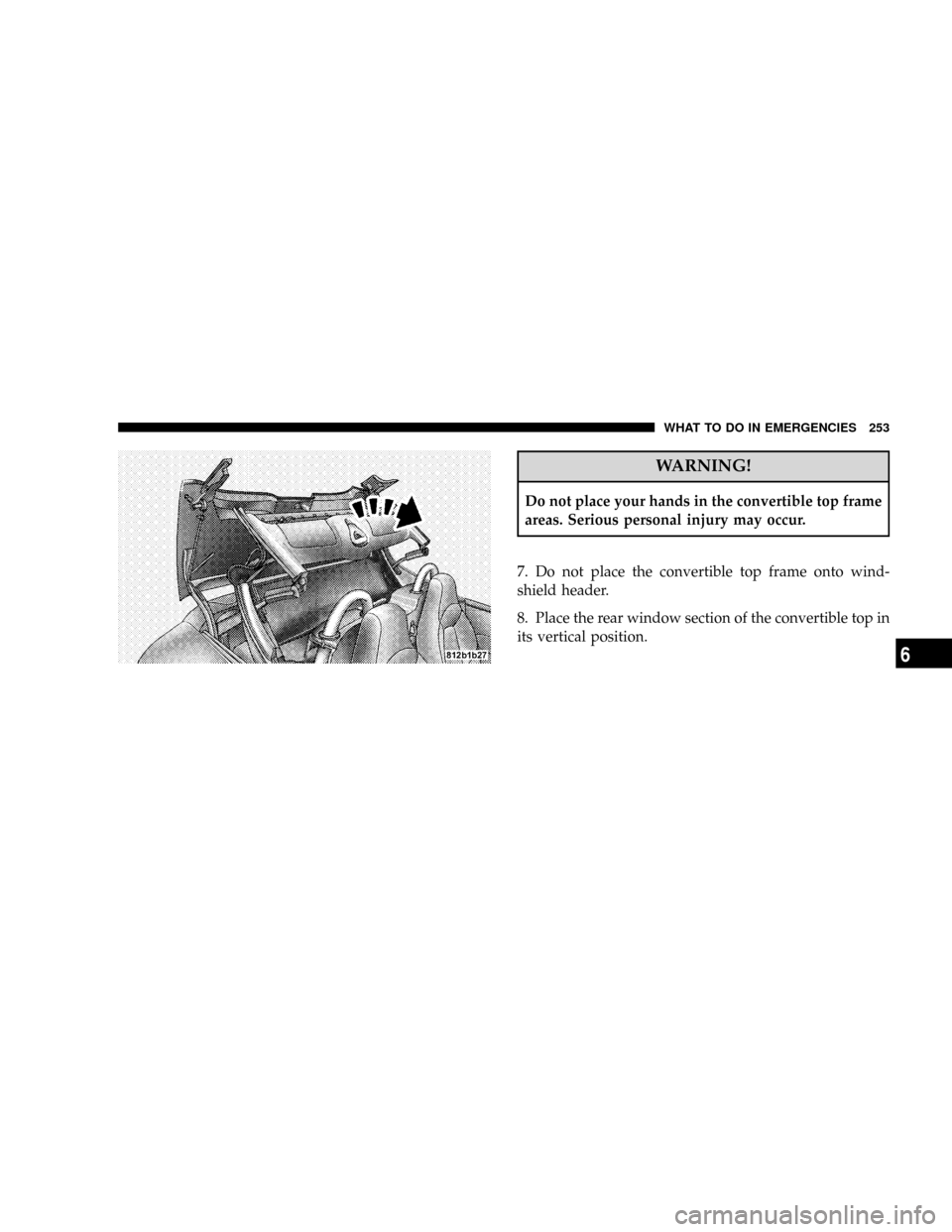
WARNING!
Do not place your hands in the convertible top frame
areas. Serious personal injury may occur.
7. Do not place the convertible top frame onto wind-
shield header.
8. Place the rear window section of the convertible top in
its vertical position.
WHAT TO DO IN EMERGENCIES 253
6
Page 266 of 358

NOTE:Intentional tampering with emissions control
systems can result in civil penalties being assessed
against you.
WARNING!
You can be badly injured working on or around a
motor vehicle. Do only that service work for which
you have the knowledge and the proper equipment.
If you have any doubt about your ability to perform
a service job, take your vehicle to a competent
technician.
MAINTENANCE PROCEDURES
The pages that follow contain the maintenance service
recommended by the engineers who designed your ve-
hicle.
Besides the maintenance items for which there are fixed
maintenance intervals, there are other items that should
operate satisfactorily without periodic maintenance.
However, if a malfunction of these items does occur, it
could adversely affect the engine or vehicle performance.
These items should be inspected if a malfunction is
observed or suspected.
Engine Oil
Checking Oil Level
To assure proper engine lubrication, the engine oil must
be maintained at the correct level. Check the oil level at
regular intervals, such as every fuel stop.
264 MAINTAINING YOUR VEHICLE
Page 271 of 358

there is any malfunction due to a faulty spark plug.
Check the specifications section for the proper type of
spark plug for use in your vehicle.
Engine Air Cleaner Filter
Under normal driving conditions, replace the air filter at
each interval called out by FSS.
WARNING!
The air cleaner can provide a measure of protection
in the case of engine backfire. Do not remove the air
cleaner unless such removal is necessary for repair or
maintenance. Make sure that no one is near the
engine compartment before starting the vehicle with
the air cleaner removed. Failure to do so can result in
serious personal injury.
Engine Fuel Filter
A plugged fuel filter can cause hard starting or limit the
speed at which a vehicle can be driven. Should an
excessive amount of dirt accumulate in the fuel tank,
frequent fuel filter replacement may be necessary. See
your authorized dealer for service.
Catalytic Converter
The catalytic converter requires the use of unleaded fuel
only. Leaded gasoline will destroy the effectiveness of the
catalyst as an emission control device.
Under normal operating conditions, the catalytic con-
verter will not require maintenance. However, it is im-
portant to keep the engine properly serviced to assure
proper catalyst operation and prevent possible catalyst
damage.
If the CHECK ENGINE light is flashing, immediate
service is required.
MAINTAINING YOUR VEHICLE 269
7
Page 272 of 358

CAUTION!
Damage to the catalytic converter can result if your
vehicle is not kept in proper operating condition. In
the event of engine malfunction, particularly involv-
ing engine misfire or other apparent loss of perfor-
mance, have your vehicle serviced promptly. Contin-
ued operation of your vehicle with a severe
malfunction could cause the converter to overheat,
resulting in possible damage to the converter and the
vehicle.
WARNING!
A hot exhaust system can start a fire if you park over
materials that can burn. Such materials might be
grass or leaves coming into contact with your exhaust
system. Do not park or operate your vehicle in areas
where your exhaust system can contact anything that
can burn.
In unusual situations involving grossly malfunctioning
engine operation, a scorching odor may suggest severe
and abnormal catalyst overheating. If this occurs, stop
the vehicle, turn off the engine and allow it to cool.
Service, including a tune up to DaimlerChrysler Corpo-
ration's specifications, should be obtained immediately.
270 MAINTAINING YOUR VEHICLE
Page 274 of 358
WARNING!
Battery posts, terminals and related accessories con-
tain lead and lead compounds. Wash hands after
handling.
Battery fluid is a corrosive acid solution and can burn
or even blind you. Don't allow battery fluid to
contact your eyes, skin or clothing. Don't lean over a
battery when attaching clamps. If acid splashes in
eyes or on skin, flush the area immediately with
large amounts of water.
Battery gas is flammable and explosive. Keep flame
or sparks away from the battery. Don't use a booster
battery or any other booster source with an output
greater than 12 volts. Don't allow cable clamps to
touch each other.
CAUTION!
It is essential when replacing the cables on the
battery that the positive cable is attached to the
positive post and the negative cable is attached to the
negative post. Battery posts are marked positive (+)
and negative (-) and identified on the battery case.
Cable clamps should be tight on the terminal posts
and free of corrosion. Apply grease to posts and
clamps after tightening.
If a ªfast chargerº is used while the battery is in the
vehicle, disconnect both vehicle battery cables before
connecting the charger to battery. Do not use a ªfast
chargerº to provide starting voltage as battery dam-
age can result.
272 MAINTAINING YOUR VEHICLE
Page 275 of 358
Air Conditioner
Check the air conditioning system at the start of the
warm weather season.
NOTE:If your air conditioning performance seems
lower than expected, check the front of the A/C con-
denser for an accumulation of dirt or insects. Clean with
a gentle water spray from behind the radiator and
through the condenser as required. Fabric front fascia
protectors may reduce air flow to the condenser, reducing
air conditioning performance.WARNING!
The air conditioning system contains refrigerant un-
der high pressure. To avoid risk of personal injury or
damage to the system, adding refrigerant or any
repair requiring lines to be disconnected should be
done by an experienced repair person.
Refrigerant Recovery And Recycling
The air conditioning system of your vehicle contains
R-134a, a refrigerant that does not deplete the ozone layer
in the upper atmosphere. The DaimlerChrysler
Corporation recommends that air conditioning service be
done by facilities using refrigerant recycling and recovery
equipment that meets SAE standard J1991.
MAINTAINING YOUR VEHICLE 273
7
Page 280 of 358
Windshield Washer Reservoir
The washer fluid reservoir is located in the engine
compartment and should be checked for fluid level at
regular intervals. Fill the reservoir with windshield
washer solvent (not radiator antifreeze) rated not to
freeze at -25ÉF (-31ÉC). Operate the system for a few
seconds to flush out the residual water.WARNING!
Do not overfill the washer reservoir. Do not attempt
to fill to the top of the filler neck. Fluid may leak out
onto the floor or driveway causing a potential slip
and fall hazard. When the indicator light first illumi-
nates, the maximum fill amount is 1 gal (4 L).
WARNING!
Commercially available windshield washer solvents
are flammable. They could ignite and burn you. Care
must be exercised when filling or working around
the washer solution.
278 MAINTAINING YOUR VEHICLE